
Disclosure: This article is published by Datamagnet, which competes with RocketReach for some use cases. RocketReach details come from its public docs and third-party listings, retrieved 2026-11-06. Vendor claims are self-reported unless otherwise noted.
RocketReach API in 2026: Endpoints, Credits, Limits and Alternatives
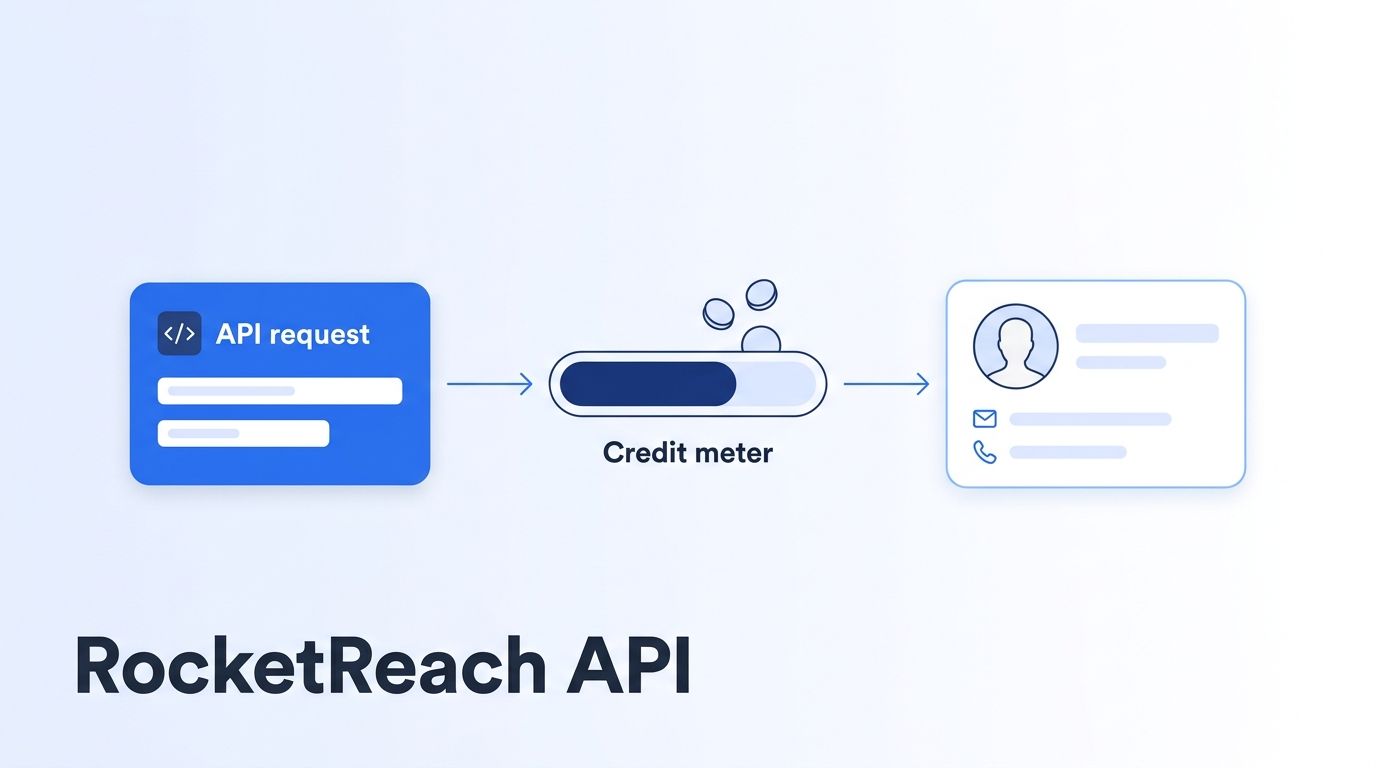
The RocketReach API turns a name, a LinkedIn URL, or a search filter into contact data, mainly emails and phone numbers. It works well when you need contacts. It gets tricky around credits, rate limits, and API plan access. This review is based on RocketReach's public documentation, not a long production test.
TL;DR
- Verdict: 6.5 / 10. Strong for email and phone lookup, harder to budget than it looks.
- As of November 2026, RocketReach's docs set a global limit of 10 requests per second, with tighter per-plan caps.
- Universal Credits price a professional email at 2, a personal email at 3, and a phone at 6.
- Need fresh LinkedIn profile data instead of contact details? A live LinkedIn API is a better match.
What Does the RocketReach API Actually Do?
RocketReach's docs list endpoints for person lookup, person search, company search, company lookup, bulk lookup, account usage, webhooks, and email verification (RocketReach Docs, API reference index, retrieved 2026-11-06). In short, you find a person or company, then spend credits to reveal contact details.
Authentication uses an Api-Key header. You generate keys in Account Settings.
We sent a person lookup request to the live API with a deliberately invalid key, twice, on 2026-11-06. Both calls came back as HTTP 401 in about 0.3 seconds (0.35s and 0.31s), with a small JSON body: {"detail":"Invalid API key","error_code":"authentication_failed"}. It's a clean, machine-readable error, which is useful when you build retry logic. We couldn't test paid lookups without a plan, so credit behavior still comes from the docs. Compare that with a bearer-token setup like the Datamagnet authentication docs, which is similar in spirit.
Here's the endpoint map worth knowing. Page sizes and result caps come from RocketReach's API reference (RocketReach Docs, API reference index, retrieved 2026-11-06). The email verify and bulk limits come from its Rate Limits page (last updated 2026-11-04).
| Job | RocketReach endpoint | Notes |
|---|---|---|
| Find people | People Search | 100 profiles per page, 10,000 results max per query |
| Reveal contact | People Lookup / Bulk Lookup | Bulk takes 1 to 100 queries per batch |
| Check progress | Lookup Status | Poll an asynchronous lookup until it finishes |
| Companies | Company Search / Lookup | Search costs 2 credits per page |
| Verify email | Email Verify | 10 per second, 300 per minute on every plan |
| Track usage | API Account | Shows team usage and rate limits |
| Get results pushed | Webhooks | HMAC-SHA256 signature in X-RocketReach-Signature |
Lookups are often asynchronous. You send a request, get back a status, and then either poll or wait for a webhook. RocketReach says it prefers webhooks to polling. If you've built against signal-style delivery before, the Datamagnet webhooks guide shows the same pattern with signed payloads.
How Do RocketReach Credits Work?
RocketReach's current Universal Credits charge by action: 1 credit per page of person search, 2 per page of company search, 2 per professional email, 3 per personal email, and 6 per phone number (RocketReach Docs, Universal Credits Overview, last updated 2026-06-17). Email credits apply only to A and A- grade results.
So what does a full contact cost? A professional email plus a phone is 8 credits. Add a personal email and you're at 11. The docs don't publish a price per Universal Credit and say account managers provide plan details. That's the main budgeting problem. For a comparison point on how another vendor's tiers and minimums add up, see our Coresignal pricing breakdown.
RocketReach's older export-credit model may still apply to some accounts. Ask in writing which credit system your plan uses, and whether re-lookups and no-result lookups are charged, before you budget.
The 6-credit phone price changes the math more than anything else. A team that needs phones on every record spends three times more per record than one that only needs a professional email, even before you count personal emails.
Two things I could not confirm from public sources: an official overage price, and which plan tier unlocks API access. RocketReach's rate-limit page says unpaid users should email its API team to set up an API plan, which suggests access is arranged rather than self-serve.
What Are the RocketReach API Rate Limits?
RocketReach applies a global cap of 10 requests per second across all APIs, plus per-endpoint limits that depend on your plan (RocketReach Docs, Rate Limits, last updated 2026-11-04). Hit the cap and you get a 429 with a Retry-After header in seconds.
Here are the person lookup limits, shown as per minute / hour / day / month:
| Plan | Person lookup limits | Person search limits |
|---|---|---|
| Essentials | 15 / 50 / 500 / 10k | 15 / 50 / 500 / 10k |
| Pro | 50 / 300 / 1,500 / 20k | 30 / 250 / 750 / 15k |
| Ultimate | 100 / 1k / 3k / 50k | 60 / 500 / 1,000 / 20k |
| Custom | 250 / 2.5k / 10k / 200k | 100 / 1k / 10k / 200k |
Bulk jobs are tighter: 10 per minute, 25 per hour, and 100 per day on Essentials, Pro, and Ultimate. Bulk request bodies are capped at 2.5 MB.
What does that mean in practice? An Essentials account can run at most 500 lookups a day, which sounds fine until you backfill a 50,000-row CRM. At that daily cap it takes 100 days. Backfills belong on a Custom plan, or you chunk them across billing cycles.
What Do Users Say About RocketReach Data Quality and Pricing?
G2 shows RocketReach at roughly 4.4 out of 5 from about 1,369 reviews, with "inaccurate data" and "outdated contacts" among the most-tagged complaints (G2, RocketReach reviews, retrieved 2026-11-06, read via search summary). That's a common pattern for any contact database, because people change jobs constantly.
Pricing is harder to pin down. G2 lists Essentials at $69/month, Pro at $119, and Ultimate at $209, but RocketReach's own pricing page wasn't readable for this review, so confirm current numbers before you budget.
Does that mean you should skip it? No. Email and phone coverage is the whole point of the product. It does mean you should run a 200-record test against your own ICP before signing an annual plan, and ask in writing whether unused credits roll over.
For compliance, RocketReach LLC appears in the California Attorney General's data broker registry (California Attorney General, data broker registry). That's a factual note, not a judgment. Review its privacy terms with your own counsel.
What Are the Pros and Cons of the RocketReach API?
| Pros | Cons |
|---|---|
| Email and phone lookup in one API | Phone costs 6 credits, so full contacts add up fast |
| Webhook delivery with signed payloads | No published price per Universal Credit |
| Email credits apply only to A and A- grade results | Plan prices only confirmed via third-party listings |
| Bulk lookup of up to 100 queries per batch | Daily caps on lower tiers slow large backfills |
| Email verification endpoint | API plan access isn't clearly self-serve |
What Are the Best RocketReach API Alternatives?
The right alternative depends on what you're buying. If you need emails and phones, you want another contact database. If you need fresh profile, company, and engagement data, you want a live API.
Datamagnet
Best if you need: live LinkedIn profile, company, post, and signal data fetched at request time. Price: 10 free credits, plans at $39, $99, and $199, and a $10 pay-as-you-go pack of 200 credits. Key difference: it isn't a dedicated contact database (email is returned only when publicly visible, and phone numbers are not returned), and it has no job-listings endpoint.
Datamagnet charges 1 credit per profile and 10 credits per search or engagement page. On the $10 pay-as-you-go pack (200 credits, about $0.05 per credit), a profile costs about $0.05 and a page of search results about $0.50. Subscription rates are lower, at $0.039, $0.0099, and $0.0080 per credit. The People API returns job history, education, skills, activity, and an email field (populated only when the address is publicly visible) as structured JSON. Phone numbers are not returned: the phone_number field is always null. The People Profile docs list every field. See pricing for current plans.
If you're weighing live data against stored records, our guide to real-time B2B people enrichment APIs explains the trade-offs. For finding decision-makers, the ICP Search API filters by title, seniority, headcount, and location, and the ICP People Search docs cover the filters. Datamagnet only collects public profile data. LinkedIn's terms restrict automated collection, and accounts used for scraping can be banned, which is why a managed API exists at all.
Apollo
Best if you need: a static contact database with seats and built-in outreach. Price: see Apollo's pricing page. Key difference: it bundles sequences and a database, while Datamagnet is API-first. Our Datamagnet vs Apollo comparison breaks it down.
ZoomInfo
Best if you need: an enterprise contact suite under an annual contract. Price: custom, sales-led. Key difference: Datamagnet vs ZoomInfo compares annual seat contracts with pay-as-you-go credits.
Many teams don't have to pick one. A common setup pairs a contact database for emails and phones with a live LinkedIn API for current role and company data. The live source tells you who changed jobs, and the contact tool fills in how to reach them.
How Do You Choose?
Pick RocketReach if contact details are the output you need and you've tested email accuracy on your own list. Pick a live LinkedIn API if you need current job titles, company headcount, or engagement data, or if you want predictable per-request costs.
Want to watch for job changes without polling? Our roundup of real-time intent signal APIs for job changes compares the options, and a job-change signal can alert your CRM when a champion moves. For the CRM side, see the benefits of programmatic CRM enrichment. Datamagnet also connects to HubSpot and Clay. Start with the free 10 credits and check the output against ten records you know well. Get started with the quickstart.
Frequently Asked Questions
Does RocketReach have a public API?
Yes. RocketReach publishes REST docs for person search, person lookup, bulk lookup, company search, company lookup, email verification, account usage, and webhooks. Keys go in an Api-Key header. Access appears to be arranged through an API plan rather than self-serve, so check with RocketReach before you build.
How much does the RocketReach API cost?
It depends on your plan and credit type. Universal Credits cost 2 for a professional email, 3 for a personal email, and 6 for a phone number. RocketReach doesn't publish a price per credit, and monthly plan prices are only available from third-party listings, so get a written quote before committing to annual billing.
What are the RocketReach API rate limits?
The global cap is 10 requests per second. Per-plan limits vary: Essentials allows 500 person lookups a day, Pro 1,500, and Ultimate 3,000. Exceeding a limit returns a 429 response with a Retry-After header. Bulk jobs are capped at 100 per day on standard plans.
What is a good RocketReach API alternative?
It depends on the job. For live LinkedIn profile, company, and engagement data, Datamagnet charges 1 credit per profile, with 10 free credits and a $10 pay-as-you-go pack of 200 credits (about $0.05 per credit); subscription rates run $0.039, $0.0099, and $0.0080 per credit. Its People API returns email only when publicly visible and never returns phone numbers, so it isn't a dedicated contact database. For contact databases with outreach tools, Apollo and ZoomInfo are the usual comparisons.
