
Best Data Enrichment APIs in 2026: 8 Ranked by Price per Record, Fields and Freshness
The best data enrichment API depends on the field you are missing: FullEnrich, Apollo and Lusha publish the lowest prices for verified emails and phone numbers, People Data Labs accepts the widest range of inputs, and Datamagnet costs the least per record for a person's current title and employer from a profile URL. The table compares eight data and people enrichment APIs on the input each needs, whether it returns contact details, its lowest published price per record and its free tier.
| # | API | Best for | Input it needs | Returns emails/phones? | Price per record (lowest published) | Free tier |
|---|---|---|---|---|---|---|
| 1 | Datamagnet | Current title, employer and work history | Public profile URL or company page URL | No | $0.02/credit pay-as-you-go; about $0.008 on the $199 plan (1 credit per profile) | 10 credits, no card |
| 2 | People Data Labs | Breadth and flexible lookup keys | Email, phone, name + company, or profile URL | Yes | About $0.28 ($98/mo for 350 person records) | 100 records/mo, contact fields obfuscated |
| 3 | Apollo.io | Contact data inside a sales platform | Email, name + company, or profile URL | Yes | About $0.02/credit on Basic (annual); 1–9 credits per person | 900 credits/year |
| 4 | FullEnrich | Verified work emails and mobiles | Name + company, or profile URL | Yes, charged only when found | $0.032 per work email; $0.32 per mobile (annual, 1.2M credits) | 50 credits, no card |
| 5 | ZoomInfo (GTM AI) | Enterprise-grade contact coverage | Contact or company identifiers | Yes (mobiles on Enterprise) | $0.38 per record at the $1,000 spend tier | 1,000 data + 1,000 AI credits |
| 6 | Lusha | Reps who want emails and direct dials | Email, name + company, or profile URL | Yes | About $0.087 per email, $0.44 per phone (Pro, billed yearly) | 40 credits/mo |
| 7 | Coresignal | Bulk records, history and job postings | Profile shorthand, record ID or search query | Not its focus | About $0.015 per core record on Premium ($1,500/mo) | 2,000 credits (about 200 records) |
| 8 | Crustdata | Company intelligence for AI agents | Profile URL; company domain, name or URL | Yes, enterprise plans only | 1 credit per base profile; dollar rate not published | Not published |
How we ranked them. We make Datamagnet, so weigh its placement accordingly. It ranks first on price per record and freshness and last on contact fields: if you need emails or phone numbers, start at #2. The rest are ordered by our judgment of field coverage, input flexibility and published price taken together. Every price links to the vendor's own pricing page or docs, checked between July and November 2026. Prices per record are our arithmetic from published plan prices and credit costs; volume quotes will differ.
What Is the Best People Enrichment API?
There is no single best people enrichment API, because the job splits in two. If you need emails and phone numbers, FullEnrich, Apollo and Lusha have the lowest published prices per contact. If you need a person's current title and employer from a profile URL, Datamagnet costs least per record. People Data Labs accepts the widest range of inputs.
Start from what you already hold and what you are missing:
- You have an email and need the rest of the record: People Data Labs, Apollo, Lusha or ZoomInfo GTM AI, all of which enrich a contact from an email.
- You have a name and company and need an email or mobile: FullEnrich, which runs a waterfall across 20+ sources and charges only when it finds verified data (FullEnrich).
- You have a profile URL and need the current role: Datamagnet, which can read the profile at the moment you call.
- You need millions of records for analysis or model training: Coresignal or People Data Labs, both of which license flat-file datasets.
see how Datamagnet's people enrichment API works
Which Data Providers Offer High-Volume Enrichment via API?
People Data Labs, Coresignal, Crustdata, FullEnrich and ZoomInfo all publish routes for high-volume enrichment. PDL and Coresignal license whole datasets as flat files. Crustdata runs batch jobs of up to 10,000 profiles. FullEnrich takes 100 contacts per bulk call. ZoomInfo sells annual volume above 100,000 credits through its enterprise plans.
The details matter more than the headline:
- People Data Labs delivers its dataset as flat files into S3, GCP, Azure or Snowflake under an enterprise data licence (PDL docs).
- Coresignal sells a Premium plan with 1,000,000 credits a month for $1,500, plus custom-quoted datasets (Coresignal pricing).
- Crustdata enriches up to 10,000 profiles per database batch job, but only 300 per job on its live add-on (Crustdata docs).
- FullEnrich allows 60 calls a minute and 100 contacts per bulk request (FullEnrich docs).
- ZoomInfo GTM AI routes buyers of 100,000+ credits to annual enterprise pricing (GTM AI pricing).
- Datamagnet reads one profile per request; its largest self-serve plan is $199 for 25,000 credits a month (Datamagnet pricing).
For one-off backfills of millions of rows, a dataset licence is usually cheaper than per-call enrichment. For records a rep will act on this week, per-call enrichment from a source that refreshes often, or reads the profile live, gives a more current answer.
1. Datamagnet: Best for Current Titles and Employers From a Profile URL
Datamagnet is our product: a live people and company data API, not a contact database. You send a public profile URL or company page URL and get the current title, employer, work history, education and skills as JSON. It returns no emails or phone numbers.
A profile costs 1 credit, charged only on success. Plans are $39 for 1,000 credits, $99 for 10,000 and $199 for 25,000 (about $0.008 a profile); pay-as-you-go starts from $0.02 a credit, with 10 free credits and no card (pricing). With use_cache: "never" the API reads the profile at the moment you call; by default it may return a stored copy (company data up to 30 days old).
The limitation: no email lookup, verification, waterfall, technographics or revenue estimates, so teams pair it with a contact provider below. See the people enrichment API and company enrichment API.
2. People Data Labs: Best for Breadth and Flexible Inputs
People Data Labs (PDL) licenses a dataset of about 2.47 billion person records (PDL stats), queried by API or delivered in bulk. It accepts emails, phone numbers, names with a company, or profile URLs, which makes it the most flexible lookup of any API in this list.
The free plan covers 100 records a month with contact data obfuscated; Pro starts at $98 a month for 350 person records, about $0.28 each (PDL pricing). Person records carry 658 million emails and 899 million phone numbers (PDL stats).
The limitation is freshness: PDL rolls out API data updates monthly (PDL docs), so a job change after the last update is not in the record yet. Datamagnet vs People Data Labs.
3. Apollo.io: Best per-Credit Price for Contact Data in a Sales Platform
Apollo is an all-in-one sales platform: a stored contact database of 230M+ contacts (Apollo) with sequencing, a dialer and an API on top. It suits small sales teams that want enrichment and outreach in one subscription rather than a standalone data feed.
The Free plan includes 900 credits a year; Basic is $49 per user per month on annual billing with 30,000 credits a year, about $0.02 a credit (Apollo pricing). Its API docs list 1 to 9 credits per person enriched and 1 per organization (Apollo API pricing).
The limitation: the API comes with a seat-based plan that decides your endpoints, rate limits and credit cost (Apollo docs). Credits reset each billing cycle (Apollo credits). Datamagnet vs Apollo.
4. FullEnrich: Best for Verified Work Emails and Mobile Numbers
FullEnrich is a waterfall contact-enrichment API. Give it a name and company or a profile URL and it queries 20+ sources in sequence until it finds a verified work email, personal email or mobile number. A lookup that finds nothing costs nothing.
A work email costs 1 credit, a personal email 3 and a mobile 10. Credits run from $29 a month for 500 ($0.058 each) to $0.035 at 100,000 a month, or $0.032 on the largest annual plan; the free trial is 50 credits with no card (FullEnrich pricing).
The limitation is speed and scope: its docs put a contact at 45 to 60 seconds (FullEnrich docs), and it returns contact details rather than work history. Datamagnet vs FullEnrich.
5. ZoomInfo (GTM AI): Best for Enterprise Coverage on Pay-as-You-Go Credits
ZoomInfo is a verified B2B contact database, and GTM AI is how it now sells API, MCP and CLI access on credits without a platform contract. One data credit enriches or exports one company, contact or intent record. Search and lookup tools cost nothing.
Signup includes 1,000 data credits and 1,000 AI credits with no card. Data credits are $0.38 each at the $1,000 spend tier, with top-ups from $20 and 70% off the first purchase for a limited time (GTM AI pricing). The full platform is quoted per organisation and billed annually (ZoomInfo).
The limitation: mobile phone data and Records Under Management (no re-charge on a record for 12 months) are enterprise features, and credits expire after 12 months (GTM AI pricing). Datamagnet vs ZoomInfo.
6. Lusha: Best for Reps Who Want Emails and Direct Dials in Their CRM
Lusha is a self-serve contact database for verified work emails and direct dials, used through a Chrome extension, CRM apps, an MCP server and an API. It suits teams whose reps reveal contacts one at a time inside tools they already use.
The Free plan gives 40 credits a month. Pro is $52.45 a month billed yearly for 7,200 credits a year and includes API access; a verified email costs 1 credit and a phone number 5, which works out to about $0.087 per email and $0.44 per phone (Lusha pricing).
The limitation: plans are priced on seats as well as credits, and its credits documentation lists a one-credit minimum for an API request that returns no results (Lusha docs). Datamagnet vs Lusha.
7. Coresignal: Best for Bulk Records, History and Job Postings
Coresignal is a bulk web-data provider with 4.5B+ employee, company and job-posting records (Coresignal), queried through APIs or delivered as flat-file datasets. It is built for market analytics, historical time series and job-postings research rather than one-at-a-time contact lookups for sales reps.
The free tier is 2,000 credits. A core record costs 10 credits and a full record 20, so Mini at $49 a month (2,500 credits) works out to about $0.20 a core record and Premium at $1,500 a month (1,000,000 credits) to about $0.015 (Coresignal pricing).
The limitation: datasets update daily, weekly or monthly depending on the product (Coresignal FAQ). Its Real-time Employee API fetches on demand, but its credits are sold through sales (Coresignal docs). Datamagnet vs Coresignal.
8. Crustdata: Best for Company Intelligence Feeding AI Agents
Crustdata is a company and people data API built for AI agents and the products that run them. Its company records carry headcount, funding, web traffic, employee reviews and technographics, and it enriches companies from a domain, name or profile URL (Crustdata docs).
Published credit costs: a database person profile is 1 credit (up to 7 with contact data), live person enrichment 7, company enrichment 2 to 4, and search 0.03 per result (Crustdata pricing docs). The dollar value of a credit is set by plan and not published (Crustdata).
The limitation: emails and phone numbers need an enterprise or higher-tier plan, and self-serve keys receive a 403 (Crustdata docs). Datamagnet vs Crustdata.
What Happened to Clearbit?
Clearbit is no longer an enrichment API you can buy. HubSpot acquired it, stopped taking new Clearbit subscriptions and folded its enrichment into HubSpot as Breeze Intelligence (HubSpot). If HubSpot is not your CRM, Clearbit is off the shortlist, which is why it is not ranked above.
Inside HubSpot, data enrichment is available on Starter, Professional and Enterprise subscriptions and does not consume HubSpot Credits. Contact enrichment matches on first name, last name and work email; company enrichment matches on domain (HubSpot Knowledge Base). Clearbit's free tools, including Clearbit Connect, were discontinued on 30 April 2025 (Clearbit changelog). Datamagnet vs Clearbit.
What Does a Data Enrichment API Actually Do?
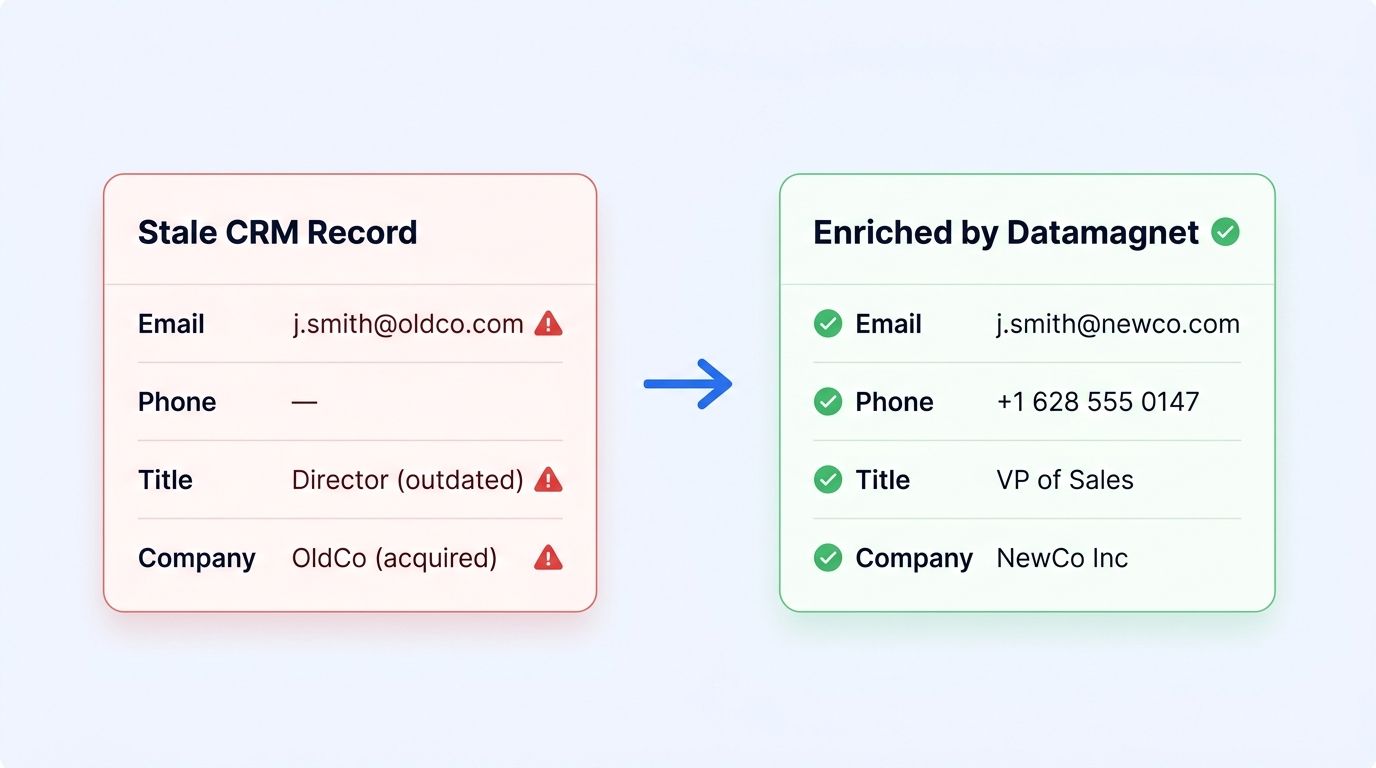
A data enrichment API takes one identifier, such as an email, a name and company, or a profile URL, and returns the fields you are missing: title, employer, seniority, company size, and on some APIs a verified email or phone number. It matters because B2B contact data decays at 22.5% to 70.3% a year (Landbase, 2026).
Data enrichment means adding third-party data points to a record you already hold. "Real-time" means the lookup happens when you ask, not in an overnight batch.
what is B2B data enrichment and how does it work
The eight APIs above get their answers in three different ways, and the method decides how fresh the record is:
- Stored databases (People Data Labs, Apollo, ZoomInfo, Lusha, Coresignal, Crustdata's database endpoints) answer from records collected earlier. They are fast and broad, but each record has an age you usually cannot see. PDL, for example, refreshes API data monthly (PDL docs).
- Waterfalls (FullEnrich) query several providers in sequence and stop when one returns a verified result. They are built to catch contacts one source misses, at the cost of speed: FullEnrich's docs put a contact at 45 to 60 seconds (FullEnrich docs).
- Live fetches (Datamagnet with
use_cache: "never", Crustdata's live add-on, Coresignal's Real-time Employee API) read the source profile at request time. The record is current, but coverage is limited to people and companies with a public profile.
How Should You Compare Enrichment API Pricing?
Compare the price of the record you actually need, not the price of a credit. Vendors charge different numbers of credits for different fields, some charge for lookups that find nothing, and some re-charge every time you read a record. Convert each plan to cost per usable record before you compare.
Four rules decide the real bill:
- Credits per field. FullEnrich charges 1 credit for a work email and 10 for a mobile (FullEnrich); Lusha charges 1 for an email and 5 for a phone (Lusha); Coresignal charges 10 for a core record and 20 for a full one (Coresignal). A Datamagnet profile is 1 credit (Datamagnet).
- Misses. FullEnrich charges nothing when it finds nothing, Crustdata does not bill unmatched identifiers (Crustdata), and Datamagnet charges only on successful profile and company requests. Lusha lists a one-credit minimum on an API request with no results (Lusha docs).
- Re-reads. ZoomInfo's enterprise plans do not re-charge an enriched record for 12 months (GTM AI pricing). Datamagnet charges 1 credit each time you read a profile, because each read can fetch it again.
- Expiry. Apollo credits reset each billing cycle (Apollo), GTM AI credits expire after 12 months (GTM AI), and FullEnrich credits roll over for 3 months on monthly plans and 12 on annual (FullEnrich).
What Are the Key Use Cases for Sales Teams?
Sales teams use enrichment APIs in four workflows: routing inbound leads, building outbound lists, keeping CRM records current and preparing for meetings. Each workflow starts from a different identifier, so each favours a different type of API. Inbound leads reached within 5 minutes are 9x more likely to convert (Utmost Agency, 2026).
Inbound Lead Enrichment
A prospect submits a form with a work email. An email-keyed API (People Data Labs, Apollo, Lusha, ZoomInfo, or HubSpot's built-in enrichment) fills in title, company and size while the lead is still on your thank-you page, so your scoring model and router have what they need before a rep looks at it.
Outbound Prospecting
You have a name and a company, or a profile URL from a search. A contact API such as FullEnrich or Lusha finds the email or mobile. If you also want the person's current role and history before you write to them, a profile-URL API such as Datamagnet returns it from the same URL.
CRM Hygiene
Titles change and people leave. With data decaying at up to 70% a year (Landbase, 2026), re-checking title and employer on a schedule catches a move before a rep pitches someone who left. This is where freshness matters most: a re-check against a stored record can return the same stale answer. For alerts instead of re-checks, Datamagnet's Signal API sends job-change and engagement webhooks; it is sales-led, so book a demo.
how to build a CRM hygiene workflow with enrichment APIs
how to detect job changes in real time and trigger outreach
Meeting Preparation
Before a discovery call, enrich the contact and the account: current title, recent posts, company headcount and funding. Datamagnet's person activity endpoint returns a person's recent activity (10 credits a page) and its funding rounds endpoint returns a company's rounds from its domain (5 credits), so the rep knows what changed since the last touchpoint.
Real-Time vs. Batch Enrichment: Which Should You Use?
Use both. Real-time enrichment belongs at the moment of conversion, because inbound leads reached within 5 minutes of a form submission are 9x more likely to convert (Utmost Agency, 2026). Batch enrichment belongs in scheduled CRM clean-ups, where coverage and cost per record matter more than speed.
Real-time advantages:
- Data arrives at the moment of conversion
- Routing and personalization can happen immediately
- Live lead-scoring models get complete inputs
Batch advantages:
- Lower cost per record at volume
- Suits periodic re-enrichment of the whole CRM
- Less load on your own infrastructure during working hours
Two worked examples using the published prices above. Finding work emails for 1,000 inbound leads a month at FullEnrich's roughly 80% average email find rate uses about 800 credits, which fits its $55, 1,000-credit monthly tier (FullEnrich). Re-checking the titles of a 50,000-contact CRM once a quarter is about 16,700 profile reads a month, which fits inside Datamagnet's $199 plan of 25,000 credits (Datamagnet).
How Do You Implement a People Enrichment API in Your Sales Stack?
Use the RACE framework, our four-step checklist: Request (decide what triggers enrichment), Authenticate (keep keys safe), Cascade (map fields and plan for partial results), Evaluate (measure cost and quality). Skipping a step usually shows up later as an inflated API bill or reps working from half-enriched records.
Step 1: Identify Enrichment Triggers (Request)
Decide when enrichment fires: a form submission, a new CRM contact, a rep's manual lookup or a scheduled re-check. Set conditions so you do not enrich every record blindly, for example only when the title field is empty or the last check is older than 90 days.
Step 2: Configure Authentication (Authenticate)
Most enrichment APIs use an API key. Store it in environment variables or a secrets manager, never in code, and test against a sandbox or a small free tier before touching production CRM data. Every API in the table offers free credits except Crustdata, which does not publish one.
Step 3: Map Fields and Plan for Partial Results (Cascade)
Map every response field to its CRM property, and only overwrite a field when the new value is more recent or more trustworthy than the existing one. Decide what happens on a partial result: FullEnrich runs a waterfall for you, while with single-source APIs such as Datamagnet you write the fallback to a second provider in your own code.
Step 4: Monitor and Iterate (Evaluate)
Track credits spent, email bounce rates after enrichment and how often enriched titles turn out wrong. If enriched emails bounce, your contact source has a coverage gap in your market. Review monthly whether enrichment is shortening time to first activity.
Common Implementation Problems
Rate limits. Queue requests and retry with exponential backoff, and run low-priority clean-up jobs off-peak so inbound enrichment always gets capacity. Published limits vary widely; FullEnrich, for example, allows 60 calls a minute (FullEnrich docs).
Overwrites. Partial results should never blank out good data. Use conditional field mapping, and keep a record of when each field was enriched and from which source.
Cost creep. Enrich only records that are missing a field you will use, and only leads that meet your minimum qualification criteria.
Compliance. Ask each provider how its data is sourced and how opt-outs are handled. Under GDPR, B2B enrichment commonly relies on legitimate interest, which requires a documented balancing test (Derrick App, 2026). This is not legal advice; confirm your basis with your own counsel.
B2B data compliance checklist for enrichment workflows
If your team works in an AI assistant, Datamagnet's MCP server exposes the same people and company lookups in Claude, ChatGPT, Cursor and other clients, so a rep can enrich a profile without writing code.
Frequently Asked Questions
What is the best data enrichment API in 2026?
It depends on the field you need. For verified emails and mobiles, FullEnrich, Apollo and Lusha publish the lowest per-contact prices, and FullEnrich charges only when it finds data (FullEnrich). For flexible inputs and breadth, People Data Labs leads. For current titles and employers from a profile URL, Datamagnet costs about $0.008 to $0.02 per profile (Datamagnet) but returns no emails or phones.
What is a people enrichment API?
A people enrichment API takes one identifier for a person, such as an email, a name and company, or a profile URL, and returns the fields you are missing: current title, employer, seniority, work history and, on contact-data APIs, a verified email or phone number. B2B contact data decays at 22.5% to 70.3% a year (Landbase, 2026), which is why teams enrich on demand.
How much does a data enrichment API cost per record?
Published prices run from about $0.008 per profile on Datamagnet's $199 plan (Datamagnet) and $0.015 per core record on Coresignal's Premium plan (Coresignal) to about $0.28 per person record on People Data Labs' entry Pro plan (PDL) and $0.38 per record on ZoomInfo GTM AI (GTM AI). Phone numbers usually cost several times more than emails.
Which enrichment APIs return email addresses and phone numbers?
People Data Labs, Apollo, FullEnrich, ZoomInfo and Lusha all return emails and phone numbers on their standard paid plans. Crustdata returns them only on enterprise or higher-tier plans (Crustdata docs). Datamagnet returns neither; it covers profile and company data such as title, employer and work history.
Does Datamagnet return email addresses or phone numbers?
No. Datamagnet has no email or phone lookup, no email verification and no waterfall across vendors. It returns a person's or company's public profile data as JSON from a profile or company page URL, for 1 credit per profile, charged only on success. Teams that need contact details pair it with a contact provider such as FullEnrich, Lusha or Apollo.
How fresh is the data from an enrichment API?
It depends on how the API gets its answer. Stored databases return records collected earlier; People Data Labs, for example, rolls out API data updates monthly (PDL docs). Live-fetch APIs read the source at request time: Datamagnet does this when you set use_cache: "never", and otherwise may return a stored copy, with company data up to 30 days old.
Is real-time enrichment better than batch enrichment?
Use real-time enrichment for inbound leads and live prospecting, and batch enrichment for scheduled CRM clean-ups. Inbound leads reached within 5 minutes of a form submission are 9x more likely to convert (Utmost Agency, 2026), so speed matters most at the moment of conversion. Batch runs suit re-checking a whole CRM at a lower cost per record.
What is waterfall enrichment?
Waterfall enrichment sends one lookup to several data providers in sequence and stops when one returns a verified result. It finds more emails and mobile numbers than a single source, because one provider's gap is often another's hit. FullEnrich runs a waterfall across 20+ sources and charges only when it finds verified data (FullEnrich). Datamagnet does not run a waterfall.
