
Disclosure: This article is published by Datamagnet. Vendor claims are self-reported unless otherwise noted.
Real-Time vs Batch Enrichment for AI Agents
Use real-time enrichment when an AI agent needs data inside a live turn: voice, chat, or an in-session reply. Use batch for anything the agent can read from a table before the conversation starts. Webhooks beat polling for external events. This guide covers only the AI-trigger angle. For the general comparison, see real-time vs batch data enrichment.
Last verified: 2026-10-25. Every number below comes from a public page named in its citation.
Key Takeaways
- In 2026, Deepgram's voice-agent production guide advises treating 800ms as the design center for voice-agent responses, with replies breaking down past roughly 1,300ms.
- A live enrichment call rarely fits inside a voice turn. Prefetch before the call, and keep live calls for chat and async steps.
- Push events (webhooks) beat polling for triggers; poll only as a reconciliation backstop.
- Cost is set by how many triggers you enrich, not by real-time vs batch. Gate first, enrich second.
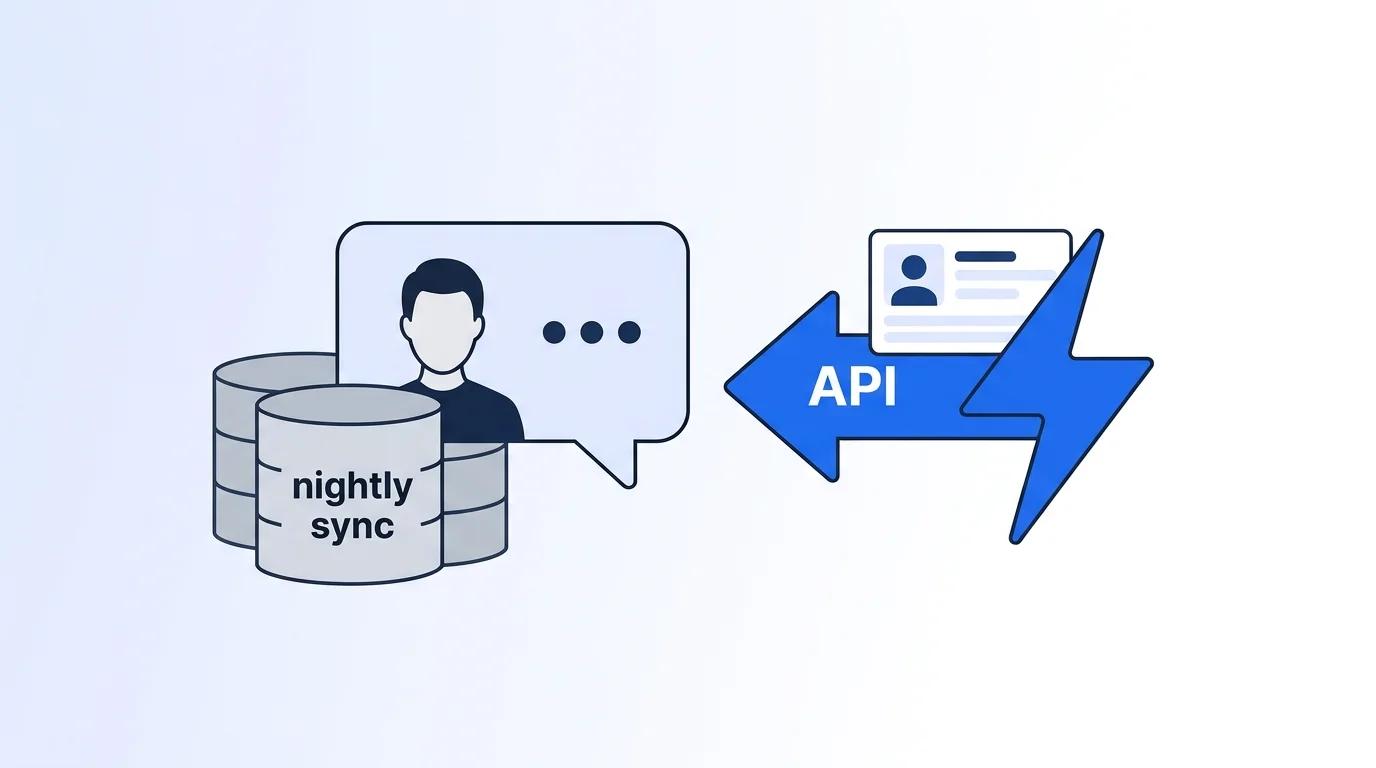
Real-time vs batch enrichment for AI agents: which one do you need?
The deciding question is whether the agent reads the data during a turn or before it. Data read during a turn must be fetched live or already cached. Data read before the conversation can come from a batch job. In our experience, most agent stacks end up needing both, split by trigger type.
| Pattern | Agent behaviour | Fits when | Breaks when |
|---|---|---|---|
| Real-time (on-demand) | Agent calls the enrichment API mid-turn | Chat, async tool calls, one-off lookups | Voice turns with a sub-second budget |
| Real-time (event-pushed) | Webhook updates the agent's context | Job changes, post alerts, intent signals | Receiver is down and nothing reconciles |
| Batch (scheduled) | Agent reads a table refreshed on a schedule | Account lists, ICP scoring, call prep | Agent acts on a record that changed after the sync |
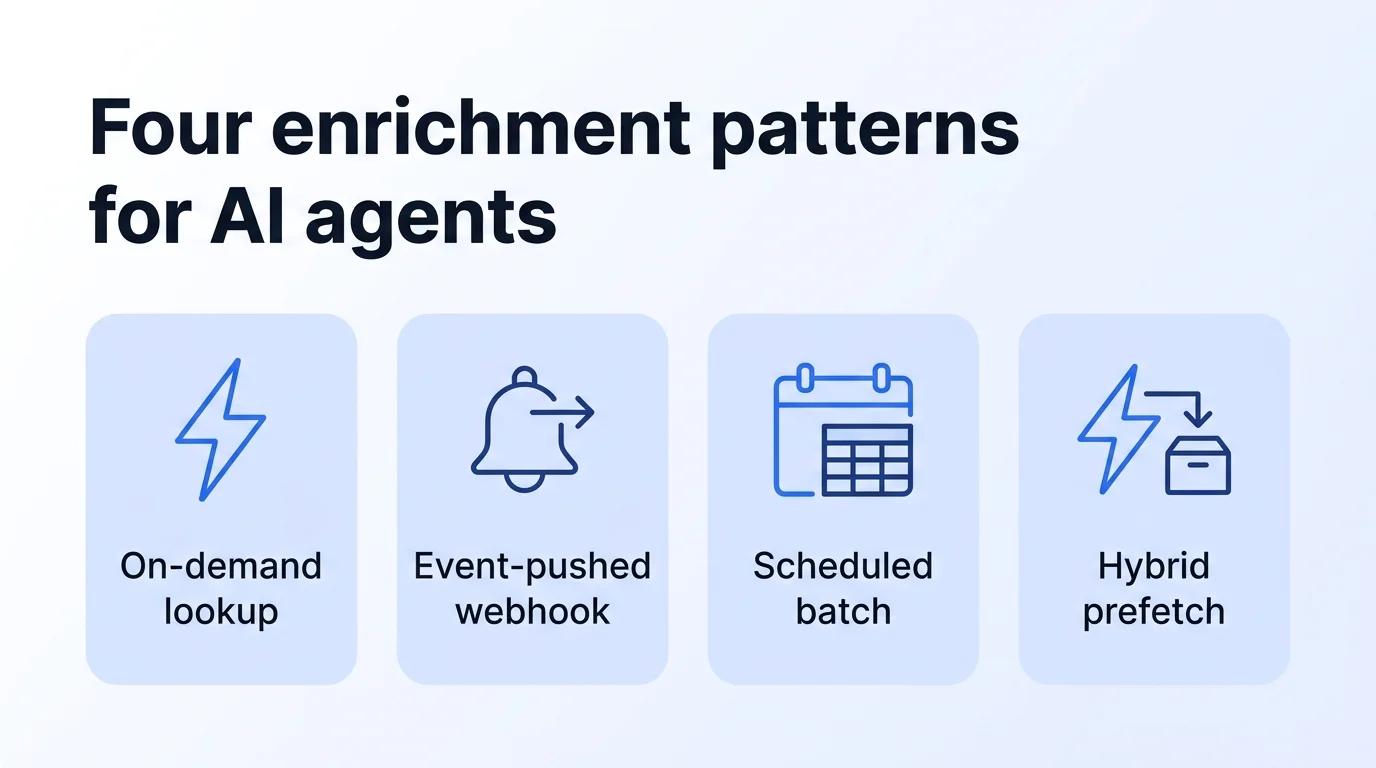
| Hybrid (prefetch) | Fetch live when the trigger fires, then cache for the turn | Outbound calls, meeting prep | You prefetch for contacts that never reply |
Other names for the same choice show up in search: sync vs async enrichment for AI agents, on-demand vs scheduled enrichment, and live vs cached lookups. They map to the same table. On-demand is real-time; scheduled is batch; cached is the prefetch half of hybrid.
What is a good latency budget for a conversational AI agent?
In 2026, Deepgram's voice-agent production guide (updated 2026-10-12, retrieved 2026-10-25) says to treat 800ms mouth-to-ear as the design center. Replies are acceptable to about 1,200ms and degrade past about 1,300ms. Deepgram attributes those upper thresholds to field experience, not measured data.
| Channel | Budget | Source |
|---|---|---|
| Human turn-taking gap | Within about 250ms of the cross-language mean | Stivers et al., PNAS, 2009 (retrieved 2026-10-25) |
| Voice agent, design center | 800ms | Deepgram, 2026 (retrieved 2026-10-25) |
| Voice agent, acceptable ceiling | about 1,200ms | Deepgram, 2026 (retrieved 2026-10-25) |
| Voice agent, p50 / p95 first audio | under 800ms / under 1,500ms | Twig AI, 2026 (vendor blog, retrieved 2026-10-25) |
| Chat, first token / full reply | under 1s / under 5s | Twig AI, 2026 (vendor blog; stated as optimization targets) |
| UI feels instant / keeps flow / holds attention | 0.1s / 1s / 10s | Nielsen Norman Group (1993, updated 2014; retrieved 2026-10-25) |
Last verified: 2026-10-25.
How do you fit an enrichment call into the budget?
Don't guess the enrichment time. Measure it, then subtract. Here's the procedure:
- Log the p50 and p95 of your enrichment call from your own region over a week.
- Take the voice or chat ceiling from the table above.
- Subtract speech-to-text, LLM time-to-first-token, and text-to-speech from your own traces.
- If the p95 enrichment call exceeds what's left, move it out of the turn: prefetch on trigger, or answer first and enrich in the background.
One public fact makes the "live call inside a voice turn" plan risky. Datamagnet's error reference says every request gets an answer within about 80 seconds, and timed-out lookups aren't charged. A live profile fetch is a real network collection, not a database read. So an 800ms voice turn should never wait on it unguarded. Set the X-Request-Timeout header (in seconds) so the API responds before your own deadline.
For an overview of the live-fetch model, see the real-time people enrichment API and the People API product page.
Webhook vs polling for AI triggers: which pattern wins?
Webhooks win for event triggers because the agent hears about a change when it happens instead of discovering it on the next poll. In 2026, Stripe's webhook docs (retrieved 2026-10-25) describe live-mode retries for up to three days with exponential backoff, and warn that endpoints may receive the same event more than once.
| Dimension | Webhook (push) | Polling (pull) |
|---|---|---|
| Time to agent | Event arrives when it fires | Up to one poll interval late |
| Wasted calls | None | Many polls return nothing new |
| Failure mode | Missed delivery if receiver is down | Missed change if interval is too long |
| Duplicates | Expected; dedupe on event ID | Rare, but re-reads are common |
| Auth | HMAC signature on raw body | API key per request |
| Best for | Job changes, post alerts, intent signals | Reconciliation, backfills, status checks |
Last verified: 2026-10-25.
What does a safe webhook receiver look like?
Follow these steps, in order. They hold for any provider.
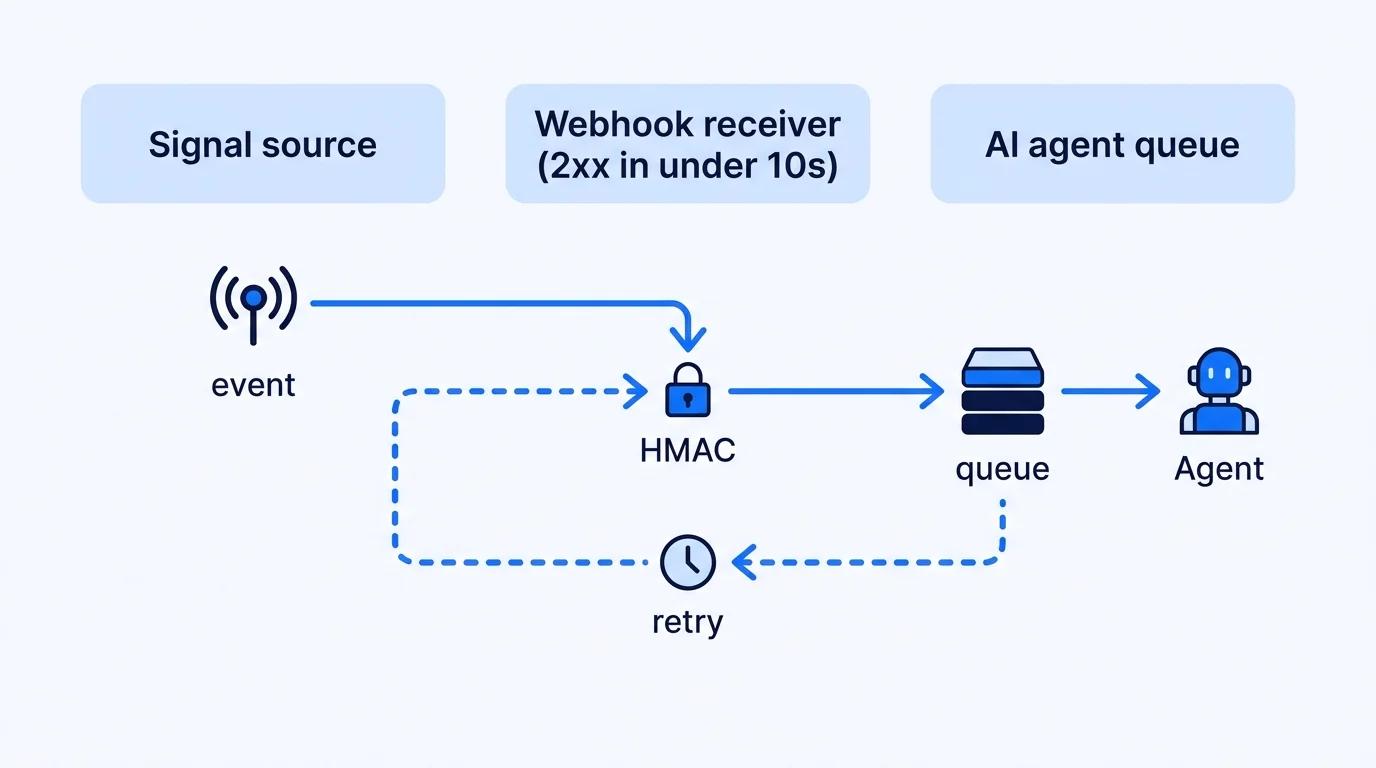
- Verify the signature first. Datamagnet signs deliveries with
X-Datamagnet-Signature(sha256=plus the HMAC-SHA256 hex digest of the raw body), only if you set awebhook_secret. Compare in constant time. Details are in the webhooks docs. - Return 2xx fast. The Datamagnet webhooks docs require a 2xx within 10 seconds, and GitHub's webhook guidance (retrieved 2026-10-25) uses the same 10-second limit. Queue the payload, then let the agent work asynchronously.
- Dedupe on the event ID. Datamagnet change events carry an
event_id. Svix (retrieved 2026-10-25) calls duplicates "normal and expected." - Don't treat 4xx as retryable. Per the Datamagnet webhooks docs, a 400, 401, 403 or 404 means the endpoint is misconfigured, so it's retried once and then dropped.
- Reconcile on a slow poll. A daily check catches anything a dropped delivery missed.
How do retries differ across providers?
| Provider | Retry window | Source |
|---|---|---|
| Stripe (live mode) | Up to 3 days, exponential backoff | Stripe docs (retrieved 2026-10-25) |
| Svix (example schedule) | 8 attempts over a little over 27 hours | Svix, updated 2026-10-20 (retrieved 2026-10-25) |
| Datamagnet | 7 attempts: immediate, 5 min, 30 min, 2h, 8h, 24h, 48h (timings approximate) | Datamagnet webhooks docs |
Last verified: 2026-10-25.
What breaks when an AI agent waits on a batch sync?
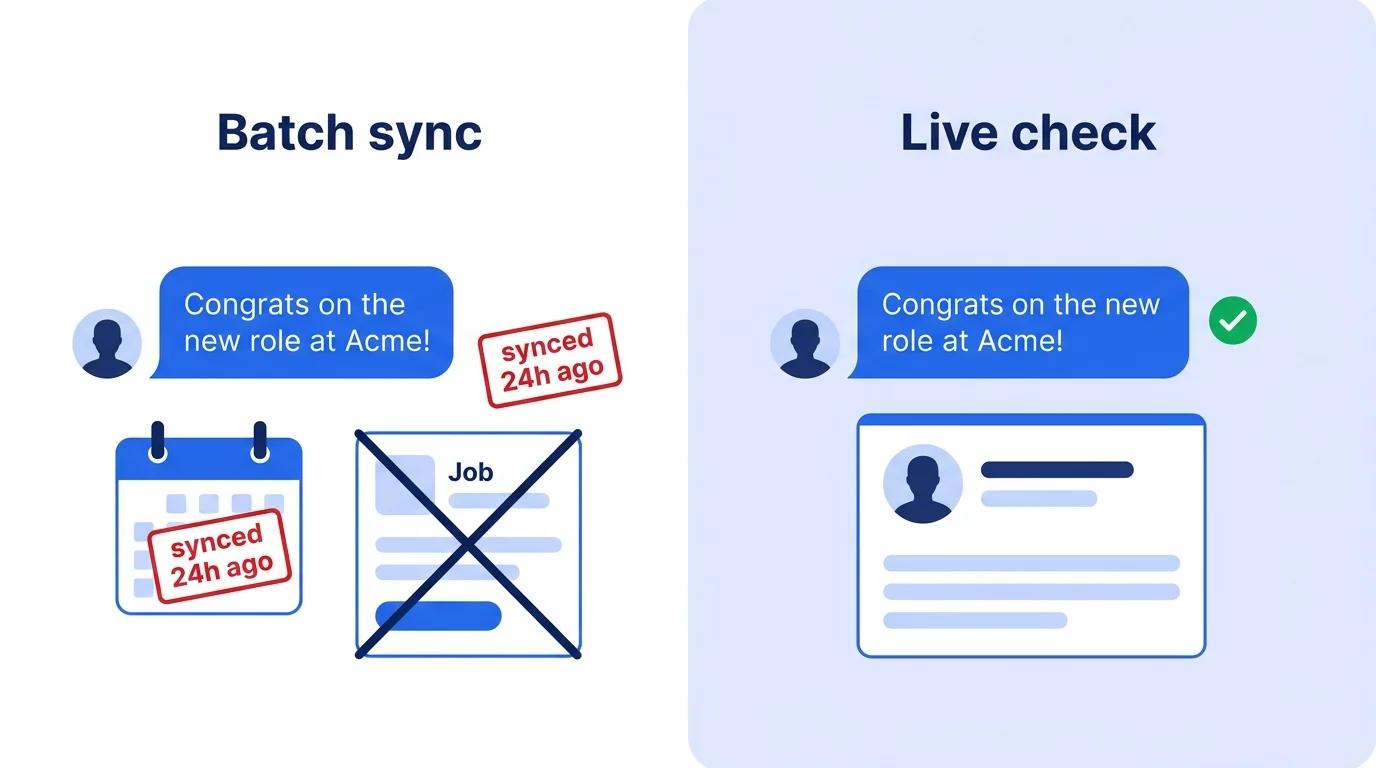
The agent acts on a record that is already wrong, and it does so with full confidence. A batch sync gives the agent a snapshot, not a live view. Everything between the snapshot and the turn is invisible to the model, and the model can't tell.
| Failure | What happens | Fix |
|---|---|---|
| Stale-fact outreach | Agent congratulates a contact on a role they've left | Re-check the single record at send time |
| Timeout cascade | Agent blocks on the sync; the voice or chat turn passes its ceiling | Never block a turn on a bulk job |
| Retry storm | Tool call times out, the LLM re-plans and retries, each turn re-billing tokens | Cap retries; return a "pending" state |
| Hallucinated gap-fill | Missing field in the table, so the model invents one | Return null; instruct the model to say it doesn't know |
| Lost trigger | With a nightly sync, a hot signal can wait up to a day before the agent sees it | Push the event; keep the sync for backfill |
Here's where the money goes in the retry storm. Claude Sonnet 5.5 is priced at $2 per million input tokens and $10 per million output tokens (Anthropic pricing, retrieved 2026-10-25). Every re-planning turn re-sends the whole prompt as input and adds fresh output. So the cost of a retry storm is retries per conversation × conversations × (prompt tokens × input rate + reply tokens × output rate). Pull the token counts from your own traces, since they vary by agent. Pricing is also model-dependent, so rerun the math whenever you change models.
Snapshot-style data has the same limit; see how periodic database snapshots compare on cost. The fix isn't "make everything real-time." It's a mixed design, shown below. For hands-on account prep, see account research infrastructure for AEs.
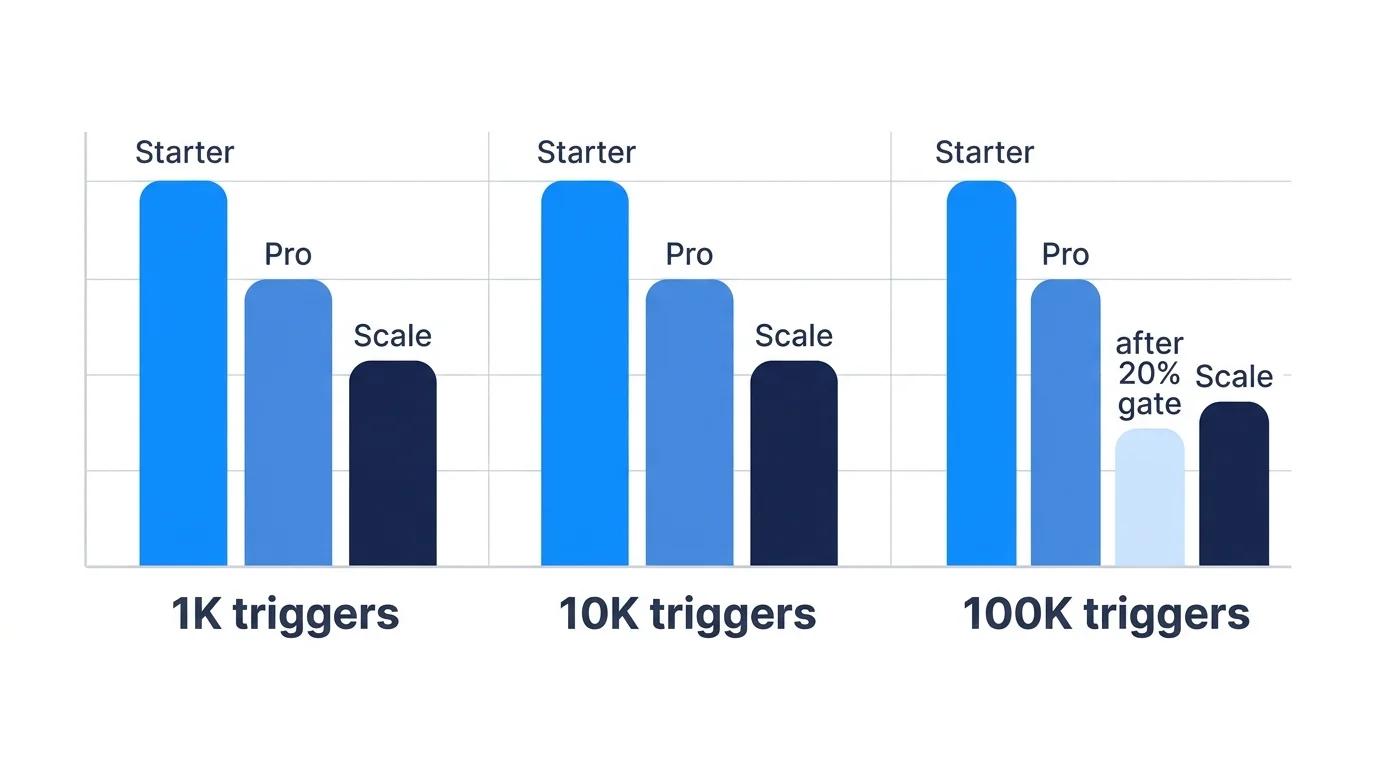
Cost modelling: real-time enrichment at 1K, 10K and 100K triggers a month
Cost scales with the number of triggers you enrich, so the cheapest lever is gating, not choosing batch. In 2026, Datamagnet's pricing page (retrieved 2026-10-25) lists a person profile at 1 credit per request, billed only on success, with effective rates of $0.039 (Starter), $0.0099 (Pro) and $0.0080 (Scale) per credit.
Formula: monthly cost = triggers × share enriched × credits per call × price per credit
The table below assumes 1 credit per call (the base person profile, no add-on flags) and enriches 100% of triggers.
| Monthly triggers | Starter ($0.039) | Pro ($0.0099) | Scale ($0.0080) |
|---|---|---|---|
| 1,000 | $39.00 | $9.90 | $8.00 |
| 10,000 | $390.00 | $99.00 | $80.00 |
| 100,000 | $3,900.00 | $990.00 | $800.00 |
Last verified: 2026-10-25. Per-credit rates are the effective plan rates on the pricing page; confirm plan limits and overage terms there before budgeting.
Now gate. If a cheap filter (title match, ICP score, reply intent) lets only part of the triggers through, the bill falls in proportion to that share, because "share enriched" is a direct multiplier in the formula above. Per the pricing page, person enrichment flags cost +2 credits each, charged only when the extra data is returned, so a call with two flags costs 5 credits, not 1 (the People endpoint docs say the same).
What should you not put in the cost model?
Signals. Datamagnet's Signal API page and pricing page don't state a per-signal credit cost, so this guide doesn't model one. Check your plan before you budget event-pushed triggers. If you use the Signal API, the page says most job changes are detected within 1 to 24 hours; that figure is vendor-reported.
Real-time vs batch enrichment decision matrix by use case
Pick by the shape of the trigger, not the vendor. If the agent reads data during a live turn, fetch live or serve a recent cache. If it reads data before the turn, batch is fine. If the data arrives as an event, push it.
| Use case | Pattern | Why | Watch for |
|---|---|---|---|
| Voice SDR on a live call | Prefetch before dial, cache for the call | The 800ms design center leaves no room for a live fetch | Prefetching for contacts who never pick up |
| Website chat agent | Live call with a short timeout | The under 5s full-reply target allows one fast lookup | Setting no timeout; use X-Request-Timeout |
| Inbound lead form, instant reply | Live enrich on submit | Speed matters; one record per trigger | Enriching junk submissions; gate first |
| Champion job-change outreach | Event-pushed webhook | Change arrives when it fires | Needs supplied profile URLs; see below |
| Weekly account scoring | Scheduled batch | Nobody is waiting on the result | Re-checking the record before send |
| Meeting-prep briefs | Hybrid: batch the list, live-refresh top accounts | Few accounts change materially within a day | Over-refreshing every account |
| Large list cleanup / backfill | Batch | Volume beats freshness | Treating the result as live afterward |
| CRM field enrichment on create | Live on create event (why programmatic CRM enrichment pays off) | One call per new record | Overwriting human-edited fields |
Last verified: 2026-10-25.
The mistake we see most is a single pipeline for every trigger. Splitting the pipeline by who is waiting (a human in a turn, or nobody) removes most of the argument.
How does job-change data fit this matrix?
Job-change signals are a watchlist: you supply the profile_urls you want monitored (see the Create Signal docs), and it won't discover people you haven't listed. Role dates in the profile data are month-year granularity (the People endpoint docs describe them as M-YYYY, with 0-YYYY for year-only roles), so don't build logic that needs a day. The webhook's detected_at is a precise timestamp, but it tells you when the change was detected, not the exact day the person started. See champion tracking and the champion tracker cookbook.
Real-time vs batch enrichment for an AI SDR: a reference architecture
An AI SDR needs three layers: a push layer for signals, a live layer for single-record checks, and a batch layer for lists. Each layer has one job, and the agent never blocks on the slowest one.
| Layer | Job | Datamagnet fit |
|---|---|---|
| Push | Deliver job changes and engagement events | Signal API, webhooks |
| Live | Verify one record at send time | People API, People endpoint docs |
| Batch | Score and refresh account lists | ICP People Search |
For a fuller view of this stack, see the AI SDR data engine, and for the signal-source comparison, real-time intent signal APIs for job changes. If you build in n8n, the n8n integration covers the webhook node.
Frequently Asked Questions
Is real-time enrichment always better for AI agents?
No. Real-time is better only when an agent reads data during a live turn or reacts to an event. For account lists and weekly scoring, nobody is waiting, so batch is cheaper to run and simpler to operate. Gate the triggers first, because enrichment cost scales with calls, not with the pattern you pick.
Should an AI voice agent call an enrichment API during the conversation?
Usually not. Deepgram's 2026 guide treats 800ms as the voice design center and says quality degrades past about 1,300ms. A live profile fetch can run far longer than that, and Datamagnet's docs say requests can take up to about 80 seconds to resolve. Prefetch before the call instead.
Webhook or polling for AI agent triggers?
Use webhooks for event triggers and a slow poll as a backstop. Webhooks reach the agent when the event fires, while polling is late by up to one interval. Providers also retry and duplicate deliveries: Stripe retries for up to three days, so dedupe on event ID and verify the HMAC signature.
How much does real-time enrichment cost at 10,000 triggers a month?
At 1 credit per call and 100% of triggers enriched, 10,000 triggers cost $390 at the $0.039 Starter rate, $99 at the $0.0099 Pro rate, and $80 at the $0.0080 Scale rate (Datamagnet pricing, verified 2026-10-25). Gating to a smaller share cuts the bill in proportion.
Next step
Start with the Signal API for pushed triggers and the People API for live checks, then see the Datamagnet quickstart. For the general real-time vs batch comparison, read real-time vs batch data enrichment.
