
Disclosure: Datamagnet publishes this article. Vendor positioning below comes from each vendor's public materials and our own comparison pages, so verify specifics in a trial before you buy.
B2B Data Enrichment Glossary: 40 Terms RevOps Teams Should Know
B2B data enrichment is the process of adding missing facts to a contact or company record from an outside source. This glossary defines 40 terms RevOps teams run into, grouped by topic, each in one or two sentences you can lift straight into a doc or a prompt. New to the topic? Start with our guide to what B2B data enrichment is.
Key Takeaways
- Enrichment terms fall into five groups: core concepts, data types, data quality, targeting, and compliance plus infrastructure.
- In 2024, Validity found 31% of CRM admins say bad data costs them at least 20% of annual revenue (Validity).
- Match the data type to its freshness need: job changes decay fast, firmographics slower.
- Pick the approach by workflow: live API, static database, or DIY scraping.
What are the core data enrichment terms?
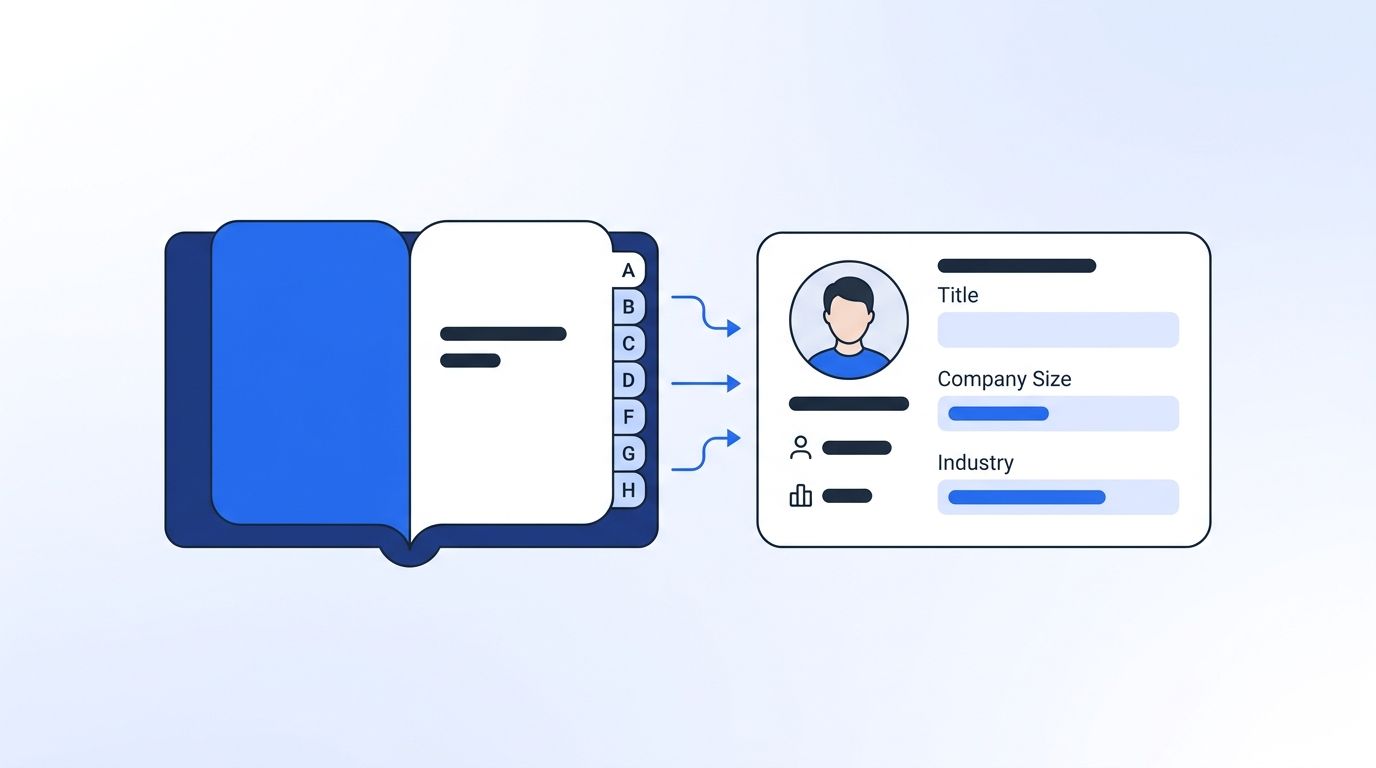
Data enrichment means adding missing fields to a record from an outside source. Core terms cover how you fetch data (real-time, batch, waterfall) and how you measure it (match rate, fill rate). Validity's 2024 survey found 24% of CRM admins say under half their data is accurate and complete (Validity).
- Data enrichment: Adding missing or outdated attributes, such as job title, headcount, or industry, to an existing contact or account record from an external source. See the full explainer on B2B data enrichment.
- Waterfall enrichment: Querying several data providers in a set order and stopping at the first one that returns a valid answer. It trades extra complexity for higher coverage.
- Real-time enrichment: Fetching data at the moment you request it, rather than reading a stored copy. Read how a real-time B2B people enrichment API works.
- Batch enrichment: Running a whole list or CRM segment through enrichment in one scheduled job. It suits cleanups and one-time list builds.
- Programmatic enrichment: Enriching records automatically through code or workflows instead of manual uploads. Here's what programmatic CRM enrichment buys you.
- Enrichment API: An interface where you send an identifier, such as a LinkedIn URL or domain, and get structured fields back. Datamagnet's People Profile endpoint and Company Profile endpoint are examples.
- Match rate: The share of submitted records a provider could identify at all. A 70% match rate means 30 of every 100 records came back empty.
- Fill rate: The share of target fields a provider populated on the records it did match. A vendor can have a high match rate and a low fill rate, so test both.
Match rate and fill rate get blended in vendor pitches, but they fail differently. Low match rate means the vendor doesn't know the person. Low fill rate means it knows them but lacks the field you need, like phone or seniority. Ask for both numbers on your own sample list.
Which data types do enrichment terms describe?
Enrichment data falls into a few families: firmographic (company facts), technographic (tools used), intent (research behavior), and signals (events like job changes). Each decays at a different speed, so match the data type to how fresh your workflow needs it. The table below compares them.
| Data type | What it tells you | Example fields | Freshness need |
|---|---|---|---|
| Firmographic | Who the company is | Industry, headcount, location, revenue | Moderate |
| Technographic | What tools they run | CRM, cloud provider, analytics stack | Moderate |
| Intent | What they're researching | Topic surges, keyword engagement | High |
| Signal | What just changed | Job change, new post, funding round | Very high |
| Contact | How to reach them | Work email, phone, profile URL | High |
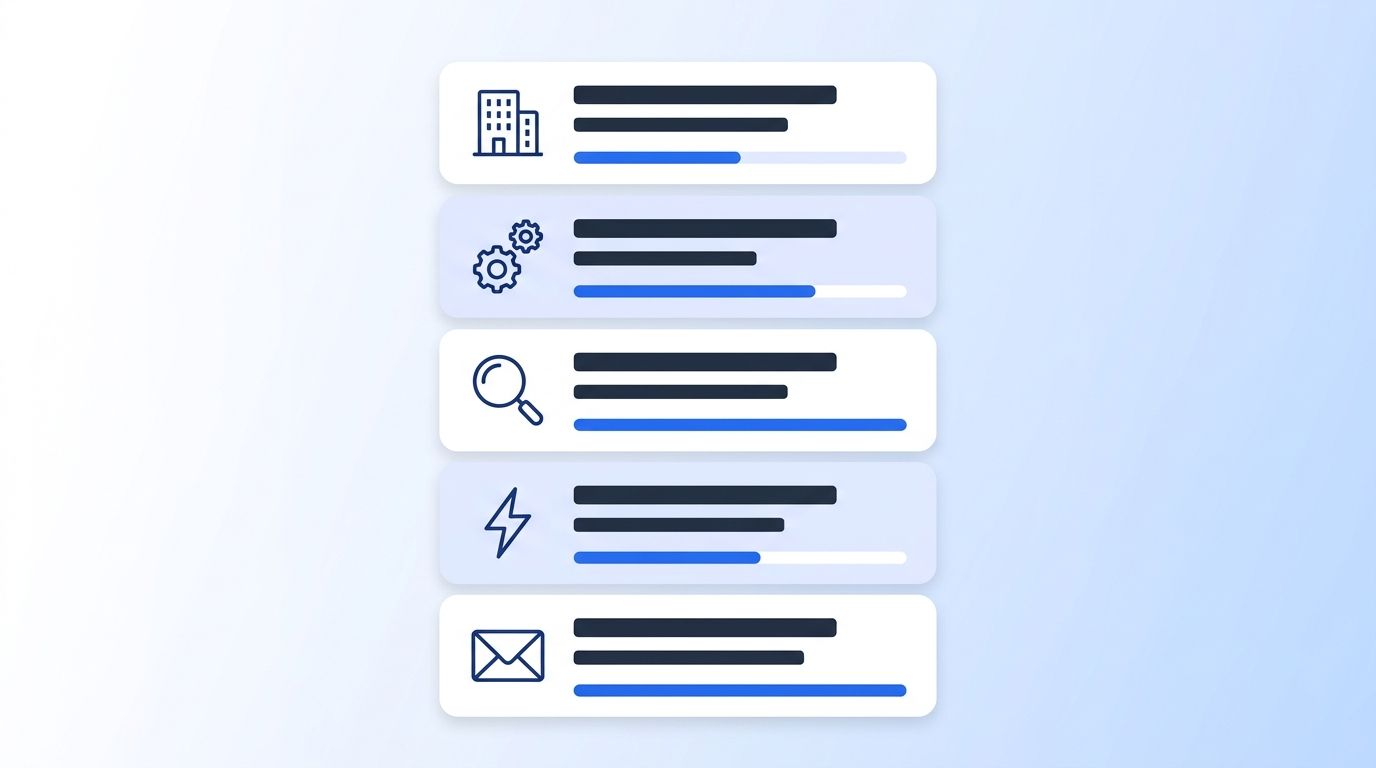
- Firmographic data: Facts about a company, such as industry, size, revenue, and location. It's the base layer for segmenting accounts. Pull it with the company API.
- Technographic data: The software and infrastructure a company uses. It helps you spot competitor customers or integration fits.
- Intent data: Behavioral evidence that an account or person is researching a topic. Sources range from content consumption to social engagement.
- Buying signal: Any observable event that suggests a deal may be coming, like a new executive or a funding round. Our guide to real-time intent signal APIs compares options.
- Job change alert: A notification that a tracked person started a new role. Docs for the create signal endpoint show how to set one up.
- Funding round data: Records of each round a company raised, including amount, type, and date. The funding rounds endpoint returns this by domain.
- Hiring signal: Evidence that a company is adding headcount in a function, such as open roles or team growth. Reps use it to time outreach to a new budget.
- Headcount growth: The change in a company's employee count over a period. It's a quick proxy for expansion or contraction.
What does data quality terminology mean for enrichment?
Email providers now police sender quality. As of 2026, Google tells bulk senders to keep spam rates below 0.1% and never reach 0.3% (Google), and Yahoo sets the same 0.3% ceiling (Yahoo Sender Hub). Sloppy lists raise complaints, so data quality terms are deliverability terms too.
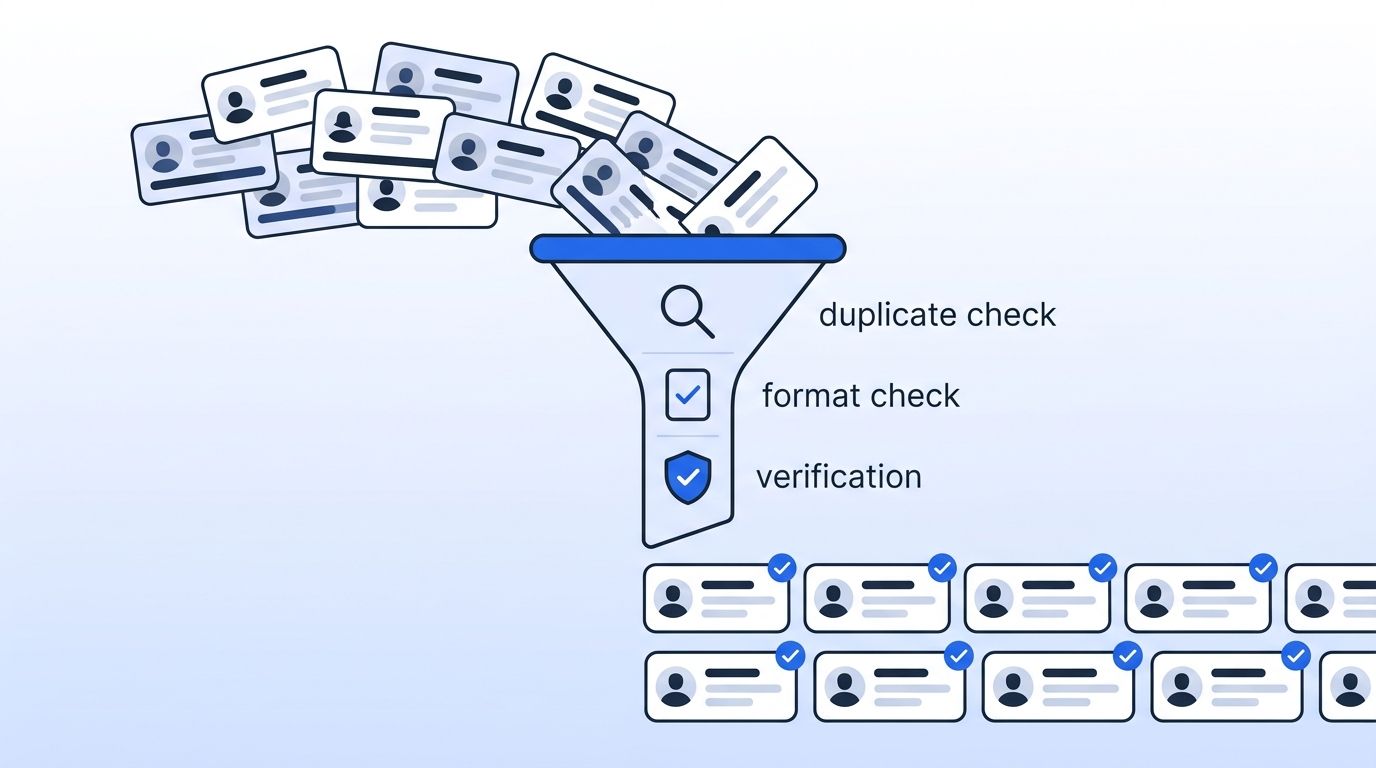
- Data decay: The steady loss of accuracy as people change jobs, companies move, and emails go dead. Treat it as a rate you manage, not a one-time cleanup.
- Data hygiene: The routine work of fixing, removing, and standardizing bad records so they don't spread across systems.
- Deduplication: Finding and merging records that describe the same person or company. Duplicates split activity history and confuse routing.
- Data normalization: Converting values to one standard format, like mapping "VP Sales" and "Vice President, Sales" to a single title field.
- Data validation: Checking that a value is well formed and plausible before you store it. Techniques range from format checks to real-time API verification.
- Email verification: Testing whether an address can actually receive mail, without sending a message. It cuts hard bounces before a campaign.
- Bounce rate: The share of sent emails that never arrive. Hard bounces come from bad addresses, so unverified lists push this number up.
- Catch-all domain: A mail server that accepts mail for any address, real or not. Verification can't confirm individual inboxes there, so treat them as risky.
How do targeting and workflow terms connect to enrichment?
In 2024, Validity found 31% of CRM admins say poor data costs them at least 20% of annual revenue (Validity). Targeting terms like ICP, TAM, and lead scoring only work when the data underneath is accurate. That's why enrichment sits upstream of every routing and scoring rule.
- Ideal customer profile (ICP): The description of the company and buyer most likely to convert and stay. Search by it with the ICP people search endpoint or the ICP Search API.
- Total addressable market (TAM): Every account that fits your ICP, whether or not you've contacted it. Enrichment tells you how many accounts you can actually reach.
- Account-based marketing (ABM): Marketing and sales aimed at a named list of target accounts instead of broad lead capture. Fresh firmographics keep that list honest.
- Lead scoring: Ranking leads with points for fit and behavior. Enriched fields such as title and company size feed the fit side.
- Lead routing: Sending each new lead to the right rep or queue based on rules like region, segment, or owner. Blank fields break routing.
- Champion tracking: Watching when your power users and buyers change jobs so you can follow them. See champion tracking and the Champion Tracker cookbook.
- Account research: Gathering context on a target account before outreach. See our guide to account research infrastructure for AEs.
- CRM sync: Writing enriched data back to your CRM so reps see it where they work. Datamagnet's HubSpot integration and Clay integration are two routes.
Which compliance and infrastructure terms should RevOps know?
GDPR fines can reach 20 million euros or 4% of worldwide annual turnover, whichever is higher (GDPR Art. 83). Enrichment buyers should learn privacy terms and API plumbing terms together, because both shape which vendor and workflow fit your team.
- GDPR: The EU's data protection regulation. It requires a lawful basis for processing personal data, which includes B2B contact data about people in the EU.
- CCPA: California's privacy law. It applies to businesses meeting thresholds such as buying, selling, or sharing the personal information of 100,000 or more California residents or households (California AG).
- Suppression list: A list of people you must not contact, such as opt-outs. Check it before every send or enrichment-driven campaign.
- Webhook: A message a service posts to your URL when an event happens. Datamagnet signals deliver events this way; see the webhooks docs.
- Bearer token authentication: Sending an API key in the request header to prove who you are. Setup is in the authentication docs.
- Rate limit: The cap on how many API requests you can make in a period. Hitting it returns an error; see the error reference.
- Credit-based pricing: Paying per unit of data pulled instead of per seat. You can check your credit balance by API, and the pricing page lists current plans.
- Public data sourcing: Collecting only information that's publicly available. Our security and data practices page describes how we handle it.
Which enrichment approach fits which team?
No single approach wins every use case. Static databases suit broad list-building, live APIs suit fresh single-record lookups and signals, and DIY scraping suits teams with engineering time to spare. The table lists vendors alphabetically and shows where each tends to win, including where Datamagnet isn't the best fit.
| Vendor | Model | Where it tends to win | Look elsewhere if |
|---|---|---|---|
| Apollo | Contact database with seats | All-in-one prospecting and outreach in one tool | You need live profile data or per-call pricing |
| Bright Data | Scraping infrastructure | Custom collection at large scale with your own engineers | You want a finished API with a stable schema |
| Coresignal | Periodic database snapshots | Bulk historical analysis and large dataset exports | You need request-time freshness |
| Datamagnet | Live LinkedIn API plus signals | Fresh profile lookups, post engagement, ICP search, job-change signals | You need a large pre-built contact database or bulk phone numbers |
| People Data Labs | Large static record database | Broad coverage across many record types | You need data fetched live |
| ScrapIn | Live LinkedIn data API | Simple live profile lookups | You also want engagement, search, or signals |
| ZoomInfo | Annual seat contracts | Enterprise suites with deep workflow tooling | You want pay-as-you-go and no sales call |
Treat the table as a starting point. Each vendor's own materials define its strengths, and coverage differs by region and persona. Run the same 200-record sample through two or three options and compare match and fill rates.
Frequently Asked Questions
What is B2B data enrichment in one sentence?
B2B data enrichment adds missing details, like title, company size, or industry, to a contact or account record from an outside source. Teams use it to fix gaps behind routing, scoring, and outreach. In 2024, Validity found 24% of CRM admins said under half their data was accurate and complete.
What's the difference between match rate and fill rate?
Match rate is the share of your records a provider could identify. Fill rate is the share of requested fields it populated on matched records. A provider can match 90% of people but fill only half the fields you need, so test both on your own list.
Does data enrichment have to comply with GDPR and CCPA?
Yes, when records cover people in the EU or California. GDPR fines can reach 20 million euros or 4% of worldwide annual turnover, and CCPA applies above thresholds such as 100,000 California residents or households. Confirm your lawful basis and honor opt-outs with a suppression list.
Should I use real-time or batch enrichment?
Use real-time enrichment when freshness matters, such as outreach triggered by a job change. Use batch enrichment for scheduled cleanups and one-time list builds. Many teams run both. Google's guidance to keep spam rates under 0.3% also argues for verifying contacts before a large send.
Sources
- Validity, The State of CRM Data Management in 2024, retrieved 2026-10-14, https://www.validity.com/resource-center/the-state-of-crm-data-management-in-2024/
- Google, Email sender guidelines FAQ, retrieved 2026-10-14, https://support.google.com/a/answer/14229414
- Yahoo, Sender Hub best practices, retrieved 2026-10-14, https://senders.yahooinc.com/best-practices/
- European Union, Regulation (EU) 2016/679, Art. 83 (via gdpr-info.eu), retrieved 2026-10-14, https://gdpr-info.eu/art-83-gdpr/
- California Attorney General, California Consumer Privacy Act (CCPA), retrieved 2026-10-14, https://oag.ca.gov/privacy/ccpa
