
Disclosure: Datamagnet publishes this article. Vendor pricing and contract terms mentioned below are illustrative and based on public reporting - always confirm current terms directly with each vendor.
How to Negotiate Multi-Year Contracts With Sales Intelligence Vendors in 2026
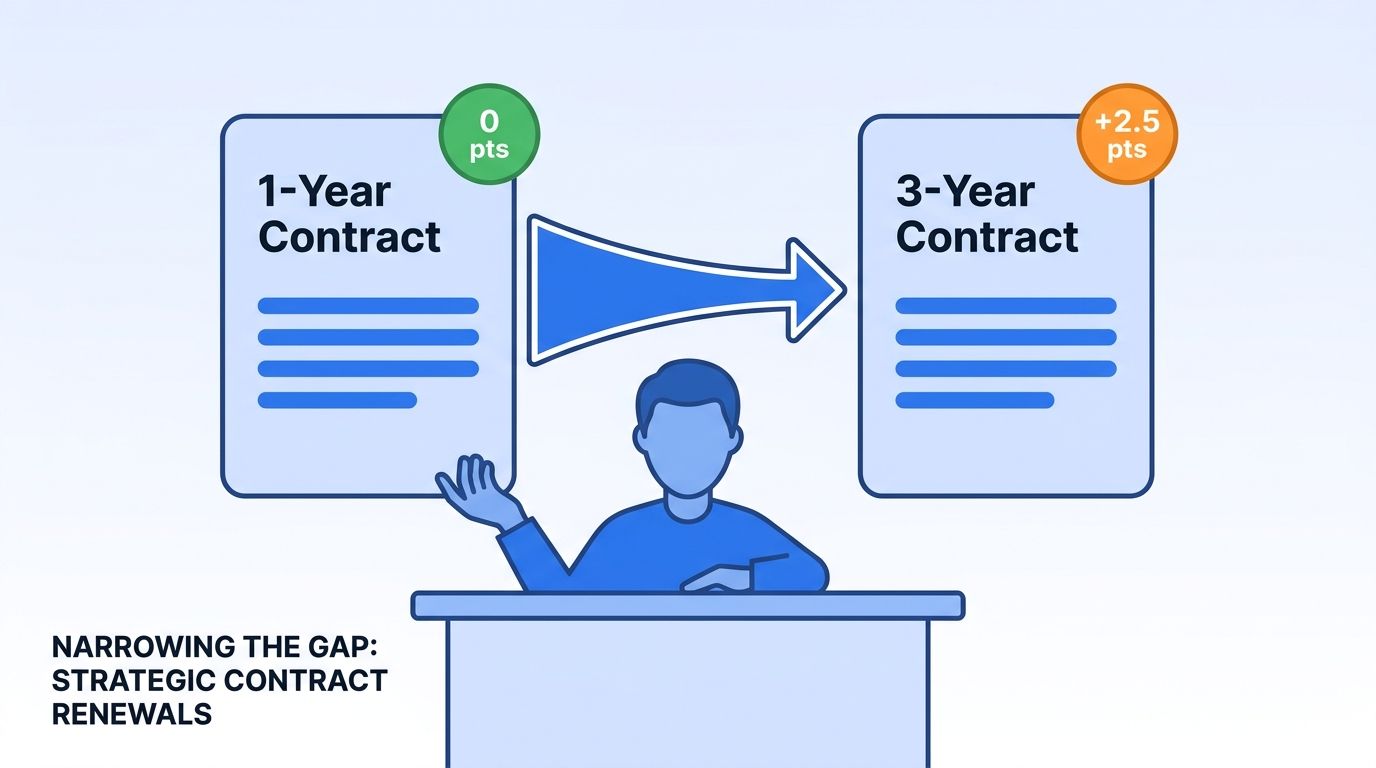
Why lock into a three-year sales intelligence contract when the multi-year discount barely beats a one-year deal? In 2025, multi-year SaaS commitments earned buyers only 2.5 to 2.6 percentage points more discount than annual terms, based on an analysis of more than 15,000 contracts across 2,600+ suppliers (Mostly Metrics, analysis of Tropic's deal database, 2025). That's a thin margin for giving up two extra years of flexibility.
It gets worse if you sign without the right protections built in. In 2026, 79% of IT leaders said they got hit with a price increase at renewal, and vendor costs in some categories rose 10-20% against average IT budget growth of just 2.8% (Zylo, 2026 SaaS Management Index, 2026). Meanwhile, the sales intelligence market you're buying into is projected to grow from $4.85 billion in 2025 to $5.37 billion in 2026 (Fortune Business Insights, 2026) - more vendors chasing your budget, which is exactly the leverage you should use at the table. This guide covers the six moves that separate a smart multi-year deal from a three-year mistake: audit usage first, benchmark the real discount data, decouple length from price, protect against renewal shock, push for usage-based terms, and build in an exit ramp before you need one.
Key Takeaways
- Multi-year sales intelligence contracts now earn just 2.5-2.6 percentage points more discount than annual deals, down sharply from prior years (Mostly Metrics / Tropic, 2025) - the "lock in and save" pitch is weaker than it sounds.
- 79% of IT leaders got hit with a renewal price increase in the past year, with some vendors raising list prices 10-20% against 2.8% average budget growth (Zylo, 2026).
- Roughly 65.8% of job titles change within 12 months and 23% of email addresses go stale every year (IndustrySelect, 2025; ZeroBounce, 2026) - negotiate data freshness guarantees, not just price.
- 85% of SaaS vendors now offer usage-based pricing in some form (Metronome & Greyhound Capital, 2025) - push for credit-based terms before you sign a flat, seat-locked multi-year deal.
What Should You Know Before You Start Negotiating?
Before you get on a call with a sales intelligence vendor, have three things ready: a usage audit, a budget ceiling, and a realistic timeline. Skip any of the three and you'll negotiate on the vendor's terms instead of yours.
What you'll need:
- Usage data - seats or credits actually used in the last 90 days, not what you originally purchased
- A budget ceiling and approval chain - know who signs off on multi-year versus annual before the call, not during it
- A realistic timeline - the average SaaS procurement cycle runs 72 days, and renewals alone average 82 days and can stretch to 87 (Vertice, Procurement Cycle Time, 2026)
- At least one competing quote, even if you don't plan to switch vendors
- Time: 2-3 weeks of active negotiation inside an ~80-day process
- Difficulty: Intermediate - requires procurement and legal coordination
If part of your evaluation involves testing an alternative vendor's capabilities, review its API documentation before the renewal clock starts, not during it. Comparing real endpoints beats comparing sales decks.
Step 1: How Do You Audit Your Actual Usage and Data Decay Exposure First?
Start by auditing how much of your current contract you actually use, because most teams pay for more seats and records than they touch. Pull 90 days of query volume, seat logins, and list exports before you open a renewal conversation.
This matters more than most negotiators realize. Roughly 65.8% of job titles and functions change within 12 months, and email addresses on file go stale at about 23% a year (IndustrySelect, 2025; ZeroBounce, Email List Decay Report, 2026). Lock into three years of static list access without a refresh clause, and by year two you're paying full price for a contact database that's meaningfully wrong.
<!-- [UNIQUE INSIGHT] -->Most procurement teams treat data decay as an operations problem to solve after signing, not a negotiation lever to use before signing. That's backward. Decay rate is exactly the kind of quantifiable risk that should shrink your contract term or expand your refresh rights, the same way a warranty period gets negotiated on a hardware purchase.
Citation capsule: A three-year sales intelligence contract signed today will, on current decay rates, have a meaningful share of its original contact data outdated well before the renewal date arrives. That's not a reason to avoid multi-year deals - it's a reason to negotiate freshness and refresh terms into the contract itself, not just price.
Re-running an ICP company search against your current target account list before renewal shows exactly how much has changed since you signed - headcount, industry classification, and hiring activity all shift faster than a static seat count assumes. Pairing that with a real-time B2B people enrichment source gives you a second data point to sanity-check whatever decay number your incumbent reports.
Step 2: How Do You Benchmark Vendor Discounts Before Negotiating Length?
Benchmark real multi-year discounts before you let a vendor set the anchor. In 2025, multi-year commitments closed at only 2.5 to 2.6 percentage points better than annual deals on average, based on more than 15,000 contracts across 2,600+ suppliers (Mostly Metrics, analysis of Tropic's deal database, 2025).
That's a thin margin for giving up two extra years of flexibility. The same analysis found buyers often come out ahead starting on a one-year term and negotiating the multi-year upgrade at renewal, when they have a full year of usage data and a competing quote in hand.
Citation capsule: The multi-year discount premium in SaaS has compressed to roughly 2.5 percentage points, based on an analysis of over 15,000 contracts. For most buyers, that's too small a gap to justify giving up a year or two of renegotiation leverage, especially in a category as competitive as sales intelligence.
So why do vendors still push three-year terms this hard if the discount is this small? Because length, not price, is where they actually win. A locked-in customer is a customer who doesn't shop the market for three years, discount or not. Compare how ZoomInfo's annual seat-based contracts stack up against pay-as-you-go pricing before deciding whether a multi-year seat lock is even the right structure for your team.
Step 3: Decouple Contract Length From Discount, and Negotiate Them Separately
Treat contract length and discount as two separate negotiating points, not one bundled ask. Vendors bundle them on purpose, because bundling hides how little the length actually buys you.
- Ask for the 1-year price first, in writing, before discussing multi-year at all
- Request the multi-year discount as a standalone number, then compare it against the 2.5-point benchmark from Step 2
- Negotiate a right to true-up or true-down, so seat and credit counts can flex with the usage audit from Step 1
- Push for a mid-term price review tied to actual usage, not just an automatic escalation clause
Vendors that resist separating length from discount are usually the ones with the weakest multi-year math. When a rep won't put the 1-year price in writing, that's the clearest signal the bundled discount doesn't hold up to scrutiny.
Step 4: How Do You Build Price-Protection Clauses Into the Contract Before You Sign?
Cap your renewal exposure now, because the market favors the vendor at renewal time otherwise. 79% of IT leaders reported a price increase at their last renewal, and list prices in some SaaS categories climbed 10-20% in a year against average IT budget growth of just 2.8% (Zylo, 2026 SaaS Management Index, 2026).
Ask for renewal pricing to be capped against a named index - CPI, or a flat single-digit percentage - rather than "then-current list price," which gives the vendor unilateral room to move. If a vendor won't cap the renewal number in writing, treat that refusal as pricing information in itself.
Vendors that ship frequent, substantive product updates - like the reliability and feature changes in Datamagnet's July 2026 release notes - should be willing to tie a renewal increase to demonstrated new value, not a blanket escalator applied regardless of what shipped.
Step 5: Push for Usage-Based or Credit-Based Pricing Instead of Flat Seats
Ask for usage-based or hybrid pricing before you accept a flat seat count for three years, because most of the market has already moved that direction. 85% of SaaS companies now offer usage-based pricing in some form, and roughly half of those adopted it within the last two years (Metronome & Greyhound Capital, State of Usage-Based Pricing, 2025).
A flat seat count locked for three years assumes your team, your ICP, and your use case all stay the same the whole time. They rarely do. A credit-based model, where you check your credit balance and pay for what you actually query, shifts that risk back onto the vendor instead of onto your budget.
Datamagnet runs on this model already: transparent, pay-as-you-go pricing with no seat minimums, so usage swings don't force a mid-term renegotiation.
Citation capsule: Usage-based pricing has gone from a niche SaaS feature to the default - 85% of vendors now offer some version of it, and adoption nearly doubled in the last two years alone. A multi-year sales intelligence contract that still forces a flat seat count is increasingly the exception, not the norm, and that's worth raising at the negotiating table.
Step 6: How Do You Negotiate Exit Ramps Before You Need One?
Build your exit before you sign, because getting out of a bad multi-year contract is far harder than getting favorable terms into it up front. Unused seats and licenses - shelfware - are common enough that SaaS management researchers routinely flag them as a recurring drag on enterprise software budgets, particularly on multi-year contracts nobody revisits until renewal.
Isn't it strange how much attention goes into negotiating the discount, and how little goes into negotiating the way out? Push for:
- Termination for convenience with a defined notice window (60-90 days), not just termination for cause
- No automatic renewal - require an active opt-in signature instead of a silent rollover
- Annual audit rights to verify billed usage against actual usage
- A defined data-export clause specifying format and timeline if you leave
Review a vendor's security and data practices as part of this step too. An exit clause only matters if you also know how your data gets deleted or returned once the contract ends.
Common Mistakes to Avoid
The single most common mistake is negotiating price before usage is confirmed. Teams that skip the audit in Step 1 end up locking in a seat count that's wrong within two quarters.
1. Accepting the vendor's first multi-year discount as final Reps open with a number that leaves room to negotiate. Counter with the 2.5-point benchmark from Step 2 and ask them to justify anything above it.
2. Letting "then-current list price" language into the renewal clause This single phrase is how most renewal sticker shock happens. Insist on a named cap instead, per Step 4.
3. Skipping the usage audit because the renewal deadline feels tight
<!-- [PERSONAL EXPERIENCE] --> Teams under deadline pressure often just re-sign the prior year's seat count without checking it. That's usually the costliest shortcut in the whole process, because the wrong seat count compounds for the entire contract term, not just one year.4. Treating data freshness as an operations issue instead of a contract term If decay isn't written into the contract, it isn't the vendor's problem to fix.
5. Getting the exit clause reviewed by legal after signing instead of before A termination or audit clause negotiated after signing has no leverage behind it at all.
Frequently Asked Questions
How much discount should I expect for a multi-year sales intelligence contract?
Expect modest, not dramatic. Multi-year deals earned buyers only 2.5 to 2.6 percentage points more discount than annual terms in 2025, based on an analysis of more than 15,000 SaaS contracts (Mostly Metrics / Tropic, 2025). If a vendor offers meaningfully more, ask what's being traded away - usually flexibility, not just price.
Is it better to sign a 1-year deal and upgrade later, or lock in multi-year now?
Often the 1-year-then-upgrade path wins. The same 2025 contract analysis found buyers who started on annual terms and negotiated a multi-year upgrade at renewal generally captured a better net discount than committing multi-year upfront, since they negotiated with a full year of usage data in hand.
How do I protect against a big price increase at renewal?
Cap the renewal number in the contract itself, tied to a named index like CPI or a flat single-digit percentage, rather than accepting vague "then-current list price" language. This matters: 79% of IT leaders reported a renewal price increase in the past year, with some categories rising 10-20% (Zylo, 2026).
Should I negotiate for usage-based pricing instead of a flat seat count?
Yes, if the vendor supports it. 85% of SaaS companies now offer some form of usage-based pricing, which removes the risk of paying for seats your team outgrows or underuses over a multi-year term (Metronome & Greyhound Capital, 2025). Ask specifically about credit-based or consumption pricing before agreeing to a flat multi-year seat count.
What should be in the contract's exit clause?
At minimum: termination for convenience with a defined notice window, no automatic renewal without a signature, annual audit rights to check billed usage against actual usage, and a specified data-export format and timeline. Negotiate these before signing - they carry far less leverage once you're already locked in.
Negotiate the Contract You'll Still Be Happy With in Year Two
A multi-year sales intelligence contract isn't automatically a bad deal - it's a bad deal when you sign it on the vendor's terms instead of yours. Audit usage first, benchmark the real discount data, decouple length from price, cap renewal increases, push for usage-based pricing, and build your exit before you need it. Do those six things and a multi-year commitment becomes a calculated bet instead of a three-year hope. For the broader ROI case behind this decision, see the ROI case for programmatic enrichment. See how pay-as-you-go pricing removes the seat-lock risk entirely - check your current contract's renewal terms against this list this week.
Sources
- Mostly Metrics (CJ Gustafson), Your Guide to Negotiating Multi-Year Deals, analysis of Tropic's contract database, retrieved 2026-08-11, https://www.mostlymetrics.com/p/your-guide-to-negotiating-multi-year-deals
- Zylo, 2026 SaaS Management Index / SaaS Pricing Trends Driving Up Enterprise Costs, retrieved 2026-08-11, https://zylo.com/blog/saas-pricing-trends
- Vertice, Procurement Cycle Time, retrieved 2026-08-11, https://www.vertice.one/insights/procurement-cycle-time
- ZeroBounce, The Email List Decay Report for 2026, retrieved 2026-08-11, https://www.zerobounce.net/email-list-decay
- IndustrySelect, Measuring the High Cost of Bad Contact Data, retrieved 2026-08-11, https://www.industryselect.com/blog/measuring-the-high-cost-of-bad-contact-data
- Metronome & Greyhound Capital, State of Usage-Based Pricing 2025, retrieved 2026-08-11, https://metronome.com/state-of-usage-based-pricing-2025
- Fortune Business Insights, Sales Intelligence Market Size, Share & Industry Report, retrieved 2026-08-11, https://www.fortunebusinessinsights.com/sales-intelligence-market-109103
- Datamagnet, Pricing, retrieved 2026-08-11, https://www.datamagnet.co/pricing/
- Datamagnet, Credit Balance endpoint, retrieved 2026-08-11, https://docs.datamagnet.co/api-reference/endpoints/credits
