
Disclosure: This article is published by Datamagnet. Vendor claims are self-reported unless otherwise noted.
How to Set Field-Level Ownership So No CRM Field Is Everyone's Job
Ask five people on your revenue team who owns the Industry field in your CRM, and you'll probably get five different answers — or a shrug. In 2025, 76% of CRM users said less than half of their organization's CRM data was accurate and complete (Validity, "The State of CRM Data Management in 2025"). Field-level ownership fixes the root cause: one accountable owner, one update cadence, and one system of record per field.
Key Takeaways
- In 2025, 76% of CRM users said less than half their CRM data was accurate and complete (Validity).
- Give every CRM field one accountable owner, an update cadence, and a named system of record — not shared responsibility.
- Fields decay at different speeds: email addresses rot about 40% faster than job titles each year (43% vs. 30%, ZoomInfo Pipeline, 2026), so cadence should vary by field.
- When multiple systems can write a field, set an explicit precedence order instead of leaving it to whoever saves last.
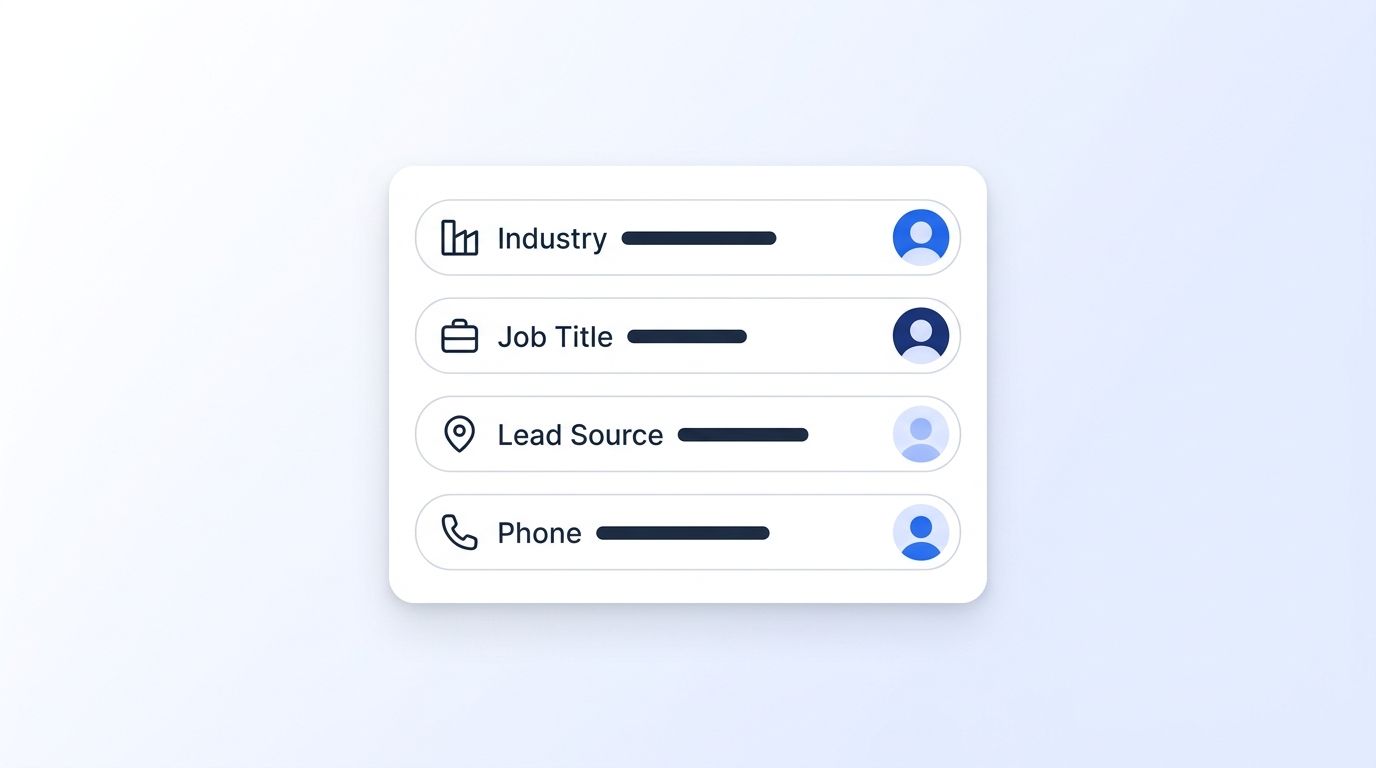
What Does "Field-Level Ownership" Actually Mean?
Field-level ownership means assigning one accountable role to each individual CRM field, not just to the record as a whole. Poor data quality costs the average organization an estimated $12.9 million a year, a figure Gartner has cited consistently as the price tag on exactly this gap — nobody owns the field, so nobody fixes it (Gartner, "How to Improve Your Data Quality," retrieved 2026-08-20).
Most teams already do record-level ownership. A rep owns the account, a manager owns the territory. That structure tells you who's responsible for closing a deal — it says nothing about who's responsible for keeping the Industry, Employee Count, or Lead Source values on that account correct. Those fields get touched by reps, marketing automation, an enrichment API, and sometimes a spreadsheet import, and none of them is "the owner."
A data steward role, if your team has one, usually covers process: writing the data quality policy, running audits, chasing exceptions. Field-level ownership is narrower and more mechanical. It answers one question per field: if this value is wrong, whose job is it to notice and fix it? Without that answer, every field defaults to everyone's job, which in practice means no one's.
Why Does Diffuse Ownership Cost You Real Revenue?
In 2025, 37% of CRM users reported a direct revenue loss tied to poor data quality (Validity, "The State of CRM Data Management in 2025"), and another 37% reported delayed key revenue-generating initiatives due to bad data (Validity, 2025 report announcement). When nobody owns individual fields, errors don't just sit there quietly — they propagate into lead routing, account segmentation, and forecasting math that reps and leadership both rely on.
The same pressure shows up higher up the org chart. In 2025, Salesforce found that data and analytics leaders estimate more than a quarter (26%) of their organization's data is untrustworthy, and 84% say their data strategy needs a complete overhaul before their AI initiatives can succeed (Salesforce, "State of Data and Analytics," 2nd Edition). That's not a coincidence — the same unowned fields that mislead a rep today are the training data an AI scoring model will misread tomorrow.
<!-- [UNIQUE INSIGHT] -->Here's the part most data quality playbooks skip: a "clean data" initiative that doesn't end in a named owner per field just resets the clock. Someone runs a dedupe pass, scores improve for a quarter, and then the same unowned fields drift right back — because the fix addressed the record, not the accountability gap behind it.
Field-level ownership resolves that. It's a durable answer, this: 76% of teams don't trust their data (Validity, 2025), 84% say their data strategy needs an overhaul before AI can work (Salesforce, 2025), and both numbers trace back to fields nobody was ever assigned to watch.
How Do You Build a Field Ownership Registry?
Start with a simple registry: one row per field, four columns — owner role, system of record, update trigger, and review cadence. This turns an abstract governance conversation into a document your RevOps and sales ops teams can actually run against.
| Field | Owner Role | System of Record | Update Trigger |
|---|---|---|---|
| Lead Source | Marketing Ops | Marketing automation platform | On lead creation |
| Job Title | Sales Ops (enrichment) | Enrichment API | Job-change signal / monthly refresh |
| Industry | Sales Ops (enrichment) | Enrichment API | Quarterly refresh |
| Company Headcount | Sales Ops (enrichment) | Enrichment API | Monthly refresh |
| Deal Stage | Rep / Sales Manager | CRM (manual) | On stage change |
| Rep, with enrichment fallback | CRM (manual) + enrichment API | On bounce or verification failure |
Notice that "owner" here is a role, not a name — roles survive reorgs, people don't. For fields sourced from structured profile data, point the owner role at the actual data source: a LinkedIn person profile endpoint can own job title, seniority, and skills fields directly, while a LinkedIn company profile endpoint is the natural owner for headcount, industry, and specialties. That keeps the registry honest about which system actually has the freshest value.
Which Fields Decay Fastest, and How Should Update Cadence Match That?
Not every field goes stale at the same speed, so a single blanket refresh cadence will always be wrong for most of your fields. In 2026, ZoomInfo Pipeline's field-level decay analysis found email addresses decaying roughly 43% a year, job titles around 30%, and phone numbers closer to 22% — nearly double the range across just three common fields (ZoomInfo Pipeline, "How to Improve B2B Data Quality: A 2026 GTM Guide," retrieved 2026-08-20).
Aggregate B2B contact data decays at roughly 25–30% a year, meaning a 10,000-record database loses 2,500 to 3,000 usable contacts annually with no active maintenance at all (ZoomInfo Pipeline, 2026). If the owner of your Job Title field only checks in once a year, they're already missing a third of the changes. Tie each field's review cadence to its actual decay rate — fast-moving fields like job title and email deserve a real-time enrichment approach rather than a quarterly batch job.
How Do You Resolve Conflicts When Multiple Systems Write the Same Field?
The average B2B seller now juggles 8 different tools to close a deal, and 42% say they feel overwhelmed by that sprawl (Salesforce, "State of Sales" report). Every one of those tools is a potential writer to the same CRM field, and without a precedence rule, whichever system syncs last quietly wins — even if it's wrong.
Set an explicit hierarchy per field instead of leaving it to sync order. A workable default: verified manual entry from a rep beats everything else for deal-specific fields, an enrichment API is the source of truth for firmographic and person fields the rep never sees directly, and marketing automation owns campaign-attribution fields only. Datamagnet's own 2026 enrichment benchmark testing found that stacking data providers raises right-person match rates from 51% with a single source to 66% with five — a reminder that even "the enrichment API" isn't one source, and your precedence rules need to say which provider wins when two disagree.
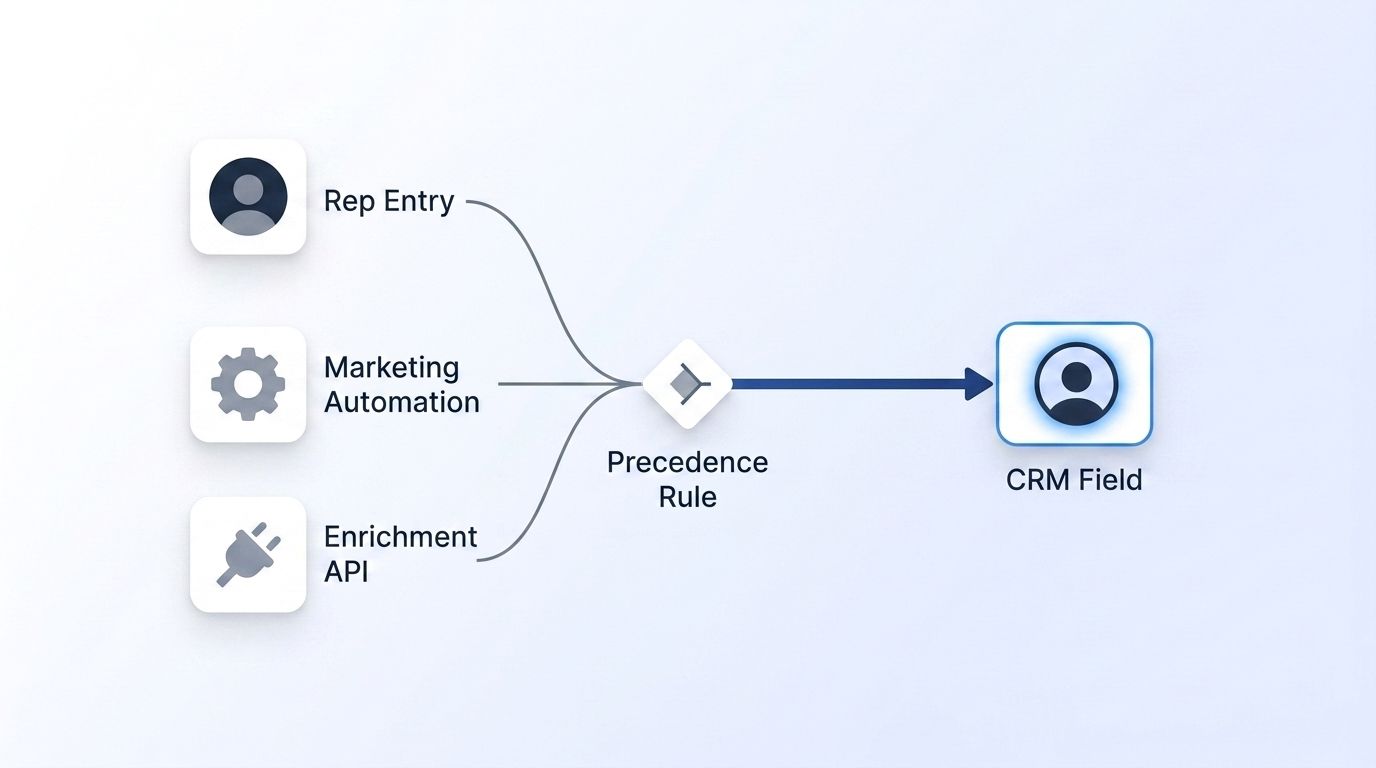
Real-time triggers make this easier to enforce than a nightly batch sync. A webhook-based signal delivery can push an update the moment a tracked person or company changes, so the enrichment API's write happens on its own schedule instead of racing a rep's manual edit mid-save. That timing gap is where most silent field conflicts actually happen.
How Do You Enforce Ownership Once It's Assigned?
Assigning an owner on a spreadsheet doesn't change behavior by itself — you still need a way to catch and route what the owner misses. In Traction Complete's 2025 CRO Survey, RevOps Co-op reported a 30-point confidence gap: half of CROs said they were confident their account data was accurate, while 80% of RevOps leaders called that same data poor or in need of major improvement (RevOps Co-op, "CROs Think Their Data's Clean (But RevOps Knows It's Not)," retrieved 2026-09-21).
That gap exists because ownership without enforcement is just a label. Three mechanisms close it. First, validation rules at the field level — reject or flag a save that violates a format or freshness rule instead of letting bad values in quietly. Second, an audit trail that records who or what last touched a field, so a wrong value has a traceable source instead of a mystery. Third, an escalation path with an SLA: if a field's owner hasn't touched a flagged record within a set window, it routes up automatically rather than sitting in a queue forever.
A signal monitor can feed that audit trail directly, logging the job-change or firmographic event that triggered each field update. And if your team runs on HubSpot, a HubSpot enrichment integration can apply those updates through native workflows, so the audit trail lives in a system reps already check instead of a separate governance tool nobody opens.
What Does This Look Like in Practice?
<!-- [PERSONAL EXPERIENCE] -->Picture a 40-rep sales team rolling this out for the first time. Week one is just the registry — twelve fields, four owners, no automation yet. Week two adds validation rules on the three worst offenders (Job Title, Industry, Lead Source), and the team immediately sees how many "clean" records were quietly wrong. Week three connects an enrichment API to refresh Job Title and Industry on a signal-triggered basis instead of a manual quarterly pull.
That sequencing matters more than the tooling. Only 25% of respondents say they completely feel their CRM gives them a single source of truth today (Salesforce, "Achieve a Single View of Customer") — and most of the other 75% aren't missing data, they're missing an owner for the data they already have. A registry with four fields and real enforcement beats a fifty-field spreadsheet nobody checks.
See who's changing jobs before your fields go stale. Explore Datamagnet's People API to keep job title, seniority, and company fields refreshed at the source instead of weeks after they change.
Frequently Asked Questions
What's the difference between a data owner and a data steward?
A data steward usually owns process — writing the governance policy, running audits, and defining standards across the whole CRM. A field owner is narrower: one role accountable for a single field's accuracy and freshness. Most teams need both, but skip the field-owner layer first, which is exactly the gap Validity's 2025 research ties to 76% of teams distrusting their own data.
Who should own CRM fields that come from an enrichment API instead of manual entry?
Assign ownership to the operations role managing that integration — usually sales ops or RevOps — not the rep who happens to view the record. The rep can flag errors, but the enrichment API is the actual system of record, so the team that configures its refresh cadence and provider precedence should carry accountability for the field's accuracy.
How often should field ownership assignments be reviewed?
Review the registry itself quarterly, but let individual field cadences vary by decay rate. Fast-moving fields like email and job title, which can decay 30–43% a year, need monthly or signal-triggered refreshes (ZoomInfo Pipeline, 2026). Slower fields like industry classification can run on a quarterly cycle without much risk.
What happens if a CRM field genuinely has no clear owner?
Treat "no owner" as a governance defect, not a minor gap — Gartner estimates poor data quality costs organizations an average of $12.9 million a year ("How to Improve Your Data Quality," retrieved 2026-08-20), and unowned fields are where that cost accumulates fastest. Assign a temporary owner immediately, even if it's a shared inbox, rather than leaving the field unassigned while you debate the permanent structure.
Is field-level ownership worth it for small sales teams?
Yes, and it's cheaper to set up early than to retrofit later. A ten-field registry with three owner roles takes an afternoon to build for a small team, while a 200-rep org retrofitting ownership onto years of unassigned fields is a multi-quarter project. Smaller teams also see the payoff faster, since fewer systems are competing to write the same field.
Sources
- Validity, "The State of CRM Data Management in 2025," retrieved 2026-08-20, https://www.validity.com/resource-center/the-state-of-crm-data-management-in-2025/
- Validity, 2025 report announcement, PR Newswire, retrieved 2026-09-21, https://www.prnewswire.com/news-releases/validity-releases-state-of-crm-data-management-in-2025-report-revealing-disconnect-between-data-quality-and-ai-implementation-302499899.html
- Gartner, "How to Improve Your Data Quality," Smarter With Gartner, retrieved 2026-08-20, https://www.gartner.com/smarterwithgartner/how-to-improve-your-data-quality
- ZoomInfo Pipeline, "How to Improve B2B Data Quality: A 2026 GTM Guide," retrieved 2026-08-20, https://pipeline.zoominfo.com/marketing/b2b-data-decay
- Salesforce, "State of Sales" statistics, retrieved 2026-08-20, https://www.salesforce.com/sales/state-of-sales/sales-statistics/
- Salesforce, "State of Data and Analytics," 2nd Edition, retrieved 2026-08-20, https://www.salesforce.com/news/stories/data-analytics-trends-2026/
- Salesforce, "Achieve a Single View of Customer," retrieved 2026-09-21, https://www.salesforce.com/resources/guides/achieve-single-view-of-customer/
- RevOps Co-op, "CROs Think Their Data's Clean (But RevOps Knows It's Not)," Traction Complete 2025 CRO Survey, retrieved 2026-09-21, https://www.revopscoop.com/webinar-series/cro-revops-data-gap
Conclusion
CRM data doesn't rot because teams don't care — it rots because no single field has a name attached to it. Build a registry that pairs every field with one owner role, one system of record, and a cadence that matches how fast that specific field actually decays. Then back it with validation rules and an audit trail so ownership survives past the day you assigned it.
Start small: pick your five most-used fields, assign an owner and cadence to each, and set one precedence rule for the field most often written by more than one system. For a deeper look at how enrichment fits into that architecture, see the case for programmatic CRM enrichment. No CRM field has to stay everyone's job forever.
