
Disclosure: This article is published by Datamagnet. Vendor claims are self-reported unless otherwise noted. This is not legal advice — the regulatory landscape described below is current as of August 2026 and changes fast. Talk to employment counsel before you build a program around it.
How to Do Diversity Sourcing With Signal Data: A Compliant 2026 Guide
At entry level, women make up 49% of the workforce. By the C-suite, that number drops to 29% — and only 93 women get promoted to manager for every 100 men who do (McKinsey & Company and LeanIn.org, Women in the Workplace 2025). That gap doesn't close itself, and it isn't a hiring problem you fix with one job ad.
It's also a legal minefield right now. The federal government rescinded the affirmative-action mandate for contractors in January 2025, the EEOC pulled its own AI-hiring guidance the same month, and four states have since written their own — and different — rules for algorithmic screening. Sourcing for diversity in 2026 means using signal data to widen who sees your roles, without using demographic data to decide who gets through.
Key Takeaways
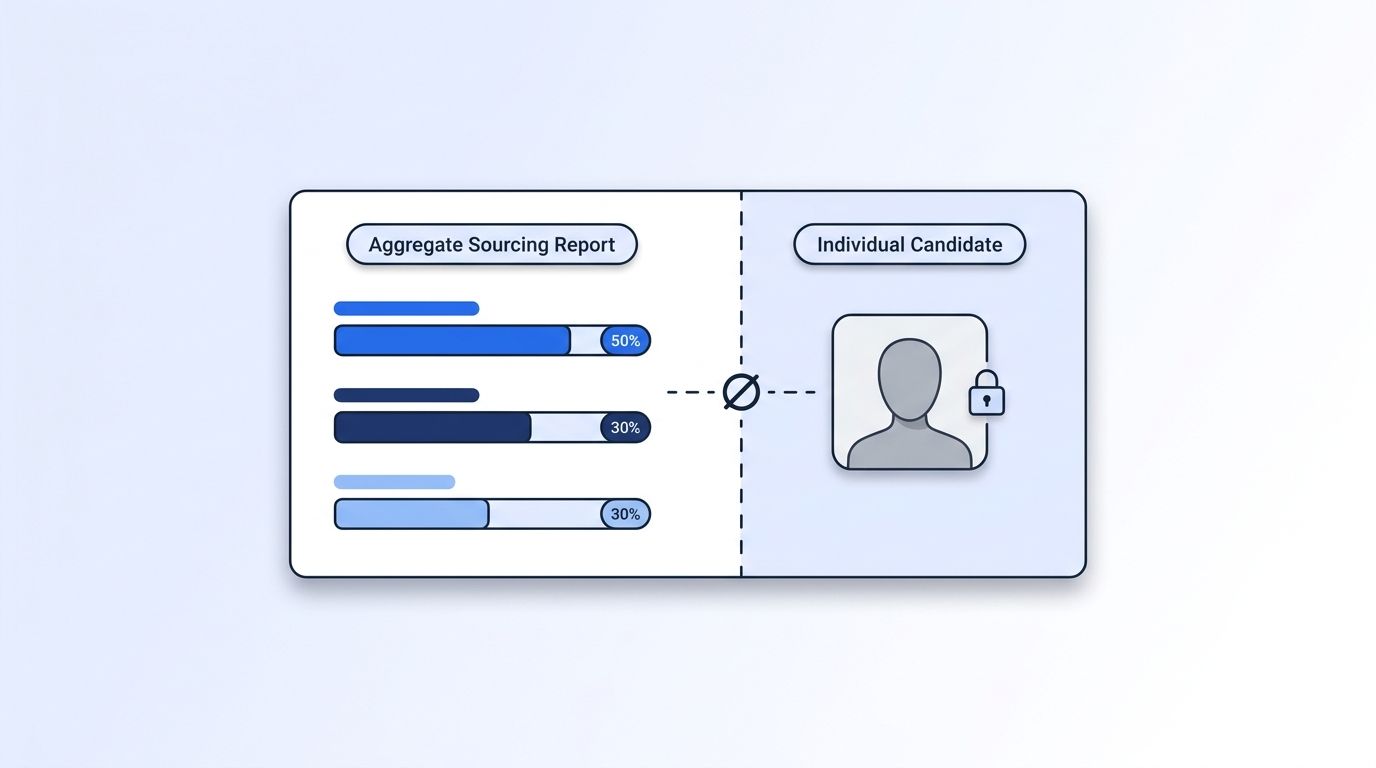
- Diversity sourcing (aggregate, channel-level analysis) is legally distinct from diversity hiring (individual candidate selection) — mixing the two invites a Title VII claim.
- Blind, structured screening raised the odds a female candidate advanced past a first round by roughly 50% in the original Goldin and Rouse orchestra-audition study, still the benchmark trial cited across HR research today.
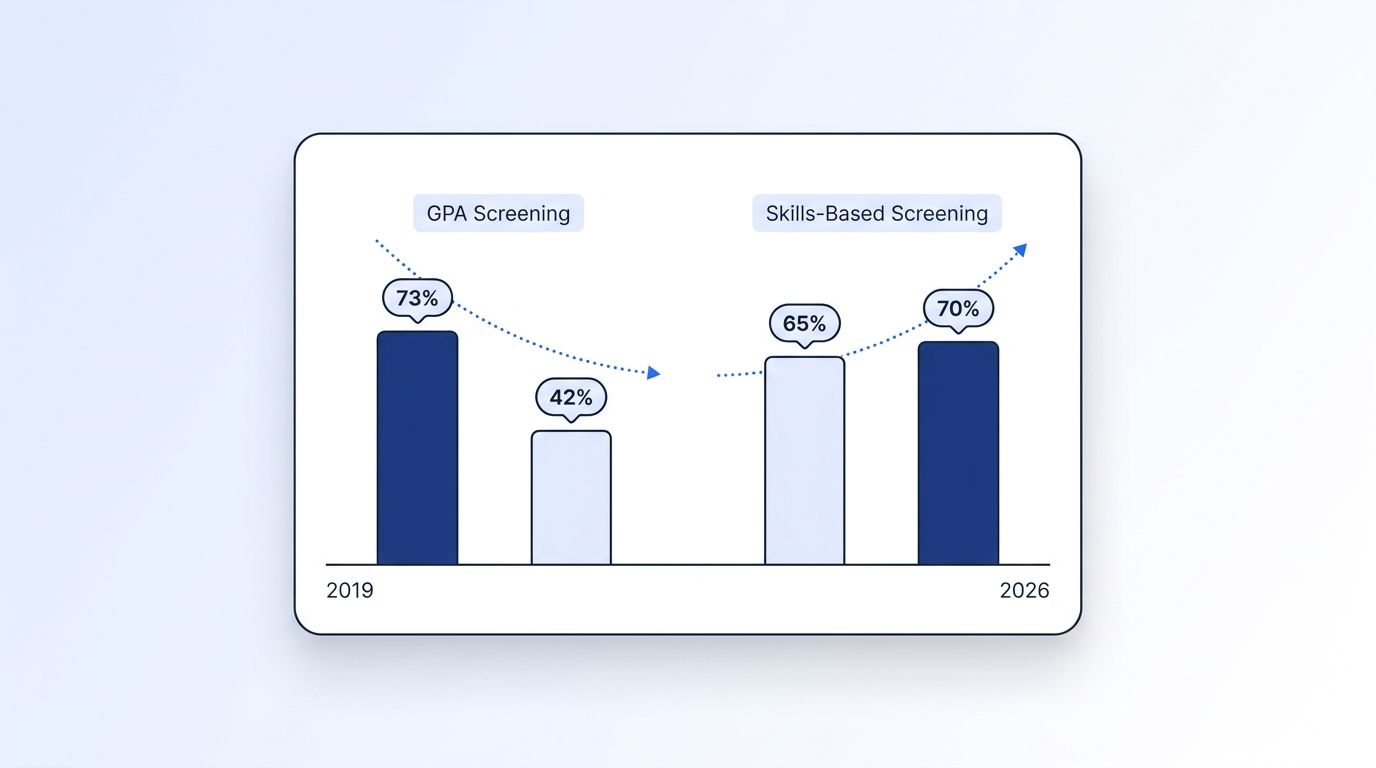
- 70% of employers now use skills-based hiring for entry-level roles, up from 65% a year earlier (NACE, Job Outlook 2026).
- Executive Order 11246 — the 60-year-old federal contractor affirmative-action rule — was rescinded on January 21, 2025. OFCCP no longer requires or reviews race- or gender-based hiring plans.
What Counts as Diversity Sourcing With Signal Data?
Diversity sourcing with signal data means using aggregate, anonymized information — not individual candidate demographics — to find and evaluate where your talent pipeline is losing representation. In 2026, that distinction is the entire legal ballgame: aggregate channel analysis is standard compliance practice, while filtering individual candidates by protected characteristics is not.
Signal data, in this context, is behavioral and structural: job changes, hiring surges at competitor companies, skills adjacencies, and sourcing-channel performance. None of it requires knowing an individual candidate's race, sex, or age. A signal monitor that tracks hiring events at target companies, for example, surfaces where to look for talent — not who to exclude once you're looking.
In practice, that means every diversity sourcing workflow has two layers that must never touch: an aggregate reporting layer (which channels, schools, or companies are producing candidates, broken down by demographic category for compliance reporting only) and an individual sourcing layer (the actual outreach list, filtered on job title, skills, seniority, and location — never on protected characteristics).
The tools that get this wrong aren't usually the ones doing something malicious — they're the ones that let a single filter panel mix "aggregate diversity metrics" and "individual candidate search" in the same UI. If a recruiter can toggle a demographic filter and immediately see a shorter candidate list, that system has built disparate-treatment risk into its interface, whether or not anyone intended it.
Why Sourcing-Channel Diversity Gaps Start Before the Interview
Most representation loss happens at the top of the funnel, not the offer stage. McKinsey's Women in the Workplace 2025 study — based on 124 organizations and roughly 3 million employees — found women hold 49% of entry-level jobs but only 29% of C-suite roles, with the steepest single drop-off at the first promotion to manager. Women of color fare worse: 74 are promoted to manager for every 100 men, against 93 for women overall.
That "broken rung" compounds every year it goes unaddressed, because a team with fewer women at manager level has fewer women eligible for the VP pipeline five years later. The fix has to start at sourcing, not promotion — you can't promote people who were never hired into the funnel in the first place.
Engineering and technical roles show an even sharper narrowing. Women hold roughly 15.4% of U.S. engineering occupations, per Census Bureau data reported through the Society of Women Engineers research hub. If your sourcing channels for technical roles mirror that number, you're not sourcing for representation — you're sourcing for the status quo, and no amount of interview-stage intervention will change the outcome.
For teams building out target-account lists for technical hiring, ICP Company Search filtered by industry, headcount, and technology stack can surface companies outside the usual big-tech feeder list — a practical way to diversify where you're sourcing from before you ever open a filter on a person.
How Do You Compliantly Widen the Top of the Funnel?
You widen the top of the funnel with structural changes to how you screen, not with filters on who candidates are. Two levers have the strongest evidence behind them: blind or structured screening, and skills-based hiring.
The original evidence for blind screening comes from Claudia Goldin and Cecilia Rouse's study of blind orchestra auditions, published through the National Bureau of Economic Research. Adding a screen between the judge and the musician raised the probability a woman advanced past a preliminary round by roughly 50%, and the researchers credit blind auditions with a meaningful share of the rise in female musicians at major U.S. orchestras since 1970. It's a 25-year-old study, and it's still the most-cited evidence in HR literature because nobody has run a cleaner natural experiment since.
Skills-based hiring is the modern, software-native version of the same idea. In 2026, 70% of employers use skills-based screening for entry-level roles, up from 65% the year before — and it's most common at the interview stage (87%) and initial screening stage (65%), according to NACE's Job Outlook 2026. GPA-based screening, a classic proxy for pedigree that correlates with socioeconomic and racial gaps, fell from 73% of employers in 2019 to 42% in 2026.
Citation capsule: In 2026, 70% of U.S. employers use skills-based hiring for entry-level roles, up from 65% the prior year, while GPA screening has fallen to 42% from 73% in 2019 (NACE, Job Outlook 2026). The shift replaces pedigree signals that correlate with demographic gaps with skills signals that don't.
For sourcing itself, ICP People Search lets you filter by job title, seniority, function, and skills-adjacent signals rather than school or prior employer alone — which keeps the sourcing criteria tied to job-relevant capability instead of pedigree proxies that quietly narrow the pool.
How Do You Audit Your Sourcing Channels Without Touching Individual Data?
You audit sourcing-channel diversity by running representation reports at the aggregate level, using anonymized demographic data that's never linked back to a specific candidate record in your outreach or scoring tools. This is the single practice that keeps a diversity sourcing program on the right side of EEOC guidance.
EEOC leadership has been explicit on this point. In public remarks, Commissioner Andrea Lucas stated there is "no diversity exception" to Title VII, and that using race or sex as any part of a hiring decision — even with a diversifying intent — violates federal law. The distinction that keeps aggregate analysis legal is that it never feeds back into an individual selection decision; it only tells you whether channel A is producing a broader pipeline than channel B.
In practice: route demographic data (where you have it, typically self-reported and voluntary) to a compliance or People Analytics function that reports on channel-level trends. Keep it entirely out of the applicant tracking system fields a recruiter or hiring manager can filter on. If a system lets a single user go from "diversity report" to "candidate shortlist" in the same session, that's the architecture to fix first.
[INFO-GAIN: PERSONAL EXPERIENCE] Talent teams running signal-based sourcing tools consistently describe the same failure mode in early builds: someone adds a demographic breakdown to a sourcing dashboard for a quarterly report, and six months later a hiring manager is using that same view to eyeball candidate lists before an interview slate goes out. The fix isn't a policy memo — it's making the aggregate report and the individual search live in separate tools with separate access, so the shortcut is never available in the first place.
A Company Engagement Signal or the People Search DB can power the individual-candidate side of this split — searching your own previously enriched profile database by title, skills, and location — while a separate reporting layer handles the aggregate diversity view.
How Do You Handle AI and Algorithmic Sourcing Tools Legally?
You handle AI-driven sourcing tools legally by running a bias audit before deployment and monitoring for adverse impact continuously — because the federal guidance on how to do this was pulled from EEOC.gov in January 2025 and hasn't been replaced. The underlying Title VII "four-fifths rule" (a selection rate for any group below 80% of the highest-performing group flags potential disparate impact) still applies; you just don't get a federal playbook for testing it anymore.
State law has filled some of the gap, unevenly. New York City's Local Law 144 requires an independent bias audit within one year of using any Automated Employment Decision Tool, public posting of results, and 10 business days' notice to candidates — with penalties of $500 to $1,500 per violation per day. California (since October 2025), Illinois (since January 2026), Texas (since January 2026), and Colorado (from June 2026) have each written their own, materially different standards — Illinois allows a private right of action with penalties up to $70,000, while Texas requires proof of discriminatory intent rather than impact alone.
If you source across multiple states, a tool defensible under Texas's intent standard could still create liability under Illinois's impact standard. That's a reason to build your own four-fifths-rule monitoring into any sourcing or scoring tool rather than relying on a vendor's self-certification alone — check what audit documentation the vendor can actually produce, not just what the marketing page claims.
For teams whose sourcing tools operate on public LinkedIn data rather than internal ATS decisioning, it's worth reading how your vendor handles authentication and data access — a signal-data sourcing layer that only surfaces job titles, skills, and hiring events (not protected-characteristic scoring) sits outside most AEDT definitions in the first place, which simplifies the audit question considerably.
What Changed With Executive Order 11246, and What Does It Mean for You?
Executive Order 11246 — the federal contractor affirmative-action mandate in place since 1965 — was rescinded on January 21, 2025, replaced by a new order titled "Ending Illegal Discrimination and Restoring Merit-Based Opportunity." OFCCP was directed to stop requiring or reviewing race- and gender-based affirmative action plans, and contractors got a 90-day transition window through April 21, 2025.
If your organization is a federal contractor and your compliance documentation still references EO 11246 affirmative-action-plan obligations, that documentation is out of date. Two categories are unaffected: protected-veteran affirmative action under VEVRAA and disability affirmative action under Section 503 remain fully in force.
There's a second, quieter shift worth tracking: the EEOC has proposed (not yet finalized, as of mid-2026) rescinding the EEO-1 Component 1 demographic reporting requirement entirely, arguing it isn't narrowly tailored. Keep complying with current EEO-1 obligations until a final rule publishes — but don't build a program that assumes EEO-1 data will remain available indefinitely as your aggregate-reporting data source.
Common Mistakes to Avoid
1. Filtering individual candidates by protected characteristics, even with good intent. Recruiters sometimes build "diverse slate" requirements by manually screening candidate names, schools, or profile photos for perceived demographic signals. That's disparate treatment under Title VII regardless of the goal — the EEOC has been explicit that there's no diversity carve-out.
2. Treating aggregate reports as if they were candidate-level tools. A quarterly channel-diversity report is a compliance artifact, not a sourcing filter. The moment someone uses it to shortlist or deprioritize individuals, the program's legal footing changes.
3. Assuming OFCCP still requires an affirmative action plan. As of the January 2025 executive order, it doesn't — for race and gender. Programs built on pre-2025 OFCCP guidance need a compliance review, not a copy-paste refresh.
4. Deploying one AI sourcing tool across states with conflicting standards. Texas's intent-only bar and Illinois's private-right-of-action impact standard aren't interchangeable. A single national rollout without a state-by-state check is the most common gap we hear about from TA leaders evaluating sourcing vendors.
5. Skipping bias-audit documentation because "it's just sourcing, not scoring." NYC Local Law 144 applies to Automated Employment Decision Tools broadly defined — if your tool substantially assists a hiring decision, confirm with counsel whether it's in scope before assuming it isn't.
What Does a Compliant Program Look Like Once It's Running?
A working diversity sourcing program shows up as a wider, more representative top-of-funnel pool — measured in aggregate, quarterly — while every individual sourcing and screening decision runs on job-relevant criteria alone. You should be able to show a compliance reviewer two things: a channel-level representation trend line, and a candidate search history with zero demographic filters in it.
Practically, that means: skills-based or blind-screened steps earlier in the process, sourcing channels re-evaluated against the aggregate report each quarter, and a documented bias audit for any algorithmic tool that substantially assists a hiring decision. None of that requires slowing down outreach — it requires separating the reporting layer from the search layer, once, at the architecture level.
Datamagnet's ICP Search Filters reference covers every job-relevant filter available for sourcing — title, seniority, function, industry, headcount, location — none of them demographic, which is precisely the boundary a compliant sourcing tool should hold.
Frequently Asked Questions
Is it legal to use signal data for diversity sourcing in 2026?
Yes, when the signal data is aggregate and channel-level, not tied to individual candidate demographics. Using job-change, hiring-event, or skills signals to find where to source from is standard practice. Filtering individual candidates by race or sex is not — the EEOC recovered a record $660 million for discrimination victims in FY2025 alone.
Can employers still consider diversity in recruiting after EO 11246 was rescinded?
Employers can still run aggregate diversity sourcing and outreach programs — the rescission removed federal contractor affirmative-action plan requirements, not general diversity efforts. What remains legally risky, unchanged since before 2025, is using an individual candidate's protected characteristics as any factor in a specific hiring decision.
What's the difference between diversity sourcing and diversity hiring quotas?
Diversity sourcing widens the candidate pool through channel selection, skills-based screening, and blind evaluation — every candidate is still assessed on the same criteria. A quota sets a numeric target tied to protected characteristics at the selection stage, which is the practice EEOC guidance and the post-SFFA legal environment treat as high-risk.
Do I need a bias audit if I only use signal data for outreach, not scoring?
It depends on whether your tool "substantially assists" a hiring decision under your state's definition — NYC's Local Law 144 and California's 2025 rules use broad definitions that can cover outreach prioritization. Confirm scope with counsel rather than assuming pure-sourcing tools are automatically exempt.
How long does it take to set up a compliant diversity sourcing program?
Most teams can separate their aggregate-reporting and individual-sourcing layers, document channel filters, and run an initial bias-audit review in 2-4 weeks, assuming compliance and TA are aligned from the start. Multi-state AI-tool audits (covering CA, IL, TX, and CO's differing standards) typically add several more weeks.
Sources
- McKinsey & Company and LeanIn.org, Women in the Workplace 2025, retrieved 2026-08-12, https://www.mckinsey.com/capabilities/people-and-organizational-performance/our-insights/women-in-the-workplace
- McKinsey & Company, Diversity Matters Even More: The Case for Holistic Impact, November 2023, retrieved 2026-08-12, https://www.mckinsey.com/featured-insights/diversity-and-inclusion/diversity-matters-even-more-the-case-for-holistic-impact
- Society of Women Engineers, SWE Research: U.S. Employment 2025 (U.S. Census Bureau / BLS data), retrieved 2026-08-12, https://swe.org/research/2025/us-employment/
- Claudia Goldin and Cecilia Rouse, Orchestrating Impartiality: The Impact of "Blind" Auditions on Female Musicians, National Bureau of Economic Research, retrieved 2026-08-12, https://www.nber.org/papers/w5903
- National Association of Colleges and Employers, Job Outlook 2026, retrieved 2026-08-12, https://www.naceweb.org/job-market/trends-and-predictions/employer-use-of-skills-based-hiring-practices-grows
- NYC Department of Consumer and Worker Protection, Automated Employment Decision Tools (Local Law 144 of 2021), retrieved 2026-08-12, https://www.nyc.gov/site/dca/about/automated-employment-decision-tools.page
- Morrison Foerster, Trump Rescinds Affirmative Action for Federal Contractors, January 22, 2025, retrieved 2026-08-12, https://www.mofo.com/resources/insights/250122-trump-rescinds-affirmative-action-federal-contractors-dei-private-companies
- National Law Review, The Federal Government Quietly Removed Its AI Hiring Guidance. Four States Are Writing Their Own., 2026, retrieved 2026-08-12, https://natlawreview.com/article/federal-government-quietly-removed-its-ai-hiring-guidance-four-states-are-writing
- U.S. Equal Employment Opportunity Commission, EEOC Highlights Record-Breaking Results in Agency Reports, April 6, 2026, retrieved 2026-08-12, https://www.eeoc.gov/newsroom/eeoc-highlights-record-breaking-results-agency-reports
- U.S. Equal Employment Opportunity Commission, remarks by Commissioner Andrea Lucas, The Future of DEI, Disparate Impact, and EO 11246 after SFFA v. Harvard/UNC, May 22, 2024, retrieved 2026-08-12, https://www.eeoc.gov/future-dei-disparate-impact-and-eo-11246-after-students-fair-admissions-v-harvardunc
Ready to build a sourcing workflow that keeps aggregate reporting and individual search cleanly separated? See how Datamagnet's recruiting intelligence tools filter on job-relevant signals only, or start with the quickstart guide to generate an API key and run your first ICP People Search. For more on how real-time enrichment fits into a compliant sourcing stack, read real-time B2B people enrichment.
