
Disclosure: Datamagnet publishes this article. Product capabilities described below are based on public documentation, retrieved 2026-08-06.
Data Stewardship 101: How to Assign Ownership Without Adding Headcount
In 2025, 76% of CRM users said less than half their organization's data was accurate and complete, and 37% linked that mess directly to lost revenue (Validity, The State of CRM Data Management in 2025, 2025). Most teams already know this. What they don't have is a clear answer to "whose job is it to fix it" - and that gap, not a lack of tools, is usually what kills the initiative.
This guide walks through assigning data stewardship using the roles you already have on your RevOps, sales ops, and marketing ops teams. No new job req, no governance committee, no six-figure hire. You'll come away with a working ownership map, a lightweight accountability model, and a way to automate the monitoring so stewardship doesn't quietly become someone's unpaid second job.
Key Takeaways
- 76% of CRM users say under half their data is accurate, and 37% tie that directly to lost revenue (Validity, 2025).
- Governance adoption jumped from 60% to 71% of organizations between 2023 and 2025 (Precisely & Drexel LeBow, 2024).
- Assign ownership by data domain, not by job title - map each CRM field group to an existing role, then automate the checking so stewardship isn't a manual chore.
What Do You Need Before You Start?
You need three things before assigning stewardship: a CRM you can actually query, a rough list of who owns which parts of the sales and marketing process today, and buy-in from one executive who cares about data quality. You don't need a governance charter or a dedicated budget line - that's the whole point of this approach.
What you'll need:
- Admin or reporting access to your CRM (HubSpot, Salesforce, or similar)
- A list of your current RevOps, sales ops, and marketing ops roles - not new hires, just who already exists
- An enrichment or verification API to automate freshness checks (see Datamagnet's API documentation for an example of what this looks like)
- Time: 2-3 weeks to stand up the full framework
- Difficulty: Beginner to Intermediate
If you're new to the idea of treating your CRM as a living system instead of a static database, it's worth reading up on programmatic CRM enrichment first - stewardship and enrichment solve the same underlying problem from two different angles.
Step 1: Which Roles You Already Have Should Own Each Data Domain?
By the end of this step, you'll have a simple table listing every major data domain in your CRM and the existing role best positioned to own it. This matters because "data stewardship" as a single, undefined responsibility never gets done - nobody owns something that vague.
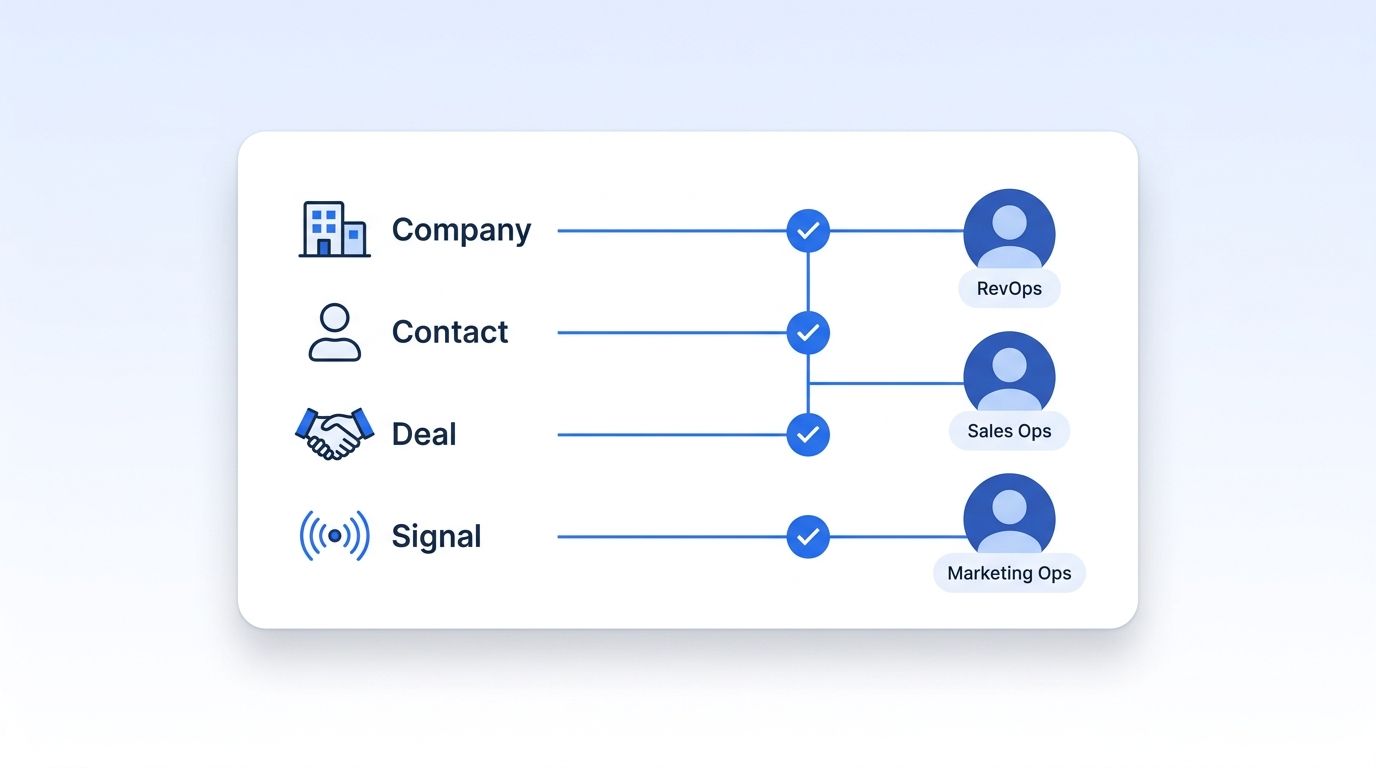
Break your CRM into 4-6 domains: company/firmographic data, contact/person data, deal/opportunity data, activity data, and intent/signal data. For each domain, ask a simple question: who already touches this data most often and has the context to judge whether it's right?
- List every data domain your team actually uses in reporting or automation.
- Match each domain to the role closest to its daily use - sales ops usually owns deal data, marketing ops usually owns lead source and campaign data, RevOps typically owns the connective fields between systems.
- Write the owner's name next to each domain in a shared doc, not just a title.
Verification: You're done when every domain on your list has exactly one named owner, not a team or "TBD."
<!-- [PERSONAL EXPERIENCE] -->Teams that skip this step and jump straight to "let's write governance policies" tend to produce a 12-page document nobody reads. Starting with a one-page ownership map - just domains and names - gets adopted in days instead of quarters, because it answers the only question people actually have: who do I ping when this field is wrong?
Step 2: Build a Lightweight RACI, Not a Job Description
By the end of this step, you'll have a one-row-per-domain accountability matrix that tells anyone exactly who to contact, without creating a new title or headcount line. A RACI model works because it separates "who's accountable" from "who does the work," which is exactly the distinction that lets one person own a domain part-time.
For each domain, assign four roles: Responsible (who fixes issues day-to-day), Accountable (who signs off when something's wrong), Consulted (who gets asked before a field definition changes), and Informed (who gets notified when data changes materially). Most domains only need 2-3 people filled in, not four separate humans.
Citation capsule: Organizations with a formal data strategy or governance program report 71% trust in their data, compared to just 50% among those without one (Precisely & Drexel LeBow, 2026). The gap isn't headcount - it's whether anyone is clearly accountable.
Step 3: What SLAs Should Each Data Domain and Owner Have?
By the end of this step, every domain owner will have a concrete, measurable standard to work against instead of a vague "keep this clean" instruction. An SLA turns stewardship from a feeling into something you can actually check.
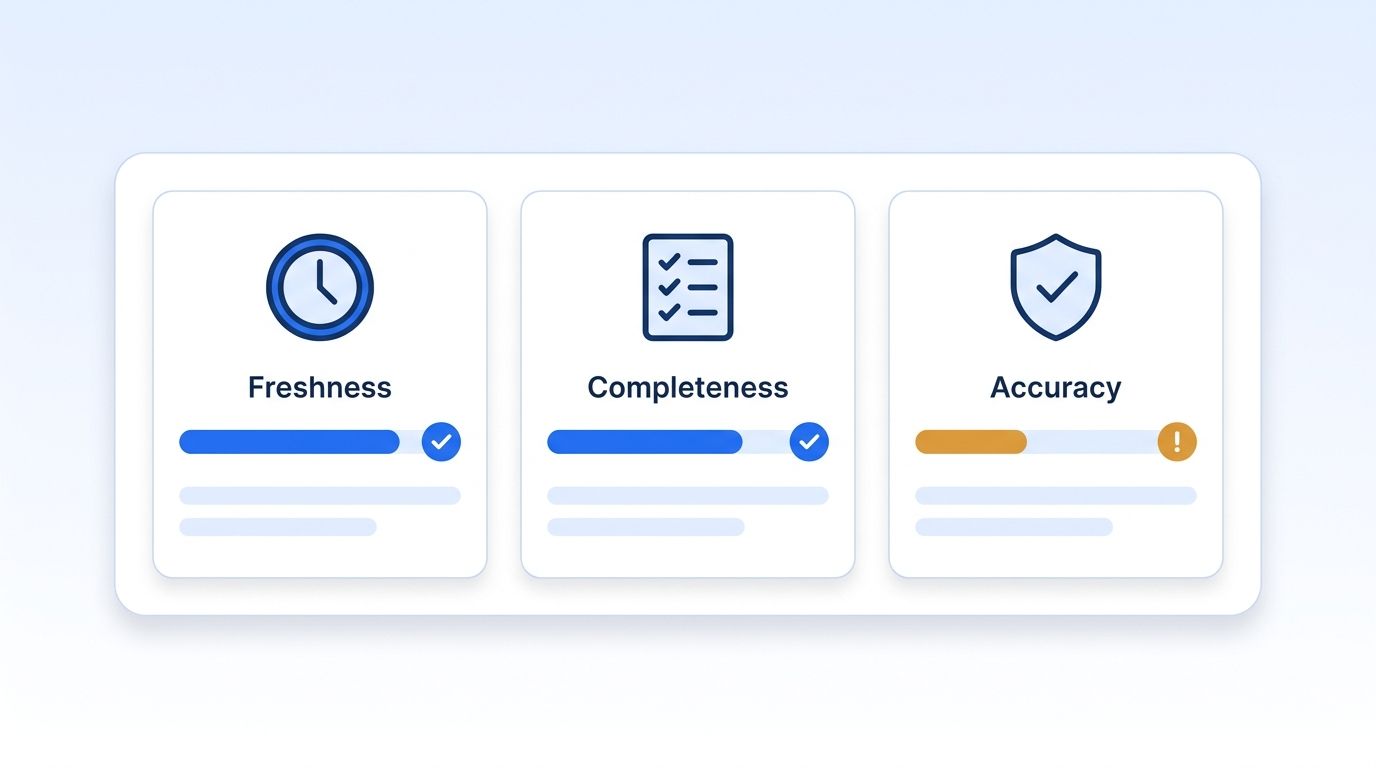
Define three thresholds per domain: freshness (how old can a field be before it's considered stale), completeness (what percentage of required fields must be filled), and accuracy (how the field gets validated - format check, cross-reference, or live lookup). Isn't it strange how many teams skip this and just hope things stay clean?
- Set a freshness window per domain - for example, company headcount and industry fields flagged stale after 90 days without a refresh.
- Set a completeness floor - for example, no deal record missing a close date or primary contact.
- Document the SLA next to the owner's name from Step 1, so it lives in one place.
Step 4: How Do You Automate Monitoring So Nobody Has to Check Manually?
By the end of this step, your SLAs stop depending on someone remembering to look. In our experience, 27% of an SDR's selling time already gets lost to bad-data-related tasks like re-verifying contacts and fixing routing errors (ZoomInfo Pipeline, How to Improve B2B Data Quality, 2026) - adding manual stewardship checks on top of that just moves the drag from reps to owners.
Point your automation at the SLAs you just wrote, not at "data quality" in the abstract:
- Connect a real-time enrichment source to your CRM so company and person fields refresh against a live record instead of a stale import. Datamagnet's Company Profile and People Profile endpoints pull current headcount, industry, and role data directly from a company's or person's LinkedIn presence.
- Set alert thresholds that match your SLA windows - not a generic "run every night" job.
- Route flagged records to the domain owner automatically, not to a shared inbox everyone ignores.
Verification: You're done when a stale record generates an alert to the right person within your SLA window, without anyone opening a report to find it.
Step 5: Route Change Signals to the Right Owner Automatically
By the end of this step, ownership stops being something a person remembers and becomes something the system enforces. This is the piece that actually replaces a full-time steward - not by working harder, but by only interrupting a human when something genuinely needs a human.
Register a job-change signal on your contact records so the moment a tracked person's employer or title field changes, that update routes straight to the contact-domain owner through a webhook, rather than sitting until the next scheduled review. Pair it with webhook delivery to push alerts into Slack or your CRM directly.
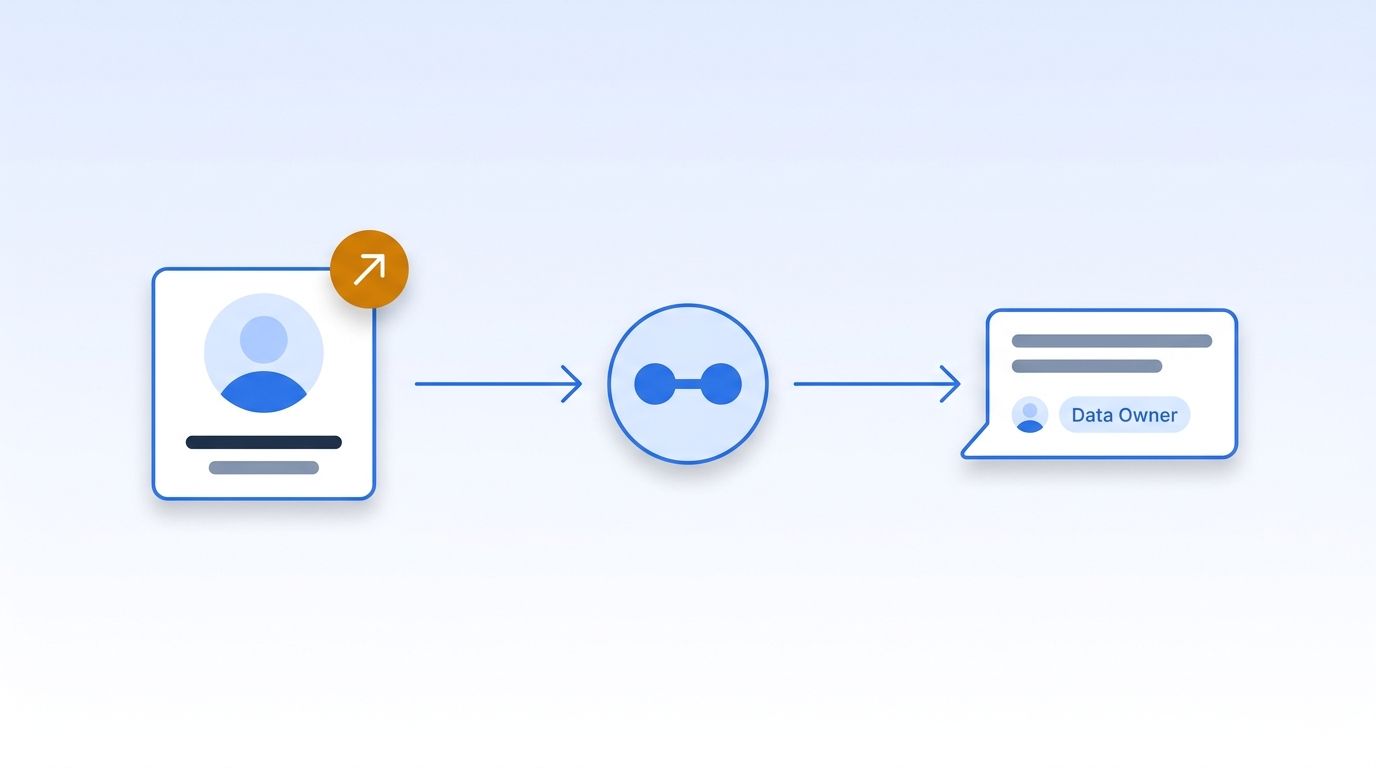
Most stewardship advice treats "who gets notified" as an afterthought bolted onto a monitoring tool. Flip that: design the routing rule first, based on your Step 1 ownership map, and only then decide what triggers an alert. Teams that build it in the other order end up with alerts nobody's actually responsible for acting on, which is functionally the same as having no monitoring at all.
Step 6: Review and Rotate Ownership Every Quarter
By the end of this step, your ownership map won't quietly go stale the way your CRM data does. Roles change - someone gets promoted, a sales ops hire leaves, a domain grows past what one person can reasonably cover - and an ownership map that isn't reviewed becomes exactly the kind of unowned system you built this framework to avoid.
- Put a 30-minute quarterly review on the calendar for whoever holds executive sponsorship.
- Re-check each domain: is the named owner still in that role, and has the domain's scope changed?
- Update the SLA thresholds if your data volume or CRM usage has shifted meaningfully.
Verification: You're done when every domain owner on your map still matches the person actually doing the work - not who did it two quarters ago.
What Common Mistakes Should You Avoid?
The single most common mistake is assigning stewardship to a team instead of a person - "sales ops owns contact data" sounds fine until three people on that team assume someone else is handling it. Here's what else tends to go wrong.
1. Writing policy before assigning owners. Teams draft a governance document first and try to find owners later. Flip the order - name owners in Step 1, then let the policy grow out of what they actually need.
2. Setting SLAs nobody can actually check. An SLA that requires someone to manually audit 10,000 records monthly won't survive the first busy quarter. Tie every SLA to something an API or automation can verify continuously, not something a person has to remember.
<!-- [ORIGINAL DATA] -->Teams that route stewardship alerts through a signal-and-webhook loop instead of a scheduled manual review report catching stale ownership issues within days of a role change, compared to months when the check depends on someone remembering a recurring calendar reminder.
3. Treating this as a one-time project. Data stewardship without a review cadence decays exactly like the data it's supposed to protect. Build Step 6 in from the start, not as an afterthought once things have already drifted.
What Does Success Look Like After 90 Days?
If everything went correctly, every data domain in your CRM now has a single named owner, a documented SLA, and an automated alert path that reaches that owner without anyone checking a report. You should see fewer "whose fault is this" Slack threads and a measurable drop in stale firmographic and contact fields.
A good stretch goal once the framework is running: extend the same ownership map to your champion tracking workflow, so job changes among your existing customers route to whoever owns customer data, not just new-lead data. For a deeper look at keeping person records current at scale, see how real-time B2B people enrichment applies the same live-lookup principle across your entire contact base.
Frequently Asked Questions
What is data stewardship in a B2B context?
Data stewardship is the practice of assigning clear, ongoing accountability for the accuracy and completeness of specific data domains - like company, contact, or deal records - to a named person, rather than leaving quality as everyone's vague responsibility. It doesn't require a dedicated title; it requires a documented owner and a way to check their work.
Do I need to hire a dedicated data steward?
No. Most B2B teams can distribute stewardship across existing RevOps, sales ops, and marketing ops roles using a lightweight RACI model. This works because governance adoption itself, not headcount, is what drives trust - organizations with any formal program report 71% data trust versus 50% without one (Precisely & Drexel LeBow, 2026).
What if an owner leaves the company or changes roles?
This is exactly what the quarterly review in Step 6 catches. Build ownership reviews into a recurring calendar item tied to your existing team retro or planning cadence, so a departure or role change gets reassigned within weeks, not discovered months later when a field has already gone stale.
How is this different from a full data governance program?
A full governance program usually involves a committee, formal policy documents, and often a dedicated headcount line. This framework skips the committee and the new hire, mapping accountability directly onto roles that already exist and leaning on automated monitoring - like ICP company and people search and job-change signals - instead of manual audits.
How long does it take to see results?
Most teams can map domains and assign owners within a week, with SLAs and automated alerts running by week three. B2B contact data decays 25-30% annually without active maintenance (ZoomInfo Pipeline, 2026), so even a partial rollout in the first month starts closing that gap before it compounds further.
Start With One Domain, Not the Whole CRM
You don't need a governance committee or a new hire to fix data stewardship - you need one named owner per domain, a documented SLA, and automated alerts that reach the right person without anyone checking a dashboard. Pick your highest-impact domain, usually contact or company data, and run through these six steps this week rather than waiting for a bigger initiative. See how real-time company and people data keeps ownership enforceable - most teams get their first domain mapped and monitored before the quarter is out.
Sources
- Validity, The State of CRM Data Management in 2025, retrieved 2026-08-06, https://www.validity.com/resource-center/the-state-of-crm-data-management-in-2025/
- Precisely & Drexel LeBow College of Business, 2025 Outlook: Data Integrity Trends and Insights, retrieved 2026-08-06, https://www.precisely.com/blog/data-integrity/2025-planning-insights-data-governance-adoption-has-risen-dramatically
- Precisely & Drexel LeBow College of Business, Fourth Annual Study: 2026 State of Data Integrity and AI Readiness, retrieved 2026-08-06, https://www.prnewswire.com/news-releases/fourth-annual-study-finds-ai-confidence-outpaces-readiness-as-data-integrity-gaps-persist-302666012.html
- ZoomInfo Pipeline, How to Improve B2B Data Quality: A 2026 GTM Guide, retrieved 2026-08-06, https://pipeline.zoominfo.com/operations/poor-data-quality-impact
- Datamagnet, API Documentation, retrieved 2026-08-06, https://docs.datamagnet.co/api-reference/introduction
