
Disclosure: This article is published by Datamagnet. Vendor claims are self-reported unless otherwise noted.
B2B Data Governance Policy Template: Frequently Asked Questions (2026)
A data governance policy is a written set of rules for who owns your CRM data, how it gets classified, who can touch it, and how you keep it accurate over time. B2B sales orgs need one because bad data isn't a hygiene problem anymore - it's a revenue problem with a dollar figure attached.
According to Dataversity's 2025 Trends in Data Management survey, 75% of organizations now have some form of data governance program in place (Dataversity, 2025). But "having a program" and "having a policy your sales team actually follows" are two very different things, and this FAQ is built to close that gap.
This page covers the 14 most common questions about data governance policies for B2B sales orgs, organized into four categories:
- Getting Started - what a policy is, why you need one, who should own it, and what to actually put in your template
- How It Works - the difference between governance and cleanup, how it applies to Salesforce/HubSpot, and review cadence
- Common Problems - duplicate records, GDPR/CCPA exposure, data decay, and the cost of skipping a policy entirely
- Advanced Topics - maturity models and where real-time verification fits into the policy itself
Most data governance content is written for data engineering teams managing warehouses. Almost none of it is written for a sales org whose "data" lives in a CRM, gets touched by 40 reps a day, and goes stale the moment a prospect changes jobs. This FAQ is scoped specifically to that use case.
Last updated: July 31, 2026. We revisit this FAQ quarterly as new compliance and RevOps survey data comes out.
TL;DR
- Only 75% of organizations have a data governance program, and even fewer have one a sales team actually enforces (Dataversity, 2025).
- Gartner puts the average cost of poor data quality at $12.9 million a year per organization (Gartner, 2021, still widely cited industry-wide).
- B2B contact data decays roughly 22.5% a year as people change jobs and titles (Instantly.ai, 2026).
- A usable policy template covers 9 sections: purpose, scope, data classification, ownership, quality standards, access/security, retention, compliance, and review cadence.
- Real-time verification against a live source, not a quarterly cleanse, is what keeps a written policy from decaying along with the data it governs.
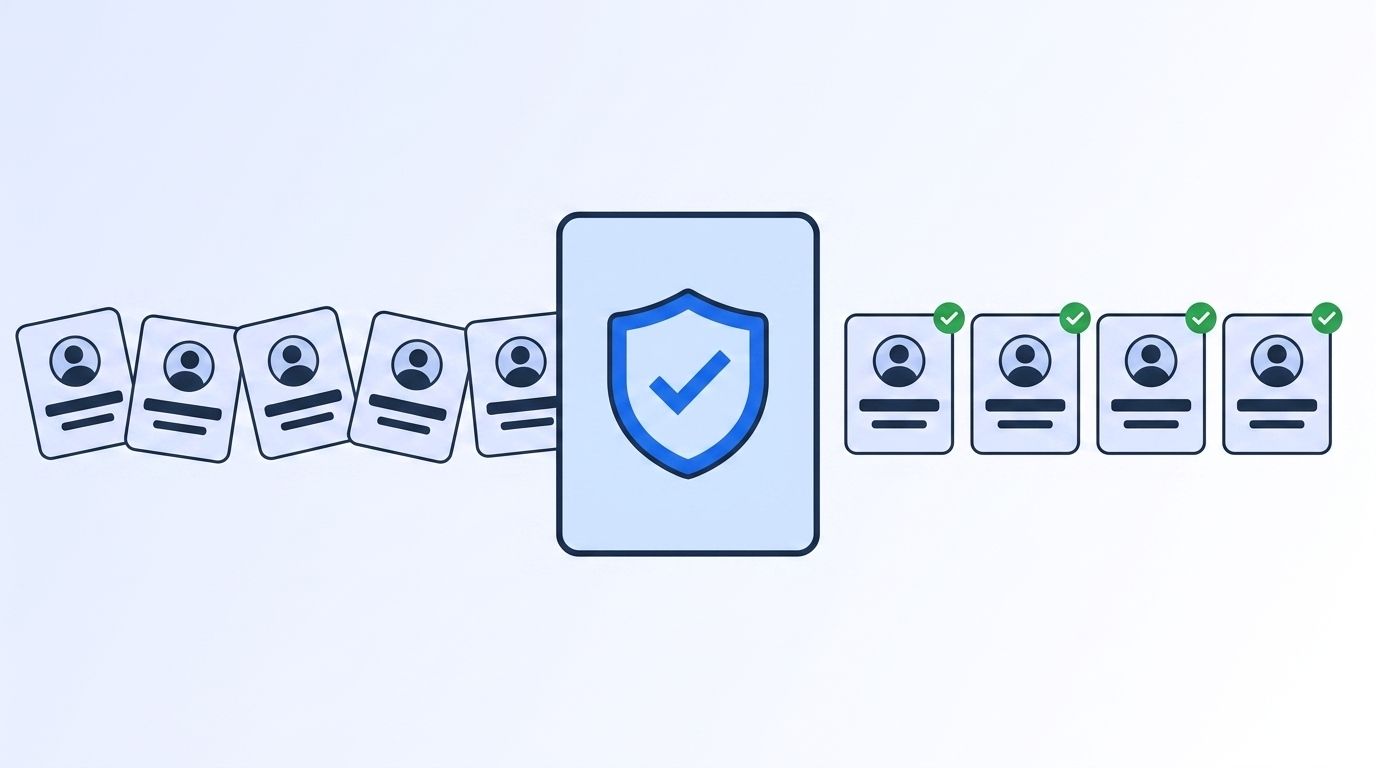
How Do You Get Started With a B2B Sales Data Governance Policy?
Getting started means answering four questions in order: what a policy actually is, why your team needs one, who owns it, and what a usable template covers. That order matters, because skipping straight to a template without naming an owner first is how governance documents end up ignored. Gartner puts the average cost of poor data quality at $12.9 million a year per organization (Gartner, 2021), a number worth keeping in mind as you scope this out.
What Is a Data Governance Policy for a B2B Sales Org?
A data governance policy is a written document that defines who owns customer and prospect data, how it's classified, who can access or edit it, and what quality standard it has to meet before a rep acts on it. For a sales org, that mostly means CRM records - contacts, accounts, and the fields reps rely on to prioritize outreach.
Citation capsule: A data governance policy isn't a compliance checkbox - it's the rulebook that decides whether a rep trusts the CRM enough to use it. Without one, data ownership defaults to "whoever touched it last," which is how duplicate records, stale titles, and conflicting account owners pile up in the first place.
If your policy names an API as a data source, start with the Datamagnet API documentation to see what authentication and quotas look like before you write the enrichment section of your template.
Why Does a B2B Sales Team Need a Formal Data Governance Policy?
A B2B sales team needs a formal policy because unmanaged CRM data actively costs money, not just tidiness. Gartner research puts the average financial impact of poor data quality at $12.9 million a year for a typical organization (Gartner, 2021), and a separate RevOps survey found 71% of sales and marketing ops leaders cite data quality and governance as a top operational pain point (MarketingOps.com, 2025).
Isn't it strange that teams will rewrite a sequence template five times before they'll write down who owns a lead record? A policy exists so that decision doesn't get made ad hoc, deal by deal, rep by rep.
Who Should Own a Data Governance Policy in a Sales Org?
RevOps typically owns the data governance policy in a modern B2B sales org, not IT and not a single sales manager. RevOps functions have grown from roughly 30% adoption among B2B companies in 2021 to 78% today (Skaled, 2026), and that growth tracks closely with data ownership consolidating under one team instead of being split across sales, marketing, and IT.
Ideal for:
- RevOps or a dedicated data steward: owns the policy document, sets quality thresholds, and approves exceptions.
- Sales managers: enforce field-level standards (required fields, naming conventions) at the team level.
Not ideal for:
- IT alone: IT can enforce technical access controls, but it usually lacks the context to define what "good" sales data looks like.
What Should a B2B Sales Data Governance Policy Template Include?
A usable policy template covers nine sections, and skipping any one of them is usually where enforcement breaks down later. Keep each section to a page or less - a 40-page governance document is the fastest way to guarantee nobody reads it.
- Purpose and scope - what data this policy covers (CRM contacts, accounts, opportunities) and what it doesn't.
- Data classification - tiers like public, internal, and regulated (PII subject to GDPR/CCPA).
- Ownership and stewardship - who's accountable for each data domain (contacts, accounts, product usage).
- Data quality standards - required fields, format rules, and acceptable staleness windows.
- Access and security controls - who can view, edit, export, or delete records.
- Enrichment and verification sources - which APIs or vendors are the authoritative source of truth for a given field. Our own breakdown of programmatic CRM enrichment benefits is a useful reference for what this section should specify.
- Retention and disposal rules - how long inactive or lost-deal records are kept before archival.
- Compliance requirements - GDPR/CCPA obligations, consent basis, and DSAR handling process.
- Review cadence - how often the policy itself gets revisited (quarterly is standard for fast-moving sales orgs).
How Does a B2B Sales Data Governance Policy Actually Work?
A data governance policy works by turning ad hoc data decisions into standing rules the CRM enforces automatically, instead of judgment calls made deal by deal, rep by rep. Organizations without a formal policy report roughly 40% more data quality issues and 60% slower compliance verification than those with one (The Data Governor, 2026). The sections below cover how that plays out day to day, inside Salesforce or HubSpot, and on a review calendar.
How Is a Data Governance Policy Different From a Data Quality Initiative?
A governance policy is the rulebook; a data quality initiative is a single project executed under that rulebook. Organizations without a formal governance policy report roughly 40% more data quality issues and 60% slower compliance verification than those with one (The Data Governor, 2026), because every cleanup project starts from scratch instead of following a standing rule.
| Data Governance Policy | Data Quality Initiative | |
|---|---|---|
| Scope | Ongoing, org-wide rules | One-time or recurring project |
| Owner | RevOps or data steward | Whoever's running the project |
| Output | A living document | A cleaner dataset, until it decays again |
| Best for | Preventing bad data from entering the system | Fixing data that's already dirty |
How Does a Data Governance Policy Apply to CRM Data in Salesforce or HubSpot?
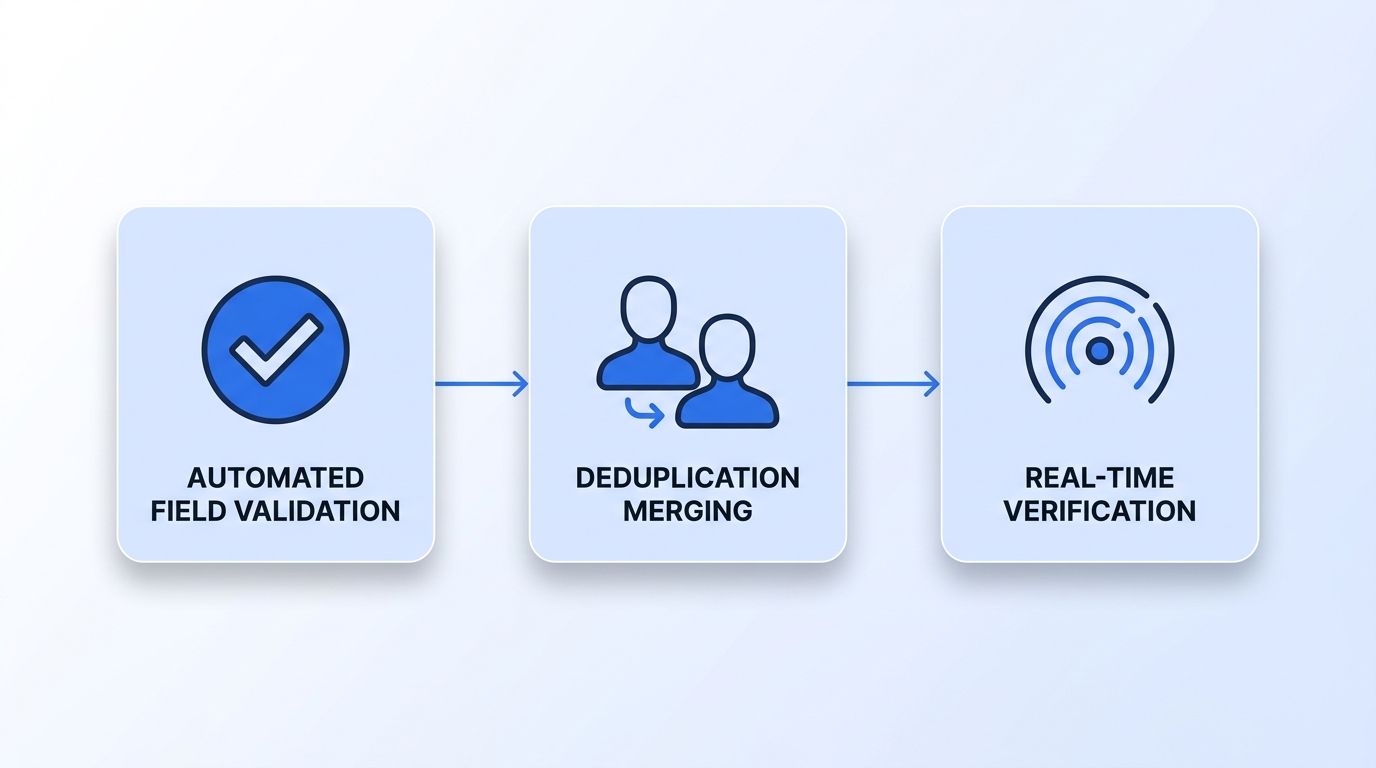
A governance policy applies to Salesforce or HubSpot by defining field-level rules the CRM enforces automatically - required fields, validation rules, and deduplication logic - rather than relying on reps to self-police. Duplication rates of 10% to 30% are common in CRMs with no active governance in place (Databar.ai, 2026). If HubSpot is your system of record, Datamagnet's HubSpot integration enforces those fields at the point a record is created, not after the fact.
How Often Should a Data Governance Policy Be Reviewed and Updated?
Quarterly, at minimum, for a B2B sales org - annual reviews leave too much time for the underlying data (and the regulations governing it) to shift underneath the policy. A quarterly cadence also lines up naturally with sales planning cycles, so policy updates get reviewed alongside territory and quota changes instead of as a separate exercise nobody prioritizes.
Citation capsule: A policy written once and never revisited quietly stops matching reality within a year, since the CRM fields, vendor integrations, and compliance rules it governs keep changing underneath it. Quarterly review is the minimum cadence that keeps the document and the data in sync.
Can a Data Governance Policy Be Enforced Automatically, or Does It Require Manual Review?
Most of it can be automated. Required-field validation, deduplication rules, and access controls all run natively inside modern CRMs, and a signal monitor for job-change tracking can flag stale records the moment a contact changes roles, instead of waiting for a manual audit. What still needs a human is judgment calls - approving policy exceptions, resolving ownership disputes, and deciding when a rule needs to change.
What Are the Most Common Data Governance Problems in B2B Sales?
The most common problems are duplicate records, regulatory exposure under GDPR/CCPA, and data decay driven by job changes, and all three compound when no policy names who's responsible for catching them. A study cited by Experian found 94% of organizations suspect their own customer data is inaccurate (Insycle, 2026), and Validity's 2025 survey found 37% of CRM users reported losing revenue directly because of poor data quality (Validity, via Salesmotion, 2025). The sections below break down each problem and how fast it grows.
Why Do CRM Databases Accumulate So Many Duplicate Records?
CRM databases accumulate duplicates because reps, marketing forms, and integrations all create records independently, with no shared check against what already exists. A study cited by Experian found 94% of organizations suspect their own customer data is inaccurate (Insycle, 2026), and duplication rates of 10% to 30% aren't unusual once a database goes unmanaged for a year or two.
<!-- [PERSONAL EXPERIENCE] -->Watching sales orgs discover their duplicate rate for the first time is a familiar pattern: someone runs a dedup report expecting a few hundred hits and finds thousands. The number is rarely the surprise - the surprise is realizing nobody owned preventing it.
How Does GDPR or CCPA Affect a B2B Sales Data Governance Policy?
GDPR and CCPA require your policy to define a lawful basis for collecting contact data, a documented process for handling data subject access requests (DSARs), and clear retention limits. GDPR fines have surpassed €7.1 billion since 2018, with about €1.2 billion issued in 2025 alone (Kiteworks, 2026), and each DSAR costs a business an average of $1,500 to process (Termly, 2025).
A policy that doesn't name who handles a DSAR, and how fast, is a compliance gap waiting to become a fine. Datamagnet's own security and data practices page is a useful reference point for what "public sources only, GDPR/CCPA compliant" actually looks like in an API's own governance posture.
What's the Biggest Cause of CRM Data Decay, and How Fast Does It Happen?
Job changes are the single biggest cause of CRM data decay. Between 15% and 20% of professionals switch jobs each year (Saleshandy, 2026), and when someone moves, their old email, direct dial, and title all go stale simultaneously rather than one field at a time. That compounding effect is why B2B contact data decays at roughly 2.1% a month - about 22.5% a year - even when nobody touches the record (Instantly.ai, 2026).
A policy that doesn't specify how staleness gets caught - real-time API checks versus a quarterly batch cleanse - is a policy that will look accurate on paper and wrong in the CRM. Datamagnet's People Profile API is built for exactly that check: query it right before a rep acts on a record, not on a batch schedule.
What Happens if a Sales Org Doesn't Have a Data Governance Policy at All?
Without a policy, data quality problems compound quietly until they show up in lost revenue. Validity's 2025 survey found 37% of CRM users reported losing revenue directly because of poor data quality, and the same survey put the average loss at 16 sales opportunities per quarter from unreliable records (Validity, via Salesmotion, 2025). Separately, 31% of RevOps admins say poor-quality data costs at least 20% of annual revenue (MarketingOps.com, 2025).
What Are the Advanced Data Governance Topics Worth Knowing?
Once the basics are in place, two topics separate a mature governance program from a starter one: which maturity model to benchmark against, and how real-time verification keeps a written policy from decaying along with the data it governs. DAMA-DMBOK is the most widely adopted framework, cited by 46.6% of data governance professionals in a survey of 341 practitioners (research summarized on Medium, 2025), ahead of DCAM at 41.7%.
What Data Governance Maturity Model Should a Growing Sales Org Use?
DAMA-DMBOK is the most widely adopted framework, cited by 46.6% of data governance professionals in a survey of 341 practitioners, ahead of DCAM at 41.7% (research summarized on Medium, 2025). Most maturity models score an organization from 1 (ad hoc) to 5 (optimized); a sales org with a written, reviewed policy and a named data steward typically sits at level 3 or above.
You don't need to adopt DAMA-DMBOK wholesale to benefit from it - borrowing its ownership and classification structure for your own template covers most of what a sales org actually needs.
How Does Real-Time Data Verification Fit Into a Data Governance Policy?
Real-time verification is how a policy stays enforceable instead of becoming a document nobody checks against. Sales reps lose an average of 27.3% of their time working with inaccurate contact data - about 546 hours a year per rep (ZoomInfo, 2025) - and that number barely moves if your "verification" step is a spreadsheet audit run once a quarter.
A policy that names a real-time source of truth closes that gap. Datamagnet's Company Profile endpoint fetches an account's current headcount, industry, and hiring signals live, at request time, so a rep checking a record sees today's data instead of whatever was true when the record was last imported.
Related Resources
These three resources go deeper on pieces this FAQ only summarizes: querying an existing database of enriched profiles, keeping records current with live enrichment instead of a batch import, and the full DAMA-DMBOK maturity model this page's framework guidance draws from. Use them once your policy template is drafted and you're ready to put it into practice. Explore these resources for deeper coverage of B2B data governance and CRM hygiene:
- People Search DB endpoint - search Datamagnet's own database of enriched profiles when building out a governed contact list.
- Real-time B2B people enrichment API - a deeper look at how live enrichment keeps governed records current.
- DAMA International - the official home of the DMBOK framework referenced above, for teams that want the full maturity model.
Still Have Questions?
Didn't find what you're looking for here? Reach out through our contact page and we'll get back to you directly. We revisit this entire FAQ quarterly, the same cadence we recommend for any sales data governance policy, and fold in new compliance rulings, GDPR/CCPA guidance, and fresh RevOps survey data as they publish. Last updated July 31, 2026.
Frequently Asked Questions
The questions below are the ten most common searches sales and RevOps teams run when building a governance policy from scratch, condensed into short, source-backed answers pulled from the categories above. Each one mirrors the JSON-LD schema at the bottom of this page, so the same answer is what search engines and AI assistants surface. Only 75% of organizations have any governance program in place today (Dataversity, 2025), so start here if you're building yours.
What is a data governance policy for a B2B sales org?
A data governance policy is a written document defining who owns CRM data, how it's classified, who can access it, and what quality bar it must meet. For sales teams, it mainly governs contact, account, and opportunity records reps rely on daily.
Why does a B2B sales team need a formal data governance policy?
Because unmanaged data has a real cost: Gartner estimates poor data quality costs organizations $12.9 million a year on average, and 71% of RevOps leaders name data governance as a top pain point. A policy prevents that cost from compounding unmanaged.
What should a B2B sales data governance policy template include?
Nine sections: purpose and scope, data classification, ownership, quality standards, access and security controls, enrichment/verification sources, retention rules, compliance requirements, and a review cadence - ideally revisited quarterly.
How is a data governance policy different from a data quality initiative?
A policy is the ongoing rulebook; a quality initiative is a one-time project run under it. Orgs without a formal policy report about 40% more data quality issues and 60% slower compliance verification than those with one.
How does a data governance policy apply to CRM data in Salesforce or HubSpot?
It defines field-level rules the CRM enforces automatically - required fields, validation, and deduplication - instead of relying on reps to self-police. Unmanaged CRMs commonly run 10% to 30% duplicate rates without these rules in place.
Why do CRM databases accumulate so many duplicate records?
Because reps, marketing forms, and integrations create records independently with no shared check. Experian-cited research found 94% of organizations suspect their own customer data is inaccurate, and 10-30% duplication rates are common without active governance.
How does GDPR or CCPA affect a B2B sales data governance policy?
It requires a documented lawful basis for data collection, a DSAR handling process, and retention limits. GDPR fines have topped €7.1 billion since 2018, and each DSAR costs businesses an average of $1,500 to process.
What's the biggest cause of CRM data decay, and how fast does it happen?
Job changes. Between 15% and 20% of professionals switch jobs yearly, and each move invalidates a contact's email, phone, and title at once - driving roughly 22.5% annual decay across a typical B2B contact database.
What happens if a sales org doesn't have a data governance policy at all?
Data problems compound into lost revenue: 37% of CRM users report losing revenue directly from poor data quality, averaging 16 lost sales opportunities per quarter, and 31% of RevOps admins say bad data costs at least 20% of annual revenue.
What data governance maturity model should a growing sales org use?
DAMA-DMBOK, the most widely adopted framework at 46.6% among surveyed data governance professionals, ahead of DCAM at 41.7%. Its ownership and classification structure adapts well to a sales org's CRM-centric needs without requiring full enterprise-scale adoption.
