
Disclosure: This article is published by Datamagnet. Vendor claims are self-reported unless otherwise noted.
8 Best Data Enrichment Tools for Startups and Small Sales Teams (2026)
Your CRM's contact data is going stale right now. B2B records decay 2.1% every month, which compounds to roughly 22.5% a year (HubSpot, 2026). If you're a startup or a five-person sales team, you don't need a $15,000-a-year platform to fix that — you need a tool priced for your stage.
Key Takeaways
- B2B contact data decays 2.1% a month, or ~22.5% a year (HubSpot, 2026) — enrichment is maintenance, not a one-time purchase.
- Credit-based, self-serve tools like Datamagnet, Hunter.io, and Snov.io all price 1,000 monthly records under $50; Coresignal and enterprise platforms push past $500 fast.
- Sales reps keep only 40% of their time for actual selling (Salesforce, 2026) — the right tool should shrink manual lookup time, not add another dashboard.
- ZoomInfo and Cognism publish no self-serve pricing at all; expect a sales call and a contract north of $15,000/year.

What Should a Startup Look for in a Data Enrichment Tool?
A startup-friendly enrichment tool needs three things: a usable free tier, credit pricing that scales down to small volumes, and instant self-serve signup. Skip anything that requires a demo call before you can see a price — that's a signal the tool is built for six-figure enterprise deals, not a 10-person GTM team.
Free tier that's actually usable. A "free trial" that expires in 7 days isn't the same as a free tier that renews every month. Datamagnet, Hunter.io, Snov.io, Lusha, Clay, and Coresignal all offer renewing monthly free credits — useful for testing before you commit a card number.
Credit-based, not seat-based, pricing. Seat-based tools charge per user regardless of usage. Credit-based tools charge for what you actually pull — a better fit when your team is 2 people doing the enrichment work of 10. Watch the fine print: a "credit" means different things at every vendor (see the pricing table below).
Self-serve signup, no sales call required. Sales reps spend just 40% of their time actively selling (Salesforce, 2026) — the rest goes to admin, meetings, and data entry. A tool that adds a week-long procurement cycle before you can test it is working against that math. If you want to check usage without leaving your terminal, most self-serve APIs — including Datamagnet's credit balance endpoint — expose a live count so you're never guessing when you'll run out.
How Much Does Data Enrichment Cost at 1,000, 5,000, and 10,000 Records?
Entry-level pricing for 1,000 records a month ranges from $39 to $499, depending on the vendor and what counts as a "record." Most self-serve tools stay under $200/month through 10,000 records — except Coresignal and Clay, whose per-record cost rises fast once you need full contact data instead of firmographic fields.
"Records" isn't standardized across vendors. Apollo.io charges 1 credit for a verified email but up to 8 for a phone number. Coresignal charges 10–20 credits per contact enrichment, not 1. The table below uses each vendor's own published credit-to-price ratio for the closest equivalent to a single enriched profile — verify current rates before you buy, since credit definitions change with product updates.
| Tool | 1,000 records/mo | 5,000 records/mo | 10,000 records/mo | Self-serve? |
|---|---|---|---|---|
| Datamagnet | $39/mo | $99/mo | $99/mo | Yes |
| Snov.io | $39/mo | $99/mo | $189/mo | Yes |
| Hunter.io | $49/mo | $149/mo | $149/mo | Yes |
| Apollo.io | ~$49/mo* | ~$79–119/mo* | Requires pooled/Org seats* | Yes |
| Lusha | $49.90/mo | Not published self-serve | Not published self-serve | Yes (capped) |
| Clay | $167–185/mo | $167–446/mo (slider-based) | ~$446+/mo | Yes |
| Coresignal | $199–499/mo† | Exceeds $500/mo† | Exceeds $500/mo† | Yes |
| People Data Labs | Only 350 records published at $98/mo‡ | Not publicly listed | Not publicly listed | Yes (limited) |
*Apollo.io's exact tier pricing wasn't independently confirmed on apollo.io during research (JavaScript-rendered pricing page); figures are corroborated across multiple third-party trackers as of September 2026 — confirm current pricing directly before purchasing. †Coresignal's credit cost per contact record (10–20 credits) means full contact enrichment at volume can exceed the Pro tier; see our full breakdown of Coresignal's 2026 pricing for the tier-by-tier math. ‡People Data Labs' pricing page is JavaScript-rendered and didn't return full tier details during research; the $98/month, 350-record entry price is corroborated across multiple third-party pricing trackers as of September 2026 — confirm current pricing directly at peopledatalabs.com/pricing before purchasing.
Sources: Datamagnet pricing, Snov.io pricing, Hunter.io pricing, Lusha pricing, Clay pricing, Coresignal pricing, People Data Labs pricing — all checked September 2026.
Which Data Enrichment Tools Actually Fit a Startup Budget?
Eight tools currently publish self-serve pricing under $500/month for meaningful volume: Apollo.io, Datamagnet, Hunter.io, Snov.io, Clay, Lusha, Coresignal, and People Data Labs. None of them is the right fit for every use case — the honest answer depends on whether you need outreach built in, raw API access, or just clean contact data.
1. Apollo.io — Best All-in-One for Prospecting Plus Enrichment
Apollo.io wins when you need enrichment and outreach sequencing in the same subscription, not two separate tools. It bundles a contact database, email finder, and sales engagement platform starting around $49/month, with a free tier of roughly 75 credits a month for testing (Apollo.io, 2026).
The tradeoff: credit costs vary by field (1 for an email, up to 8 for a phone number), so your actual monthly spend depends heavily on which fields you pull. Teams that want a narrower API-first alternative for company and people data can read our Apollo vs. Datamagnet comparison for a side-by-side on data freshness and pricing model.
2. Datamagnet — Best for Real-Time LinkedIn-Sourced People and Company Data
Datamagnet fits teams that want fresh, request-time data from an API rather than a static database that ages between refreshes. It starts with 10 free credits (no card required) and a $39/month Starter tier for 1,000 credits, scaling to $99/month for 10,000 (Datamagnet, 2026).
Where competitors win: Datamagnet doesn't include email sequencing like Apollo, and it doesn't offer a pre-built static database to browse like People Data Labs or ZoomInfo — it's built for developers and GTM engineers who want to call an API at the moment they need a record, not maintain a bulk export. If that's your workflow, the quickstart guide walks through generating an API key and making a first request in a few minutes.

3. Hunter.io — Best for Straightforward Email Finding and Verification
Hunter.io is the cheapest reliable option when all you need is verified emails, not full contact or company profiles. Its Starter tier is $49/month (or $34/month billed annually) for 2,000 credits, with a 50-credit free tier for testing (Hunter.io, 2026).
It doesn't do phone numbers, firmographic data, or LinkedIn activity — just email discovery and verification. That narrow focus is exactly why it's cheap at low volume, but you'll outgrow it fast if your ICP research needs more than an inbox address.
4. Snov.io — Best Budget Alternative With Outreach Included
Snov.io undercuts Hunter.io at the entry tier ($39/month for 1,000 credits vs. $49) and bundles basic drip-campaign tooling most email finders charge extra for (Snov.io, 2026). Its free tier also renews monthly at 50 credits.
The catch is the jump between tiers: 5,000 credits costs $99/month, but 10,000 skips straight to a 20,000-credit tier at $189 — you'll pay for headroom you may not use if your volume sits right at 10,000.
5. Clay — Best for No-Code, Multi-Source Waterfall Enrichment
Clay is the pick when you want to chain multiple data providers — including Datamagnet as a live LinkedIn source — into one automated workflow without writing code. Plans start at $167/month (annual) for 3,000 data credits and 15,000 workflow actions, with a free tier of 500 actions and 100 credits (Clay, 2026).
Clay's pricing uses a slider rather than fixed tiers, so exact cost at 5,000 or 10,000 records depends on your configuration in-app. Teams already using Clay can add Datamagnet as a live enrichment column to pull fresh LinkedIn data mid-workflow instead of relying on a single static source.
6. Lusha — Best for a Solo Rep Who Wants a Browser Extension
Lusha is built for individual reps prospecting directly from LinkedIn, not bulk API pulls. Its Starter plan is $49.90/month for 400 credits, with a 40-credit free tier (Lusha, 2026).
The limitation: published self-serve tiers cap around 3,400 credits/month even at the Premium level, so 5,000+ records a month means a custom sales quote — Lusha simply isn't priced for that volume as a self-serve product.
7. Coresignal — Best for Bulk Datasets and API Access at Scale
Coresignal makes sense when you need large historical or bulk datasets rather than one-off contact lookups — think building your own enriched database, not enriching a weekly lead list. Its Mini tier starts at $49/month for 2,500 credits, with a free 2,000-credit, 7-day trial (Coresignal, 2026).
For a startup, this is the one to watch closely on budget: full contact enrichment costs 10–20 credits per record, so 5,000 contact-level enrichments a month can exceed the $499/month Pro tier entirely. It's a strong fit for raw dataset licensing, a weak fit for a small team doing routine contact enrichment.
8. People Data Labs — Best for Developers Building on a Raw Data Graph
People Data Labs suits engineering teams building a product feature on top of enrichment, not a sales team doing manual lookups. Its self-serve entry point runs $98/month for 350 person records, with a 100-record free tier that returns email and phone fields masked rather than as usable contact data (People Data Labs, 2026) — PDL's own pricing page is JavaScript-rendered and didn't surface full tier details during research, so these figures are corroborated against third-party pricing trackers rather than confirmed directly on-page.
Beyond that entry tier, PDL doesn't publish 1,000/5,000/10,000-record pricing — you'll need to talk to sales for volume discounts, which pulls it partway out of the "pure self-serve" category despite the accessible starting price.
Which Tools Cost More Than $500/Month and Require a Sales Call?
ZoomInfo, Cognism, and HubSpot's Breeze Intelligence all sit outside the startup budget bracket because none publishes pricing that lets you self-serve into a plan. If a vendor's pricing page only shows a "Talk to Sales" button, budget for a multi-thousand-dollar annual contract, not a monthly card charge.
ZoomInfo has no published self-serve tier; third-party purchase-data aggregator Vendr reports a median annual contract of roughly $31,875 across more than 1,300 verified deals (Vendr, 2026). Cognism's own pricing page confirms it publishes no numbers at all, showing only "tailored" quotes (Cognism, 2026). HubSpot's Breeze Intelligence runs on HubSpot Credits bundled into your existing paid subscription tier — not a standalone product a startup can buy on its own (HubSpot, 2026). If you're currently on one of these and comparing the self-serve alternative, our ZoomInfo comparison and Clearbit/Breeze comparison walk through the pricing-model difference in more detail.
Self-Serve vs. Sales-Led: Which Buying Model Fits a Small Team?
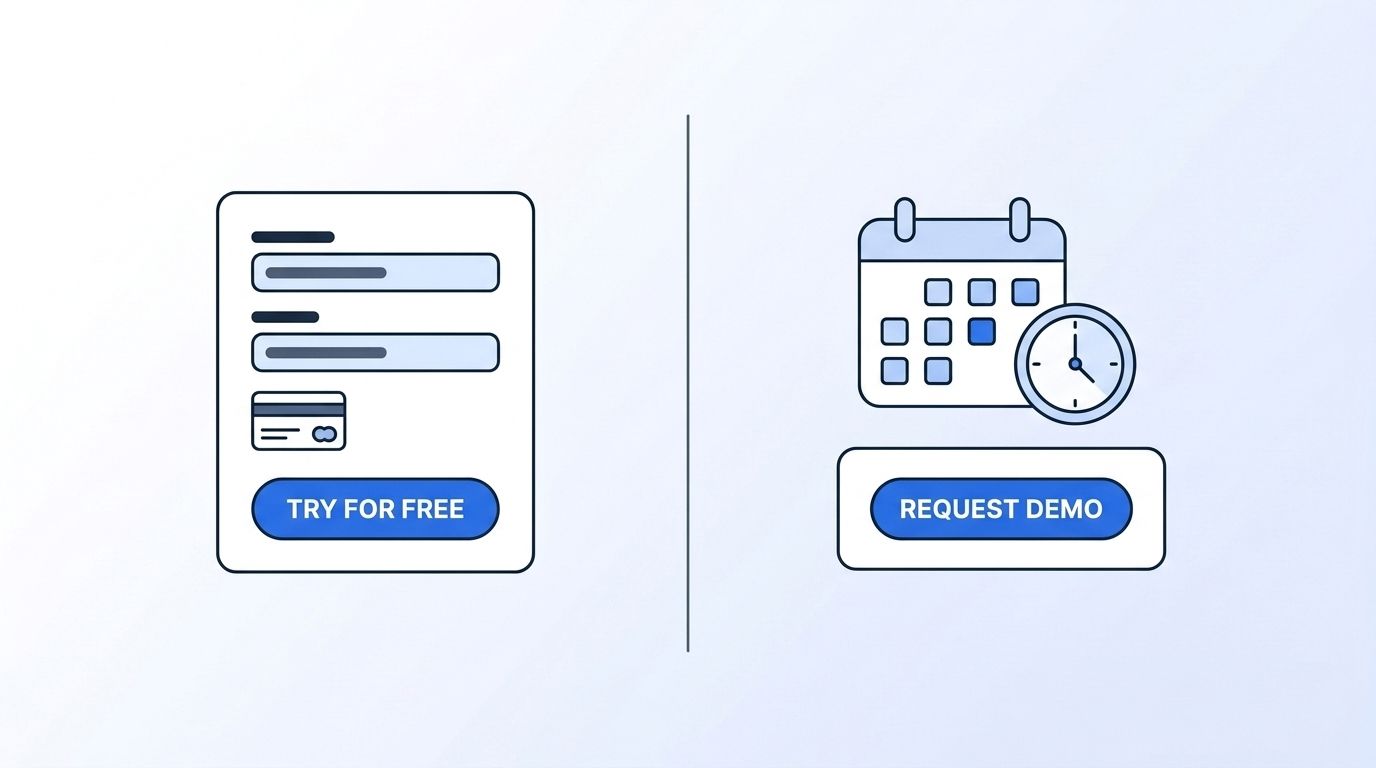
Self-serve fits a startup better because it removes the procurement delay between "we need this" and "we're using this." Companies with self-serve revenue post roughly 68% profitability on average, versus 36.4% for companies with none, and convert free users to paid 25.9% better (ProductLed, 2025) — a signal that self-serve pricing tends to correlate with product-led efficiency, not just lower sticker prices.
Sales-led tools aren't inherently worse — enterprise buyers often get volume discounts and dedicated support that a credit card checkout can't offer. But if your whole team is under 10 people, a demo call and a contract negotiation is overhead you don't need yet. You can generate an API key in minutes with most self-serve enrichment APIs and be enriching records the same day.
<!-- [UNIQUE INSIGHT] -->Our take: The clearest signal a tool is priced for startups isn't the sticker price — it's whether the pricing page shows numbers at all. Every vendor in this list that fits under $500/month publishes exact tier pricing publicly. Every vendor priced for enterprise (ZoomInfo, Cognism) hides it behind a sales call.
Frequently Asked Questions
What is a data enrichment tool for startups?
A data enrichment tool takes a partial record — an email, a name, a company domain — and fills in missing details like job title, company size, or LinkedIn activity. For startups, the ones worth using publish self-serve credit pricing and a renewing free tier, so you can test fit before committing a monthly budget.
How much does data enrichment cost per month?
Entry-level self-serve pricing runs $39–$99/month for around 1,000 enriched records at Datamagnet, Snov.io, Hunter.io, and Apollo.io (vendor pricing pages, 2026). Costs rise sharply at higher volumes for tools like Coresignal, where full contact enrichment can exceed $500/month past a few thousand records.
What's the difference between credit-based and seat-based pricing?
Credit-based pricing charges per record or data point pulled, regardless of team size — useful when 2-3 people do the enrichment work. Seat-based pricing charges per user license, which gets expensive fast for small teams that don't need many logins but do need high usage volume.
Should a startup choose self-serve or sales-led vendors?
Self-serve is generally the better fit for teams under 10 people, since it skips procurement delays and lets you validate a tool the same day you sign up. Companies with self-serve revenue report roughly 68% profitability versus 36.4% without it (ProductLed, 2025), suggesting the model correlates with leaner operations overall.
Is Datamagnet a good fit for a small sales team?
Datamagnet fits small teams that want fresh, request-time LinkedIn-sourced company and people data through an API, starting at $39/month for 1,000 credits. It's not the right fit if you need built-in email sequencing (Apollo.io) or a browseable static database (People Data Labs) — it's purpose-built for real-time API calls, not an all-in-one sales suite.
The Bottom Line
Startups don't need to choose between "free and unreliable" and "enterprise and expensive." Eight vendors — Apollo.io, Datamagnet, Hunter.io, Snov.io, Clay, Lusha, Coresignal, and People Data Labs — publish self-serve pricing that fits comfortably under $500/month for at least entry-level volume, with clear free tiers to test before you commit.
Match the tool to the job: Apollo.io if you want outreach bundled in, Hunter.io or Snov.io if you just need verified emails, Clay if you're chaining multiple sources, and Datamagnet if you want real-time LinkedIn-sourced data through a straightforward API. Check Datamagnet's pricing page for current tiers, or start with the free credits and see how the data holds up against your own CRM.
Sources
- HubSpot, "Database Decay: How Fast Does Your Database Decay?", retrieved 2026-09-28, https://www.hubspot.com/database-decay
- HubSpot, "Understand HubSpot Credits and Billing", retrieved 2026-09-28, https://knowledge.hubspot.com/account-management/understand-hubspot-credits-and-billing
- Salesforce, "State of Sales Statistics", retrieved 2026-09-28, https://www.salesforce.com/sales/state-of-sales/sales-statistics/
- Instantly.ai, "Cold Email Benchmark Report 2026", retrieved 2026-09-28, https://instantly.ai/cold-email-benchmark-report-2026
- ProductLed, "State of B2B SaaS in 2025", retrieved 2026-09-28, https://productled.com/blog/state-of-b2b-saas-2025-report
- Vendr, "ZoomInfo Pricing", retrieved 2026-09-28, https://www.vendr.com/marketplace/zoominfo
- Apollo.io, "Pricing", retrieved 2026-09-28, https://www.apollo.io/pricing
- Hunter.io, "Pricing", retrieved 2026-09-28, https://hunter.io/pricing
- Snov.io, "Pricing", retrieved 2026-09-28, https://snov.io/pricing
- Lusha, "Pricing", retrieved 2026-09-28, https://www.lusha.com/pricing/
- Clay, "Pricing", retrieved 2026-09-28, https://www.clay.com/pricing
- Coresignal, "Pricing", retrieved 2026-09-28, https://coresignal.com/pricing/
- People Data Labs, "Pricing", retrieved 2026-09-28, https://www.peopledatalabs.com/pricing
- Cognism, "Pricing", retrieved 2026-09-28, https://www.cognism.com/pricing
- Datamagnet, "Pricing", retrieved 2026-09-28, https://www.datamagnet.co/pricing/
