
Disclosure: This article is published by Datamagnet. Vendor claims are self-reported unless otherwise noted. This is a drafting guide, not legal advice. Have counsel review any clause before you send it.
Data Consistency Guarantees: Contract Clauses Vendors Skip
What should data consistency guarantees in a vendor contract include? Five things, each written as a measurable test: a freshness SLA with a timestamp field, a match-rate definition with a numerator and denominator, cross-endpoint consistency rules, tiered remediation credits, and audit rights over methodology and samples. Draft clauses for each are below. Last verified: 2026-10-25.
Key Takeaways
- A guarantee you can't measure from the API response isn't enforceable. Require a
last_verifiedordetected_atfield first.- Define match rate as
matched ÷ submittedwith an explicit exclusion list, or the vendor controls the denominator.- Tie credits to tiers. The AWS EC2 SLA uses two, 10% and 30% of monthly fees (AWS EC2 SLA, last updated 2022, retrieved 2026-10-25). A 100% tier is a negotiating ask, not an AWS precedent.
- Expect vendors to refuse accuracy warranties, unlimited audits, and uncapped refunds. Ask for sampling-based substitutes.
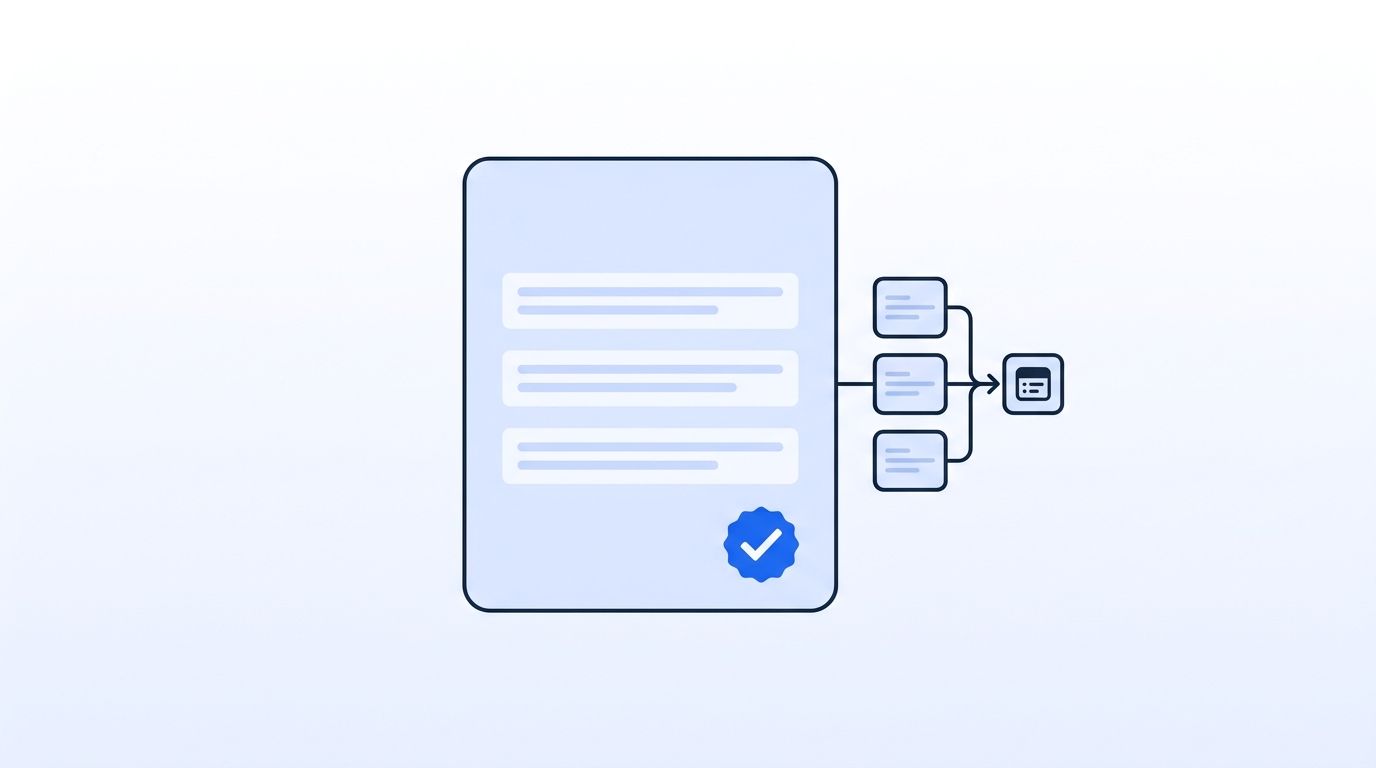
How do you write data freshness SLAs into a vendor contract?
You write them as a maximum age, measured by a field in the response. "Real-time" and "frequently updated" aren't testable. A clause that says "no record older than 30 days at time of response, per the last_verified field" is. Without a timestamp field, you can't prove a breach, and the vendor knows it.
Start with one question in the pre-signature call: what does each response tell me about when this record was last confirmed? Some APIs fetch live at request time. Others serve from a stored database. Either can be fine. Your contract has to say which one you're buying.
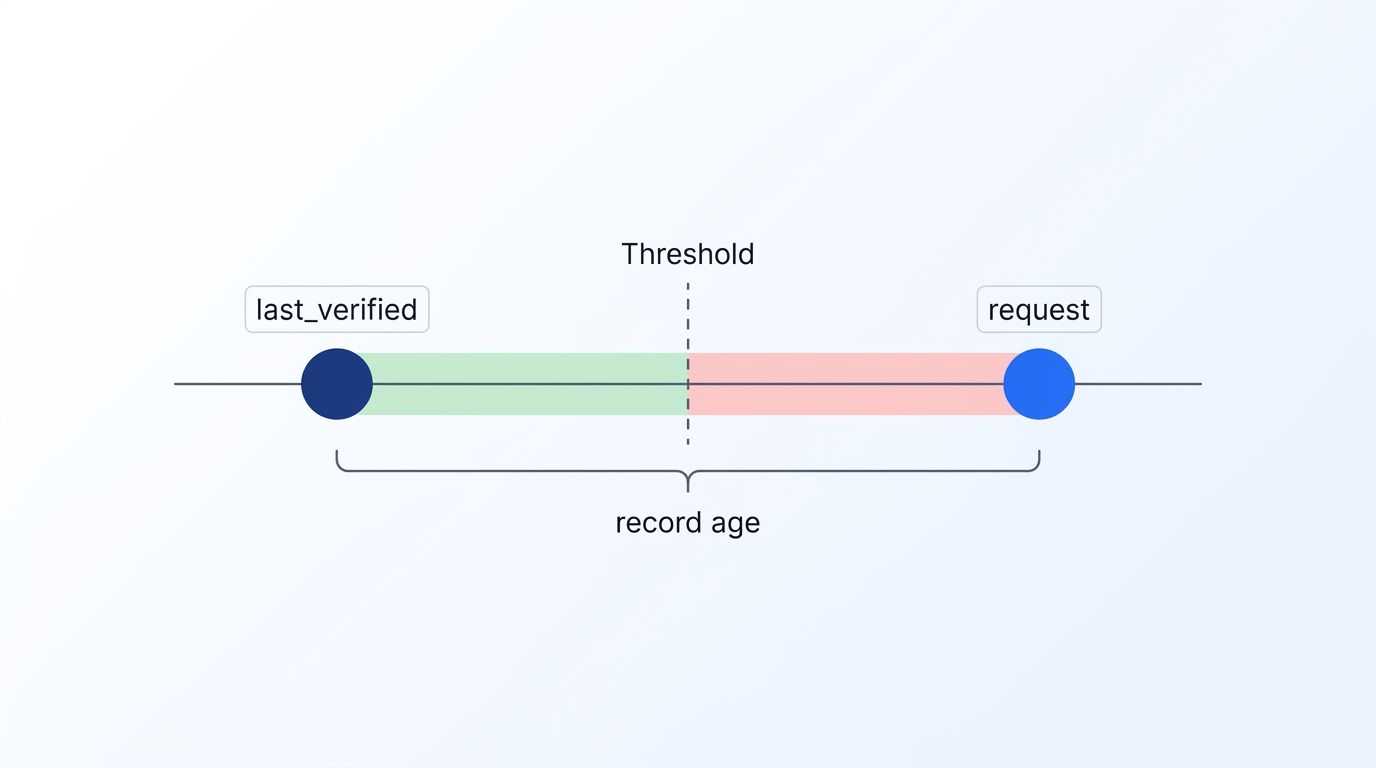
Clause: freshness SLA
Section 4.1 Data Freshness. For each Record returned by the Service, Vendor shall include a machine-readable timestamp ("Verification Timestamp") indicating when the Record's source was last retrieved or confirmed. Vendor warrants that, measured over each calendar month, at least [95]% of Records for the fields listed in Schedule B return a Verification Timestamp no older than [30] days at the time of the API response, and no Record returns a Verification Timestamp older than [90] days. A Record with a missing Verification Timestamp counts as a failure.
The bracketed numbers are negotiating positions, not industry benchmarks. Set them from your own baseline: pull a sample of 500 records, check them against the source, and see how old the wrong ones were. We don't publish a "standard" figure because no verified public one exists.
Freshness thresholds worth specifying by field type
| Field class | What to specify | Why it differs |
|---|---|---|
| Job title / employer | Max record age, per-record timestamp | Changes without notice; stale values drive misrouted outreach |
| Company firmographics (headcount, industry) | Max record age, refresh cadence in days | Changes slowly, so a looser threshold is fair |
| Contact data (email, phone) | Verification date plus verification method | Email validity decays; method matters more than age alone |
| Event or signal data | Detection-to-delivery window, using an event timestamp | Measured on the vendor's side, so demand the field |
Clause: signal and webhook delivery timing
If you buy event data, freshness means delivery, not record age. Make the delivery window testable.
Section 4.2 Event Delivery. Each event delivered by webhook shall carry a unique event identifier and a detection timestamp. Vendor shall retry failed deliveries for no fewer than [48] hours. Customer may deduplicate on event identifier, and duplicate delivery of an event shall not incur additional charges.
For a reference point on what documented behavior looks like, Datamagnet's own webhook documentation (self-reported by the vendor, retrieved 2026-10-25) states up to 7 delivery attempts spread over 48 hours, an event_id for deduplication, a detected_at ISO 8601 timestamp on profile-based changes, and HMAC-SHA256 signatures. Ask every vendor for the equivalent document and write what it says into your schedule.
What is a match rate guarantee, and how do you make it enforceable?
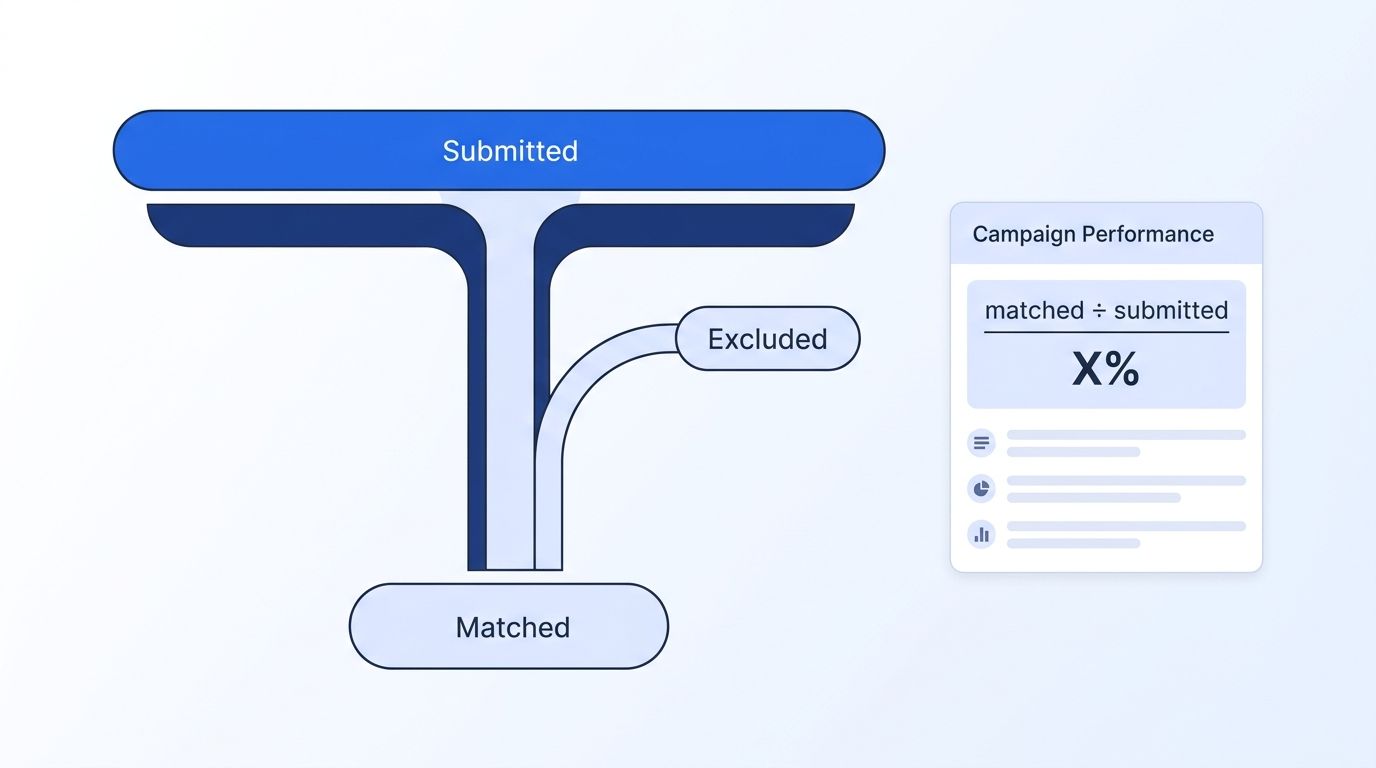
A match rate guarantee is a promise that a stated share of the records you submit will come back with data. It's enforceable only if the contract fixes the numerator, the denominator, the exclusions, and the test sample. Otherwise the vendor can shrink the denominator until any number looks good.
I found no authoritative public definition of "match rate," so define it yourself. That's good news: you can write the version that favors you.
Clause: match rate definition
Section 5.1 Match Rate. "Match Rate" means the number of Submitted Records for which the Service returns a non-empty value for every field in Schedule B, divided by the total number of Submitted Records, expressed as a percentage, measured per calendar month. "Submitted Record" means any request containing at least the identifier fields listed in Schedule B. Vendor may exclude only (a) requests with malformed identifiers, as determined by a published validation rule, and (b) requests Customer cancelled before completion. No other exclusions apply. Vendor warrants a Match Rate of at least [X]%, where X is set in Schedule B from the Baseline Test in Section 5.2.
Clause: baseline test (this is what makes the number real)
Section 5.2 Baseline Test. Within 30 days before the Effective Date, Customer may submit a sample of up to [1,000] Customer-selected records. The Match Rate measured on that sample, less [3] percentage points, becomes the committed minimum in Schedule B.
Never accept a match-rate figure from a vendor's marketing page as your SLA number. Let your own sample set it.
Match rate, accuracy and coverage are three different promises
| Term | Plain definition | Common contract trap |
|---|---|---|
| Match rate | Share of submitted records returning any data | A "match" can be a wrong record |
| Accuracy | Share of returned values that are correct | Needs a sampling method and a ground truth |
| Coverage | Share of your target universe the vendor holds | Usually can't be measured by you at all |
If you only get one, take accuracy, measured by sampling (see audit rights below). A high match rate with 80% accuracy is worse than a lower match rate with clean data.
What are consistency guarantees across endpoints?
Cross-endpoint consistency means the same fact comes back the same way from every endpoint that exposes it. If a person's employer differs between your search endpoint and your profile endpoint, you've got a data-quality defect, not two valid answers. Demand a rule for which endpoint wins and a tolerance for how long they may disagree.
This is the least-negotiated area in most contracts, which is exactly why it's where buyers get burned. Pipelines join search results to enrichment output, then to CRM records. One disagreement quietly breaks a join.
Clause: cross-endpoint consistency
Section 6.1 Consistency. Where the same data element is returned by more than one endpoint or delivery method of the Service (including search, enrichment, bulk file and event delivery), Vendor warrants that (a) the element shall use the same field name, data type and enumeration values in each; (b) any two returned values for the same entity and field, retrieved within [24] hours of each other, shall be identical except where Vendor identifies a newer Verification Timestamp on one of them; and (c) the endpoint with the most recent Verification Timestamp shall be deemed authoritative. Inconsistency affecting more than [1]% of sampled entities in a month constitutes a Service Failure under Section 7.
Clause: schema stability
Section 6.2 Schema Changes. Vendor shall give at least [90] days' written notice before removing or changing the type or meaning of any field in Schedule B. Additive changes require [14] days' notice. Vendor shall version the API and maintain the prior version for the notice period.
Consistency checks to put in your acceptance test
| Check | How to run it | Pass condition |
|---|---|---|
| Same entity, two endpoints | Request 200 entities via each endpoint within one hour | Identical values on Schedule B fields, or newer timestamp explains the diff |
| Search vs. profile | Compare search-result snippet to full profile | Same employer and title |
| Bulk vs. API | Compare a file delivery to live API calls for the same IDs | Differences explained by timestamps |
| Enum drift | Diff the set of values for each enumerated field month over month | No new values without notice |
What remediation should a contract require when the data is wrong?
Remediation should be a tiered schedule: re-delivery or credit for individual wrong records, a percentage service credit when a monthly threshold is missed, and a termination right after repeated misses. The AWS EC2 SLA is a useful structural template. It documents two credit tiers, 10% and 30% of monthly fees, as availability drops (AWS, Amazon EC2 Service Level Agreement, last updated 2022-05-25, retrieved 2026-10-25). A third, 100% tier is something you'd ask for, not something AWS offers.
Credits alone don't make you whole. A wrong job title that triggered a bad outreach sequence costs more than the lookup fee. But credits create a financial incentive to fix root causes, and they're what vendors will actually sign.
Clause: tiered service credits
Section 7.1 Service Credits. If, in any calendar month, a measured metric in Schedule B falls below its committed threshold, Customer is entitled to a credit against the next invoice equal to the following percentage of the fees for the affected Service for that month:
| Shortfall vs. committed threshold | Credit (negotiating position) |
|---|---|
| Up to 2 percentage points below | 10% |
| More than 2 and up to 5 points below | 30% |
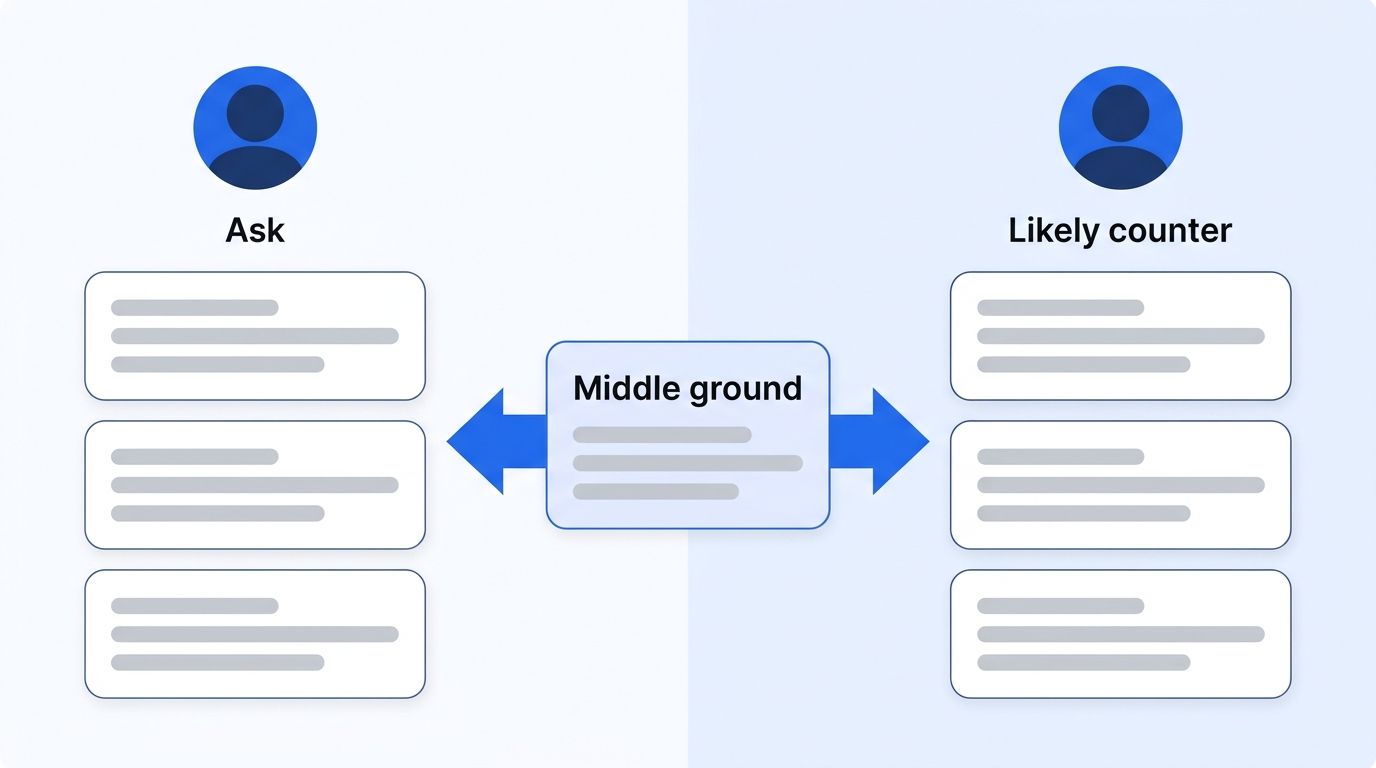
| More than 5 points below | 100% (opening ask; expect a counter) |
The 10% and 30% tiers mirror the AWS structure. The 100% tier has no AWS basis. It's our suggested opening position for data that's unusable at that level of shortfall, and vendors will likely push back on it.
Section 7.2 Record-Level Remedy. For each Record that Customer demonstrates is inaccurate against a primary source (a "Disputed Record"), Vendor shall within [5] business days either correct and re-deliver the Record or credit the per-record fee paid. Customer may submit Disputed Records in batches of up to [500] per month with source evidence.
Section 7.3 Chronic Failure. If Vendor misses any Schedule B threshold in [3] of any [6] consecutive months, Customer may terminate without penalty and receive a pro-rata refund of prepaid fees.
Clause: failed requests must not be billed
Section 7.4 Failed Requests. Customer shall not be charged for any request that results in a server error, a timeout, or a retryable failure.
This one is reasonable and some vendors already document it. Datamagnet's own errors documentation (self-reported by the vendor, retrieved 2026-10-25) states that lookups failing on an internal timeout of about 80 seconds return a retryable failure and are not charged, and it describes an X-Request-Timeout header that stops abandoned requests from completing and billing. It doesn't document refunds for other error types, which is the sort of gap you should close in writing, with any vendor.
Uptime conversions you'll need for the schedule
These are plain arithmetic, not sourced figures: allowed downtime = 43,200 minutes in a 30-day month × (1 − availability). State your month definition in the contract.
| Availability commitment | Allowed downtime per 30-day month |
|---|---|
| 99.9% | 43.2 minutes |
| 99.5% | 216 minutes (3.6 hours) |
| 99.0% | 432 minutes (7.2 hours) |
| 95.0% | 2,160 minutes (36 hours) |
A published uptime target isn't a contractual SLA. Datamagnet's own security page (self-reported, retrieved 2026-10-25) calls its 99.9% figure a target, not a contractual commitment. Read every vendor's version the same way, and ask whether credits attach to it.
What audit rights should you ask for in a data vendor contract?
Ask for three rights: access to methodology documentation, the right to run a sample-based accuracy test twice a year, and a records-retrieval right covering provenance for any Disputed Record. Full facility audits are what vendors refuse. Sample testing and documentation review are what they accept.
If you process personal data, you have a statutory anchor. GDPR Article 28(3)(h) requires a processor to make available all information necessary to demonstrate compliance and to allow for and contribute to audits, including inspections (GDPR Art. 28 text, Regulation (EU) 2016/679, via gdpr-info.eu, retrieved 2026-10-25). Article 5(1)(d) requires personal data to be accurate and, where necessary, kept up to date (GDPR Art. 5 text, Regulation (EU) 2016/679, retrieved 2026-10-25). Verify the full text on EUR-Lex before citing either in a contract. Whether your vendor is a processor or an independent controller changes which rights apply, so get counsel's view.
Clause: audit rights
Section 8.1 Methodology Disclosure. Vendor shall provide, on request and under confidentiality, written documentation of (a) how each Schedule B field is sourced, (b) the verification method behind each Verification Timestamp, and (c) how Match Rate is computed.
Section 8.2 Accuracy Sampling. Not more than [twice] per contract year, Customer or an independent third party bound by confidentiality may test a random sample of up to [1,000] Records per audit against primary sources. If the measured error rate exceeds the threshold in Schedule B, Vendor shall bear the audit cost and Section 7 applies.
Section 8.3 Provenance. For any Disputed Record, Vendor shall within [10] business days identify the source type and retrieval date for each disputed field.
Section 8.4 Logs. Vendor shall retain request logs sufficient to reproduce any billed request for [12] months and make them available to Customer for billing disputes.
What do data vendors typically refuse to sign?
Vendors typically refuse unlimited accuracy warranties, uncapped credits, on-site audits, source disclosure, and unilateral schema-change limits. Each refusal has a business reason, and each has a workable substitute. This checklist is based on general contract-negotiation patterns, not a survey. Public vendor terms are hard to find, so I found no verified source for individual vendors' terms.
| Clause buyers ask for | Why vendors refuse | What to ask for instead |
|---|---|---|
| "100% accuracy" warranty | Data comes from third-party sources they don't control | Sampling-based threshold with tiered credits |
| Uncapped liability for bad data | Fee-sized deals can't absorb downstream losses | Cap at 12 months' fees, with credits outside the cap |
| Named-source disclosure | Source lists are their competitive asset | Source type and retrieval date per Disputed Record |
| On-site or unlimited audits | Operational burden and confidentiality | Two sample audits per year, third party under NDA |
| Verification Timestamp on every field | Their pipeline may not store field-level dates | Record-level timestamp, with field-level on Schedule B fields only |
| Match-rate guarantee without exclusions | They don't control your input quality | Narrow exclusion list tied to a published validation rule |
| Credits for any shortfall, however small | Metrics jitter month to month | A deadband (e.g., first 1 point below is free of credit) |
| 90-day schema-change notice | Engineering roadmap constraints | 90 days for removals, 14 for additions, versioned API |
| Refund of fees for downstream outcomes | They can't see your campaign results | Refund of data fees only, plus termination right |
| Compliance warranty on source collection | Legal risk on scraped or public data | Representation of lawful collection, with indemnity for their breach |
Note the last row. If you buy data sourced from LinkedIn or similar platforms, ask for a representation about how it was collected. Platform terms and litigation outcomes vary, so have counsel review rather than rely on a blog's summary.
Data consistency guarantees in a contract: a pre-signature checklist
Run this before signing. Every row maps to a clause above. If a vendor can't answer a row, treat that as a finding and price it in.
| # | Question | Clause | Done |
|---|---|---|---|
| 1 | Does every record carry a verification or detection timestamp? | 4.1, 4.2 | ☐ |
| 2 | Is the freshness threshold in days, with a percentile? | 4.1 | ☐ |
| 3 | Is match rate defined with numerator, denominator and exclusions? | 5.1 | ☐ |
| 4 | Did you run a baseline test on your own records? | 5.2 | ☐ |
| 5 | Is there a rule for which endpoint is authoritative? | 6.1 | ☐ |
| 6 | Are schema changes versioned with notice periods? | 6.2 | ☐ |
| 7 | Are credits tiered, with a termination right? | 7.1, 7.3 | ☐ |
| 8 | Are failed or timed-out requests unbilled? | 7.4 | ☐ |
| 9 | Do you have sample-audit rights twice a year? | 8.2 | ☐ |
| 10 | Is the SLA a contractual commitment, not a "target"? | All | ☐ |
When is a different approach better than negotiating a contract SLA?
A different approach is better when your deal is too small to win real concessions, when your data is better verified by you than by the vendor, or when a live-fetch API removes the need for a freshness clause. Heavy SLA negotiation costs legal time. Under a certain spend, that time costs more than the credits you'd ever collect.
Here's an honest comparison.
| Situation | Better approach than a heavy SLA | Why |
|---|---|---|
| Small monthly spend, self-serve plan | Pay-as-you-go with a paid pilot and exit at any time | Credits will be tiny; the right to leave is worth more |
| You need verified emails | Run your own verification step before sending | You control the bounce rate, rather than rely on a vendor claim. Gmail bulk senders must keep spam rates below 0.30% (Google, Gmail sender guidelines, 2026 version, retrieved 2026-10-25) |
| Data is only useful when fresh | Fetch live at request time and read the timestamp | Age is observable on every call instead of promised monthly |
| You can't measure accuracy yourself | Build a 500-record gold set first | Without ground truth, no SLA is enforceable |
| Highly regulated use case | Negotiate hard, with counsel | Statutory duties apply regardless of fees |
Live-fetch APIs aren't a free pass. They change what you ask for: instead of "records no older than 30 days," you ask for error behavior, timeout charging, and schema stability. If you're comparing models, our guide to a real-time B2B people enrichment API shows what request-time data looks like in practice, and the People API page covers what Datamagnet returns per request.
If your use case is job-change tracking, check the scope before you write the clause. Datamagnet's job_change signal is a watchlist: you supply the profile_urls, so it isn't cold discovery of people who changed jobs. The first run records a baseline and reports nothing, and change dates are month-year granularity. A freshness clause for that data should measure detection lag from the event timestamp, not claim day-level precision. The Signal API overview lays out the signal types.
If you're comparing against a seat-based incumbent, the ZoomInfo comparison is a starting point for contract-structure differences, and the pricing page shows the self-serve option.
Frequently Asked Questions
What is a data freshness SLA?
A data freshness SLA is a contractual maximum age for the records a vendor returns, measured by a timestamp in the response. A workable version reads "95% of records verified within 30 days, none older than 90." Those figures are negotiating positions, not benchmarks. Without a timestamp field, you can't measure or enforce it.
How do you define match rate in a contract?
Define it as records returning every required field divided by total submitted records, per calendar month. List every permitted exclusion, such as malformed identifiers, and allow no others. Set the committed minimum from a baseline test on your own sample, for example 1,000 records, less a few points of tolerance. Vendor marketing figures shouldn't set your SLA.
What remedies should you get when vendor data is wrong?
Ask for three layers: record-level correction or credit within five business days, a tiered monthly service credit (10% and 30% tiers like the AWS EC2 SLA, plus a 100% tier as your opening ask), and a termination right after repeated misses. Also require that failed or timed-out requests are never billed.
Can you audit a data vendor?
Yes, but within limits. Vendors generally accept methodology documentation, sample-based accuracy tests twice a year, and provenance details for disputed records. They usually refuse on-site audits and full source lists. If you process personal data, GDPR Article 28(3)(h) gives audit rights over processors (gdpr-info.eu). Confirm your vendor's role with counsel.
What do vendors usually refuse to sign?
Vendors usually refuse accuracy warranties of 100%, uncapped liability, named-source disclosure, on-site audits, and refunds tied to downstream campaign results. They tend to accept sampling-based thresholds, record-level timestamps, tiered credits and schema-change notice. The checklist table above pairs each refusal with a workable substitute you can offer instead.
Next step
Take Sections 4 through 8 above, fill the bracketed numbers from your own baseline sample, and send them with your first redline. Want to see what documented API behavior looks like before you negotiate? Start with the Datamagnet API documentation and compare its error, webhook and signal pages against whatever the other vendor sends you.
Sources
- Google, Gmail sender guidelines, retrieved 2026-10-25, https://support.google.com/a/answer/81126
- AWS, Amazon EC2 Service Level Agreement (last updated 2022-05-25), retrieved 2026-10-25, https://aws.amazon.com/ec2/sla/
- gdpr-info.eu, GDPR Article 5, retrieved 2026-10-25, https://gdpr-info.eu/art-5-gdpr/
- gdpr-info.eu, GDPR Article 28, retrieved 2026-10-25, https://gdpr-info.eu/art-28-gdpr/
- Datamagnet, Errors, retrieved 2026-10-25, https://docs.datamagnet.co/api-reference/errors
- Datamagnet, Webhooks, retrieved 2026-10-25, https://docs.datamagnet.co/api-reference/webhooks
- Datamagnet, Create Signal, retrieved 2026-10-25, https://docs.datamagnet.co/api-reference/endpoints/signal-create
- Datamagnet, Security & Data Practices, retrieved 2026-10-25, https://www.datamagnet.co/security/
