
Disclosure: Datamagnet publishes this article. Coresignal's endpoints, credit costs, and rate limits described below are based on public documentation, retrieved September 27, 2026.
Coresignal API Guide: Endpoints, Credits and Rate Limits
Coresignal splits every API call into two categories: free Search requests that filter records, and paid Collect requests that return the actual profile (Coresignal, Credits documentation, retrieved 2026-09-27). Add a separate multi-source pricing tier, a dedicated real-time endpoint, and per-plan rate limits, and it's easy to see why most first integrations get the credit math wrong on day one.
This guide walks through exactly how Coresignal's employee, company, and jobs APIs are structured - what a Search costs versus a Collect, when multi-source data doubles your bill (and when it doesn't), what the real-time endpoint actually does, and the documented rate limit at every plan tier.
Key Takeaways
- Coresignal's Search requests (filter, ES DSL, semantic search) are free across every API - credits are only charged on Search Preview and Collect calls (Coresignal, Credits documentation, retrieved 2026-09-27).
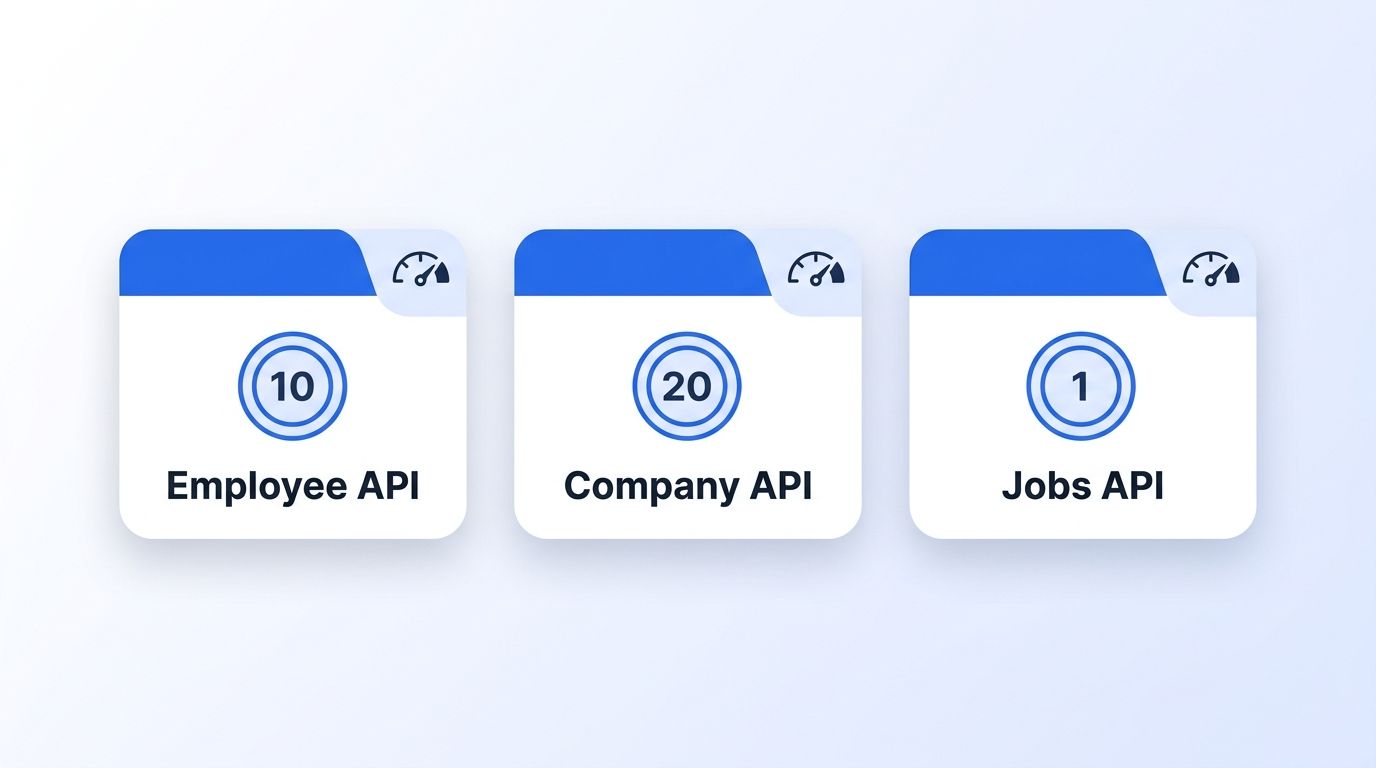
- A Collect call costs 10 credits on the Base Employee or Company API, 20 credits on the Multi-source Employee or Company API, and just 1 credit on either version of the Jobs API.
- The Real-time Employee API triggers a live collection at request time for 12 credits, capped at a fixed 50 URLs per minute regardless of plan.
- Documented rate limits scale from 5 requests/second on Free Trial through Starter plans up to 100+ requests/second on Scale and Elite (Coresignal, Rate Limits documentation, retrieved 2026-09-27).
- For a full breakdown of monthly plan pricing and credit packs, see our dedicated Coresignal pricing guide - this post focuses on the API mechanics, not the price tags.
What Endpoints Does the Coresignal API Actually Offer?
Coresignal's API is organized around three data types - employee, company, and job posting - and each type ships in multiple variants (Coresignal, APIs Overview, retrieved 2026-09-27). Picking the right variant matters more than picking the right data type, since the variant is what determines your credit cost per record.
For companies, Coresignal offers a Base Company API for fast, minimally-transformed records at scale, a Clean Company API for deduplicated and normalized data, and a Multi-source Company API that merges firmographics, headcount changes, and funding data pulled from more than one source. A separate Historical Headcount API tracks headcount and follower-count time series, refreshed once a month.
For employees, the pattern repeats: Base Employee API, Clean Employee API, and Multi-source Employee API for merged, entity-resolved profiles, plus a Real-time Employee API that triggers a live collection instead of serving from the standing dataset. An Employee Posts API and a Company Posts API return recently published content and engagement metrics.
For jobs, Coresignal runs a Base Jobs API for hiring signals and historical vacancy data, and a Multi-source Jobs API that deduplicates postings across multiple job boards. Firmographic and funding fields - industry, headcount, funding rounds, investors - aren't separate products; they're data fields returned within the Base and Multi-source Company APIs (Coresignal, Company Data API, retrieved 2026-09-27).
How Do Coresignal's Search and Collect Credits Actually Work?
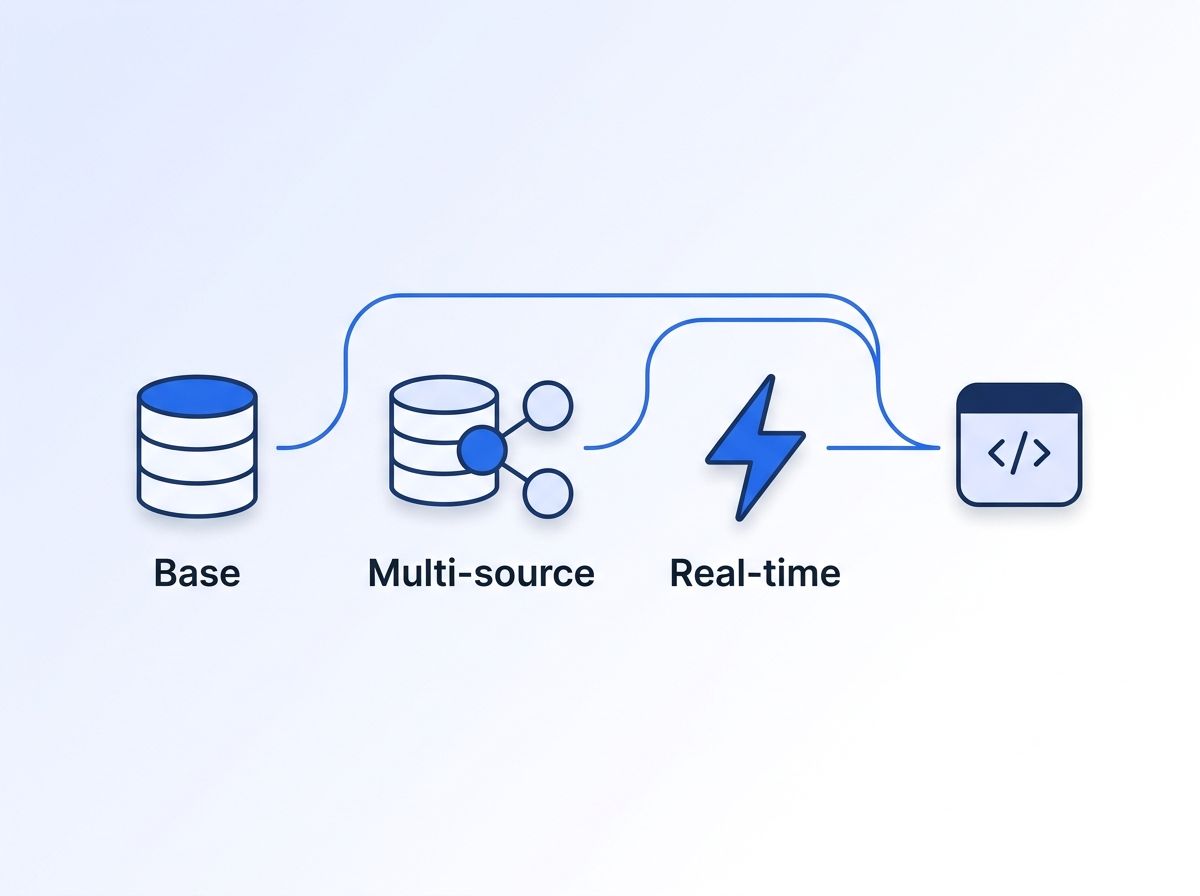
Coresignal's credit system runs on a simple rule that's easy to miss on first read: searching is free, and only pulling the record costs credits. Standard Search endpoints - filter search, Elasticsearch DSL, and semantic search - return zero credits charged on every API family, whether you're querying employees, companies, or jobs (Coresignal, Credits documentation, retrieved 2026-09-27).
Credits get deducted at two other points instead. A Search Preview call, which returns a partial preview of matching records before you commit to a full pull, costs 10 credits on Base/Clean APIs and 20 credits on Multi-source APIs. A Collect call, which returns the full record, costs the same tiered amounts - except on the Jobs API, where Collect is a flat 1 credit regardless of source tier (Coresignal, Pricing documentation, retrieved 2026-09-27). Bulk Collect requests charge credits per record returned, so pulling 200 job postings in one bulk call costs 200 credits, not a flat per-call fee (Coresignal, Collect and Enrich documentation, retrieved 2026-09-27). Every successful response carries an x-credits-remaining header, so you can track spend without a separate balance check - though Coresignal also documents a dedicated Credit Balance endpoint pattern for that purpose if you'd rather poll it directly.
Citation capsule: Coresignal charges nothing for search filtering - credits only get deducted on Search Preview and Collect calls (Coresignal, Credits documentation, retrieved 2026-09-27), and the rate varies by API: 10 credits on Base Employee or Company, 20 on Multi-source Employee or Company, and 1 on either Jobs API tier (Coresignal, Pricing documentation, retrieved 2026-09-27).
That "search is free" design contrasts with request-scoped APIs where every fetch is metered the same way. Datamagnet's ICP People Search works differently again: it's a paid search that returns matching decision-maker profiles directly by job title, seniority, and company filters, rather than splitting the workflow into a free filter step and a separate paid pull.
When Does Multi-Source Data Actually Cost More - and When Doesn't It?
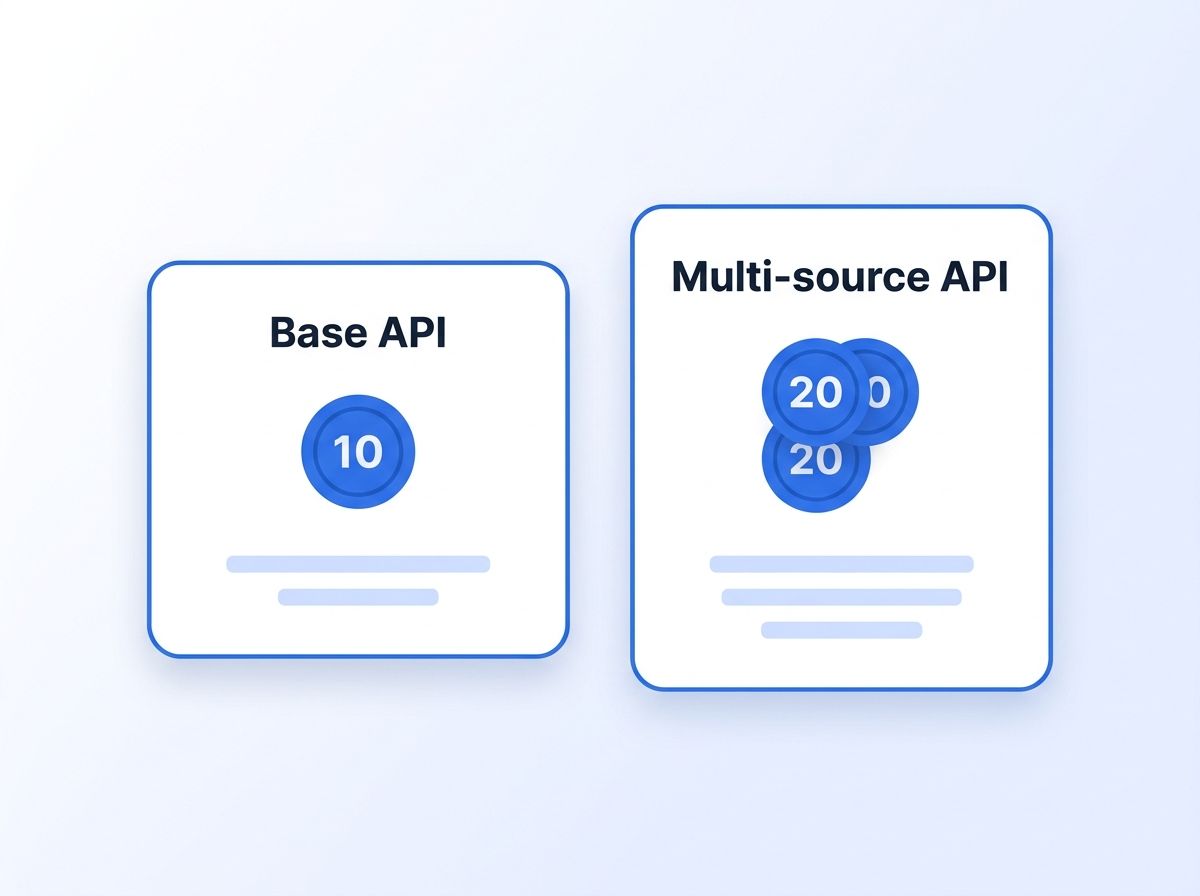
Multi-source data costs double on two of Coresignal's three API families, but not the third - and that's an easy detail to miss if you're pricing a jobs integration off the Company or Employee API's pattern. The Multi-source Company and Multi-source Employee APIs both charge 20 credits per Collect, exactly double the 10-credit Base rate, because each record merges data pulled from more than one public source with entity resolution applied (Coresignal, Multi-source Company API docs, retrieved 2026-09-27).
<!-- [UNIQUE INSIGHT] -->The Multi-source Jobs API breaks that pattern entirely. It costs the same 1 credit per Collect as the Base Jobs API, even though it deduplicates postings across multiple job boards and, per a 2026 Coresignal blog post, now delivers that merged dataset daily (Coresignal, Multi-source Jobs API docs, retrieved 2026-09-27). If you're budgeting a jobs-data project on the assumption that "multi-source always doubles the price," you'll overestimate the cost - the doubling only applies to Company and Employee data.
Why the split? Company and employee profiles benefit from reconciling the same entity across sources - matching "Jane Doe, VP Sales at Acme" found on three different platforms into one deduplicated record takes real processing work. Job postings are more binary: a posting either matches an existing listing or it's new, so the entity-resolution overhead - and the price premium tied to it - doesn't apply the same way.
Datamagnet's Company Profile endpoint takes a different approach to the same problem: instead of a separate multi-source tier, every request fetches live data directly from a company's current LinkedIn page for a flat 1 credit, so there's no separate pricing decision to make between a "base" and "enriched" version of the same profile.
What Does the Real-Time Employee API Actually Do?
The Real-time Employee API triggers a live collection attempt at the moment you make the request, rather than serving a profile from Coresignal's standing dataset (Coresignal, Real-Time Employee Data API, retrieved 2026-09-27). It merges data from multiple public sources with entity resolution applied in that single request, and it's priced separately from the standard Employee API tiers at 12 credits per successful call.
Coresignal states an average API response time of 176 ms across its documented endpoints - a general performance claim, not one published exclusively for the real-time product (Coresignal, homepage, retrieved 2026-09-27). The endpoint's rate limit is worth flagging separately from the rest of the platform: it's fixed at 50 URLs per minute, and that cap applies no matter which plan tier you're on - unlike every other endpoint, where the limit scales up as you move to a higher plan.
<!-- [UNIQUE INSIGHT] -->That fixed cap is a meaningful design signal. Coresignal's plan-tier rate limits (covered next) scale from 5 to 100+ requests per second as you pay more, which normally means "upgrade your plan, get more throughput." The Real-time Employee API doesn't follow that rule - its 50-URLs-per-minute ceiling holds for a Mini subscriber and an Elite subscriber alike, which suggests the constraint sits on the live-collection process itself, not on account-level infrastructure.
According to Coresignal's own FAQ, its bulk dataset deliveries refresh on daily, weekly, or monthly cycles depending on the product and subscription, while the API-connected database behind most endpoints is described as continuously updated in the background (Coresignal, FAQ, retrieved 2026-09-27). The Real-time Employee API is the one endpoint built to skip even that continuously-updated store and attempt a fresh pull at request time - everything else serves from the indexed database.
Datamagnet's People Profile endpoint runs on that live-fetch model by default, for every request, at a flat 1 credit - job history, headline, current role, and skills pulled from the public LinkedIn profile at the moment you call it, not held in a separate real-time product tier.
What Are Coresignal's Documented Rate Limits?
Coresignal's standard rate limits scale by plan, from 5 requests per second on the Free Trial, Mini, and Starter plans up to 100 or more requests per second on Scale and Elite (Coresignal, Rate Limits documentation, retrieved 2026-09-27). Pro sits at 10 req/s, Growth at 20, and Premium at 50 - the limit applies account-wide across search, collect, bulk collect, search preview, and webhook endpoints, rather than varying between the Base, Clean, and Multi-source versions of the same API.
Citation capsule: Coresignal's per-second rate limit is tied directly to plan spend - 5 requests per second through the Starter plan, rising to 10 on Pro, 20 on Growth, 50 on Premium, and 100 or more on Scale and Elite - so a rate-limit bottleneck on a bulk sync job is often a plan-tier problem, not a code problem (Coresignal, Rate Limits documentation, retrieved 2026-09-27).
Two other limits sit outside the plan-tier table and don't move regardless of what you pay: the Real-time Employee API's 50-URLs-per-minute cap covered above, and the Agentic Search /reasoning endpoint, which is capped at 10 requests per hour. Before building a high-throughput integration, check authentication setup requirements against whichever platform you're integrating, since key rotation and rate-limit headers both factor into how reliably a bulk job runs.
How Much Does Coresignal's API Cost, and Where Does That Data Come From?
Pricing runs on eight plans, from a free 7-day trial with 2,000 credits up to a $5,000/month Elite plan with 10 million credits, and we've broken down every tier's monthly price, annual discount, and credit allotment in our dedicated Coresignal pricing guide rather than repeating the full table here. What matters for this guide is how the credit mechanics above interact with that pricing: a Starter plan's 12,000 monthly credits covers roughly 1,200 Multi-source Company collects, or 12,000 Jobs API collects, because the per-record cost swings by 20x depending on which API you're calling.
Coresignal was founded in 2016 (Coresignal, About Us, retrieved 2026-09-27) and states it has collected data since that year, building out a database that currently spans more than 907 million employee records, 482 million job postings, and 70 million company records, according to figures published on its homepage (Coresignal, homepage, retrieved 2026-09-27).
On compliance, Coresignal states it's a founding member of the Ethical Web Data Collection Initiative and describes GDPR- and CCPA-compliant data handling practices (Coresignal, Data and Compliance documentation, retrieved 2026-09-27). It doesn't publicly list a SOC 2 certification as of this writing - worth checking directly with their team if that's a procurement requirement for your organization.
Coresignal's Database Model vs. a Live Request-Time API - What's the Real Difference?
The real difference comes down to when the data gets fetched, not just how much it costs. Coresignal is architecturally a pre-collected database: its API-connected backend is continuously updated, but bulk dataset deliveries follow scheduled cadences - the Multi-source Jobs dataset refreshes daily, and the Historical Headcount dataset refreshes monthly, at the start of each month (Coresignal, Historical Headcount API docs, retrieved 2026-09-27). Only the Real-time Employee API is built to attempt a fresh collection at the exact moment you call it.
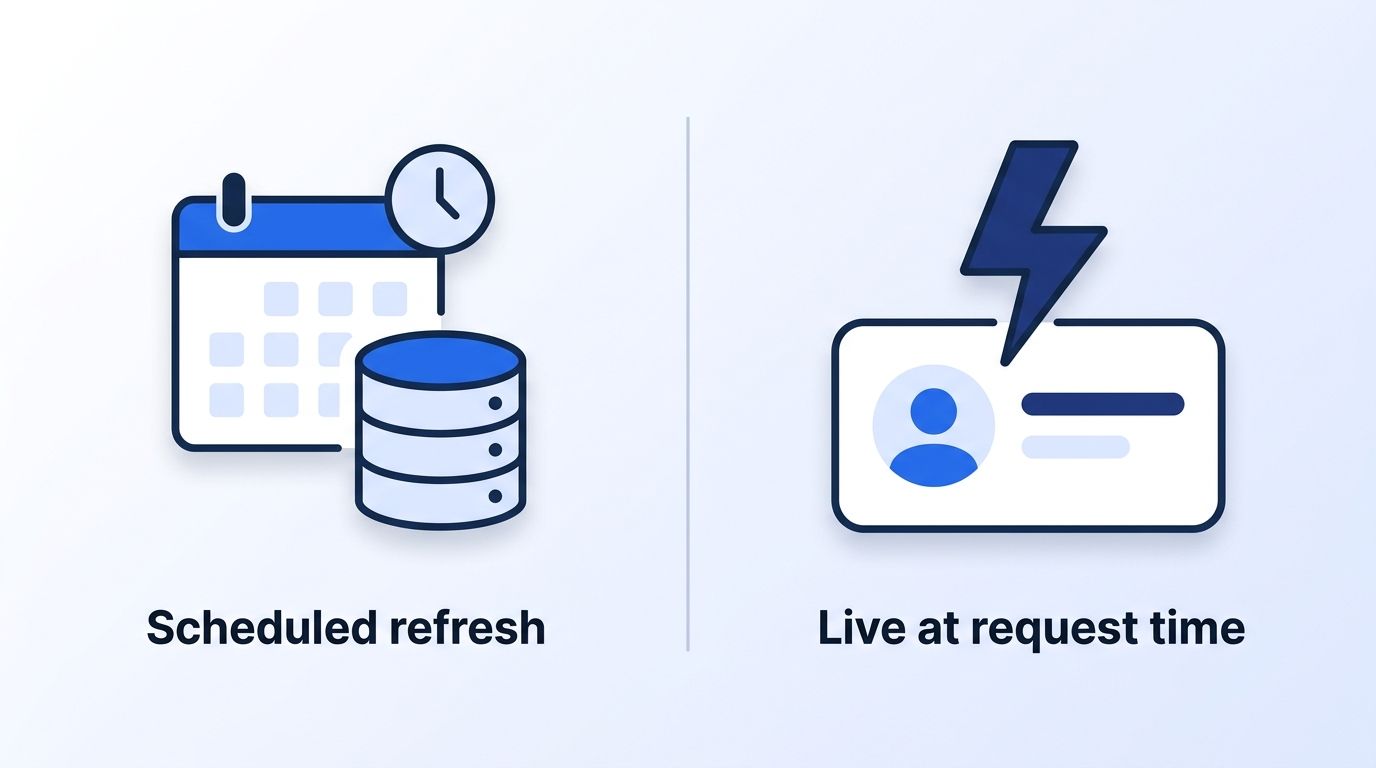
Datamagnet takes the opposite default: every People and Company Profile call fetches the current LinkedIn page live, at request time, for a flat 1 credit - there's no separate "real-time" product tier because that's simply how every request works. Datamagnet also adds ICP and Sales Navigator URL search, LinkedIn post engagement data, and job-change signals as request-time and webhook-delivered features, though - like Coresignal - it doesn't return email addresses or phone numbers; both platforms work from public profile and firmographic data, not contact-finder databases.
If you're weighing a live-fetch model against a pre-collected database for your specific workload, our full Coresignal alternatives comparison breaks down the credit models, coverage, and feature gaps side by side. For teams whose workflow depends on knowing the instant a target account posts or a contact changes jobs rather than querying a periodically-refreshed store, that timing difference tends to matter more than the per-record price.
Frequently Asked Questions
Does Coresignal charge credits for Search requests?
No. Standard Search requests - filter search, Elasticsearch DSL, and semantic search - are free across every Coresignal API (Coresignal, Credits documentation, retrieved 2026-09-27). Credits are only deducted on Search Preview calls (10-20 credits, depending on the API) and Collect calls that return the full record (Coresignal, Pricing documentation, retrieved 2026-09-27).
Why does the Multi-source Jobs API cost the same as the Base Jobs API?
Both cost 1 credit per Collect, unlike Multi-source Company and Employee APIs, which cost double their Base equivalent (20 vs. 10 credits). Job postings don't require the same entity-resolution work as reconciling a person or company across multiple sources, so Coresignal doesn't apply a multi-source price premium to jobs data (Coresignal, Multi-source Jobs API docs, retrieved 2026-09-27).
What does Coresignal's Real-time Employee API cost per request?
The Real-time Employee API costs 12 credits per successful call and triggers a live collection attempt at request time rather than serving from the standing database. It's rate-limited to a fixed 50 URLs per minute regardless of plan tier, unlike other endpoints, where the limit scales with your subscription (Coresignal, Real-Time Employee Data API, retrieved 2026-09-27).
What is Coresignal's highest documented rate limit?
Scale and Elite plan subscribers get 100 or more requests per second on standard endpoints, up from 5 req/s on the Free Trial, Mini, and Starter plans. That limit applies account-wide, not per-API, and is separate from the fixed caps on the Real-time Employee API (50 URLs/minute) and Agentic Search reasoning endpoint (10 requests/hour) (Coresignal, Rate Limits documentation, retrieved 2026-09-27).
How does Coresignal's credit model compare to a flat per-request API?
Coresignal's cost per record ranges from 1 to 20 credits depending on which API and variant you call, so the same monthly credit budget stretches very differently across products. Datamagnet uses a flat 1-credit cost per live People or Company profile fetch instead, which removes the need to model per-API pricing tiers before estimating a project's credit spend.
Sources
- Coresignal, APIs Overview, retrieved 2026-09-27, https://docs.coresignal.com/api-introduction/apis-overview
- Coresignal, Credits documentation, retrieved 2026-09-27, https://docs.coresignal.com/api-introduction/credits
- Coresignal, Pricing documentation, retrieved 2026-09-27, https://docs.coresignal.com/pricing
- Coresignal, Collect and Enrich documentation, retrieved 2026-09-27, https://docs.coresignal.com/api-introduction/requests/collect
- Coresignal, Multi-source Company API docs, retrieved 2026-09-27, https://docs.coresignal.com/company-api/multi-source-company-api
- Coresignal, Multi-source Jobs API docs, retrieved 2026-09-27, https://docs.coresignal.com/jobs-api/multi-source-jobs-api
- Coresignal, Historical Headcount API docs, retrieved 2026-09-27, https://docs.coresignal.com/company-api/historical-headcount-api
- Coresignal, Real-Time Employee Data API, retrieved 2026-09-27, https://coresignal.com/solutions/employee-data-api/
- Coresignal, Rate Limits documentation, retrieved 2026-09-27, https://docs.coresignal.com/api-introduction/rate-limits
- Coresignal, FAQ, retrieved 2026-09-27, https://docs.coresignal.com/introduction/faq
- Coresignal, Data and Compliance documentation, retrieved 2026-09-27, https://docs.coresignal.com/introduction/data-and-compliance
- Coresignal, homepage, retrieved 2026-09-27, https://coresignal.com/
- Coresignal, About Us, retrieved 2026-09-27, https://coresignal.com/about-us/
- Coresignal, Company Data API, retrieved 2026-09-27, https://coresignal.com/solutions/company-data-api/
- Datamagnet, People Profile endpoint, retrieved 2026-09-27, https://docs.datamagnet.co/api-reference/endpoints/people
- Datamagnet, Company Profile endpoint, retrieved 2026-09-27, https://docs.datamagnet.co/api-reference/endpoints/company
