
Disclosure: This article is published by Datamagnet. Vendor claims are self-reported unless otherwise noted.
Batch vs. Streaming Enrichment: A Cost and Latency Comparison (2026)
Batch enrichment is cheaper to run per record. Streaming enrichment is cheaper when you count what a stale record actually costs you. In 2025, Confluent's Data Streaming Report found that 44% of enterprise IT leaders now report a 5x or higher ROI from streaming infrastructure — up from 41% the year before. This piece compares the two architectures on real infrastructure cost, latency, and data freshness, so you can pick the one that fits your actual workload instead of the one that sounds more modern.
Key Takeaways
- Streaming enrichment APIs return records at p95 latency under 500ms, while batch pipelines wait for the next scheduled run — often hours, sometimes a full day.
- B2B contact data decays roughly 2.1% per month, compounding to about 22.5% stale within a year (HubSpot, ongoing), which erodes the value of any batch snapshot the moment it's taken.
- The MIT/InsideSales Lead Response Management Study found contacting a lead within 5 minutes instead of 30 raises qualification odds by 21x — a gap only real-time enrichment can close.
- Batch wins on raw infrastructure cost and simplicity. Streaming wins on cost-of-delay. Choose batch for nightly pipeline refreshes; choose streaming for anything that touches an active buyer.
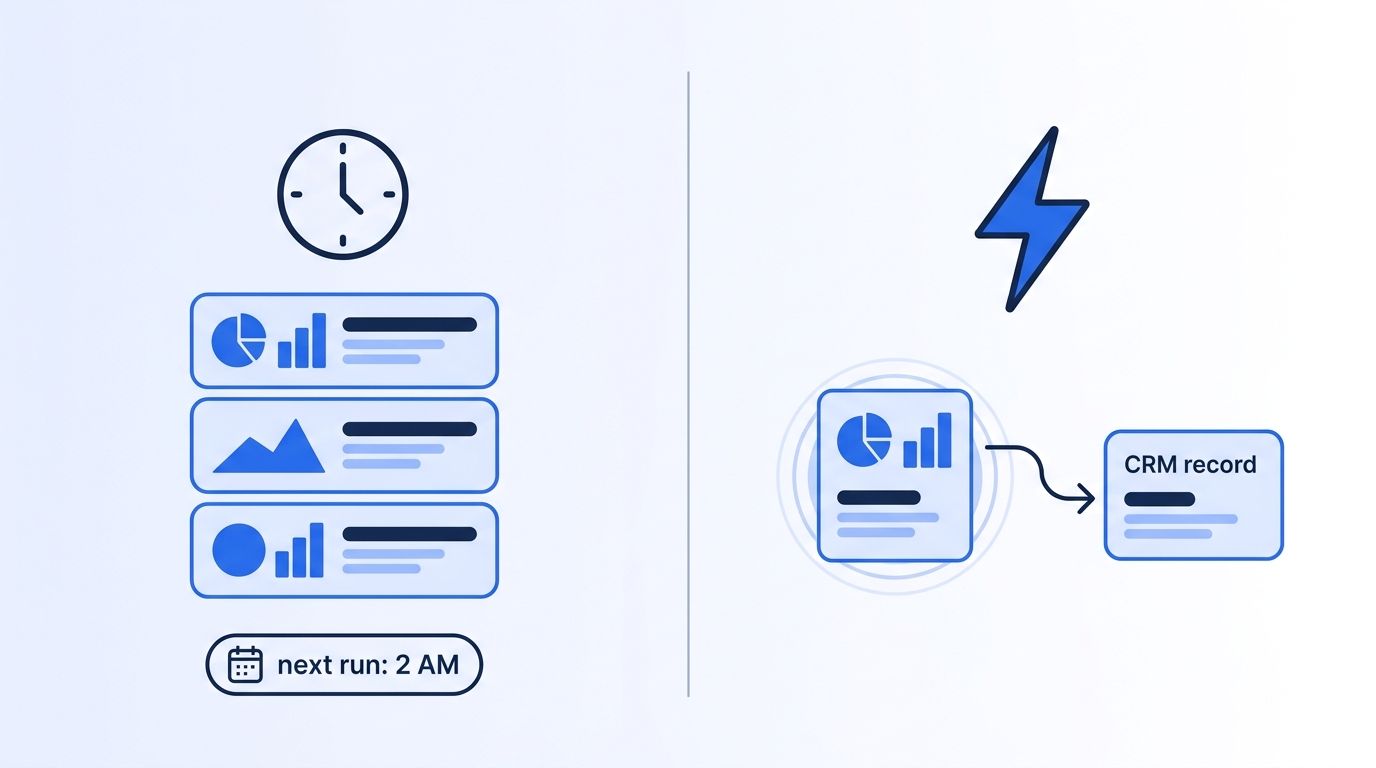
Batch vs. Streaming Enrichment: Quick Comparison
| Category | Batch Enrichment | Streaming Enrichment |
|---|---|---|
| Best For | Nightly CRM cleanup, large historical backfills | Lead routing, live signal alerts, form fills |
| Typical Latency | Hours to a full day (scheduled runs) | p50 ~150-200ms, p95 under 500ms |
| Infrastructure Cost | Lower — jobs run, finish, release compute | Higher — clusters stay provisioned around the clock |
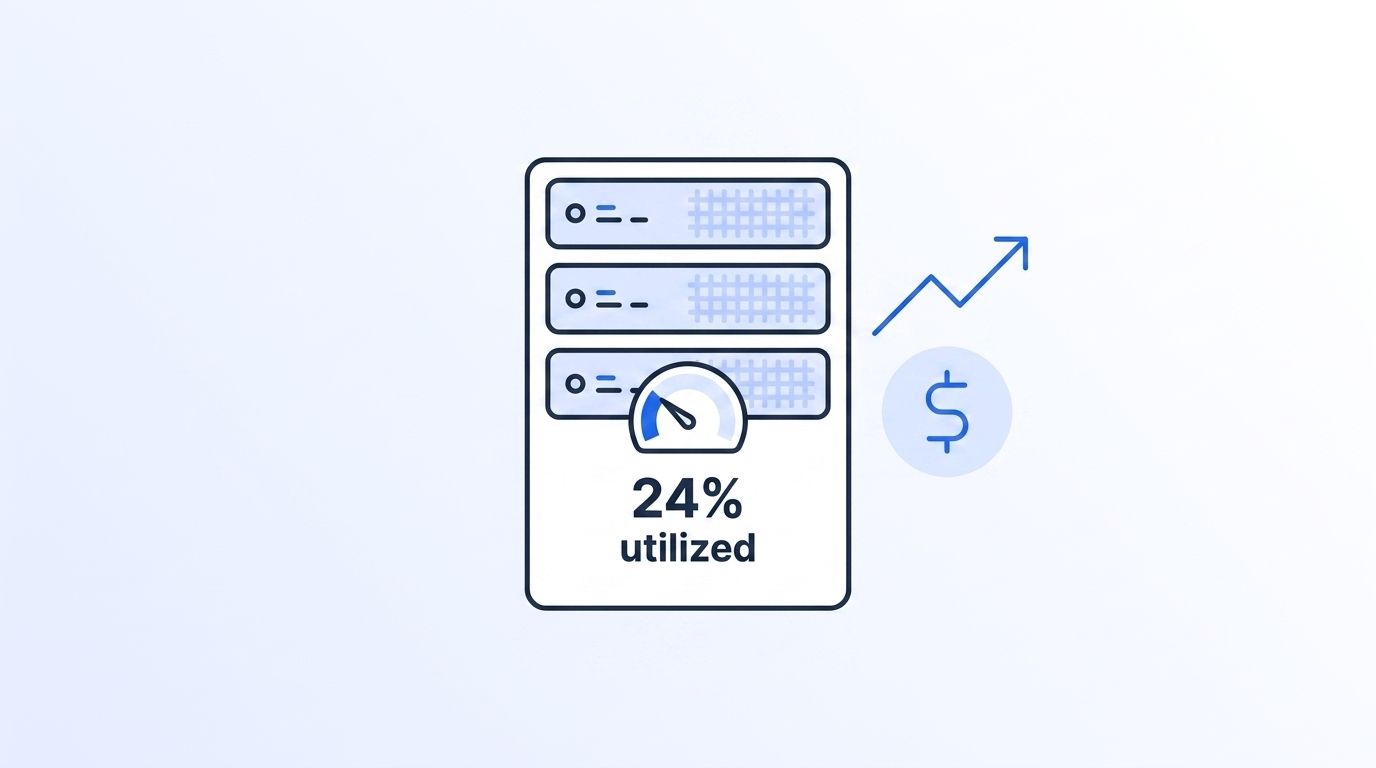
| CPU Utilization | High during the run window, idle otherwise | Often under 25% average, held in reserve for spikes |
| Build/Maintain Cost | Simpler to stand up with existing ETL tools | Up to 8x more to build, 2x+ more to maintain in-house |
| Data Freshness | As stale as the last scheduled run | Continuously current as events fire |
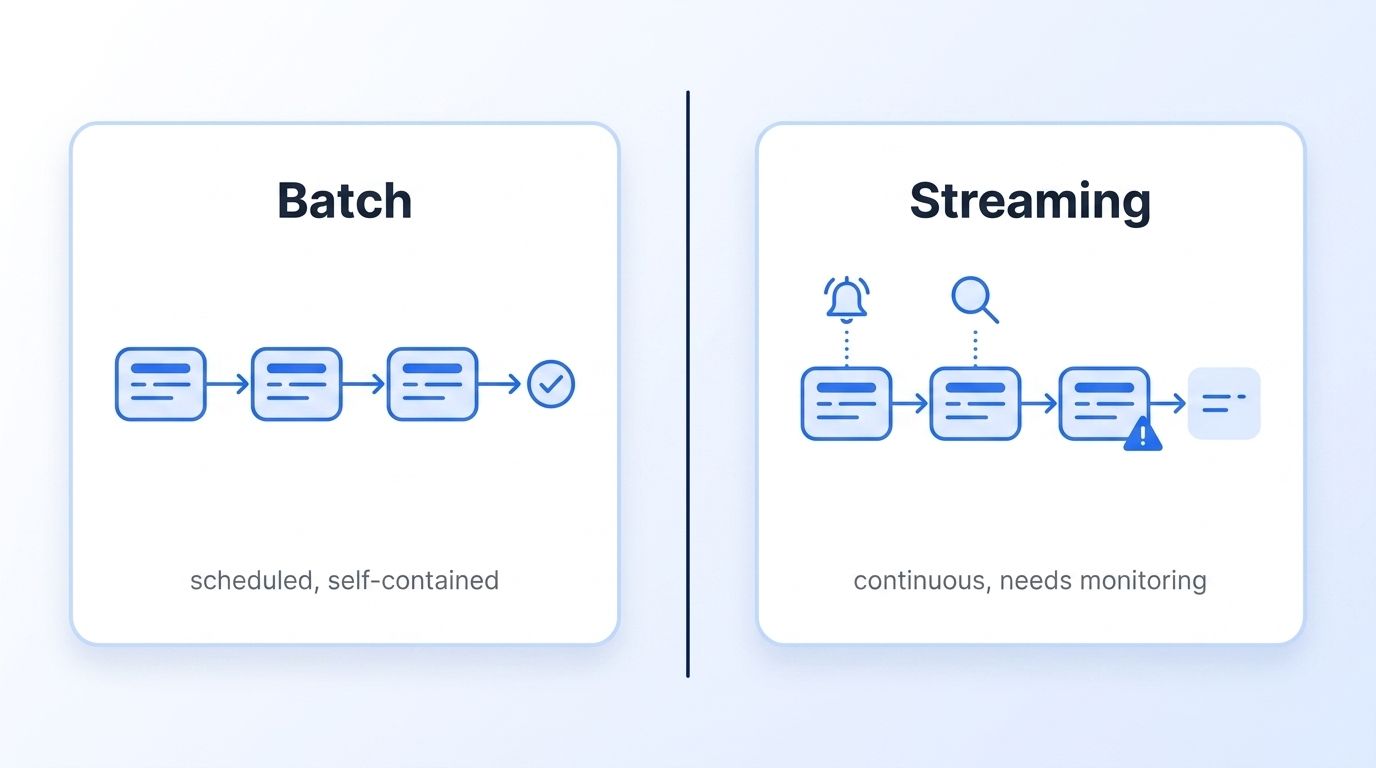
| Failure Handling | A failed job delays the whole batch until the next cycle | A dropped event can be retried or replayed independently |
| Operational Complexity | Low — cron job or scheduled DAG | Higher — needs monitoring, backpressure handling, alerting |
| Our Verdict | Wins on cost and simplicity | Wins on time-to-value for revenue-critical workflows |
Which Has Lower Infrastructure Cost?
Batch enrichment wins on raw infrastructure cost, and it isn't close. A batch job spins up compute, processes a queue, and releases it — you pay for the run, not the sitting-around time. Streaming infrastructure has to stay provisioned continuously to absorb traffic spikes without dropping events, which means you're paying for capacity you use only part of the time.
In 2025, Confluent's own cost-modeling research on self-managed Kafka clusters found that organizations running streaming infrastructure in-house average under 25% CPU utilization, because the cluster has to be sized for worst-case load, not average load. That headroom isn't waste from an engineering standpoint — it's insurance against dropped events — but it shows up on the infrastructure bill every month whether you use it or not.
Building that infrastructure yourself compounds the gap. Confluent's 2025 total-cost-of-ownership analysis found self-built streaming platforms can cost up to 8x more to build and more than 2x more to maintain than a managed alternative. Batch tooling, by comparison, layers onto ETL frameworks most data teams already run. Verdict: batch wins on infrastructure cost — but that's only half the cost equation, and the other half belongs to streaming.
Which Delivers Enriched Data Faster?
Streaming enrichment wins on latency by two to three orders of magnitude. A well-built real-time enrichment API returns a matched, structured record in well under a second — not because the underlying lookup is instant, but because the record is served the moment it's requested instead of waiting in a queue. Batch enrichment, by design, has no latency constraint on the request path at all; it just delays actionability until the next scheduled run.
Production-grade real-time enrichment APIs commonly target p50 latency around 150-200ms and p95 under 500ms for cached or recently-indexed records, according to engineering benchmarks published by data-infrastructure vendors in 2025. Batch pipelines, by contrast, typically run on hourly or nightly cycles — a lead captured at 9 AM might not be enriched until the 2 AM batch run, sitting unactionable for the better part of a day.
That gap matters most for anything tied to a live human decision — lead routing, real-time signal alerts, or form-fill enrichment on your website. It matters far less for a quarterly database cleanup, where nobody's waiting on the result. Datamagnet's signal API delivers job-change and engagement events over webhooks the moment they're detected, which is the streaming pattern in practice. Verdict: streaming wins decisively on latency — batch has no mechanism to compete once a human is waiting on the other end.
Which Keeps Your Data Fresher?
Streaming enrichment keeps data fresher because it never stops checking. Batch enrichment, however fast the job itself runs, is only ever as current as its last scheduled execution — and B2B contact data doesn't wait politely for the next run.
In 2025 and 2026, HubSpot's database decay research put the monthly B2B contact decay rate at roughly 2.1%, compounding to about 22.5% of a database going stale within a single year. As of 2026, ZoomInfo's own pipeline data lands in a similar range, estimating 25-30% annual decay — a ten-thousand-record database loses 2,500 to 3,000 usable contacts a year without continuous refresh. Two independent vendors landing in the same band is a stronger signal than either figure alone.
Run the math against a monthly batch cycle: by the time the next refresh fires, roughly 2% of the records it's about to "fix" are already stale again, and the ones it missed last cycle have kept decaying the whole time. Streaming enrichment doesn't eliminate decay — nothing does — but it shrinks the window between a record going stale and getting corrected from a month to effectively zero. That's the real argument for real-time people and company enrichment over a scheduled refresh: it isn't speed for its own sake, it's shrinking the decay window.
Which Wins on Revenue Impact?
Streaming enrichment wins on revenue impact because sales response time isn't a nice-to-have — it's one of the most heavily studied variables in B2B pipeline conversion. The MIT/InsideSales.com Lead Response Management Study, built on more than 15,000 leads and 100,000 call attempts across six companies, found that contacting a web-generated lead within 5 minutes instead of 30 minutes raises the odds of qualifying that lead by 21x. The odds of making contact at all rose by roughly 100x.
Validity's 2025 State of CRM Data Management survey, based on 602 CRM users, found 37% had directly lost revenue because of poor data quality, and 76% said less than half their CRM data was accurate or complete. A batch-enriched record sitting in a queue for hours isn't just stale — during that window, it's also unroutable, which means the rep who should be calling that lead doesn't even know it exists yet.
The pattern across both studies points to the same conclusion: response-time economics and data-freshness economics are really the same problem measured two different ways. A lead can't be called in 5 minutes if the enrichment that qualifies it for routing hasn't landed yet — which means enrichment latency is upstream of every sales-velocity stat teams already track. Verdict: streaming wins on revenue impact — it's the only architecture fast enough to feed a 5-minute response window.
Which Is Easier to Build and Maintain?
Batch wins on operational simplicity, and this is where most teams start for good reason. A batch pipeline is a scheduled job — it runs, it finishes, and if it fails, it fails in a predictable, contained window that a retry can usually fix before the next cycle even notices. Most data teams already have the ETL tooling to support it without adding new infrastructure.
Streaming pipelines demand standing operational discipline: monitoring for backpressure, alerting on consumer lag, and a plan for what happens when an event fails mid-flight instead of at a clean batch boundary. That's exactly why Confluent's over-provisioning finding above isn't wasteful engineering — it's the cost of keeping a live pipeline from silently dropping events under load.
There's no independently published, enrichment-specific failure-rate benchmark comparing batch and streaming pipelines head-to-head — a genuine gap in the public research, and one worth naming rather than papering over with a number that doesn't hold up. What is well established qualitatively: a failed batch job delays an entire cohort of records until the next run, while a dropped streaming event can typically be retried or replayed on its own without holding up everything behind it. Verdict: batch is easier to build and maintain — streaming asks for more operational maturity in exchange for the latency it delivers.
Which Fits Where the Industry Is Heading?
Streaming is where enterprise data infrastructure is headed, even for teams not ready to move today. In 2025, Confluent's Data Streaming Report — based on a survey of 4,175 IT leaders across 12 countries — found 90% planned to increase their data streaming investment that year, and 44% reported at least 5x ROI from streaming initiatives, up from 41% in 2024.
Gartner's forecasting points the same direction at a steeper angle. As of 2025, Gartner projects streaming adoption tied to real-time and agentic AI use cases will grow from under 15% of organizations to more than 60% by 2028 — a shift from early-adopter territory to majority practice inside three years.
None of that means batch disappears. Nightly reconciliation jobs, historical backfills, and large one-time data migrations are still batch problems, and they'll stay that way regardless of where streaming adoption trends. What's shifting is which workloads default to streaming — anything touching an active buyer, an active candidate, or a live CRM record is migrating toward real-time by default, not by exception.
Pricing and Total Cost of Ownership
For a typical mid-market GTM team enriching tens of thousands of records a month, batch usually costs less on the compute line and more on the opportunity-cost line — while streaming flips that ratio. A nightly batch job against a CRM export runs on modest, schedulable compute and finishes in a defined window, so the visible bill stays low and predictable. A streaming pipeline covering the same volume needs standing infrastructure sized for peak concurrent load, which shows up as a steadier, usually higher monthly number.
The free-tier and pay-as-you-go layer matters more than the sticker price for most teams evaluating this trade-off. A pay-per-record enrichment API — like Datamagnet's people and company endpoints — lets a team get real-time latency without owning streaming infrastructure at all; you're paying for the API call, not the cluster underneath it. That reframes the batch-vs-streaming cost question from "which architecture is cheaper to run" to "who's carrying the infrastructure cost — you or your vendor," and it's worth checking your credit balance regularly against usage either way.
Hidden costs run in both directions. Batch pipelines hide the cost of delay — stale records routed to the wrong rep, or a signal missed entirely between runs. Self-built streaming hides the maintenance tax Confluent's TCO research flagged at up to 8x the build cost and 2x-plus the ongoing maintenance cost of a managed alternative.
The "batch vs. streaming" framing usually hides a third, cheaper option: neither side actually has to own the infrastructure. Teams debating whether to self-host Kafka or run cron jobs are often solving an infrastructure problem when the real question is a vendor question — who's paying for the idle capacity, you or the API provider. Value verdict: managed real-time APIs largely dissolve this trade-off — you get streaming-grade latency without owning streaming-grade infrastructure.
Who Should Choose What
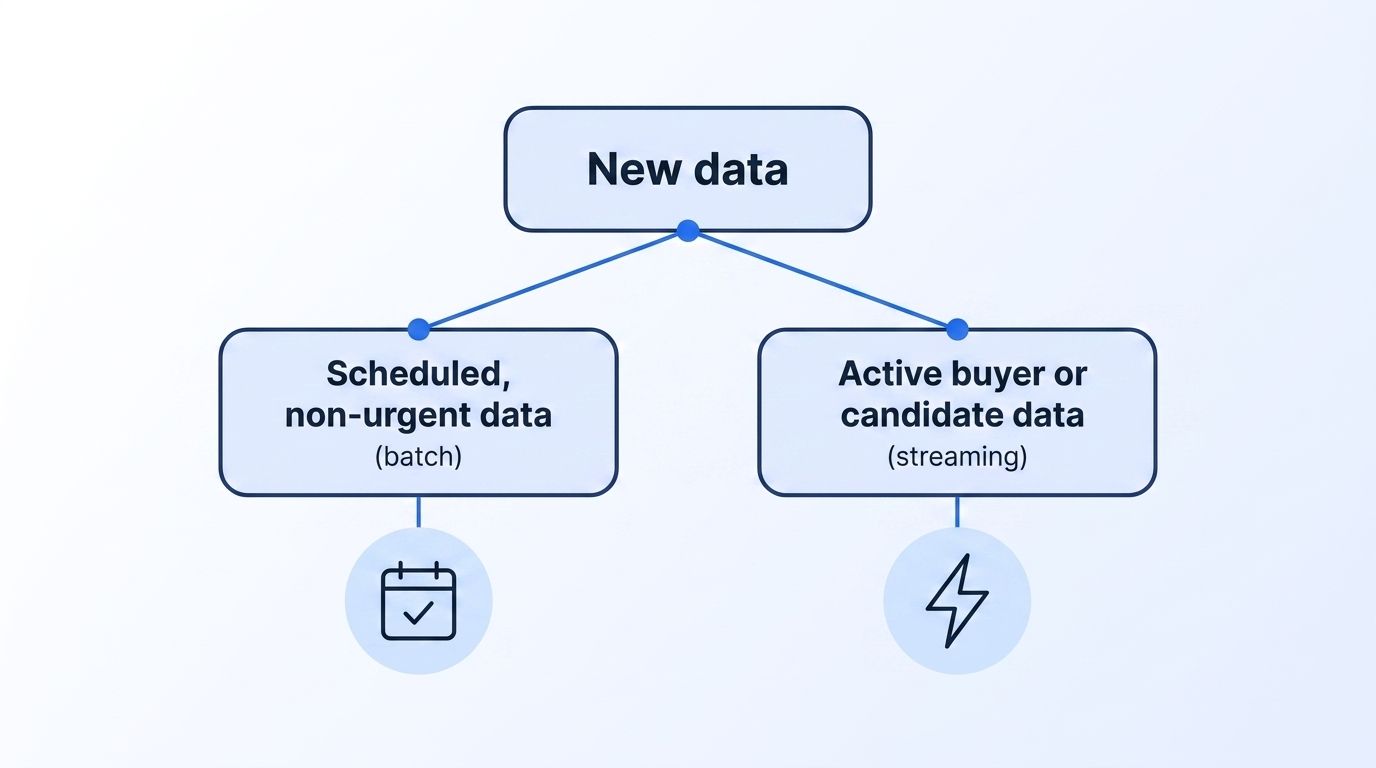
Data teams running nightly CRM hygiene or large historical backfills: stick with batch. There's no active buyer waiting on a quarterly deduplication job, so the latency cost is zero and the infrastructure savings are real.
RevOps and sales teams routing inbound leads: move to streaming enrichment. The MIT/InsideSales response-time data makes this close to a non-negotiable, since a batch-enriched lead sitting in queue for hours is a lead a competitor's rep calls first.
Teams building signal-based selling or champion-tracking workflows: streaming is the only option that works at all — job-change and engagement signals lose most of their value if they arrive a day after the event. Datamagnet's signal creation endpoint and HubSpot integration both enrich and route on the event itself, not on a schedule.
Small teams without dedicated data infrastructure: don't build either one from scratch. A managed, pay-as-you-go enrichment API gets you streaming-grade latency without the operational overhead of running Kafka yourself — see our guide on real-time B2B people enrichment for the implementation pattern.
Frequently Asked Questions
Is streaming enrichment always more expensive than batch?
Not on a per-record compute basis when self-hosted — batch usually wins there. But when you factor in the cost of delayed routing and stale records, streaming often comes out ahead on total value delivered, especially for time-sensitive workflows like lead response, where the MIT/InsideSales study found a 21x swing in qualification odds tied to response speed.
Can I use batch and streaming enrichment together?
Yes, and most mature GTM data stacks do exactly that. A common pattern uses streaming enrichment for inbound leads and signal events that need immediate routing, paired with a nightly or weekly batch job to catch records the real-time layer missed and keep the broader database clean.
How much does self-managed streaming infrastructure cost compared to a managed API?
Confluent's 2025 total-cost-of-ownership analysis found self-built streaming platforms can cost up to 8x more to build and more than 2x more to maintain than a managed alternative. A pay-per-record API sidesteps that entirely, since the vendor owns the streaming infrastructure and you pay per enriched record.
How fast does B2B contact data actually go stale?
HubSpot's database decay research puts the monthly decay rate at roughly 2.1%, compounding to about 22.5% of a database going stale within a year. ZoomInfo's own pipeline research lands in a similar 25-30% annual range, which is why a batch snapshot older than a few weeks should be treated as provisionally accurate, not current.
Is batch enrichment obsolete in 2026?
No. Gartner forecasts streaming adoption growing from under 15% to over 60% of organizations by 2028, but that's adoption for real-time and agentic AI use cases specifically, not a wholesale replacement of batch. Historical backfills, large-scale deduplication, and non-urgent database hygiene remain legitimately batch problems.
The Verdict
| Category | Winner |
|---|---|
| Infrastructure cost | Batch |
| Latency | Streaming |
| Data freshness | Streaming |
| Revenue impact / response time | Streaming |
| Build and maintenance simplicity | Batch |
| Industry trajectory | Streaming |
| Overall | Streaming for anything touching an active buyer or candidate — batch for scheduled, non-urgent hygiene work |
Every enrichment architecture question we get from GTM engineering teams eventually reduces to the same one: is a human or a workflow waiting on this record right now? When the answer is yes, batch's cost advantage evaporates the moment a lead goes cold waiting for the next scheduled run. When the answer is no, streaming's latency advantage buys nothing worth paying for.
If your team is still routing leads off a nightly enrichment job, that's the workflow worth migrating first. Datamagnet's real-time company and people APIs return enriched records inline, so you can test the latency difference against your own pipeline before committing to a full architecture change.
