
Disclosure: Datamagnet publishes this article. Apollo.io product details described below are based on Apollo's public documentation. Apollo does not publish dollar figures in static page content, so pricing details are based on third-party pricing trackers instead — both sets of sources retrieved September 20, 2026.
Apollo.io API: Endpoints, Credits, Rate Limits and Limitations
The Apollo.io API gives developers programmatic access to people enrichment, organization enrichment, search, and CRM-style objects like sequences and deals, billed through a shared credit pool that also powers Apollo's web app. If you're scoping a pipeline build, the two numbers that matter most are how many credits each call burns and how many requests your plan lets you fire per minute before you hit a 429.
This guide walks through Apollo's actual documented endpoints, how its credit system prices each one, the rate limits by plan tier, and the structural limitations developers run into once they move past a prototype and into production volume. If you're running the same evaluation against Datamagnet, its quickstart guide covers key generation and your first request in the same amount of detail.
TL;DR
- Apollo's People Enrichment endpoint costs 1 credit for email/demographic data, plus 8 more credits if it returns a mobile number (Apollo.io API Pricing docs, retrieved 2026-09-20).
- Rate limits scale by plan: Free caps standard endpoints at 600 requests/day, while Organization allows 6,000/day (Apollo.io Rate Limits docs, retrieved 2026-09-20).
- API access starts on the Basic plan, roughly $49/user/month billed annually per third-party pricing trackers since Apollo's own page doesn't expose figures in static content (Warmly, Apollo Pricing 2026, retrieved 2026-09-20), and enrichment/export volume both scale with plan tier.
- Apollo's People Search endpoint is free (0 credits) to run, but enrichment and mobile reveals are where the credit meter moves fastest at bulk volume.
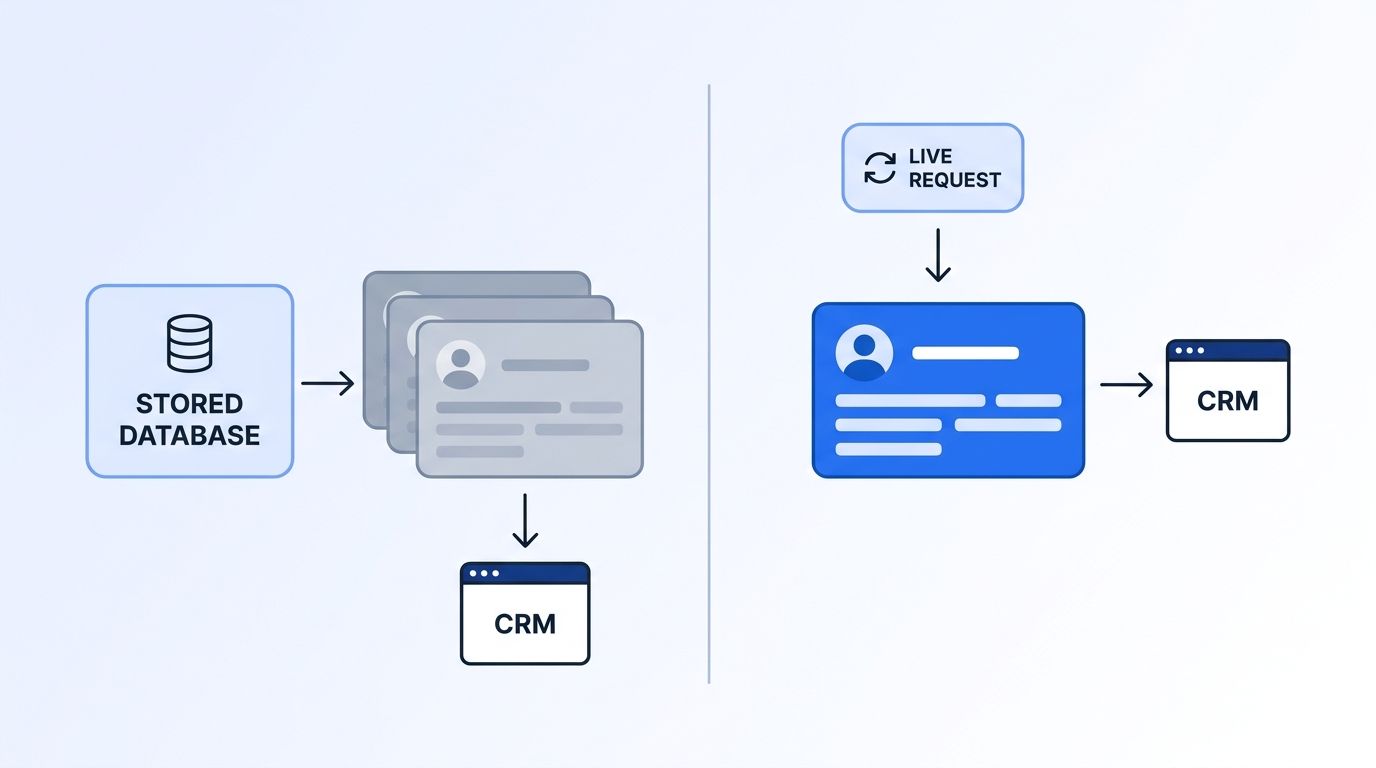
- Apollo enriches against a stored database rather than fetching a person's LinkedIn profile live at request time — a structural tradeoff worth knowing before you build a pipeline around it.
What Endpoints Does the Apollo.io API Actually Offer?
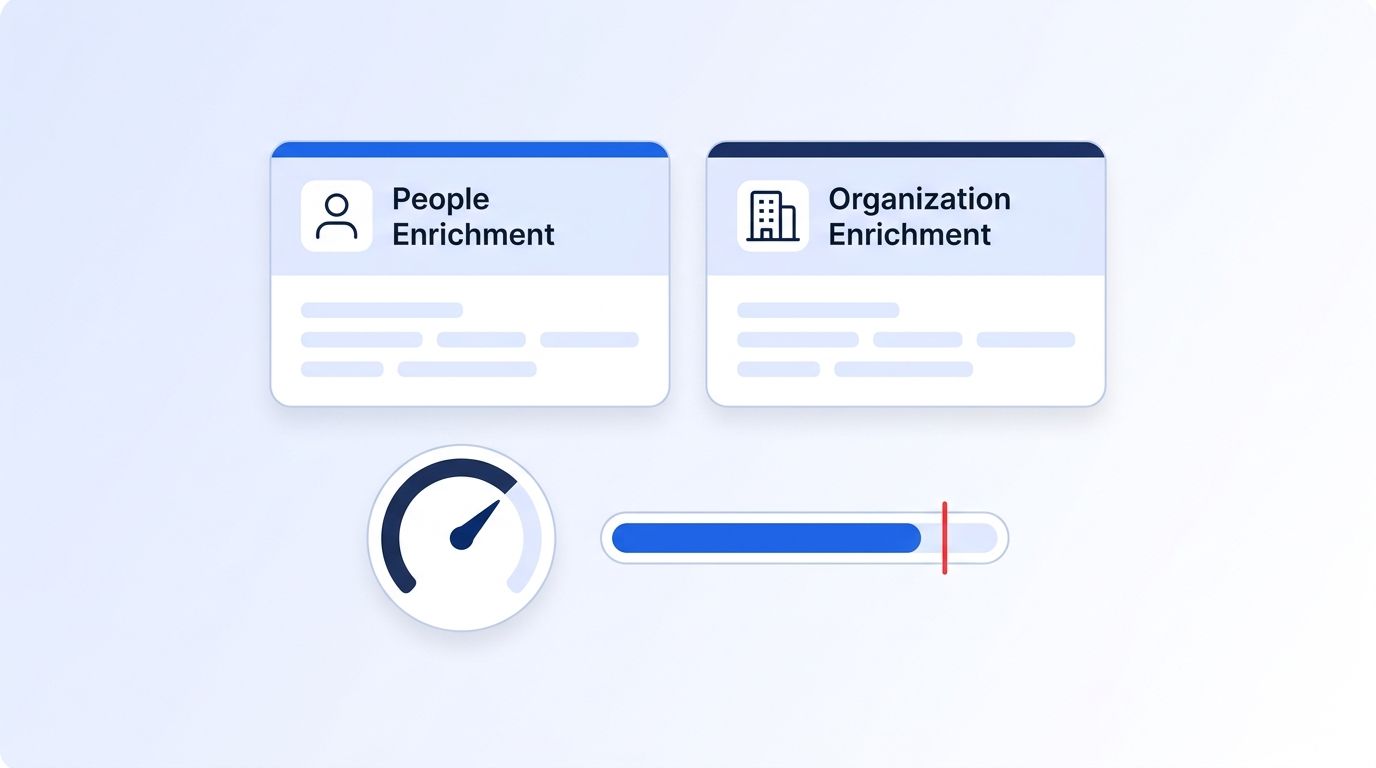
Apollo's REST API centers on two enrichment endpoints, two search endpoints, and a set of CRM-object endpoints for sequences, tasks, deals, and contacts, all authenticated with an x-api-key header or OAuth2 bearer token (Apollo.io API docs, retrieved 2026-09-20). That's a broader surface than a pure data API — Apollo's endpoints double as the backend for its own outbound sequencing product. Datamagnet's API uses a comparable bearer-token authentication model, so the request-signing pattern will feel familiar if you're porting a pipeline over.
The core data endpoints break down like this:
| Endpoint | Method | What It Returns |
|---|---|---|
| People Enrichment | POST /v1/people/match | Single person match by email, name, or LinkedIn URL |
| Bulk People Enrichment | POST | Up to 10 people per call |
| Organization Enrichment | POST | Single company match by domain |
| Bulk Organization Enrichment | POST | Up to 10 companies per call |
| People Search | POST /v1/mixed_people/api_search | Filtered person search across Apollo's database |
| Organization Search | POST | Filtered company search, paginated |
| Sequences, Tasks, Deals, Contacts, Accounts | Various | CRM-style objects for outbound workflows |
| Email Accounts | GET | Lists connected mailboxes used with sequence sends |
Datamagnet's closest equivalents to Apollo's two search endpoints are its own People Search and ICP Company Search endpoints, both built for the same filtered-lookup use case without the CRM objects bundled in.
Isn't it worth asking whether you need the CRM layer at all? If your pipeline only needs enrichment and search, half of Apollo's documented endpoints are dead weight you'll never call — but you're still paying into the same credit pool that funds them. Datamagnet's People Profile endpoint takes the opposite approach, sticking to a single-purpose lookup rather than bundling in sequencing and deal objects. If you're weighing whether to build enrichment workflows on top of a bundled CRM layer or keep the two decoupled, see Datamagnet's take on programmatic CRM enrichment.
How Do Apollo API Credits Work?
Apollo prices most calls in credits, and the exact cost depends on what the call returns, not just which endpoint you hit. A People Enrichment call costs 1 credit when it returns email or demographic data, jumps to 9 credits total if it also reveals a mobile number, and costs 0 credits if no billable data comes back (Apollo.io API Pricing, retrieved 2026-09-20).
That mobile-number surcharge is the line item that catches teams off guard at scale. Enriching 10,000 contacts where even a third return a mobile number adds roughly 24,000 extra credits beyond the base enrichment cost — a real budget line, not a rounding error.
| Action | Credit Cost |
|---|---|
| People Enrichment (email/demographic) | 1 credit |
| People Enrichment (+ mobile number revealed) | +8 credits (9 total) |
| Waterfall email enrichment | ~1-4 credits (up to 20+ for hard matches) |
| Waterfall phone enrichment | ~8-25 credits (up to 45+ for hard matches) |
| Organization Enrichment | 1 credit per company |
| Organization Search | 1 credit per page (up to 100 results) |
| People Search | 0 credits |
Export and conversation-intelligence credits draw from a separate pool from enrichment credits, according to Apollo's own pricing documentation. Budget for both pools separately if your pipeline both enriches records and pulls call/conversation data — treating them as one shared number will throw off your cost forecasting.
<!-- [UNIQUE INSIGHT] -->Most cost estimates for Apollo pipelines only model the base 1-credit enrichment cost, then get blindsided when mobile-number reveals push real spend 3-5x higher than the forecast. Model your credit budget around your expected mobile-match rate, not the advertised per-record floor. If you're weighing a credit-based API, check the provider's credit balance endpoint before you commit, so you can monitor spend programmatically instead of getting surprised by a dashboard once a month.
What Are Apollo's API Rate Limits by Plan?
Apollo enforces per-minute, per-hour, and per-day rate limits that scale up as you move to higher plan tiers, and every documented tier shares the same ceiling until you reach Organization (Apollo.io Rate Limits docs, retrieved 2026-09-20). Exceed your limit and the API returns an HTTP 429, which means your pipeline needs backoff logic built in from day one, not bolted on after your first outage. If you're evaluating a second provider's throttling behavior alongside Apollo's, Datamagnet's API error reference documents its own rate-limit and validation error codes for the same kind of comparison.
| Plan | Standard (min/hr/day) | Enrichment (min/hr/day) | Search (min/hr/day) |
|---|---|---|---|
| Free | 50 / 200 / 600 | 50 / 200 / 600 | 50 / 200 / 600 |
| Basic | 200 / 400 / 2,000 | 1,000 / no limit / no limit | 200 / 6,000 / 50,000 |
| Professional | 200 / 400 / 2,000 | 1,000 / no limit / no limit | 200 / 6,000 / 50,000 |
| Organization | 200 / 600 / 6,000 | 1,000 / no limit / no limit | 200 / 6,000 / 50,000 |
Citation capsule: Apollo's Free plan caps standard API calls at 50 requests a minute and 600 a day, while its Organization tier raises the daily ceiling to 6,000 — a 10x jump that matters if you're enriching a live inbound list rather than running a one-time batch import.
How Much Does Apollo Cost for API Access?
Apollo bundles API access into its standard per-seat pricing rather than selling it as a separate SKU, and access starts on the Basic plan. Apollo's pricing page doesn't display dollar figures in static content, so the numbers below come from third-party pricing trackers that monitor Apollo's checkout flow directly: Free ($0), Basic (around $49/user/month billed annually), Professional (around $79/user/month billed annually), and Organization (around $119/user/month billed annually, minimum 3 seats) — with monthly billing running roughly 20% higher on each paid tier (Warmly, Apollo Pricing 2026, retrieved 2026-09-20). Treat these as directionally accurate rather than contractual, and verify current figures with Apollo sales before budgeting.
| Plan | Approx. Price (annual billing) | Approx. Annual Credits | API Access |
|---|---|---|---|
| Free | $0/user/mo | ~900 | Limited, low rate caps |
| Basic | ~$49/user/mo | ~30,000 | Included |
| Professional | ~$79/user/mo | ~48,000 | Included, adds AI research tools |
| Organization | ~$119/user/mo, 3-seat minimum | ~72,000 | Included, higher rate ceilings |
Source: Warmly, Apollo Pricing 2026, retrieved 2026-09-20 — Apollo's own pricing page renders figures dynamically and doesn't publish them in static content.
Higher-volume or custom rate-limit needs typically require an Enterprise or custom contract rather than a self-serve plan. That's a common pattern across sales-intelligence platforms — several large B2B data vendors, ZoomInfo included, don't publish self-serve API pricing at all and route API access through a sales conversation instead, which makes Apollo's published tiers relatively transparent by comparison even with the caveats above. See Datamagnet vs. ZoomInfo for how a pay-as-you-go credit model compares to annual seat contracts that require a sales call. For a look at Datamagnet's own pay-as-you-go credit pricing without per-seat minimums, compare against Apollo's tiers above.
Where Does the Apollo API Fall Short for Pipelines?
The biggest structural limitation is that Apollo enriches against a stored, periodically-refreshed database rather than fetching a person's current LinkedIn profile at the moment you call the API. That's a fine tradeoff for a one-time list cleanse. It's a worse tradeoff for a pipeline that needs to know someone's job title today, not whenever Apollo's database last refreshed that record.
A few other limitations developers commonly run into once a pipeline moves past a handful of test calls:
- Mobile-reveal costs scale fast. The +8-credit surcharge per mobile number means bulk enrichment runs can burn through a monthly allotment faster than the base per-record price suggests.
- Low-tier rate limits throttle real pipelines. A 50-request-per-minute cap on Free is workable for a demo, not for a live CRM sync processing hundreds of records an hour.
- Data freshness depends on refresh cycles, not request time. Because Apollo matches against a stored database, a contact who changed jobs last week may not show up updated until Apollo's own backend refreshes that record. Coresignal and People Data Labs share this same periodic-refresh tradeoff — see Datamagnet vs. Coresignal or Datamagnet vs. People Data Labs for how a live-fetch model compares to a snapshot database. A job change is exactly the kind of event a stale snapshot misses — Datamagnet's guide to real-time job-change intent signals covers how live detection closes that gap.
- Community accuracy complaints exist, though unverified by Apollo itself. Some developer forums and review sites report lower real-world accuracy on direct-dial phone numbers than Apollo's own marketing claims — treat any specific accuracy percentage you see outside Apollo's own docs as anecdotal, not measured.
Teams that scope an Apollo-based pipeline around the advertised 1-credit enrichment price alone tend to blow through their monthly allotment within the first few weeks, once mobile reveals and waterfall lookups start hitting the higher end of their credit ranges. Model the worst case, not the floor.
Which API Fetches LinkedIn Data Live Instead of a Stored Database?
Datamagnet is the live-fetch alternative: it pulls a LinkedIn person or company profile at the moment you call the API, for 1 credit per request, rather than matching against a stored snapshot (Datamagnet People Profile endpoint, retrieved 2026-09-20). That matters most for pipelines that check a contact right before a rep acts on it, where a week-old snapshot is already stale.
Datamagnet also covers ground Apollo's API doesn't: ICP company and people search and Sales Navigator URL search for building lead lists, post engagement and job-change signals for timing outreach, and company firmographic lookups pulled straight from a company's live LinkedIn page. To be direct about the tradeoff: Datamagnet does not return email addresses or phone numbers. If your pipeline needs verified contact details alongside profile data, that's a real gap worth weighing against Apollo's mobile-reveal credits.
For a fuller side-by-side on pricing model, data freshness, and endpoint coverage, see the Datamagnet vs. Apollo comparison. You can also see how live LinkedIn enrichment works in practice, or read how one team built a real-time B2B people enrichment pipeline on top of it, before deciding which model fits your pipeline.
Frequently Asked Questions
What does the Apollo.io API cost?
Apollo bundles API access into its per-seat plans rather than selling it separately. Access starts on the Basic plan, priced around $49/user/month billed annually according to third-party pricing trackers (Warmly, 2026), since Apollo's own pricing page doesn't publish dollar figures in static content. Professional and Organization tiers add more credits and higher rate limits. Always check with Apollo sales before budgeting, since tiers change.
How many credits does the Apollo API use per contact?
A single People Enrichment call costs 1 credit for email or demographic data, plus 8 more credits (9 total) if it returns a mobile number (Apollo.io API Pricing, retrieved 2026-09-20). Organization Enrichment costs 1 credit per company, and People Search is free at 0 credits.
What are Apollo's API rate limits?
Rate limits scale by plan. Free caps standard endpoints at 50 requests/minute and 600/day, while Organization allows up to 200/minute and 6,000/day on standard endpoints (Apollo.io Rate Limits docs, retrieved 2026-09-20). Exceeding your limit returns an HTTP 429 error.
Is Apollo's API data live or from a stored database?
Apollo's enrichment and search endpoints match against a stored, periodically-refreshed database rather than fetching a person's current LinkedIn profile at request time. That means a contact record can lag behind a recent job change until Apollo's backend refreshes it, which matters for time-sensitive pipelines.
What's an alternative to Apollo's API for live LinkedIn data?
Datamagnet fetches LinkedIn person and company profiles live at request time for 1 credit per call, and adds ICP search, Sales Navigator URL search, post engagement data, and job-change signals. It does not return emails or phone numbers, so teams needing verified contact details should weigh that gap against Apollo's mobile-reveal credits.
Sources
- Apollo.io, API Pricing (credits per action), retrieved 2026-09-20, https://docs.apollo.io/docs/api-pricing
- Apollo.io, Rate Limits, retrieved 2026-09-20, https://docs.apollo.io/reference/rate-limits
- Apollo.io, People Enrichment API Reference, retrieved 2026-09-20, https://docs.apollo.io/reference/people-enrichment
- Apollo.io, People API Search Reference, retrieved 2026-09-20, https://docs.apollo.io/reference/people-api-search
- Warmly, Apollo Pricing 2026 (third-party pricing tracker, used since Apollo's own pricing page doesn't publish dollar figures in static content), retrieved 2026-09-20, https://www.warmly.ai/p/blog/apollo-pricing
- Datamagnet, People Profile endpoint, retrieved 2026-09-20, https://docs.datamagnet.co/api-reference/endpoints/people
- Datamagnet, Company Profile endpoint, retrieved 2026-09-20, https://docs.datamagnet.co/api-reference/endpoints/company
