
Disclosure: This article is published by Datamagnet. Vendor claims are self-reported unless otherwise noted.
AI SDR Data: MCP vs REST API for Live Data (2026)
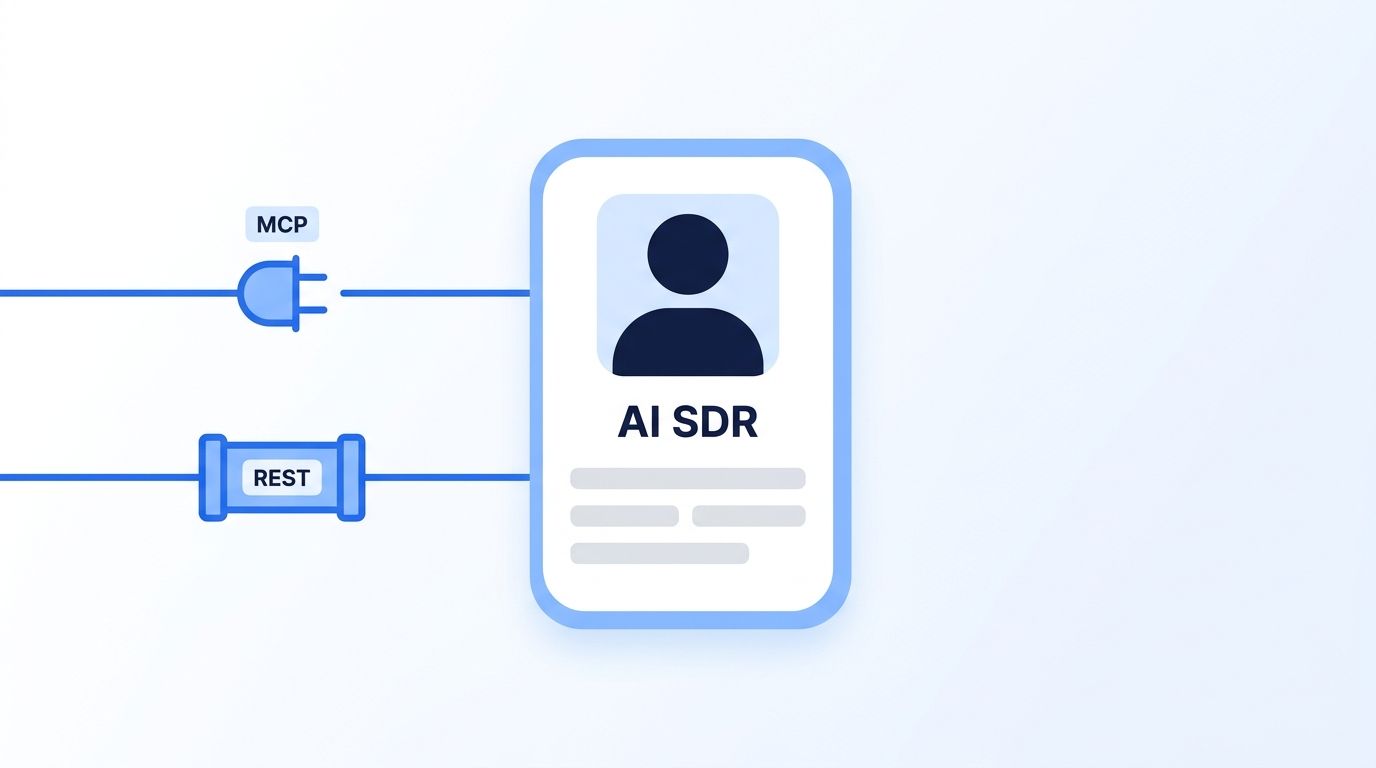
Your AI SDR is only as good as the data it reads. If that data is a month old, the agent will email people who have already left the company. You have two main ways to feed it live data: the Model Context Protocol (MCP) or a plain REST API. For a production AI SDR, a REST API is the safer default today. MCP wins when a human is in the loop and you want fast setup.
Key Takeaways
- REST suits unattended AI SDRs: predictable, secure, cheap on tokens. One Anthropic example cut tool-definition overhead from 150,000 tokens to 2,000 (Anthropic Engineering, 2025).
- MCP suits chat-style prototyping, where a rep supervises and setup takes an afternoon.
- Choose REST if your agent runs on a schedule or reacts to signals.
Why Does an AI SDR Need Live Data?
In 2026, Salesforce's survey of 4,050 sales professionals found that 54% have already used AI agents, and 55% use AI for prospecting (Salesforce, "The Productivity Gap: New Survey Shows 9 in 10 Sellers Are Betting on AI and Agents To Help", Feb 3, 2026). Agents are already working your pipeline. Stale data makes them wrong at scale.
The same Salesforce report says 51% of sales leaders with AI report that disconnected systems slow their AI initiatives. Data access, not the model, is the usual bottleneck.
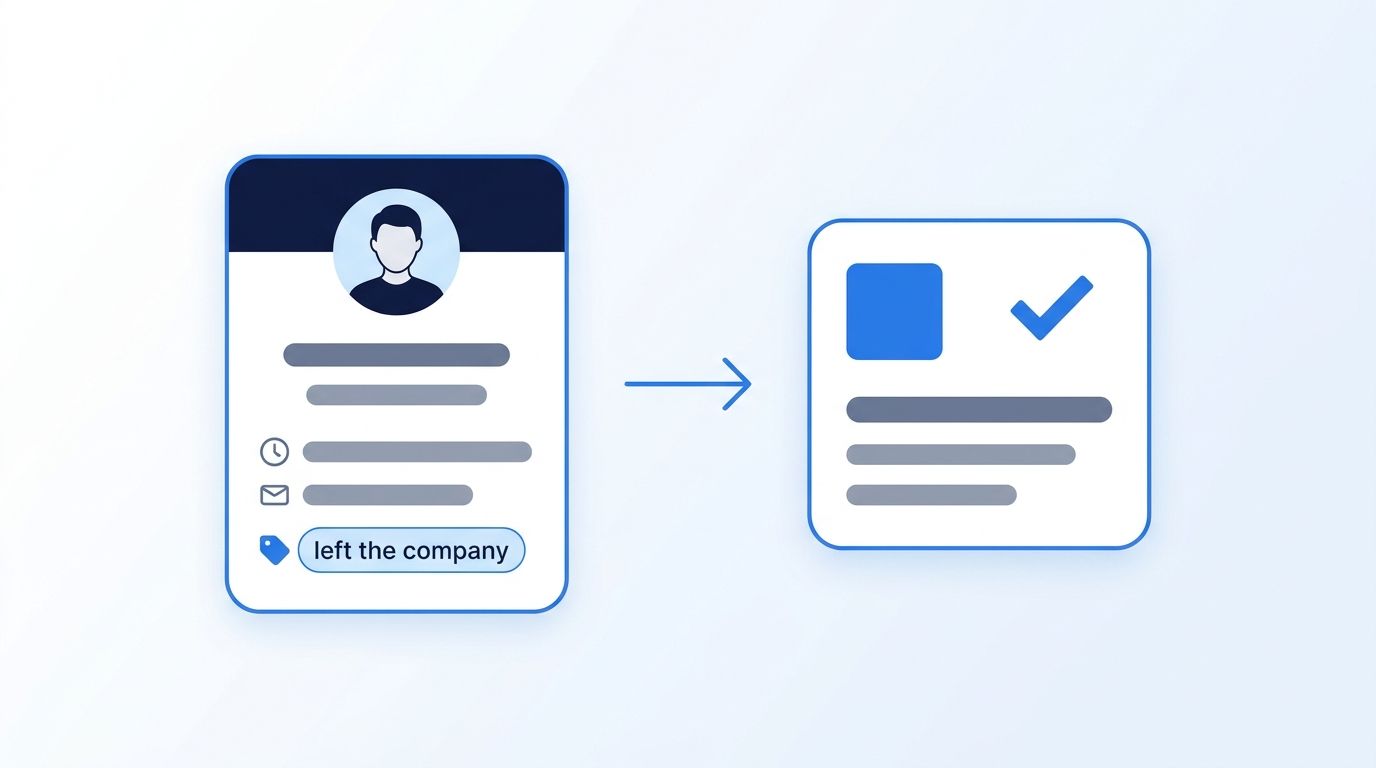
People move. The U.S. Bureau of Labor Statistics reported that median tenure with a current employer was 4.1 years in January 2026 (BLS, "Employee Tenure Summary", Sep 2026). That's a general workforce number, not a B2B one. Still, it means contacts turn over constantly, and a static list ages quietly.
A human rep spots a stale record when something feels off. An agent has no such instinct. It trusts whatever the data layer returns, so freshness has to be built into the connection itself. That's the real MCP-versus-REST question.
What Are MCP and REST, in Plain English?
Anthropic released MCP on Nov 25, 2024, as "an open standard" for connecting AI assistants to the systems where data lives (Anthropic, "Introducing the Model Context Protocol", Nov 25, 2024). Think of it as a universal plug. An agent connects to an MCP server and discovers which tools it can call.
A REST API is the older, simpler pattern. Your code sends an HTTP request with a URL and a token, and gets JSON back. You decide when to call it and with what. The agent never "discovers" anything.
MCP has real momentum. In December 2025, Anthropic said there were more than 10,000 active public MCP servers and 97M+ monthly SDK downloads, and that it was donating MCP to the Linux Foundation's Agentic AI Foundation (Anthropic, "Donating the Model Context Protocol and establishing the Agentic AI Foundation", Dec 9, 2025).
Here's the catch. MCP usually sits on top of an API. The server you connect to still calls REST endpoints underneath. So it's less "MCP or REST" and more "who decides when the call happens?"
How Do MCP and REST Compare Side by Side?
REST wins four of the six rows below for unattended agents, and MCP wins two. Each row carries its own source, so you can check the number yourself.
| Dimension | MCP | REST API | Source |
|---|---|---|---|
| Setup effort | Agent discovers tools automatically | You write the calls and parsing | Anthropic, Nov 25, 2024 (MCP launch post) |
| Token overhead | Most clients load all tool definitions upfront, so context grows | Only the response you request enters context | Anthropic Engineering, "Code execution with MCP", Nov 4, 2025 |
| Large API surface | 2,500+ endpoints as tools would take over 2M tokens (Cloudflare's hypothetical) | Call only the endpoint you need | Cloudflare, "Code Mode", Feb 20, 2026 |
| Auth | Authorization is optional in the spec; HTTP transports build on OAuth 2.1 | Bearer-token auth you control | MCP spec, Authorization, 2025-11-25 |
| Human oversight | Spec says there SHOULD be a human in the loop | You design approvals yourself | MCP spec, Tools, 2025-11-25 |
| Tool-description risk | Hidden instructions in tool descriptions can steer the model | No model-readable tool descriptions | Invariant Labs, Apr 1, 2025 |
Source URLs and retrieval dates are in the source block at the bottom of this post.
Which Is Better for Setup Speed?
MCP wins on setup speed. Anthropic's launch post says the point of MCP is a standard connection between data sources and AI tools, so one integration works across many clients. Add a server to a supporting assistant, and the agent can list and call tools right away.
REST takes more work. You read the docs, write a request, handle errors, and map fields. The Datamagnet quickstart walks you through creating an account, generating an API key, configuring your client, and making your first request.
The nuance: setup speed only matters once. A scheduled AI SDR runs for months. After week one, the cost you feel is token spend and reliability, not onboarding.
Verdict: MCP for prototypes. REST once the workflow is fixed.
Which Is Cheaper on Tokens and Cost?
REST wins on cost. Anthropic Engineering notes that most MCP clients load all tool definitions upfront into the context window, which raises response time and cost. In its example, a code-execution approach cut overhead from 150,000 tokens to 2,000 (Anthropic Engineering, "Code execution with MCP: Building more efficient agents", Nov 4, 2025).
Cloudflare makes the same point. Its API has over 2,500 endpoints, and exposing each as an MCP tool would take over 2 million tokens. Its two-tool "Code Mode" design needs around 1,000 (Cloudflare, "Code Mode: give agents an entire API in 1,000 tokens", Feb 20, 2026). Both baselines are vendor examples, not universal benchmarks.
A REST call sends only what you ask for and returns only what you request. Add the data bill on top. Datamagnet charges 1 credit per profile, 10 credits per search or engagement page, and 5 credits for funding rounds. Plans run $39, $99, and $199 a month, with pay-as-you-go pricing starting at $10 (Datamagnet pricing, retrieved Nov 18, 2026).
Worked example, from those credit costs: checking funding rounds for 500 target accounts costs 500 × 5 = 2,500 credits per full sweep. Enriching 200 changed contacts costs 200 × 1 = 200 credits. That's about 2,700 credits, and it's predictable before the agent runs. For more on keeping contact records current, see real-time B2B people enrichment.
Verdict: REST. Tokens are cheaper, and so is budgeting.
Which Is More Secure?
REST wins for unattended agents. The MCP spec says authorization is optional, and that HTTP-based transports should follow its OAuth 2.1-based flow (MCP specification, Authorization, 2025-11-25). Optional means some servers will skip it. You have to check each one.
MCP has a model-specific risk too. Invariant Labs describes "tool poisoning" as malicious instructions hidden in tool descriptions, invisible to users but readable by the model (Invariant Labs, "MCP Security Notification: Tool Poisoning Attacks", Apr 1, 2025). The MCP Tools spec also says there SHOULD always be a human in the loop able to deny tool calls (MCP specification, Tools, 2025-11-25).
That last point cuts against fully autonomous SDRs. With REST, your code is the gatekeeper. The agent can only call endpoints you wire up, with a token you rotate. See Datamagnet's authentication guide for how bearer tokens work.
Verdict: REST for autonomy. MCP is fine when a human approves each action.
Which Delivers Real-Time Signals Better?
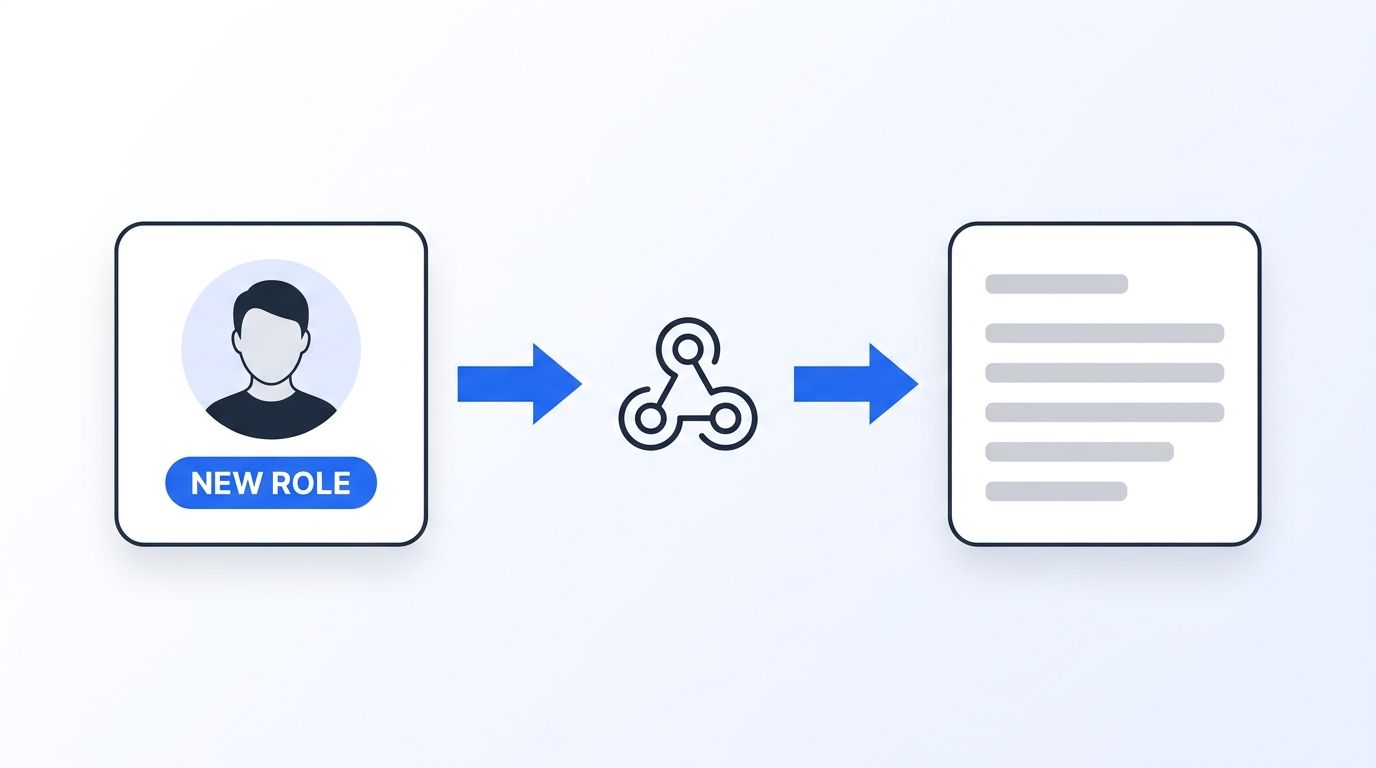
REST plus webhooks wins. MCP is pull-based. The agent has to ask. A live AI SDR needs the data to push to it the moment something changes, so it can act while the lead is still warm. Datamagnet's webhooks docs describe signal notifications sent by HTTP POST, with retries and signature verification.
So what do you do about the question we hear most? "My AI SDR needs to detect job changes, promotions and funding events in real time. What API gives me those signals?" Here's the direct answer:
- Job changes: The Signal API offers a
job_changesignal that pushes alerts by email digest or signed webhook. You create the monitor with the Create Signal endpoint. Access is sales-led, so you book a demo. There's no self-serve signup. To watch your best customers and users, see champion tracking. For a vendor-by-vendor comparison, read our guide to real-time job change signal APIs. - Promotions: The Signal API page lists
job_change, not a separate promotion signal. For title changes inside the same company, you can re-check key profiles with the People endpoint (1 credit per profile) and compare titles (see the People API page). Ask the team during your demo whether your promotion use case is covered. - Funding events: Use the funding rounds endpoint. Pass a company domain and get the Crunchbase funding history for 5 credits. It's a lookup, so you schedule it, say weekly, and compare to the last result.
One thing to confirm in your demo: which contact fields and signal types your outreach needs, since coverage is defined by the endpoints and signals in the docs. For a deeper look at the signal side, see the champion tracking cookbook.
Verdict: REST. Push beats pull for time-sensitive signals.
What About Scraping LinkedIn Yourself?
Some teams skip both options and build their own scrapers. That's a different risk profile, and a LinkedIn scraper API with structured JSON output avoids maintaining scrapers yourself. LinkedIn's User Agreement (section 8.2) says members may not use software, scripts, robots, crawlers, or browser plug-ins to scrape or copy the services, including profiles (LinkedIn, User Agreement, effective Nov 3, 2025).
LinkedIn's help page on prohibited software adds that members using such tools risk account restriction or suspension (LinkedIn Help, "Prohibited software and extensions"). If your agent runs on a personal account, that account is what's at stake.
That's a factual summary of those pages, not legal advice. Whatever route you choose, stick to public profile data, and read the terms yourself.
Who Should Choose What?
Start with one rule: if nobody is watching the agent, use REST. If someone is, MCP gets you moving faster.
An ops or RevOps lead building a scheduled outbound agent: Choose REST. Costs are predictable, and your code controls every call.
A sales rep trying an AI assistant on their own accounts: Choose MCP. Setup is quick, and you approve each action.
A GTM engineer building signal-triggered outreach: Choose REST with webhooks. Start with the AI SDR data engine, and receive signal webhooks in a workflow tool using the n8n integration or push job-change updates into your CRM with the HubSpot integration. For the CRM side, see programmatic CRM enrichment.
A team that wants both: Many teams do. They prototype with MCP, then move the proven steps to REST. If you need to find new prospects first, the ICP search API (see the ICP People Search docs) returns 25 results per page for 10 credits.
Verdict
| Category | Winner | Source for the claim |
|---|---|---|
| Setup speed | MCP | Anthropic, Nov 25, 2024 |
| Token and data cost | REST | Anthropic Engineering, Nov 4, 2025 |
| Security | REST (unattended) | MCP spec, Authorization, 2025-11-25 |
| Real-time signals | REST + webhooks | Datamagnet webhooks docs |
| Overall | REST for production AI SDRs | Combined above |
Use MCP to learn what your agent needs. Use REST to run it. Want to test the data side? Create a Datamagnet account and make your first request.
Sources
- Salesforce, "The Productivity Gap: New Survey Shows 9 in 10 Sellers Are Betting on AI and Agents To Help", Feb 3, 2026, retrieved 2026-11-18, https://www.salesforce.com/news/stories/state-of-sales-report-announcement-2026/
- U.S. Bureau of Labor Statistics, "Employee Tenure Summary", retrieved 2026-11-18, https://www.bls.gov/news.release/tenure.nr0.htm
- Anthropic, "Introducing the Model Context Protocol", Nov 25, 2024, retrieved 2026-11-18, https://www.anthropic.com/news/model-context-protocol
- Anthropic, "Donating the Model Context Protocol and establishing the Agentic AI Foundation", Dec 9, 2025, retrieved 2026-11-18, https://www.anthropic.com/news/donating-the-model-context-protocol-and-establishing-of-the-agentic-ai-foundation
- Anthropic Engineering, "Code execution with MCP: Building more efficient agents", Nov 4, 2025, retrieved 2026-11-18, https://www.anthropic.com/engineering/code-execution-with-mcp
- Cloudflare, "Code Mode: give agents an entire API in 1,000 tokens", Feb 20, 2026, retrieved 2026-11-18, https://blog.cloudflare.com/code-mode-mcp/
- MCP specification, "Authorization", 2025-11-25, retrieved 2026-11-18, https://modelcontextprotocol.io/specification/2025-11-25/basic/authorization
- MCP specification, "Tools", 2025-11-25, retrieved 2026-11-18, https://modelcontextprotocol.io/specification/2025-11-25/server/tools
- Invariant Labs, "MCP Security Notification: Tool Poisoning Attacks", Apr 1, 2025, retrieved 2026-11-18, https://invariantlabs.ai/blog/mcp-security-notification-tool-poisoning-attacks
- LinkedIn, "User Agreement", effective Nov 3, 2025, retrieved 2026-11-18, https://www.linkedin.com/legal/user-agreement
- LinkedIn Help, "Prohibited software and extensions", retrieved 2026-11-18, https://www.linkedin.com/help/linkedin/answer/a1341387
- Datamagnet, "Pricing", retrieved 2026-11-18, https://www.datamagnet.co/pricing/
Frequently Asked Questions
Is MCP better than a REST API for an AI SDR?
Not for unattended agents. In 2025, Anthropic Engineering noted that most MCP clients load all tool definitions into context upfront, which adds token cost. The MCP spec also says a human SHOULD be in the loop on tool calls. REST gives you tighter control, so use MCP for prototypes and REST for scheduled production workflows.
Does Datamagnet have an MCP server?
Datamagnet's pricing page, API docs introduction, and Signal API page, checked on Nov 18, 2026, don't mention an MCP server. Its documented interface is a REST API with bearer-token authentication and signed webhooks. You can wrap REST endpoints in your own MCP server if your agent framework needs one.
How do I get real-time job change alerts for my AI SDR?
Use the Signal API's job_change signal. It sends alerts by email digest or signed webhook, so your agent reacts as changes land. Access is sales-led: you book a demo with the Datamagnet team, since there's no self-serve signup. Confirm in the demo which contact fields your outreach needs.
How do I track funding events with an API?
Call the funding rounds endpoint with a company domain. It returns Crunchbase funding history, including amount, round type, and announcement date, for 5 credits per call. It's a lookup, not a push feed, so schedule it weekly for your target accounts and compare each result with the previous one.
