
Disclosure: This article is published by Datamagnet. Vendor claims are self-reported unless otherwise noted.
Why Most Intent Data Platforms Miss Bottom-of-Funnel Buyers
Most intent data platforms are built to catch a buyer while they're still forming an opinion, not after they've already formed one. That's a problem, because 94% of B2B buyers now rank their vendor shortlist in order of preference before they ever talk to a seller (6sense, The B2B Buyer Experience Report for 2025, retrieved 2026-08-12). By the time an account-level "surge" alert lands in your inbox, the buyer you actually wanted to reach may have already decided.
Key Takeaways
- Account-level topic-surge intent data (Bombora, TechTarget, similar co-ops) compares research activity over a rolling window against a longer historical baseline — a structural lag, not a bug (Bombora Company Surge methodology, via RollWorks, retrieved 2026-08-12).
- 94% of buyers rank-order their vendor shortlist before contacting a seller, and whoever's ahead at that point wins the deal 77% of the time (6sense, 2025).
- B2B buying groups now average 13 internal stakeholders and 9 external influencers — far more people than any single account score can name (Forrester, 2026).
- 74% of buyers lean on peer reviews for research, versus just 13% on analyst content, down 63% since 2022 — a shift away from the publisher network most co-ops monitor (TrustRadius, 2026).
- The fix isn't buying more intent data. It's tracking the actual people on the buying committee in real time instead of waiting on a weekly account-level refresh.
What Are Intent Data Platforms Actually Built to Catch?
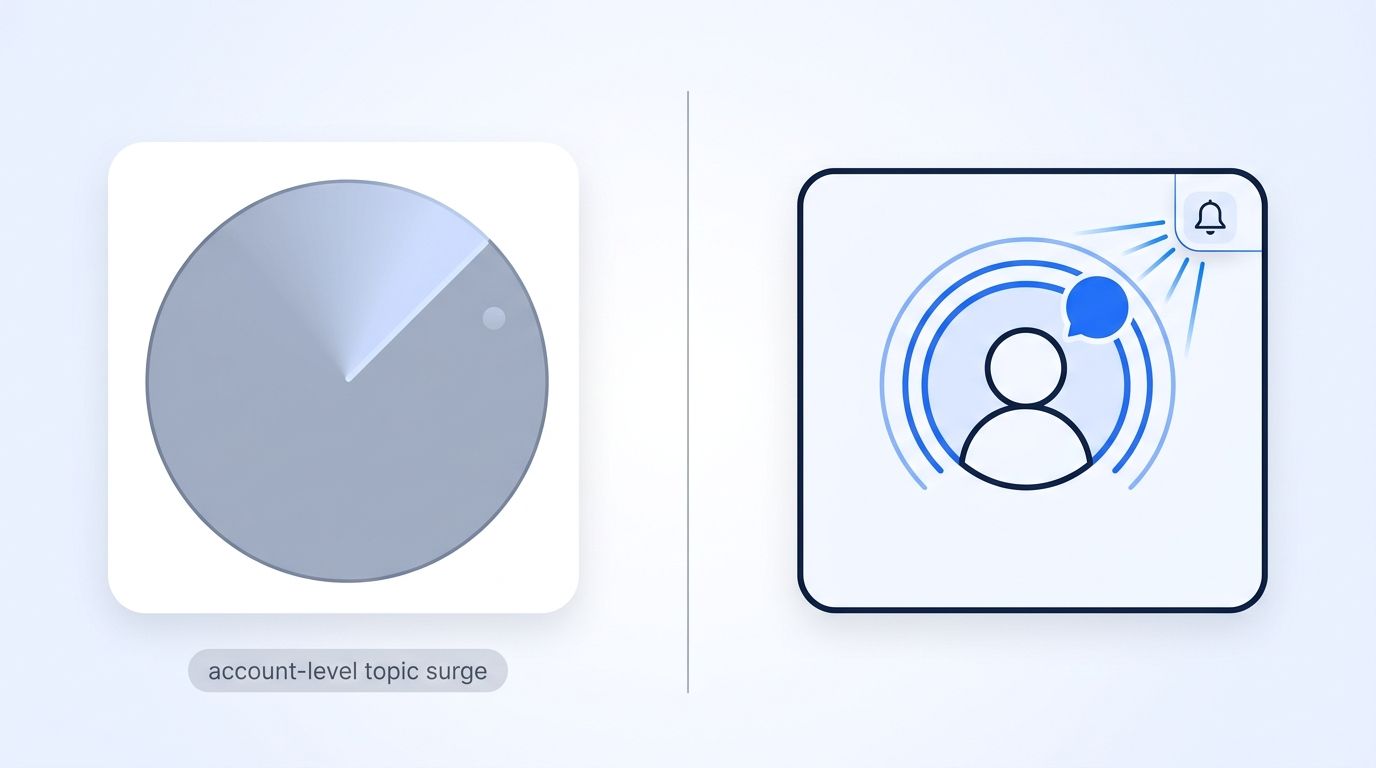
Most commercial intent data platforms score accounts by comparing recent research activity against a longer historical baseline, and that comparison window is exactly what makes them slow. Bombora's Company Surge® methodology — the model licensed inside dozens of ABM and sales tools — tracks a company's research interactions over a rolling 3-week window. It compares that window against a 12-week baseline and flags a topic as "surging" once it crosses a score of 60. Scores refresh weekly (Bombora Company Surge methodology, via RollWorks, retrieved 2026-08-12).
That's not a criticism of the engineering. It's a reasonable way to spot a company that's starting to research a category it wasn't researching before. TechTarget's Priority Engine and ZoomInfo's intent product work on the same basic principle. They watch a co-op network of publisher and review sites, count the researchers, and flag an account once the volume crosses a threshold relative to its own history.
The part that gets lost in the pitch deck is what this model is actually measuring. It's aggregate content consumption across a third-party network, not a specific person's position in a specific deal. It answers "is this account warmer than usual?" It doesn't answer "who on this account is about to sign, and how close are they?"
Why Does That Model Miss the Buyers Closest to Signing?
The core problem isn't accuracy — it's timing and resolution. Account-level topic-surge data structurally can't see the moment a buying committee locks in a favorite. That moment happens inside private conversations, peer-review comparisons, and vendor demos that no publisher co-op is watching.
The lag problem. A 3-week-vs-12-week comparison window means a surge alert, by construction, lags real buyer behavior by weeks. In that same window, 6sense found the vendor who's winning at the end of a buyer's independent evaluation phase usually closes the deal. It happens 77% of the time, down slightly from 83% the prior year but still the dominant outcome (6sense, The B2B Buyer Experience Report for 2025, retrieved 2026-08-12). If the leader is usually decided before your co-op alert even fires, the alert is confirming a race that's already over.
The committee problem. In 2026, Forrester found the typical B2B buying decision now involves 13 internal stakeholders and 9 external influencers, a number that climbs further for complex or AI-related purchases (Forrester, The State of Business Buying, 2026, retrieved 2026-08-12). An account-level score can't tell you which of those 22 people is the economic buyer, which is a champion, and which is quietly blocking the deal. A lot of them never show up in any co-op's data at all. Edelman and LinkedIn's 2025 research on "hidden buyers" found these non-user stakeholders in finance, legal, and procurement spend nearly as much time on industry content as primary target buyers do. Yet 71% report little to no direct interaction with a sales rep (Edelman and LinkedIn, 2025 B2B Thought Leadership Impact Report, retrieved 2026-08-12). They're influencing the outcome. They're invisible to the surge score.
The venue problem. Where does BOFU research actually happen now? Not mostly on the analyst sites and trade publications a co-op network monitors. TrustRadius's 2026 survey of 1,862 technology buyers found 74% rely on peer reviews for purchase research, while only 13% still cite analyst reports — a 63% drop since 2022 (TrustRadius, 2026 B2B Buying Disconnect Report, retrieved 2026-08-12). Buyers also narrow their shortlist to three or fewer vendors before serious engagement begins, per the same survey. If the publisher network your intent vendor watches isn't where late-stage research happens anymore, the "surge" you're paying for is measuring a shrinking slice of the funnel.
Our take: [UNIQUE INSIGHT] Intent data vendors rarely market their product as "early-funnel awareness tooling," but that's what the methodology actually supports. The lag built into a rolling-window-versus-baseline score isn't a data-quality flaw you can fix with a better vendor. It's math. Any co-op running that comparison will always tell you about last month's curiosity, not this week's decision.
What Does the Data Show About Bottom-of-Funnel Behavior?
Isn't the whole point of BOFU buyers that they stop browsing and start deciding? That shift shows up clearly once you look past aggregate content metrics. G2's 2025 Buyer Behavior Report found two-thirds of B2B buyers now prefer to do their own research before engaging a sales team at all (G2, 2025 Buyer Behavior Report, retrieved 2026-08-12). Gartner's Future of Sales research puts a number on how little of that research is even theoretically visible to a vendor. Buyers spend only about 17% of their total purchase-consideration time meeting with potential suppliers, across the entire multi-vendor process (Gartner, Future of Sales, retrieved 2026-08-12).
That data holds up at the highest deal sizes too. McKinsey's B2B Pulse Survey found 39% of B2B buyers are now willing to spend more than $500,000 per order through self-service or remote digital channels, up from 28% just two years earlier (McKinsey & Company, B2B Pulse Survey, retrieved 2026-08-12). One in five buyers is now willing to go as high as $5 million in a single self-serve transaction. Big, late-stage decisions increasingly happen in channels a topic-surge co-op was never built to watch: vendor pricing pages, procurement portals, and peer-review comparisons, not third-party trade content.
For a deeper breakdown of how this compares to first-party signals, see our comparison of website visitor intent versus third-party intent data. The short version: neither model alone was built to track a named buying committee through its final weeks.
The Better Approach: Track People, Not Aggregate Topic Scores
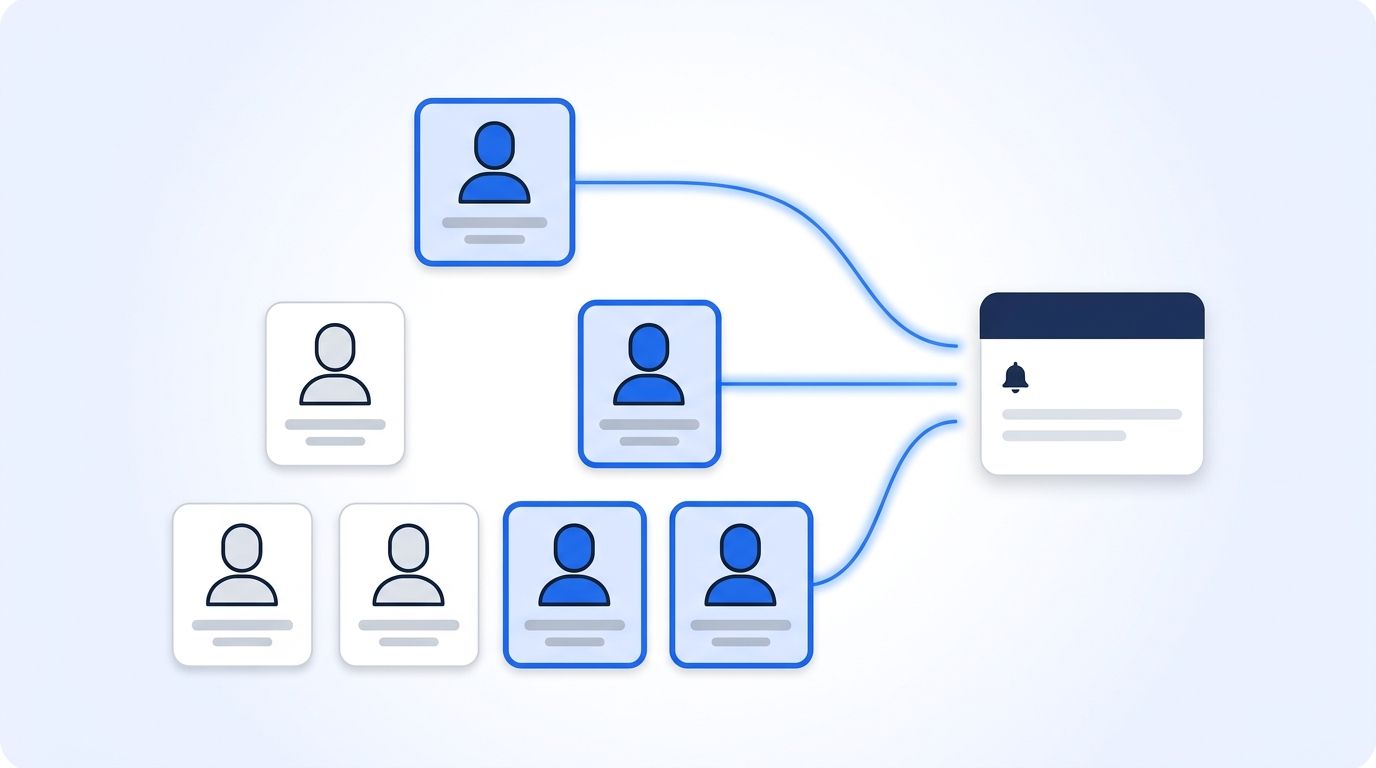
Name the approach plainly: stop scoring accounts and start watching the specific people who make up the buying committee. That single shift closes most of the gap described above. It replaces a weekly aggregate refresh with signals tied to individuals — the economic buyer, the champion, the procurement lead — as they act.
The core principles:
- Map the committee first, not the account. A LinkedIn ICP People Search can filter for the job titles, seniority levels, and functions in a typical buying group. Now you know who to watch before anything surges.
- Watch job changes on champions and economic buyers. New executives buy differently in their first 100 days. A job-change signal fires the moment someone with buying authority lands somewhere new — see our breakdown of real-time job change intent APIs for how detection speed compares across vendors.
- Watch engagement on the person, not just the topic. A Person Engagement Signal flags when a specific named buyer posts, comments, or reacts on LinkedIn. A Company Engagement Signal does the same at the account level for anyone engaging with target-company content.
- Fire in minutes, not on a weekly refresh. Speed to action is still the single biggest lever available. The MIT/Kellogg School Lead Response Management Study found the odds of successfully qualifying a lead drop roughly 21x when response time stretches from 5 minutes to 30 minutes (MIT, Kellogg School of Management, and InsideSales.com, Lead Response Management Study, retrieved 2026-08-12). A weekly co-op refresh can't compete with that math.
[PERSONAL EXPERIENCE] We build real-time signal infrastructure for exactly this reason. The teams getting the most out of it aren't the ones with the biggest topic-surge budget. They're the ones who've mapped their buying committees down to named people, then routed engagement alerts straight to a rep's queue the moment someone on that list moves.
How Do You Build a BOFU-Aware Signal Stack?
Start with the account list you already have, then narrow to people before you add any new tooling. Here's the rollout in order:
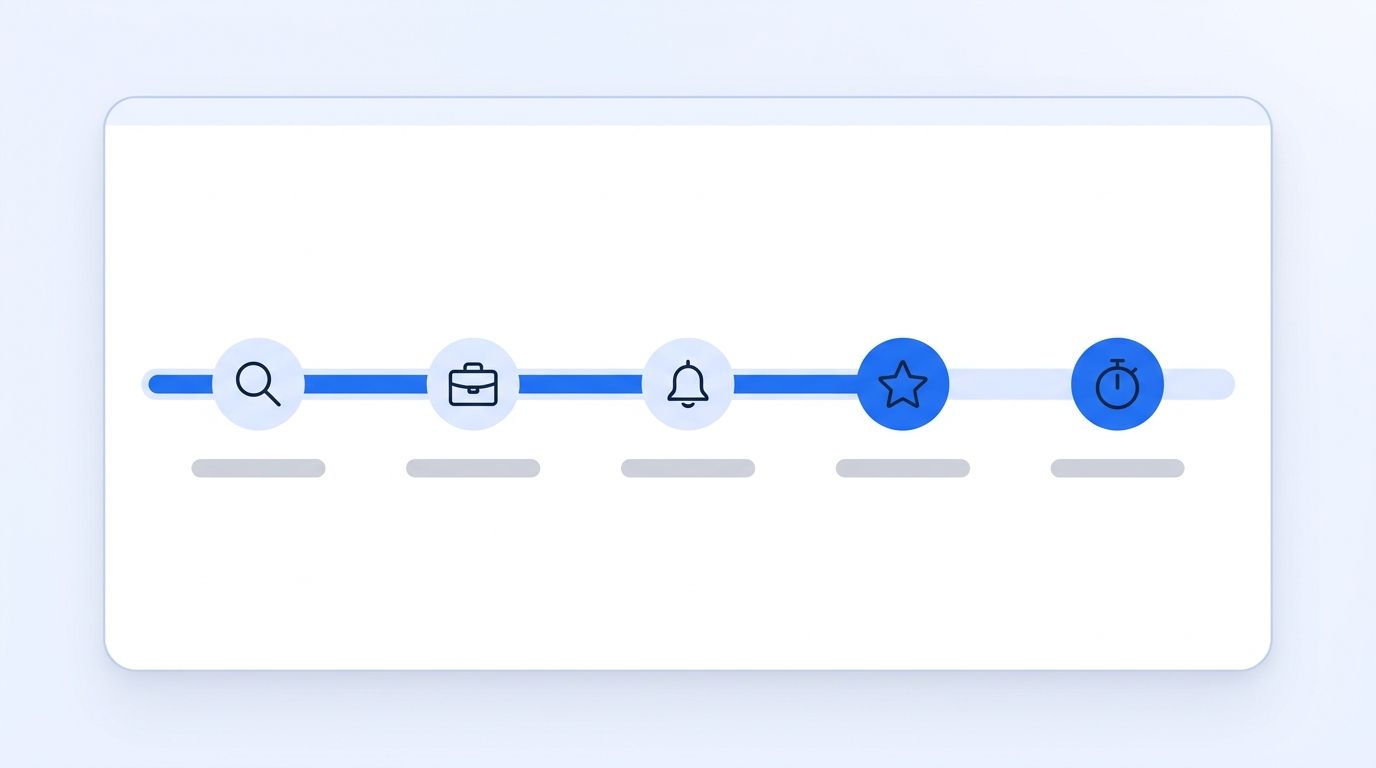
- Map the buying committee (week 1). Run your top 50-100 target accounts through an ICP People Search filtered by the job titles and seniority tiers that typically appear in your buying committees.
- Track champions across job changes (week 1-2). Add every mapped stakeholder to a champion tracking list. A job-change signal then fires the moment one of them lands at a new company — often the fastest re-engagement window you'll get.
- Layer engagement signals on the named individuals (week 2-3). Turn on person- and company-level engagement monitoring through the Signal API so a like, comment, or post from someone on your list reaches a rep within minutes.
- Watch for the executives, not just the account (ongoing). An executive engagement radar flags the moment a named decision-maker posts, so outreach can land while the context is still fresh instead of a week later.
- Measure by response time, not just alert volume. Track median time-to-first-touch on every signal that fires — if it's creeping past 30 minutes, the qualification math above says you're already losing ground.
What Doesn't Person-Level Signal Tracking Fix?
Person-level signal tracking has real limits, and pretending otherwise would undercut the argument. Topic-surge co-op data still earns its keep at the true top of the funnel. Spotting a company that's never shown interest in your category before is exactly what an aggregate score is good at, and person-level tracking can't replace that early discovery function.
Person-level tracking also asks more of your team than a dashboard subscription does. Someone has to maintain the buying-committee map, and stale org charts produce false negatives just as easily as a lagging co-op score produces false positives. And for accounts too small to have a real committee — a five-person startup buying its first tool — this whole framework is overkill. A simple company-level alert is enough.
Frequently Asked Questions
Does this mean third-party intent data is worthless?
No. It's well-suited to early-funnel discovery — flagging an account that's newly researching your category — which is a different job than identifying a buyer who's about to sign. The problem is treating a weekly, account-level surge score as a bottom-of-funnel signal when its own methodology, a 3-week window against a 12-week baseline, makes that structurally unlikely.
How big are B2B buying committees, actually?
Forrester's 2026 research puts the average at 13 internal stakeholders and 9 external influencers per decision, and that number grows for complex or AI-related purchases. Older estimates commonly cited a smaller range closer to 6-10 people. Either way, no single account-level score can name that many individuals or tell you which one is closest to signing.
What's the fastest way to spot a BOFU buyer if not through intent surges?
Watch the named people on the buying committee directly: job changes among champions and economic buyers, and engagement signals (posts, comments, reactions) tied to their individual LinkedIn activity. Both can fire within minutes of the behavior happening, versus a weekly refresh on an aggregate score.
Is it worth keeping a co-op intent contract if we add person-level signals?
For most mid-market and enterprise teams, yes — run both. Co-op data still catches the earliest "is this account waking up" signal that person-level tracking isn't built for. Layer person-level, real-time signals on top for the accounts that are already active, rather than replacing one system with the other.
The Bottom Line
Most intent data platforms weren't built to catch the buyer who's already decided. They were built to catch the one who's just starting to look, and their own methodology guarantees a lag between behavior and alert. The buying committee has grown to over 20 people on average. Most of that research now happens on peer-review sites instead of the publisher network co-ops monitor. And the leader at the end of the independent research phase wins the deal more often than not. Closing that gap means watching named people in real time, not waiting on next week's account refresh. Start by mapping your buying committees and routing person-level signals straight to the reps who can act on them within minutes, not weeks.
