
Disclosure: This article is published by Datamagnet. Vendor claims are self-reported unless otherwise noted.
Website Visitor Intent vs. Third-Party Intent Data: Which Should You Trust?
You've got two very different pitches in your inbox. One tool says it can name the company (maybe even the person) browsing your pricing page right now. The other says it can tell you which accounts are researching your category somewhere else on the internet, before they've ever heard of you. Both call themselves "intent data." They're not the same thing, and mixing them up wastes budget.
Key Takeaways
- Website visitor intent identifies who's already on your site — company-level match rates typically run 30-60%, real-time, but limited to your own traffic.
- Third-party intent data (Bombora, TechTarget, ZoomInfo) tracks research activity across the web, but only 24% of B2B marketers report exceptional ROI from it, and 87% say the signals are unreliable or inflated (DemandScience, 2026).
- 70% of the B2B buying journey is finished before a buyer contacts a vendor directly (6sense, 2024) — which is exactly the window third-party data is built to see and first-party data isn't.
- Speed matters more than source: the odds of qualifying a lead drop roughly 21x when response time stretches from 5 minutes to 30 minutes (MIT/InsideSales.com).
- Most GTM teams that get real value run both — first-party for real-time action, third-party for pipeline you can't see yet.
What's the Actual Difference Between These Two Data Types?
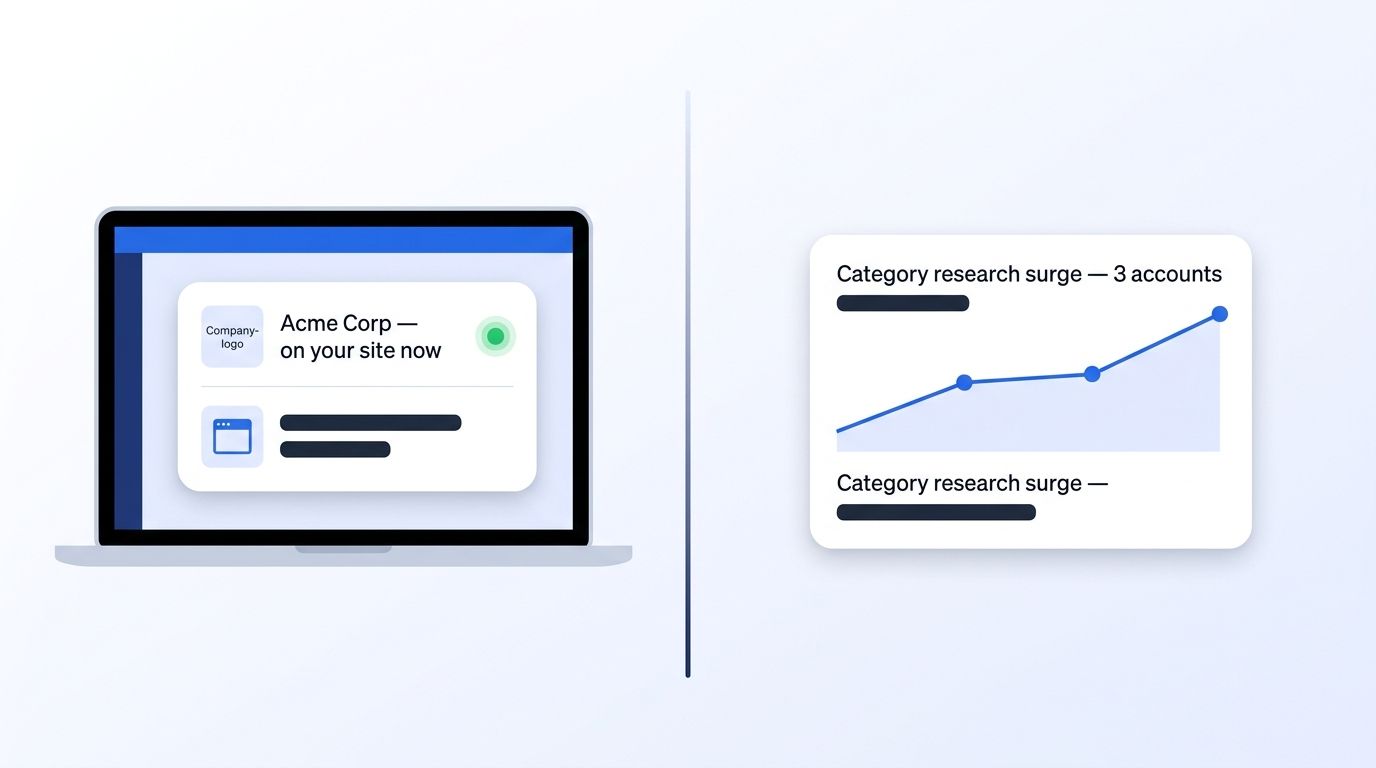
Website visitor intent identifies companies (and sometimes individuals) browsing your own site, using IP-to-company matching or device-graph lookups. Third-party intent data tracks research activity across a network of publishers and review sites, then sells you the aggregate signal.
Website visitor intent tools — RB2B, Warmly, Leadfeeder/Dealfront, Clearbit Reveal — resolve an IP address hitting your server to a company, and in some cases a named person, using reverse-IP databases or cookie/device graphs. The signal is narrow but immediate: someone is on your pricing page right now.
So which one should you believe when a vendor pitches you? It depends on what question you're actually trying to answer. Third-party intent providers — Bombora, Informa TechTarget's Priority Engine, G2, ZoomInfo — don't watch your site at all. They watch a co-op of publisher and review sites, then flag accounts whose research activity on a topic has "surged" relative to baseline. Bombora's co-op alone spans more than 5,000 partner publisher sites and resolves signals to roughly 2.8 million businesses (Bombora, retrieved 2026-07-22).
real-time signal monitoring across LinkedIn sits in a third lane worth naming here — social engagement intent, which watches who's liking, commenting, and posting about your category on LinkedIn rather than your site or a publisher network. It's a useful complement to both models covered below, not a replacement for either.
Which One Gives You More Accurate Signals?
Neither has an independently audited accuracy benchmark, and that's the first thing to admit. Company-level IP resolution on website traffic typically lands in a 30-60% match-rate range across vendors, with person-level identification running much lower — often single digits to low teens.
Website visitor ID vendors publish their own numbers with no third-party audit behind them. RB2B, for example, claims 40-45% person-level identification and up to 70-80% combined person-plus-company matching on U.S. traffic (RB2B, retrieved 2026-07-22) — a self-reported figure, not an outside evaluation.
Third-party intent data has its own accuracy problem, and it's a bigger one because you can't check the underlying visit yourself. In DemandScience's 2026 State of Performance Marketing Report, a survey of 750 senior B2B marketing leaders, 87% said their intent signals were unreliable or inflated, and only 26% of flagged accounts ever converted to a qualified opportunity (DemandScience, retrieved 2026-07-22). That's not a fringe complaint — it's the majority experience.
Our take: [UNIQUE INSIGHT] The accuracy question isn't really "which is more accurate" — it's "which type of error can you live with." Website visitor intent gives you false negatives (real buyers you never spot because their IP doesn't resolve). Third-party intent gives you false positives (accounts flagged as "surging" that were never actually shopping). Pick the failure mode that costs your team less.
Verdict: too close to call on raw accuracy — website visitor intent fails by omission, third-party intent fails by over-inclusion.
Which One Covers More of the Buyer Journey?
Third-party intent data wins on coverage, because most of the B2B buying journey happens somewhere you can't see it. In 2024, 6sense found that 70% of the B2B buying journey is complete before a buyer ever contacts a vendor directly, and 80% of the time it's the buyer who initiates that first contact, not a rep (6sense, 2024 B2B Buyer Experience Report, retrieved 2026-07-22).
Website visitor intent only sees the sliver of that journey where a buyer is already on your domain. If a buyer is reading category comparisons on a trade publication or a review site, first-party tools are blind to it — there's no visit to resolve. Third-party co-op data is specifically built to catch that earlier research phase, before your site ever shows up in their history.
The trade-off: third-party coverage is broad but shallow. A "surge" flag tells you a company is researching a topic — not which page, not which competitor, not who on the buying team. Website visitor intent is the opposite: narrow but specific, down to the exact page and, sometimes, the exact person.
Verdict: third-party intent wins on journey coverage. Website visitor intent wins on specificity once a buyer reaches you.
Which One Lets You Act Faster?
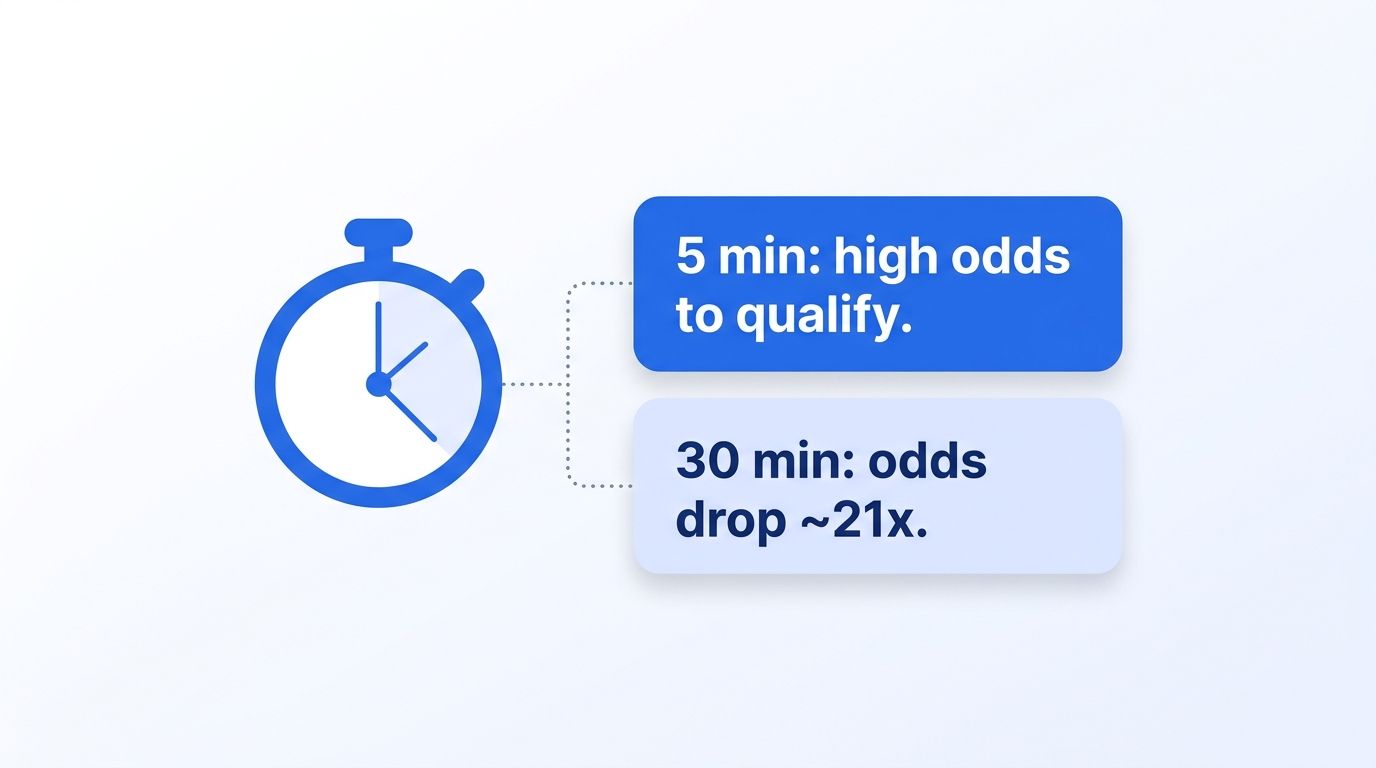
Website visitor intent wins decisively here, and speed is the metric that actually moves pipeline. In the MIT/InsideSales.com Lead Response Management Study — still the most-cited primary research on this question — the odds of successfully qualifying a lead dropped roughly 21x when response time stretched from 5 minutes to 30 minutes after the signal fired (MIT/InsideSales.com Lead Response Management Study, retrieved 2026-07-22).
A website visitor tool can alert a rep the moment a target account hits your pricing page, while that person is still in the browser tab. Third-party intent data can't do that. Bombora's methodology compares a 3-week research window against a 12-week baseline before it flags a surge — by the time you see the alert, the "moment" is already days or weeks old.
That real-time gap is where combining signal types earns its keep. monitor keyword and industry engagement alongside on-site visits can flag category-relevant LinkedIn activity within minutes rather than weeks, closing part of the lag that pure content-consumption co-ops carry by design.
Verdict: website visitor intent wins on speed. Third-party intent trades speed for reach.
Which One Carries More Privacy and Compliance Risk?
Website visitor intent carries more regulatory exposure, particularly at the person level. In September 2025, the Court of Justice of the European Union ruled in Case C-413/23 P that pseudonymized identifiers — including IP addresses and cookie IDs — aren't automatically "personal data" in every context; classification depends on whether the party holding the data can realistically re-identify an individual (Court of Justice of the European Union, retrieved 2026-07-22). That cuts both ways: company-level identification is generally on firmer footing, but naming an individual visitor pushes a tool much closer to regulated personal data.
U.S. exposure is concrete and dollar-denominated. Under the CCPA/CPRA, as updated by the California Privacy Protection Agency effective January 1, 2025, administrative fines run $2,663 per unintentional violation and $7,988 per intentional violation or one involving a minor under 16 (California Privacy Protection Agency, retrieved 2026-07-22). Those numbers scale fast — flag 10,000 individual site visitors without a defensible basis and the unintentional-tier math alone tops $26 million.
Third-party intent data generally carries lower per-record risk, because reputable co-ops like Bombora operate on consent-based publisher relationships and resolve to company-level accounts rather than named individuals in most standard packages. The risk shifts instead to provenance — you're trusting a vendor's data-sourcing claims you can't independently audit.
Our take: [PERSONAL EXPERIENCE] Building signal infrastructure ourselves, the compliance line we watch most closely isn't "is this legal" — it's "can we explain, in one sentence, how we got this data." Company-level firmographic matching is easy to explain to a prospect or a DPO. Naming an individual from a device graph they never opted into is a much harder sentence to finish.
Verdict: third-party intent carries lower regulatory exposure. Website visitor intent is safer at the company level than the person level.
Which One Costs Less to Run?
Is cheaper actually better here, or just easier to start? Website visitor intent tools tend to have transparent, lower-cost entry tiers — several publish self-serve pricing or offer a free plan capped by traffic volume. Third-party intent platforms are typically sold as enterprise contracts with custom quotes, priced per topic taxonomy and account volume, and usually require an annual commitment. Neither Bombora, TechTarget, nor ZoomInfo publishes list pricing, so exact figures aren't independently verifiable — treat any specific dollar number you see in a comparison chart as a third-party estimate, not a vendor-confirmed rate.
The real cost difference shows up in what you're paying for. A website visitor tool charges roughly for volume of traffic resolved. A third-party intent platform charges for breadth of topic coverage and account universe — you're renting access to a research network, not a resolution service.
Verdict: website visitor intent is cheaper to start. Third-party intent costs more but is priced for reach, not volume.
Which One Fits Your Existing Sales Stack Better?
Website visitor intent integrates more naturally into real-time workflows — Slack alerts, CRM tasks, SDR queues — because the signal is a discrete event (a visit) that fires once. Third-party intent data fits better into account scoring and territory prioritization models, because a "surge" is a rolling comparison, not a single trigger, and works best feeding a weighted score rather than a one-off alert.
If your team is already running signal-based playbooks for job changes, new posts, and engagement events, layering a webhook-driven visitor tool on top is a small lift. If your stack is built around account-based scoring in a platform like ZoomInfo's intent tier or a similar ABM suite, a third-party surge feed slots in with less rework.
Verdict: website visitor intent fits event-driven, rep-facing workflows. Third-party intent fits scoring-driven, marketing-facing workflows.
Who Should Choose What
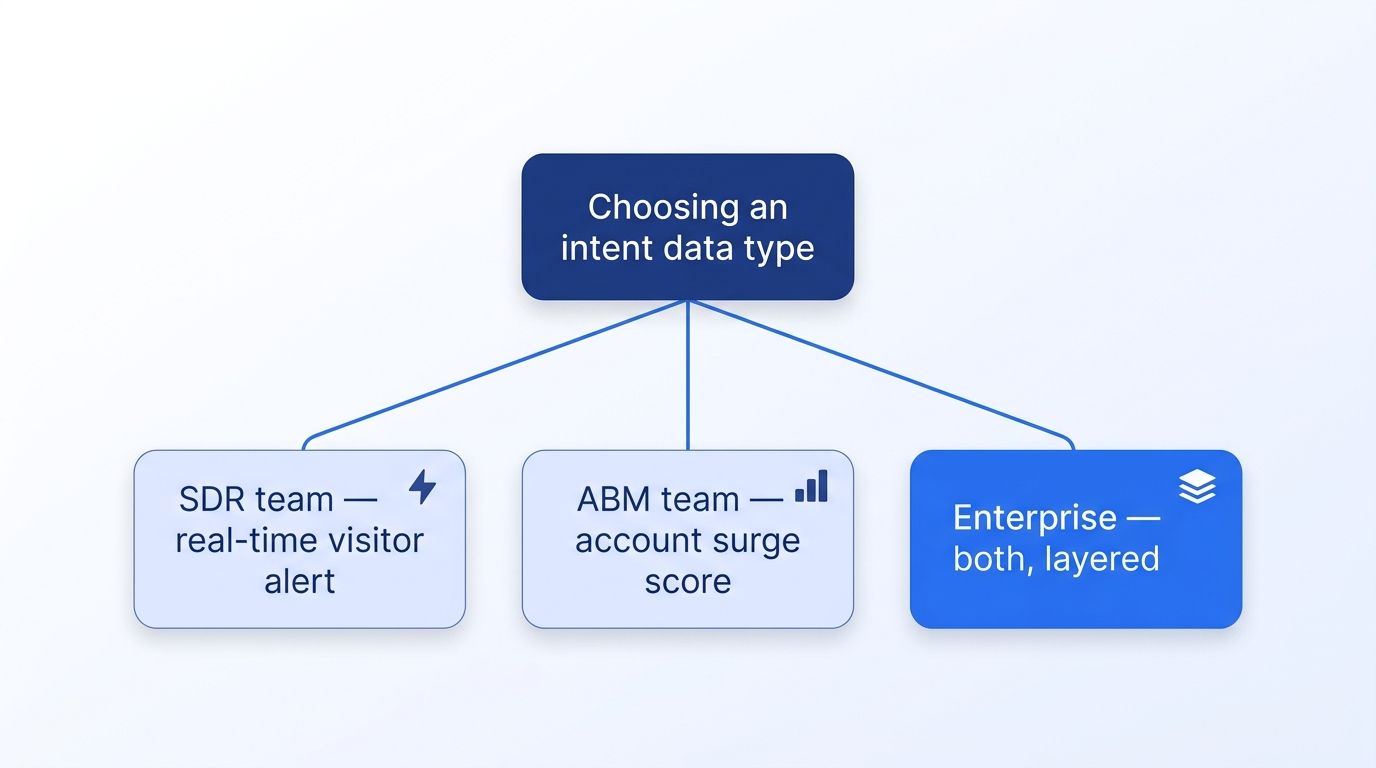
SDR and outbound teams working a live pipeline: Choose website visitor intent. You need the alert while the buyer is still in the tab, and the MIT response-time data makes the case for you.
Demand gen and ABM teams building account scores: Choose third-party intent. You're trying to catch the 70% of the journey that happens before anyone lands on your domain, and a rolling surge score is built for exactly that.
Teams running lean on budget: Start with website visitor intent — watch company and industry engagement signals as a lower-cost entry point before committing to an enterprise co-op contract.
Enterprise teams with mature RevOps: Run both, and don't expect them to replace each other. Feed third-party surge data into account prioritization, then use website visitor intent as the real-time trigger once a prioritized account actually shows up on your site. track champions and buying-committee members across job changes to keep the loop closed after the initial signal.
Frequently Asked Questions
Is website visitor intent more accurate than third-party intent data?
Neither has an independently audited accuracy benchmark. Website visitor intent typically resolves 30-60% of company-level traffic, self-reported by vendors. Third-party intent data has a documented reliability problem — 87% of B2B marketers say their signals are unreliable or inflated (DemandScience, 2026). Pick based on which error type — missed visits or false surges — costs your team more.
Can I use website visitor intent and third-party intent data together?
Yes, and most mature RevOps teams do. Third-party data prioritizes which accounts to target before they've engaged with you directly; website visitor intent tells you the moment a prioritized account actually shows up. Layering both closes the gap between the 70% of the journey that happens off your site and the 30% that happens on it.
Does website visitor identification break GDPR or CCPA?
Company-level identification is generally lower risk under both frameworks — a 2025 CJEU ruling (Case C-413/23 P) found pseudonymized identifiers like IPs aren't automatically personal data in every context. Person-level identification carries more exposure. Under CCPA/CPRA, fines run $2,663-$7,988 per violation depending on intent (California Privacy Protection Agency, effective Jan 1, 2025).
Which type of intent data converts better?
No independently verified study directly compares conversion rates between the two. What's documented: only 26% of third-party-flagged accounts convert to a qualified opportunity (DemandScience, 2026), and response speed to any signal matters more than its source — qualification odds drop roughly 21x between a 5-minute and 30-minute response (MIT/InsideSales.com).
Is third-party intent data worth it if I already have website visitor intent?
It depends on how much of your pipeline currently comes from inbound traffic versus outbound prospecting into cold accounts. If your team relies on outreach into accounts that haven't visited your site yet, third-party data fills a gap website visitor intent structurally can't — it's the only one of the two that sees research happening away from your domain.
Verdict: Category Winners
| Category | Winner |
|---|---|
| Signal accuracy | Toss-up (different failure modes) |
| Buyer journey coverage | Third-party intent data |
| Speed to action | Website visitor intent |
| Privacy/compliance risk | Third-party intent data (lower risk) |
| Cost to start | Website visitor intent |
| Sales stack fit | Depends on workflow (event-driven vs. scoring-driven) |
| Overall | Layer both — third-party for reach, website visitor intent for the real-time trigger |
Neither data type replaces good rep judgment, and neither is trustworthy enough to run on autopilot. Third-party intent data catches the 70% of the journey happening away from your site; website visitor intent catches the moment a prioritized account finally shows up. Treat them as two stages of the same funnel, not competing bets, and route both into a workflow a rep can actually act on within minutes — not days.
