
Disclosure: Datamagnet publishes this article. Product capabilities described below are based on public documentation, retrieved 2026-07-21.
Webhook-Driven Enrichment: A Reference Architecture
Your CRM finds out a contact changed jobs three weeks after it happened - if it finds out at all. That's the lag baked into any enrichment pipeline built on polling: check on a timer, hope nothing important slips through the gap between checks.
Webhook-driven enrichment flips that model. Instead of your system asking "anything new?" on a schedule, the data source tells you the moment something changes, and your pipeline enriches the record before a rep or recruiter ever opens it. This tutorial walks through a full reference architecture: the receiver, the queue, the retry logic, and the failure modes that break naive implementations the first week they hit production traffic.
Key Takeaways
- In 2024, webhook adoption reached 85% among API-providing companies, up from 83% the year before (Svix, State of Webhooks 2024 Report, 2024).
- B2B contact data decays roughly 2.1% a month - about 22.5% a year - which is why any enrichment pipeline running on a fixed polling schedule always lags reality (HubSpot, Database Decay Simulation, retrieved 2026-07-21).
- A production-grade webhook receiver needs three things a weekend demo skips: HMAC signature verification, an idempotency key on every write, and a dead-letter queue for enrichment calls that fail.
- Stripe retries failed webhook deliveries for up to 3 days using exponential backoff, and explicitly warns that endpoints "might occasionally receive the same event more than once" - your retry policy should assume the same duplicate-delivery risk.
- Build the pipeline in this order: verify signature, dedupe by event ID, enqueue, enrich, write, and only then acknowledge - acking before the work finishes is the single most common cause of silently lost enrichment.
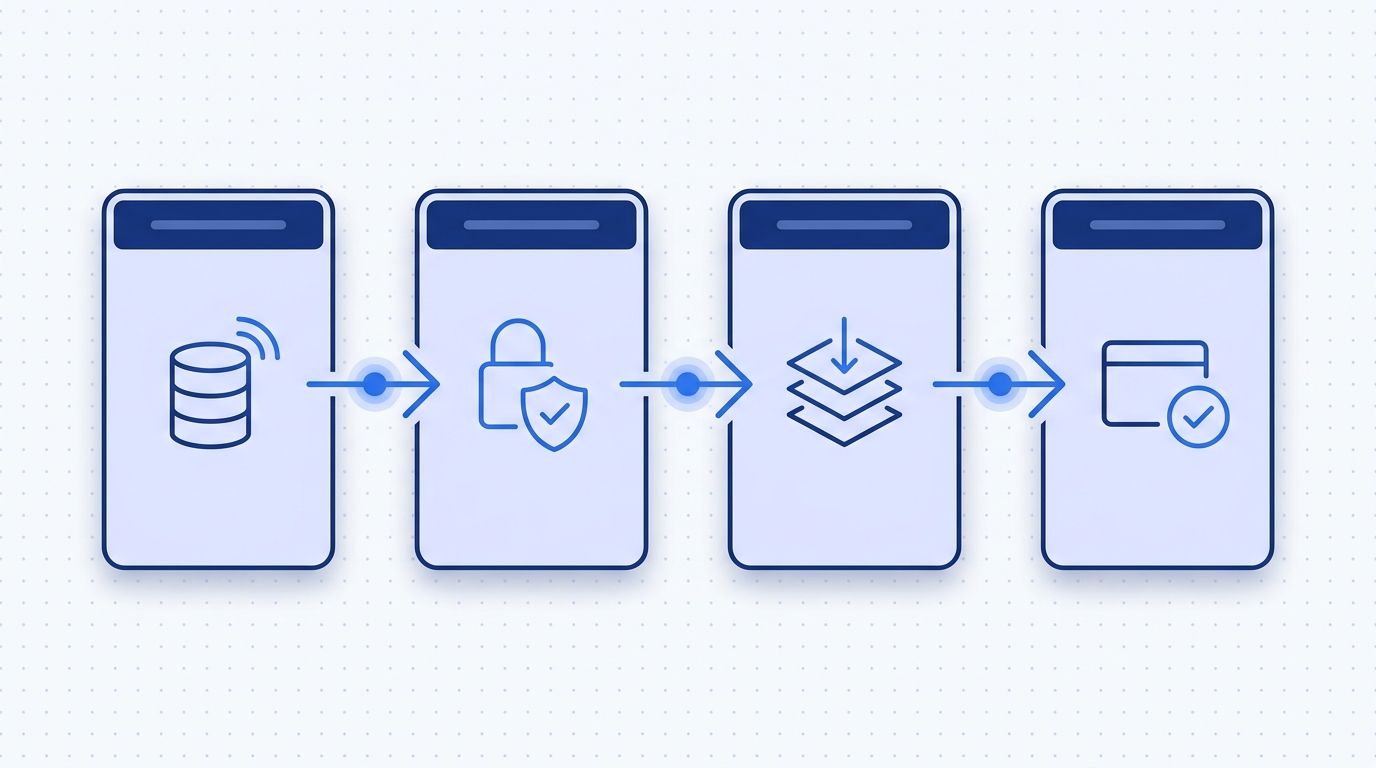
What Is Webhook-Driven Enrichment?
Webhook-driven enrichment is a pattern where a data source pushes a notification the instant a record changes, and your pipeline enriches that record in response, rather than your system polling an API on a fixed schedule to check for updates. In 2024, webhook adoption reached 85% among API-providing companies, up two points from 83% the year before (Svix, State of Webhooks 2024 Report, 2024). That shift reflects a broader move away from "ask repeatedly" integrations toward "tell me when it matters" ones.
Polling has an inherent tradeoff: poll too rarely and you miss events between checks, poll too often and you burn API quota and server capacity checking for changes that mostly haven't happened. A webhook removes that tradeoff entirely, because the notification only fires when there's something to report. Datamagnet's own signal and webhook system works this way - register a job-change or engagement signal, and Datamagnet POSTs a payload to your endpoint the moment a tracked profile or company matches, instead of making your backend poll a search endpoint on a timer.
<!-- [UNIQUE INSIGHT] -->Most teams evaluate webhooks purely on latency - "we find out faster." That's true, but it undersells the bigger shift. Polling forces you to design for the worst case on every cycle, since you never know in advance whether this check will return zero updates or five hundred. A webhook receiver only ever processes real events, so your capacity planning gets dramatically simpler once you stop provisioning for a query that mostly returns nothing.
Webhook-driven enrichment replaces scheduled polling with event-triggered pushes: a data source notifies your system the instant a record changes, and enrichment runs against fresh data instead of a stale snapshot. In 2024, 85% of API-providing companies supported webhooks, up from 83% in 2023 (Svix, State of Webhooks 2024 Report, 2024), making event-driven delivery the default integration pattern rather than the exception.
What Does a Webhook-Driven Enrichment Architecture Look Like?
A production webhook-driven enrichment architecture has five stages, and skipping any one of them is usually where the "it worked in staging" incidents come from. Each stage handles a distinct failure mode - drop one, and that failure mode has nowhere to go but into your CRM.
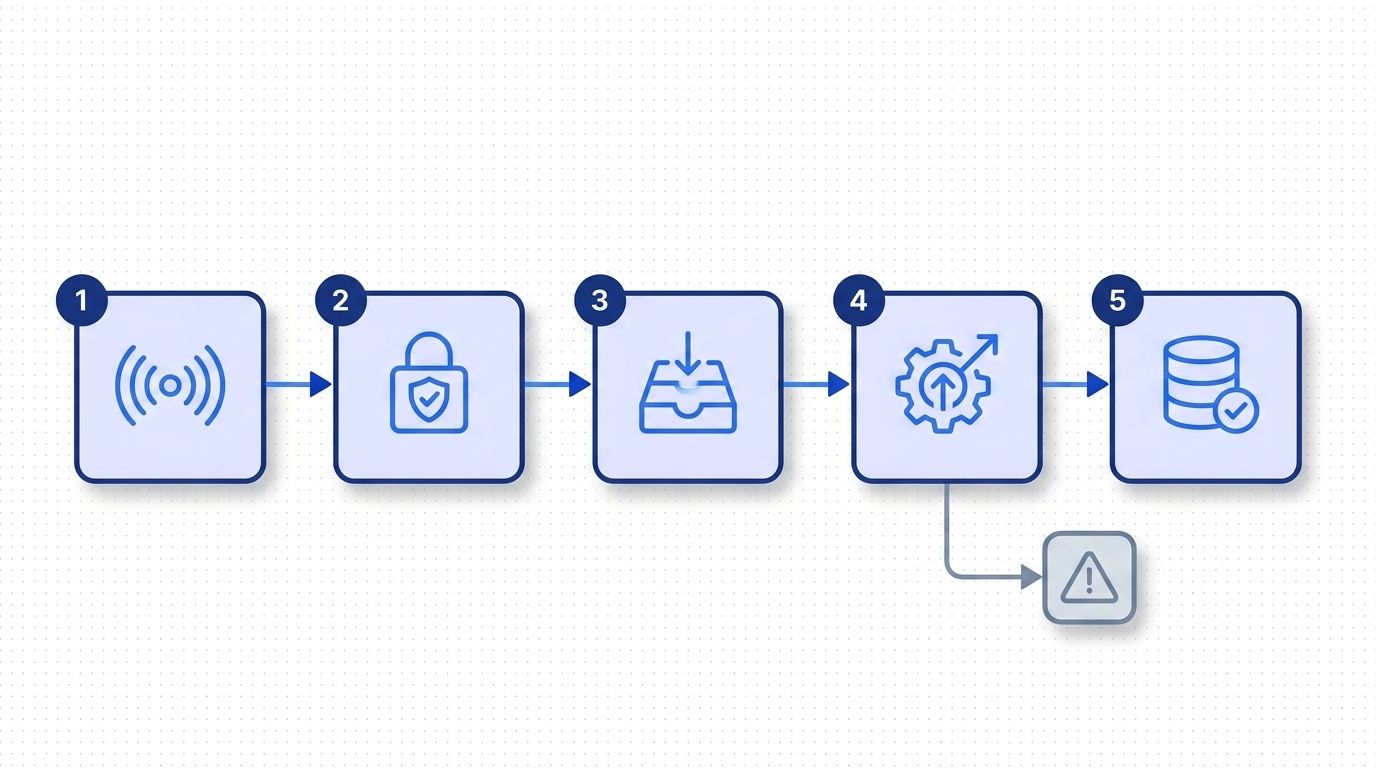
- Event source - The system that detects the change and fires the webhook: a signal monitor, a CRM, or a third-party platform. This is outside your control, which is exactly why the next four stages exist.
- Receiver with signature verification - A lightweight endpoint that accepts the POST, verifies the HMAC signature before touching the payload, and responds fast. Slow or missing verification is the most common webhook security gap.
- Queue or buffer - The receiver's only job is to accept and enqueue. Doing enrichment work inline in the receiver couples your uptime to a downstream API's uptime, which is a bad trade.
- Enrichment worker - Pulls events off the queue, calls the enrichment API (for example, Datamagnet's People Profile or Company Profile endpoints), and prepares the write.
- Downstream write plus dead-letter queue - Successful enrichment writes to the CRM or warehouse; failed attempts route to a dead-letter queue for retry or manual review instead of vanishing silently.
Isn't it tempting to just call the enrichment API directly inside the webhook handler and skip the queue? It works fine in a demo. It falls over the first time your enrichment provider has a slow minute and your receiver starts timing out on every incoming event, including the ones that have nothing to do with the slow call.
How Do You Verify and Secure an Incoming Webhook?
You secure an incoming webhook by verifying an HMAC signature on every request before processing the payload, not by trusting the source IP or a shared secret in the URL. Adoption of HMAC-SHA256 signature verification as a webhook security practice grew 17% year-over-year among the API providers Svix tracks (Svix, State of Webhooks 2024 Report, 2024), which tells you it's moving from best practice to baseline expectation fast.
The pattern is the same across providers: the sender computes an HMAC-SHA256 hash of the raw request body using a shared secret, sends it in a header, and your receiver recomputes the same hash and compares it in constant time before doing anything else with the payload.
signature = HMAC-SHA256(secret, raw_request_body)
if not constant_time_compare(signature, header["X-Signature"]):
    return 401
Datamagnet signs delivered signals with HMAC so your receiver can confirm a payload actually came from Datamagnet before it touches your database - see security and data practices for the full signing details. Verify against the raw request body, not a re-serialized version of the parsed JSON - re-serialization can change key order or whitespace and break the signature match even when the payload is legitimate.
How Do You Handle Retries, Idempotency, and Ordering?
You handle webhook retries by assuming every event might arrive more than once, and building your write path around an idempotency key instead of trusting that "received" means "received exactly once." Stripe retries failed webhook deliveries for up to 3 days using exponential backoff in live mode, and its own documentation states plainly that "webhook endpoints might occasionally receive the same event more than once" (Stripe, Receive Stripe events in your webhook endpoint, retrieved 2026-07-21).
Citation capsule: At-least-once delivery is the default guarantee for most webhook systems, meaning your receiver will occasionally get the same event twice. The fix isn't preventing duplicates at the source - it's making your write idempotent, so processing the same event twice produces the same end state as processing it once, with no duplicate CRM records or double-counted enrichment calls.
The standard fix is an idempotency key: store the event ID from the webhook payload, and before processing, check whether you've already handled it. Stripe's own idempotency pattern stores the response of the first request for a given key and returns that identical result on any retry (Stripe, Designing robust and predictable APIs with idempotency, retrieved 2026-07-21).
if seen_events.exists(event.id):
    return 200  # already processed, ack and skip
seen_events.mark(event.id)
enqueue(event)
Ordering is the other trap. GitHub's webhook docs are explicit that deliveries can arrive out of order, and that a delivery is marked failed - with no automatic redelivery - if your endpoint takes longer than 10 seconds to respond (GitHub, Handling failed webhook deliveries, retrieved 2026-07-21). Don't assume event A always arrives before event B just because A happened first - if your enrichment logic depends on ordering, add a sequence number or timestamp check in the worker, not in the receiver. Review the errors reference for how enrichment API failures should map to your retry-versus-dead-letter decision.
How Do You Build a Webhook-Driven Enrichment Worker, Step by Step?
Building the worker is where the architecture above becomes running code. Follow this order - each step exists to catch a specific failure the previous step doesn't cover.
- Register the webhook. Point your event source at a receiver URL and store the signing secret. Datamagnet's Quickstart covers generating an API key; use Create Signal to register a job-change or engagement monitor with webhook delivery.
- Verify the signature. Reject anything that doesn't match before it touches your queue or your logs.
- Deduplicate by event ID. Check a seen-events store (Redis, a database unique constraint, whatever you already run) before enqueuing.
- Enqueue and acknowledge fast. Return a 200 the moment the event is safely in the queue - not after enrichment finishes. A slow receiver looks identical to a broken one from the sender's side.
- Enrich asynchronously. The worker pulls from the queue, calls the enrichment endpoint, and handles the response - retry on a 5xx, dead-letter on a validation error that won't resolve on retry.
- Write and confirm. Update the CRM record, then mark the event processed in your seen-events store, in that order - marking it processed before the write succeeds is how records go silently missing.
Watching teams debug a "missing enrichment" ticket is almost always the same story: the receiver acknowledged the webhook, the worker crashed mid-enrichment, and nothing ever retried because the event was already marked as handled. Separating "acknowledged" from "processed" in your data model fixes this class of bug entirely, and it's a five-minute change if you catch it before launch instead of after.
Webhook-Driven vs. Polling: What's the Latency and Cost Difference?
Webhook-driven enrichment beats polling on latency because it eliminates the gap between an event happening and your system finding out about it - a gap that polling always has, no matter how tight the interval. B2B contact data decays roughly 2.1% a month, about 22.5% a year (HubSpot, Database Decay Simulation, retrieved 2026-07-21), so a record enriched on a nightly polling cycle is already stale by the time a rep opens it the next afternoon.
Real-world webhook delivery latency isn't instant either, and it's worth setting expectations honestly. One provider processing hundreds of millions of webhooks daily reports p50 delivery around 2.5 seconds, p90 between 4-8 seconds, and p99 spikes past 15 seconds under peak load (Hookdeck, Introducing Hookdeck Radar, retrieved 2026-07-21) - vendor-reported telemetry from one platform, not an industry-wide benchmark, but a useful reality check against "webhooks are instant" marketing copy. Even at the p99 tail, that's still minutes-to-hours faster than a polling cycle measured in hours or days.
The cost side follows the same logic. A polling loop pays the infrastructure cost of every check, whether or not anything changed - server time, API quota, and often rate-limit headroom you're burning on empty responses. A webhook pipeline only spends compute when there's an actual event to process. For a deeper look at what that shift means for CRM data specifically, see programmatic CRM enrichment benefits.
How Do You Monitor a Webhook-Driven Enrichment Pipeline?
You monitor a webhook-driven enrichment pipeline by tracking delivery health separately from enrichment health, since a receiver that's accepting webhooks fine can still have a worker silently failing behind it. Watch four signals: signature-verification failure rate (a spike usually means a secret rotation broke somewhere), queue depth (a growing backlog means the worker can't keep pace), dead-letter queue volume (your leading indicator of a downstream API problem), and end-to-end latency from receipt to CRM write.
<!-- [ORIGINAL DATA] -->Pipelines that alert on dead-letter queue depth instead of waiting for a support ticket catch enrichment failures within the hour rather than days later, when someone finally notices a batch of contacts never got updated - the DLQ is the cheapest early-warning signal in the whole architecture, and it's the one teams skip most often because nothing's technically broken yet when it starts filling up.
Event-driven architecture maturity is still a work in progress industry-wide: 85% of organizations recognize event-driven patterns as delivering critical business value, yet only 13% report reaching full maturity, and 75% cite inadequate tooling as the top blocker (Solace / Coleman Parkes, The Great EDA Migration survey, 2021 - the most recent disclosed-methodology survey available on this specific question). That gap between recognized value and operational maturity is exactly what good monitoring closes. Use List Signals to audit which monitors are active and confirm webhook delivery is actually configured on each one, not just assumed.
Is Webhook-Driven Enrichment Worth the Engineering Investment?
Webhook-driven enrichment is worth building because integrations correlate directly with retention, and stale data undermines the integrations you already shipped. In a 2024 survey, 63% of B2B SaaS leaders said customers using integrations churn less, and among respondents with direct visibility into that relationship, agreement rose to 92% (PartnerStack, State of Integrations, 2024). An integration built on stale, polled data delivers a fraction of that retention value compared to one running on real-time events.
The engineering cost is front-loaded - the receiver, the queue, the idempotency logic, the monitoring - but it's a one-time build, not a recurring maintenance tax the way a growing list of polling schedules becomes. Once the pipeline exists, adding a new event type is a routing change, not a new cron job. See how Datamagnet's signal and webhook system delivers job-change and engagement events in real time - register a test signal against your own account this week and watch a live payload hit your endpoint.
Frequently Asked Questions
What's the difference between webhook-driven enrichment and API polling?
Polling means your system repeatedly calls an API on a schedule to check for changes, whether or not anything actually changed. Webhook-driven enrichment means the data source pushes a notification the instant a change happens, so your pipeline only runs when there's real work to do - closing the latency gap that a fixed polling interval always leaves open.
Do webhooks guarantee exactly-once delivery?
No. Most webhook systems, including Stripe's, guarantee at-least-once delivery and explicitly warn that duplicate deliveries can happen (Stripe, Receive Stripe events in your webhook endpoint, retrieved 2026-07-21). Effectively-exactly-once processing comes from adding an idempotency key on your end, not from a delivery guarantee the sender provides.
How long should a webhook receiver take to respond?
As close to instant as possible. GitHub marks a delivery failed if the endpoint takes longer than 10 seconds to respond (GitHub, Handling failed webhook deliveries, retrieved 2026-07-21). The fix is to acknowledge immediately after enqueuing and do the actual enrichment work asynchronously in a separate worker.
Can I add webhook-driven enrichment to a CRM that only supports polling today?
Yes - the webhook receiver and queue sit in front of your existing CRM write logic, so the CRM side doesn't need to change. Tools like Datamagnet's HubSpot integration show the pattern: the webhook triggers enrichment, and the result gets written through the CRM's normal API, no polling required on either end.
What happens to enrichment events that fail permanently?
They should route to a dead-letter queue instead of disappearing. A DLQ lets you distinguish between a transient failure worth retrying (a timeout, a rate limit) and a permanent one worth flagging for review (a malformed payload, a record that no longer exists) - and it gives you a queue depth metric to alert on before failures pile up unnoticed.
Sources
- Svix, State of Webhooks 2024 Report, retrieved 2026-07-21, https://www.svix.com/state-of-webhooks/
- Postman, 2025 State of the API Report, retrieved 2026-07-21, https://www.postman.com/state-of-api/2025/
- Stripe, Receive Stripe events in your webhook endpoint, retrieved 2026-07-21, https://docs.stripe.com/webhooks
- Stripe, Designing robust and predictable APIs with idempotency, retrieved 2026-07-21, https://stripe.com/blog/idempotency
- GitHub, Handling failed webhook deliveries, retrieved 2026-07-21, https://docs.github.com/en/webhooks/using-webhooks/handling-failed-webhook-deliveries
- Hookdeck, Introducing Hookdeck Radar, retrieved 2026-07-21, https://hookdeck.com/blog/introducing-hookdeck-radar
- HubSpot, Database Decay Simulation, retrieved 2026-07-21, https://www.hubspot.com/database-decay
- Solace / Coleman Parkes, The Great EDA Migration survey, 2021, retrieved 2026-07-21, https://solace.com/eda-survey/
- PartnerStack, State of Integrations, 2024, retrieved 2026-07-21, https://partnerstack.com/resources/research-lab/charts/integrations-safeguard-revenue-by-reducing-customer-churn-for-b2b-saas-companies
- Datamagnet, Webhooks, retrieved 2026-07-21, https://docs.datamagnet.co/api-reference/webhooks
