
Disclosure: Datamagnet publishes this article. Product capabilities described below are based on public documentation, retrieved 2026-08-18.
How to Build a Warm Introduction Engine for Executive Search in 2026
A cold InMail to a VP or C-suite candidate converts at roughly 18-25% (LinkedIn Talent Blog, 2024). A warm introduction from someone the candidate already trusts routinely beats that by a wide margin. If your search process still starts with a cold message, you're leaving your best candidates for a recruiter who reached them through someone they know first.
A warm introduction engine is a repeatable system - not a one-off favor - for finding, scoring, and activating the people who can open a door to an executive candidate on your behalf. This guide walks through building one in six steps, using the network data your team already has plus a live people-data API to keep it current.
TL;DR
- In 2025, SHRM found executive cost-per-hire averages $35,879 versus $5,475 for non-executive roles - nearly 7x more (SHRM, 2025 Talent Acquisition Benchmarking Report, 2025), which is why a bad warm-path guess costs more at the executive level.
- Referred hires post a 42% one-year retention rate versus 32% for job-board hires and 14% for career-site hires, and referral time-to-hire runs 29 days versus a 44-day company average (SHRM / SilkRoad, Sources of Hire).
- A 2026 Journal of Empirical Finance study found 37% of externally hired CEOs were socially connected to the hiring board before appointment, versus roughly 5% expected by chance (Kim & Low, Journal of Empirical Finance, 2026).
- Build the engine in this order: map your team's existing network, identify connector paths per candidate, score them, draft the ask, automate signal detection, then track response rates and iterate.
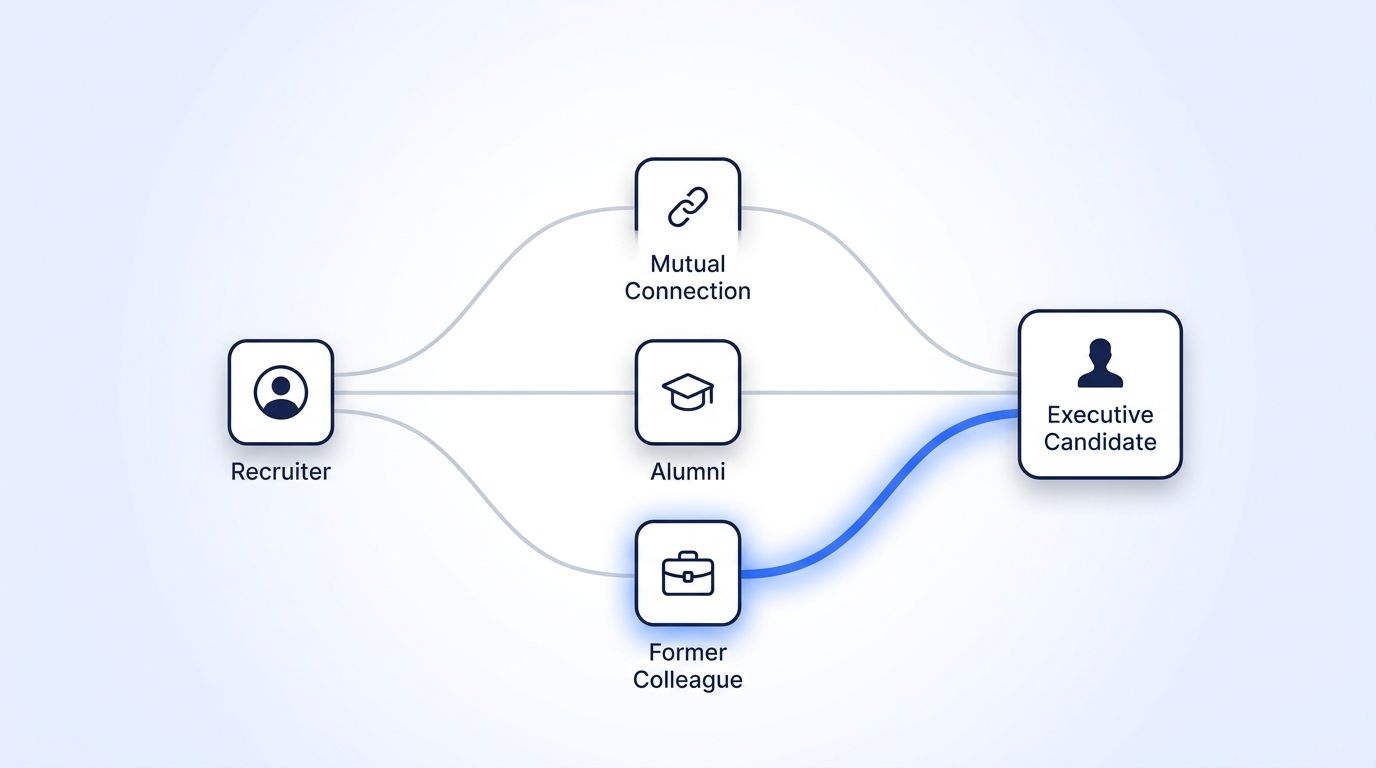
What Is a Warm Introduction Engine, and Why Does It Beat Cold Outreach?
A warm introduction engine is a system that turns your team's collective network into a searchable map of paths to any target candidate, instead of relying on whoever happens to remember a useful connection. In 2018, LinkedIn's own recruiting team raised their InMail response rate from a 28% baseline to 85% simply by prioritizing candidates who already had a company connection or content affinity signal (LinkedIn Talent Blog, 2018).
That gap hasn't closed. Isn't it strange how many search firms still run outreach as a series of individual cold messages, one recruiter and one candidate at a time, when the data on connected outreach has been public for years? A warm introduction engine treats every recruiter's network as shared infrastructure - not a personal Rolodex that dies when someone leaves the firm.
<!-- [UNIQUE INSIGHT] -->Most search firms already have the raw data for this system sitting in individual recruiters' LinkedIn accounts, ATS notes, and email threads. The failure isn't a lack of connections - it's that nobody has turned scattered individual relationships into a single, queryable asset the whole team can act on before a search even opens.
Citation capsule: LinkedIn's internal data shows connected outreach - InMails sent to candidates with an existing company tie, follower relationship, or content overlap - converts at roughly 3x the rate of cold InMail. That gap is why warm introduction paths deserve the same systematic treatment as any other sourcing channel, not ad hoc favors between recruiters.
Datamagnet's recruiting intelligence tools are built for exactly this kind of connection mapping - pulling live LinkedIn profile, activity, and company data so a search team can see relationship paths instead of guessing at them.
What Do You Need Before You Start?
Building a warm introduction engine takes roughly 4-6 hours for a 10-person search team working through the setup for the first time. You'll need a defined candidate list, export access to your team's LinkedIn connections, a live people-data API, and a spreadsheet or lightweight CRM to hold the network map. Here's the full checklist:
Prerequisites checklist:
- A list of target executive candidates (or the ICP filters that define them: title, seniority, function, industry)
- Export access to your team's individual LinkedIn connections, or a shared CRM/ATS where past placements and client contacts already live
- A people-data API for live profile, company, and connection-adjacent data (this guide uses Datamagnet's People Search and People Profile endpoints)
- A spreadsheet or lightweight CRM to hold the network map
- Time to build the first version: roughly 4-6 hours for a 10-person search team
- Difficulty: Intermediate
Step 1: How Do You Map Your Team's Existing Network Graph?
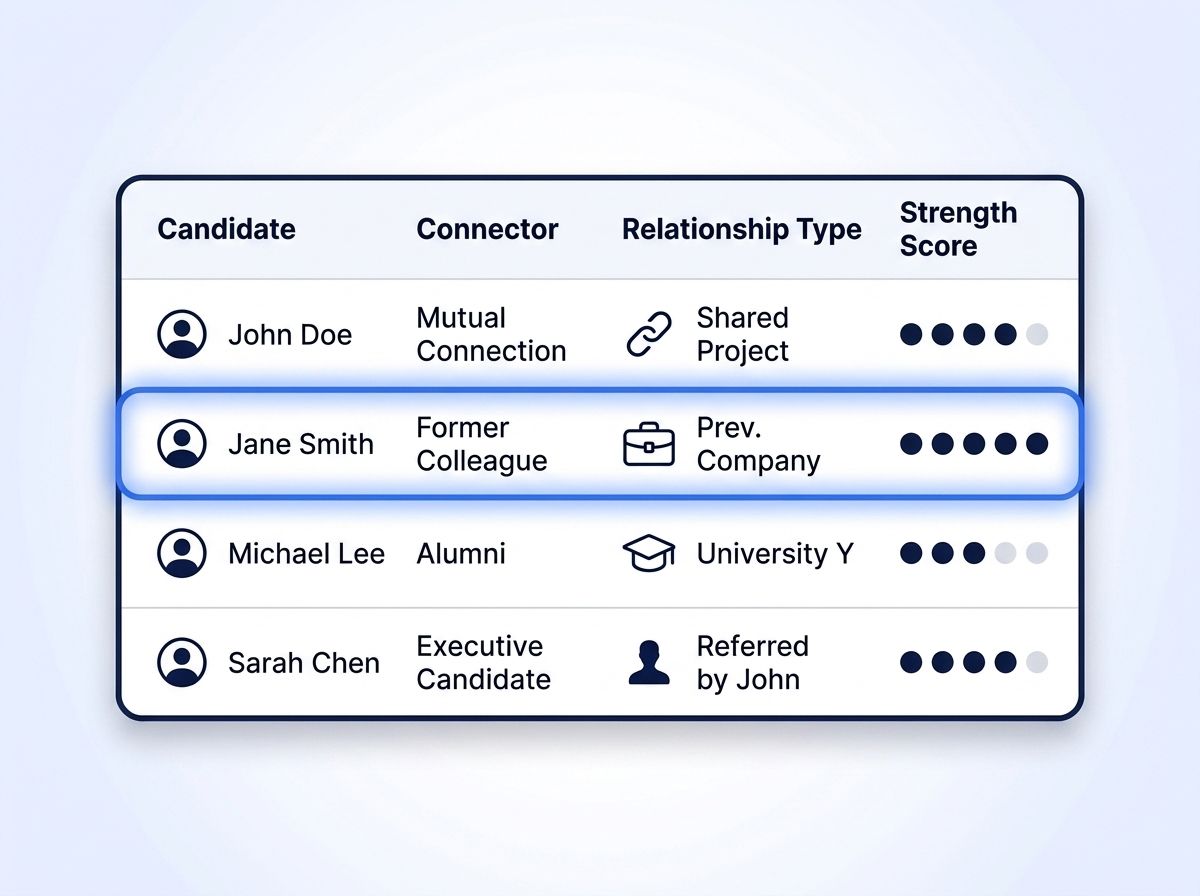
By the end of this step, you'll have a single, centralized list of every meaningful professional connection your search team collectively holds - not eleven separate LinkedIn accounts nobody else can see. Start by exporting each recruiter's LinkedIn connections and combining them into one sheet with three columns: connector name, connector's current company, and which recruiter owns that relationship. This step matters because a warm path only exists if someone on your team can actually see it - and right now, most of that visibility is trapped in individual accounts.
For deeper coverage, query Datamagnet's People Search DB against your own team's names to surface previously enriched profiles - former colleagues, alumni, and prior placements - that a manual export alone would miss. Pull company history for every connector, not just their current employer, since a shared past employer is often the strongest connector signal you have.
Verify this step worked by spot-checking five connectors against their live LinkedIn profiles to confirm employer and title data is current, not from a stale export.
<!-- [PERSONAL EXPERIENCE] -->Search teams that skip this consolidation step almost always rediscover the same problem three months in: a recruiter leaves the firm, and every warm path they personally held leaves with them. Centralizing the map isn't extra process - it's the difference between an engine and a personal favor bank.
Step 2: How Do You Identify the Highest-Value Connector Paths to Each Candidate?
By the end of this step, you'll have a short list of the two or three strongest paths to each target candidate, ranked by who's most likely to make an effective introduction. For every candidate on your target list, cross-reference their current and past employers against your consolidated connector map from Step 1. A connector who worked at the same company as the candidate - especially during overlapping years - is a stronger path than a distant LinkedIn connection with no shared context.
Run ICP People Search filtered by the candidate's current company and function to surface additional people at that company who might know them directly, even if they're not yet in your network. This widens the path options beyond who your team already knows to who your team could reach through one more hop.
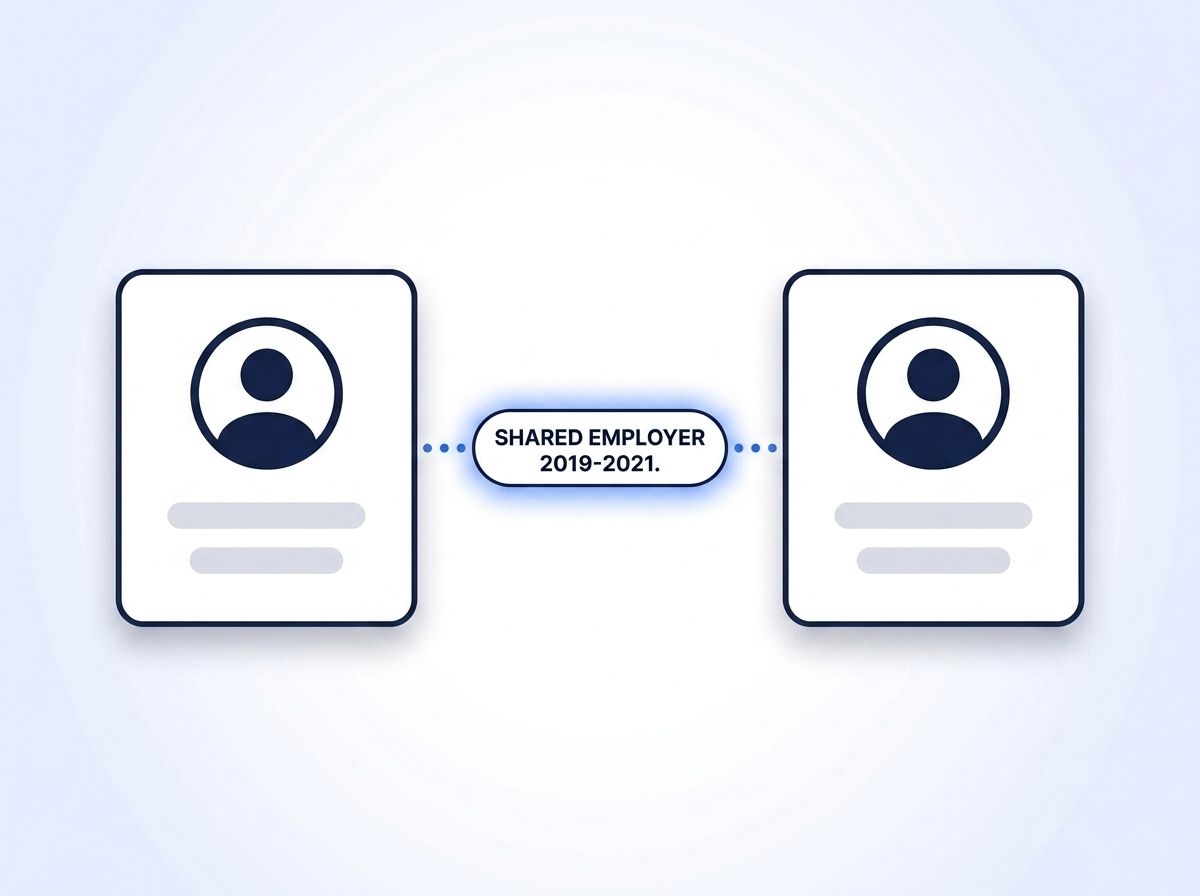
In 2026, peer-reviewed research found nearly a third of externally hired CEOs at large public firms had a pre-existing social tie to the hiring company's board (Kim & Low, Journal of Empirical Finance, 2026) - well above the roughly 5% that pure chance would predict. Board and investor overlap deserves its own row in your connector map for senior searches, not just former-colleague ties.
Step 3: How Do You Score and Rank Warm Paths by Strength and Relevance?
By the end of this step, every candidate on your list has a ranked shortlist of connectors instead of a flat, unordered pile of names. Score each connector path on three factors: relationship recency (an active colleague relationship outranks one from a decade ago), relationship depth (a direct manager or close peer outranks a large-team acquaintance), and the connector's willingness to help (someone who's made introductions before is a safer bet than an untested name). A simple 1-3 scale on each factor, summed to a 3-9 total, is enough to rank candidates without building anything elaborate.
Prioritize connectors your team can verify are still at a relevant company right now. A connector whose employer data is two years stale can send you chasing an introduction path that no longer exists - re-check current company and title before committing outreach time to a path.
Step 4: Draft an Ask That Actually Gets a Yes
By the end of this step, you'll have a short, specific introduction request template your team can reuse instead of writing one from scratch every time. The strongest asks name the candidate specifically, explain the opportunity in one sentence, and make it easy to say yes with almost no effort - a forwarded email the connector can send with one line added, not a request to "jump on a call." Vague asks like "do you know anyone good for a VP role?" get ignored far more often than a specific, low-effort request.
Bold the single most important instruction: always give your connector an easy opt-out and never mention the candidate's name to anyone else without the connector's confirmation that the outreach is welcome - a mishandled warm introduction can burn both the relationship and the candidate's trust in one message.
Referral-sourced hires post a 42% one-year retention rate against 32% for job-board hires and 14% for career-site hires, and referral time-to-hire runs 29 days against a 44-day company average (SHRM / SilkRoad, Sources of Hire). That gap is the business case for treating warm paths as a primary channel, not a nice-to-have.
Step 5: How Do You Automate Signal Detection So New Paths Surface on Their Own?
By the end of this step, your engine surfaces fresh warm paths automatically as your network changes, instead of requiring someone to manually re-run Step 1 every quarter. Networks aren't static - a connector changes jobs, a former colleague gets promoted into a hiring seat, or a candidate's own company shows a leadership departure that puts them back in play. Register a person engagement signal on your highest-priority candidates and connectors so you're alerted the moment they post, comment, or change roles, rather than checking manually.
For candidates who are especially high-value, Datamagnet's VIP Engagement Radar cookbook walks through setting up alerts the moment a target executive posts on LinkedIn - a strong trigger moment to route a warm introduction, since engagement signals real, current activity rather than a stale profile snapshot. Deliver alerts through a webhook into Slack or your ATS so the signal reaches a recruiter within minutes, not at the next weekly check-in.
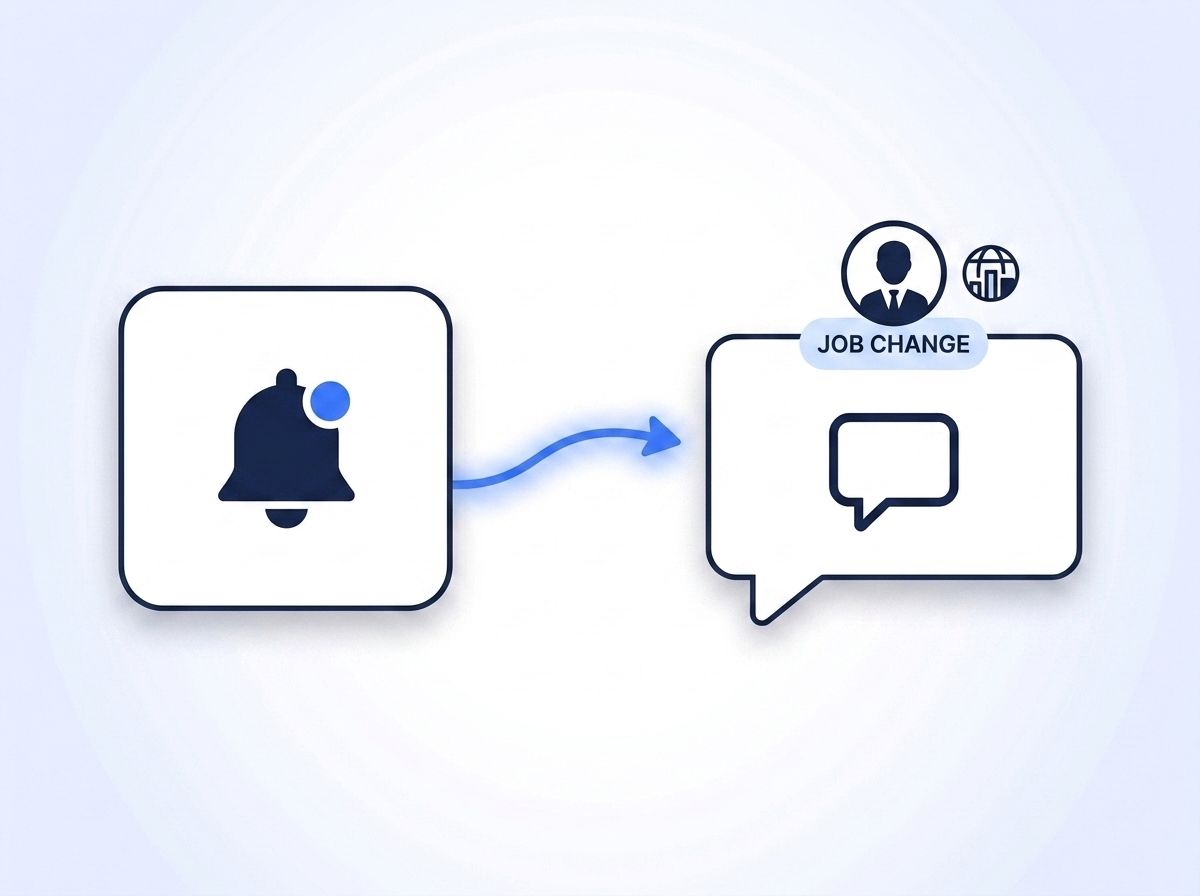
Search teams running signal-driven path detection report catching a connector's job change or a candidate's board departure within days, not at the next quarterly network refresh - the gap between "the relationship changed" and "the team knows it" shrinks from months to days once the check runs automatically instead of manually.
Boomerang hiring adds another layer worth tracking here: in March 2025, 35% of new U.S. hires were returning to a former employer, the highest rate ADP Research Institute has recorded since it began tracking in 2018. Champion tracking applies the same signal logic to your own former colleagues and placements - people who already trust your team and are statistically more likely to re-enter your network's orbit than the average passive candidate.
Step 6: How Do You Track Response Rates and Iterate the Engine?
By the end of this step, you'll know which connector types and ask templates actually convert, so the engine gets sharper with every search instead of staying static. Log three numbers per warm introduction attempt: whether the connector agreed to make the intro, whether the candidate responded, and time from ask to first candidate reply. Compare those numbers against your team's cold-outreach baseline every quarter - if warm paths aren't meaningfully outperforming cold InMail, the scoring model from Step 3 needs recalibrating, not more volume.
Roughly 73-75% of the professional workforce qualifies as passive talent at any given time, and about 45% of that group is "approachable" - open to the right opportunity reaching them the right way (LinkedIn Talent Solutions, originally published 2014, still LinkedIn's most-cited passive-talent benchmark). A warm introduction engine is how you reach the approachable half of that group before a competing search firm does.
What Common Mistakes Should You Avoid?
Most warm introduction engines stall out for the same handful of reasons - here's what to watch for. The five mistakes below cover the most common ways a promising network map turns into another abandoned spreadsheet, from treating it as a one-time project to skipping a consistent ask template.
1. Treating the network map as a one-time project. Teams build the connector spreadsheet once, use it for a search, and let it go stale. A network map that isn't refreshed on a cadence is just a historical record by the time you need it again.
2. Skipping the ask template and improvising every time. Inconsistent asks produce inconsistent results, and it's hard to tell whether a low response rate is a bad path or a bad message when every message is different.
3. Ignoring connector fatigue. Going back to the same three well-connected people for every search burns goodwill fast. Spread the ask across a wider pool, and track which connectors have already been tapped this quarter.
4. Over-indexing on LinkedIn-visible connections only. The strongest paths - former direct reports, board overlaps, investor introductions - often live outside what a LinkedIn export shows. Cross-reference company history and board data, not just connection lists.
5. Not verifying a connector's current role before asking. A connector whose company or title has changed since your last export can send an introduction request into a dead end, wasting the ask on a path that no longer exists.
What Does Success Look Like?
If your warm introduction engine is working, you should see a measurably higher response rate on warm-routed outreach compared to your cold-outreach baseline, plus a shrinking average time from "search opens" to "first qualified conversation." Executive mis-hires cost nearly 7x more than non-executive ones to correct (SHRM, 2025, 2025), so even a modest lift in warm-path accuracy pays for itself many times over on a single senior search.
As a stretch goal once the core engine is running, extend the same connector-scoring logic to client-side relationships - mapping warm paths into decision-makers at target client companies, not just candidates, using the same account research infrastructure principles search-adjacent sales teams already apply.
Frequently Asked Questions
What is a warm introduction engine in executive search?
A warm introduction engine is a repeatable system for mapping, scoring, and activating the people in your team's collective network who can introduce you to a target candidate or client. It replaces ad hoc favors with a shared, searchable database of connector relationships, refreshed continuously with live profile and company data.
How much more effective is a warm introduction than a cold InMail?
Meaningfully more effective. General cold InMail response rates run 18-25% (LinkedIn Talent Blog, 2024), while LinkedIn's own recruiting team lifted response to 85% by prioritizing candidates with an existing connection or affinity signal (LinkedIn Talent Blog, 2018).
Can you build a warm introduction engine without a paid data tool?
You can start with spreadsheets and manual LinkedIn exports, but the map goes stale fast without live data - connectors change jobs, and a two-year-old export can send an introduction request into a dead end. A live people-data API keeps connector employer and title data current without a manual re-export cycle.
How do you scale warm introductions across a whole search team?
Centralize the connector map in one shared system instead of individual recruiters' LinkedIn accounts, so a relationship survives even if the recruiter who found it leaves the firm. Assign scoring and ask-template ownership to one person so quality stays consistent as more recruiters contribute paths.
Does this only work for retained executive search firms?
No. In-house recruiting teams building a leadership bench, RevOps teams sourcing warm paths into target accounts, and staffing agencies working contingency searches all use the same core mechanics - map the network, score the paths, automate the refresh. The 42% referral retention rate versus 32% for job-board hires (SHRM / SilkRoad) holds regardless of who's running the search.
Sources
- SHRM, 2025 Talent Acquisition Benchmarking Report, retrieved 2026-08-18, https://www.shrm.org/about/press-room/shrm-releases-2025-benchmarking-reports--how-does-your-organizat
- SHRM / SilkRoad, Employee Referrals Remain Top Source of Hires, retrieved 2026-08-18, https://www.shrm.org/topics-tools/news/talent-acquisition/employee-referrals-remain-top-source-hires
- LinkedIn Talent Blog, How InMail Response Rates Compare Across Industries and Functions, retrieved 2026-08-18, https://www.linkedin.com/business/talent/blog/talent-engagement/how-inmail-response-rates-compare-across-industries-and-functions
- LinkedIn Talent Blog, This Simple Use of Data Helped LinkedIn's Recruiters Achieve an 85% InMail Response Rate, retrieved 2026-08-18, https://www.linkedin.com/business/talent/blog/talent-analytics/how-to-use-data-to-boost-response-rates
- LinkedIn Talent Solutions, Active vs. Passive Candidates: Latest Global Breakdown Revealed, retrieved 2026-08-18, https://www.linkedin.com/business/talent/blog/talent-strategy/active-vs-passive-candidates-latest-global-breakdown-revealed
- Kim, H. & Low, A., Who Hires Whom? Connected Hiring in the CEO Labor Market, Journal of Empirical Finance (2026), retrieved 2026-08-18, https://papers.ssrn.com/sol3/papers.cfm?abstract_id=5130033
- ADP Research Institute, Boomerang Employees analysis, March 2025, retrieved 2026-08-18, https://enterprisealumni.com/research/adp-boomerang
- Datamagnet, People Search endpoint, retrieved 2026-08-18, https://docs.datamagnet.co/api-reference/endpoints/people-search
- Datamagnet, Webhooks, retrieved 2026-08-18, https://docs.datamagnet.co/api-reference/webhooks
