
Disclosure: Datamagnet publishes this article. Product capabilities described below are based on public documentation, retrieved September 6, 2026.
How to Version Your Enrichment Schema Without Breaking Downstream Consumers
You rename one field - company_size becomes employee_count - and by Monday morning three dbt models are failing, a Clay table is full of nulls, and a Slack channel is asking why the CRM sync stopped. That's not a fluke. It's what happens when a schema changes without a version to catch it.
This guide walks through a practical way to version an enrichment schema so new fields, renamed fields, and type changes don't take down every pipeline reading from it - dbt, reverse ETL, Zapier or n8n flows, and direct CRM field mappings included.
TL;DR
- In 2025, Postman found 60% of API teams version their APIs, but only 26% use semantic versioning and just 17% run contract testing (Postman, 2025 State of the API Report) - most teams have a version number with no real safety net behind it.
- Over 25% of organizations report annual losses exceeding $5 million from poor data quality, and schema drift is a direct contributor (IBM Institute for Business Value, 2025).
- Additive-first changes, dated version pins, and a published deprecation window (Stripe, GitHub, and Shopify all use some version of this) let you evolve a schema without a coordinated "everyone update today" migration.
- Contract testing against your own schema - not just your own code - catches breaking changes before a downstream consumer does.
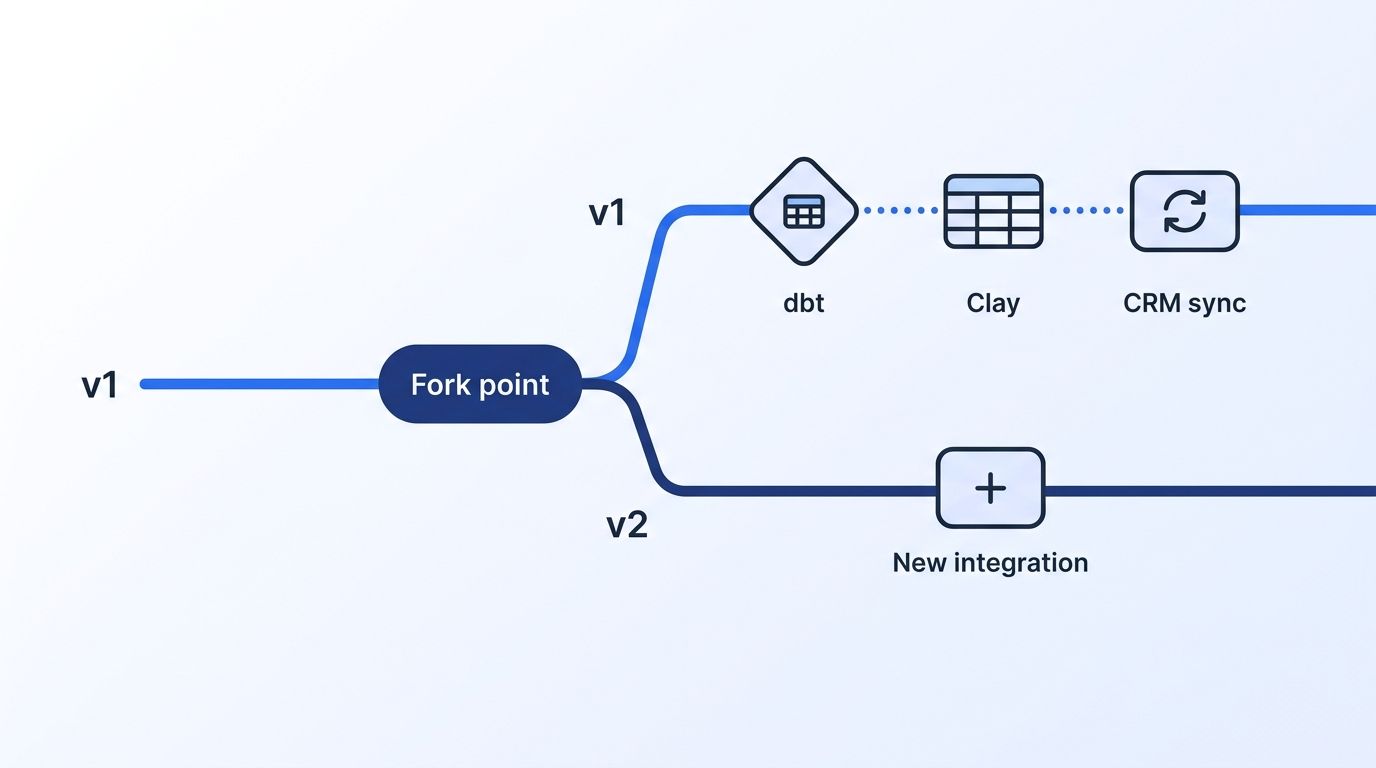
Why Does Schema Versioning Matter for Enrichment APIs?
Schema versioning matters because enrichment data changes more than most databases ever will. In 2025, Postman surveyed more than 5,700 developers and found 60% of API teams version their APIs, but only 26% use semantic versioning and just 17% run contract testing against their schema (Postman, 2025 State of the API Report). That gap between "having a version" and "actually protecting consumers" is where most breakage happens.
An enrichment schema isn't static like an internal order table. It tracks job titles, company headcounts, and org structure - all things that change constantly in the real world, not just in your database. Datamagnet's own May 2026 changelog standardized a field to employee_count across People, Company, and Post Search responses - a small, deliberate rename that any consumer hard-coding the old field name would have felt immediately.
Most teams treat a schema like a database table: something you alter in place when you need to. Treat it like a contract instead. A contract has a version number, a notice period, and two parties who both agree when it changes - and that framing is what actually prevents the 2 a.m. Slack message about a broken sync.
What Actually Breaks When an Enrichment Schema Changes Without Warning?
An unversioned schema change breaks whatever reads the field it touched - and in a modern GTM stack, that's rarely just one system. Uptime Institute's 2026 Annual Outage Analysis found that 57% of organizations said their most recent impactful outage cost more than $100,000, and 20% said it cost more than $1 million (Uptime Institute, Annual Outage Analysis 2026).
The pattern shows up outside enrichment too, at a much bigger scale. Nordic APIs' 2026 reliability report, built from public status-page data across 215+ services, tracked how a single upstream failure - the October 2025 AWS DynamoDB disruption in us-east-1 - cascaded into 141 downstream services (Nordic APIs, API Reliability Report 2026). An enrichment schema sits in the same position: one upstream field change, many downstream consumers that never saw it coming.
Citation capsule: A schema change that isn't versioned doesn't fail once - it fails everywhere the field is read. A renamed or retyped field can silently corrupt a dbt model, break a Clay enrichment column, and null out a CRM sync at the same time, because none of those consumers were warned the contract had changed.
How Do Stripe, GitHub, and Shopify Version Their APIs?
None of these three companies solved versioning by picking a clever numbering scheme - they solved it by deciding what happens to existing consumers by default. That default, not the version label itself, is the part worth copying.
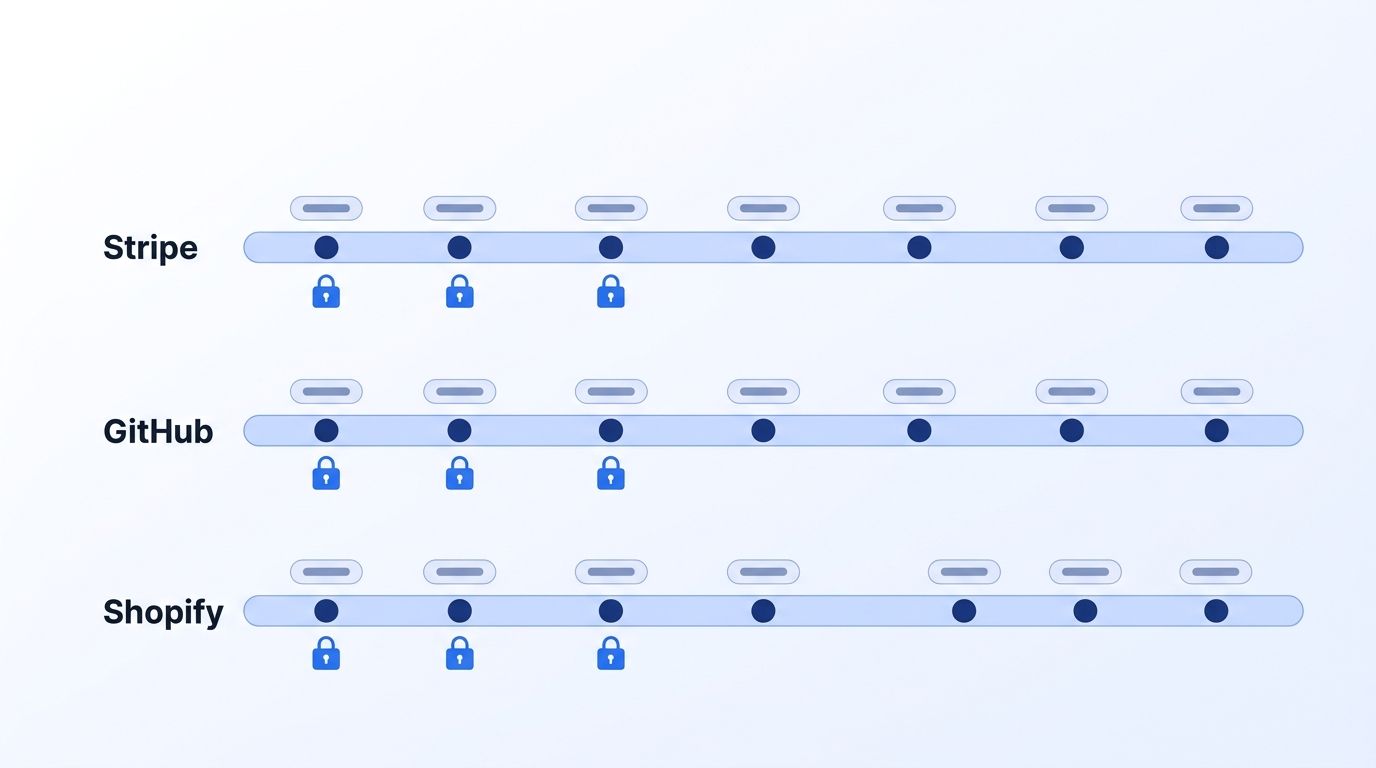
- Stripe pins every new account to whatever API version is live on their first call, and that pin sticks until they explicitly upgrade via the
Stripe-Versionheader or the dashboard (Stripe, API Versioning). New fields ship without breaking anyone, because nobody is forced onto them. - GitHub uses calendar-dated versions (like
2022-11-28) and only issues a new one when something breaking happens - additive changes roll out to every version at once. Each version stays supported for at least 24 months (GitHub, API Versioning). - Shopify ships a new stable, dated version every quarter and guarantees at least 9 months of overlap between versions, with deprecations flagged in the changelog, a health report, and in-tool warnings (Shopify, About API Versioning).
The shared thread: additive changes never require a version bump, breaking changes always do, and existing consumers are never force-migrated without a published runway.
How Do You Design a Version Scheme for Your Enrichment Schema?
You design a safe version scheme by separating "additive" changes from "breaking" ones and only requiring action from consumers on the second kind. Adding a new field, a new endpoint, or a new optional filter shouldn't ever require a version bump - only renaming a field, changing its type, or removing it should.
Pick a dated or numbered scheme and stick to it. Datamagnet's July 2026 changelog shipped new People enrichment flags and Company insights - interests, similar profiles, hiring trends - as additive fields that existing integrations never had to touch. That's the pattern to build toward: ship new capability constantly, but reserve version bumps for the rare case that actually breaks a contract.
Once you've drawn that line, document it somewhere a machine can read, not just a changelog a human might miss. A response header like X-Schema-Version, or a schema_version field in the payload itself, lets a downstream consumer detect a change programmatically instead of finding out when a dbt model throws a null-type error. Review the API introduction and quota docs for how base URLs and versioning fit into request structure before you commit to a scheme.
How Do You Communicate Breaking Changes to Downstream Consumers?
You communicate a breaking change by pushing the notice to where the consumer already looks, not by expecting them to check a changelog page. Datamagnet's webhooks deliver signal and event payloads directly to a downstream endpoint, and the same delivery pattern works for deprecation notices - fire an event when a field enters its deprecation window, not just when it disappears.
<!-- [PERSONAL EXPERIENCE] -->Watching a schema change land badly usually comes down to the same root cause: the notice went out, but only to a changelog nobody on the receiving team reads. The dbt maintainer finds out when a model breaks in production. The RevOps admin finds out when a CRM field goes blank. A machine-readable signal - a header, a webhook, a deprecation flag in the payload - reaches the pipeline itself instead of relying on a human to have read an email.
Datamagnet's April 2026 changelog is a useful reference for how to phrase this kind of update: it separated "reliability improvements" (no consumer action needed) from "refinements to Post Search filters" (worth reviewing) in plain language, rather than burying both under one vague "updates" heading.
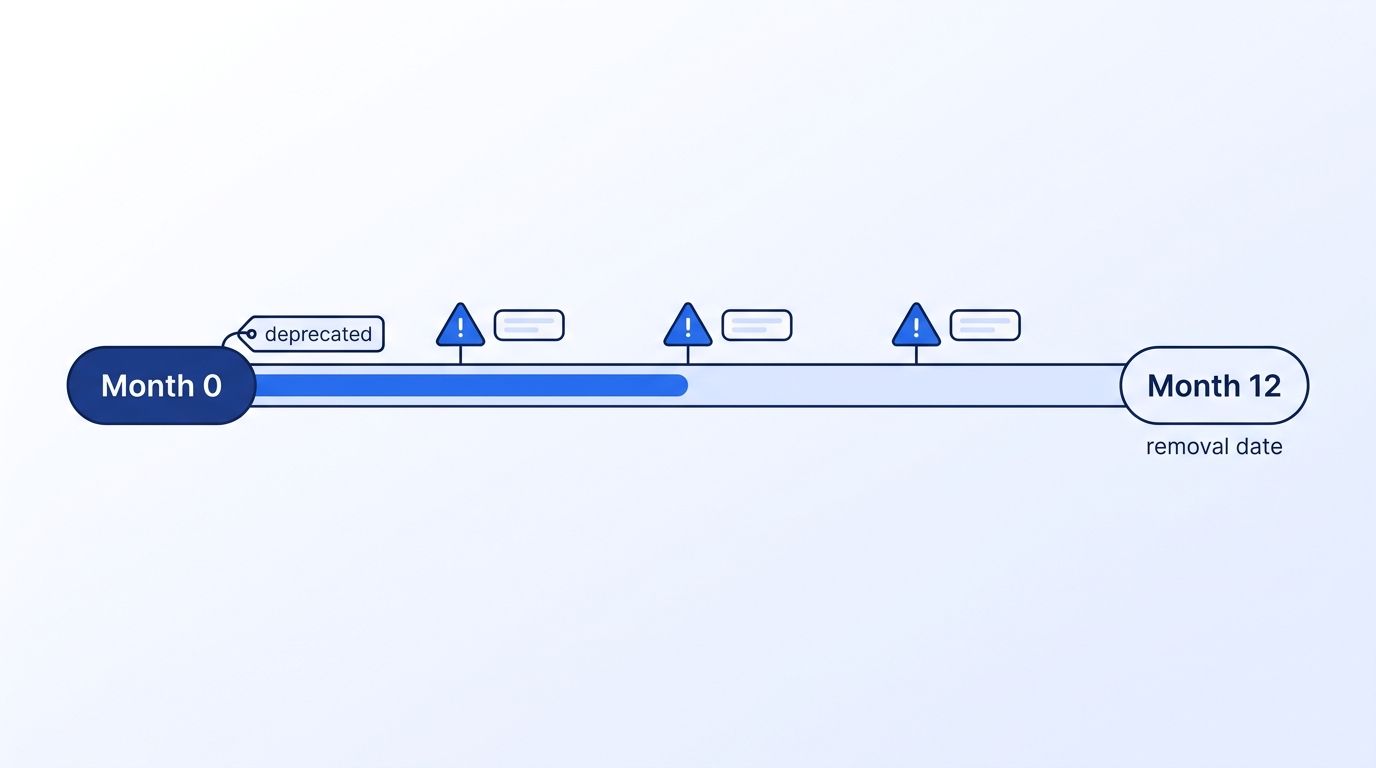
How Long Should Your Deprecation Window Be?
Your deprecation window should be long enough to outlast the pace your own data changes, and for enrichment schemas tracking people and companies, that pace is fast. B2B contact data decays at roughly 2.1% a month - about 22.5% a year - as people change roles and employers (HubSpot, Database Decay Simulation), and the U.S. Bureau of Labor Statistics puts the total monthly job-separation rate at around 3.2-3.3% through 2024-2025 (U.S. Bureau of Labor Statistics, JOLTS).
That churn is exactly why enrichment schemas need to evolve - new fields to capture seniority signals, revised categories for company size, updated employment-status flags - more often than a typical internal database schema does. A 12-month deprecation window, matching what Shopify guarantees as a minimum, gives most annual planning and re-integration cycles enough runway to catch up. Anything shorter than a full quarter risks colliding with a downstream team's own release freeze.
How Do You Test a Schema Change Before It Ships?
You test a schema change by validating it against real consumer expectations before it reaches production, not by trusting your own code review. Contract testing - checking that a schema change still satisfies the shape a downstream consumer expects - is the exact practice only 17% of API teams currently run, according to Postman's 2025 survey (Postman, 2025 State of the API Report), which makes it one of the highest-value gaps to close first.
Citation capsule: Contract testing catches what code review can't - a field that's still technically valid JSON but no longer matches what a dbt model, Clay column, or CRM mapping expects to receive. Running it against a staged version of your schema, before the version ships, turns a production incident into a caught bug.
Build a small suite of "consumer contracts" - the exact fields and types a dbt model or Zapier flow expects - and run every candidate schema change against them in a staging environment first. Datamagnet's People Profile endpoint and Company Profile endpoint documentation lists the full current field set, which is the right starting point for building that contract list if you're consuming either one. If a candidate change fails a contract, it's a breaking change - full stop - and it belongs in the next major version, not a patch.
Consider how the change plays out for common downstream tooling before shipping it. An n8n HTTP Request node parsing a specific field path, or a HubSpot workflow mapped to a specific property name, both fail the same way a dbt model does: silently, until someone notices the data stopped updating.
Ship Schema Changes Your Downstream Consumers Can See Coming
A versioned enrichment schema isn't extra process for its own sake - it's the difference between a planned migration and a Monday-morning incident. Separate additive changes from breaking ones, pin existing consumers to what they already have, publish a deprecation window long enough to outlast your own data's churn, and test every candidate change against a real consumer contract before it ships. For more on why the fields themselves need this much care in the first place, see why programmatic CRM enrichment benefits depend on stable, current data. See Datamagnet's current People API field reference and map it against your own downstream contracts this week.
Frequently Asked Questions
What is enrichment schema versioning?
Enrichment schema versioning is the practice of assigning a version identifier - dated or numbered - to the structure of an enrichment API's response, so downstream consumers can detect when a field is added, renamed, retyped, or removed. It separates safe, additive changes from breaking ones that require consumer action.
How do I know if a schema change is breaking or additive?
A change is additive if every existing consumer keeps working without modification - a new optional field or endpoint qualifies. A change is breaking if it alters or removes anything a consumer currently reads: renaming a field, changing its type, or dropping it from the response all count as breaking.
How long should I support an old schema version before removing it?
At least 12 months for most B2B data consumers, matching the minimum overlap window Shopify guarantees on its own API (Shopify, About API Versioning). Enrichment data changes fast - B2B contact data decays roughly 2.1% a month (HubSpot, Database Decay Simulation) - but downstream integration and budget cycles usually move on an annual schedule.
What's the difference between schema versioning and API versioning?
API versioning covers the entire contract of an endpoint - authentication, rate limits, and response shape together. Schema versioning is narrower: it tracks changes to the structure and types of the data payload itself. An enrichment API can bump its schema version without changing anything else about how requests are authenticated or rate-limited.
Can I version a schema without breaking existing integrations immediately?
Yes - pin every existing consumer to the schema version active when they first integrated, the same default Stripe uses for new accounts (Stripe, API Versioning). New consumers get the current version by default, while existing ones stay on their pinned version until they explicitly upgrade.
Sources
- Postman, 2025 State of the API Report, retrieved 2026-09-06, https://www.postman.com/state-of-api/2025
- IBM Institute for Business Value, The True Cost of Poor Data Quality, retrieved 2026-09-06, https://www.ibm.com/think/insights/cost-of-poor-data-quality
- Uptime Institute, Annual Outage Analysis 2026, retrieved 2026-09-06, https://uptimeinstitute.com/resources/research-and-reports/annual-outages-analysis-2026
- Nordic APIs, API Reliability Report 2026: Uptime Patterns Across 215+ Services, retrieved 2026-09-06, https://nordicapis.com/api-reliability-report-2026-uptime-patterns-across-215-services/
- HubSpot, Database Decay Simulation, retrieved 2026-09-06, https://www.hubspot.com/database-decay
- U.S. Bureau of Labor Statistics, JOLTS (Job Openings and Labor Turnover Summary), retrieved 2026-09-06, https://www.bls.gov/jlt/
- Stripe, APIs as Infrastructure: Future-Proofing Stripe With Versioning, retrieved 2026-09-06, https://stripe.com/blog/api-versioning
- GitHub, To Infinity and Beyond: Enabling the Future of GitHub's REST API With API Versioning, retrieved 2026-09-06, https://docs.github.com/en/rest/about-the-rest-api/api-versions
- Shopify, About API Versioning, retrieved 2026-09-06, https://shopify.dev/docs/api/usage/versioning
- Datamagnet, Changelog: May 2026, retrieved 2026-09-06, https://docs.datamagnet.co/changelog/may-2026
- Datamagnet, Changelog: July 2026, retrieved 2026-09-06, https://docs.datamagnet.co/changelog/july-2026
- Datamagnet, Changelog: April 2026, retrieved 2026-09-06, https://docs.datamagnet.co/changelog/april-2026
- Datamagnet, Webhooks, retrieved 2026-09-06, https://docs.datamagnet.co/api-reference/webhooks
