
Disclosure: Datamagnet publishes this article. Datamagnet's own API capabilities are described below as one example among many vendor categories a scorecard can evaluate.
How to Build a Vendor Scorecard for Your GTM Tool Stack
The average company with 1 to 500 employees now runs 152 SaaS applications, and enterprises with over 10,000 employees run as many as 660 (Zylo, 2025 SaaS Management Index, retrieved 2026-08-18). Most of that stack got approved one Slack message at a time, not through any real evaluation process.
A vendor scorecard fixes that. It's a weighted rubric that turns "this tool seems fine" into a documented, comparable score across every vendor you're considering. This guide walks through the exact criteria to include, how to weight them, and how to keep the scorecard from turning into a spreadsheet nobody opens again.
TL;DR
- Companies waste an average of $21 million a year on unused SaaS licenses, up 14.2% year-over-year (Zylo, 2025 SaaS Management Index, retrieved 2026-08-18).
- A working scorecard needs 5-8 weighted criteria: data accuracy, integration depth, security/compliance, pricing transparency, support SLA, and roadmap fit.
- IT security review is the single biggest source of deal delay, blocking 39% of B2B software purchases (G2, 2026 Buyer Behavior Report, retrieved 2026-08-18) — weight it accordingly.
- Score candidates against real data from a pilot, not a sales deck.
- Re-run the scorecard on a cadence, not just at initial purchase, since buying cycles and tool needs both keep shifting.
Why Does Your GTM Tool Stack Need a Formal Vendor Scorecard?
Your GTM tool stack needs a formal scorecard because ad hoc buying has already produced real waste. In 2025, Zylo found that organizations manage an average of 152 SaaS apps at the smallest company sizes and up to 660 at the largest, and waste $21 million a year on licenses nobody uses (Zylo, 2025 SaaS Management Index, retrieved 2026-08-18). That's not a rounding error — it's the direct cost of skipping evaluation.
The tool count problem compounds on the sales floor, too. According to a Gartner sales survey reported in Salesforce's 2026 State of Sales research, sellers use an average of 8 tools to close a single deal, and 42% of reps say they feel overwhelmed by the number of tools in their stack — overwhelmed reps are 45% less likely to hit quota (Salesforce, State of Sales, 2026, retrieved 2026-08-18). Every new tool you add without a scorecard is a bet that it earns its seat instead of just adding to that pile.
<!-- [UNIQUE INSIGHT] -->Most teams don't lack tool options — they lack a repeatable way to say no. A scorecard isn't really about picking the "best" vendor. It's a forcing function that makes the tradeoffs visible before a contract gets signed, so the decision doesn't rest entirely on whoever ran the best demo.
What Criteria Belong on a GTM Vendor Scorecard?
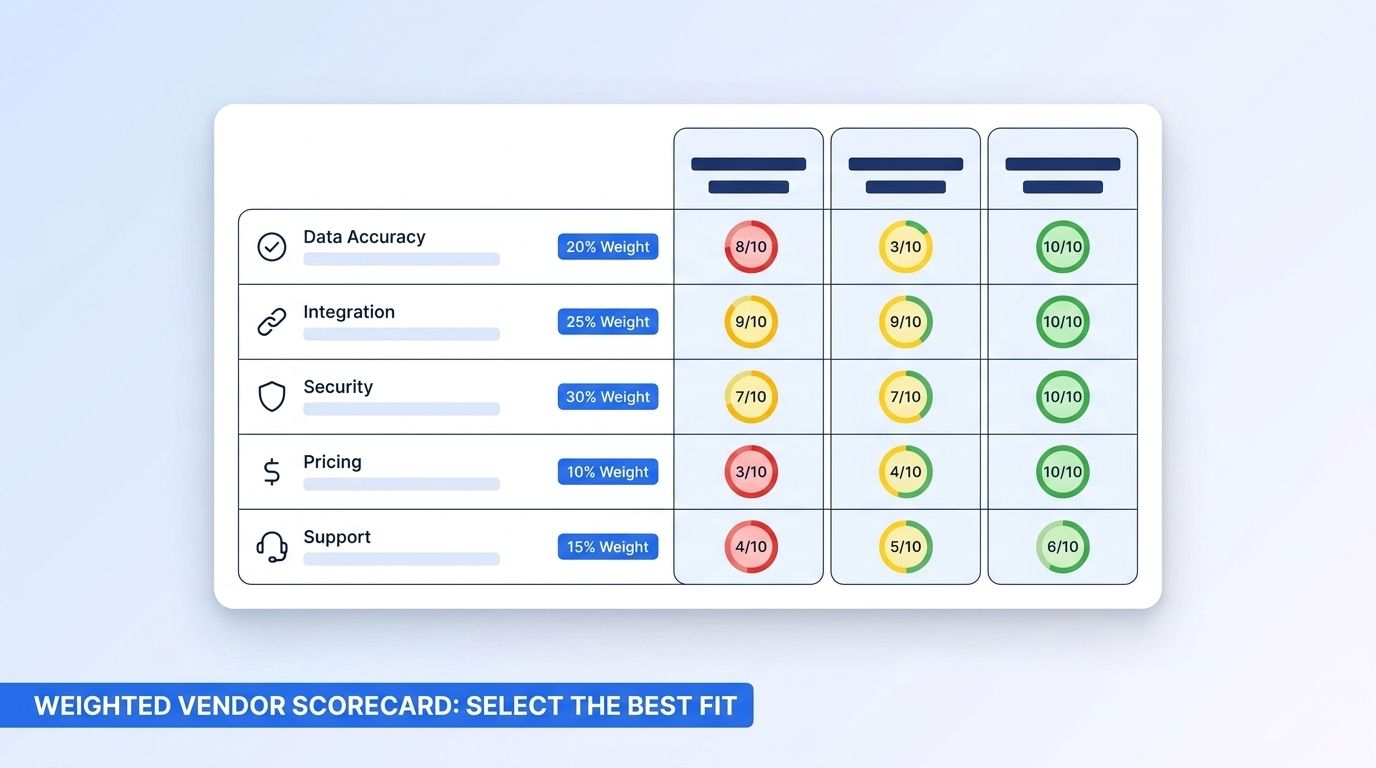
A GTM vendor scorecard needs criteria that map to how the tool actually gets used, not just how it gets sold. Six categories cover most GTM tools — data providers, sales engagement platforms, CRM add-ons, and intent tools alike — and skipping any one of them tends to surface as a support ticket six months later.
| Criterion | What you're really testing |
|---|---|
| Data accuracy & coverage | Does the tool return current, verified data, or a stale snapshot? |
| Integration depth | Does it connect to your CRM and stack via a real API, or exports and Zapier duct tape? |
| Security & compliance | Will it pass an IT security review without a six-week delay? |
| Pricing transparency | Is the model usage-based and predictable, or a seat contract with hidden overage fees? |
| Support & SLA | What's the response time when the integration breaks at 4pm on a Friday? |
| Roadmap fit | Does the vendor's direction match where your GTM motion is headed in 12 months? |
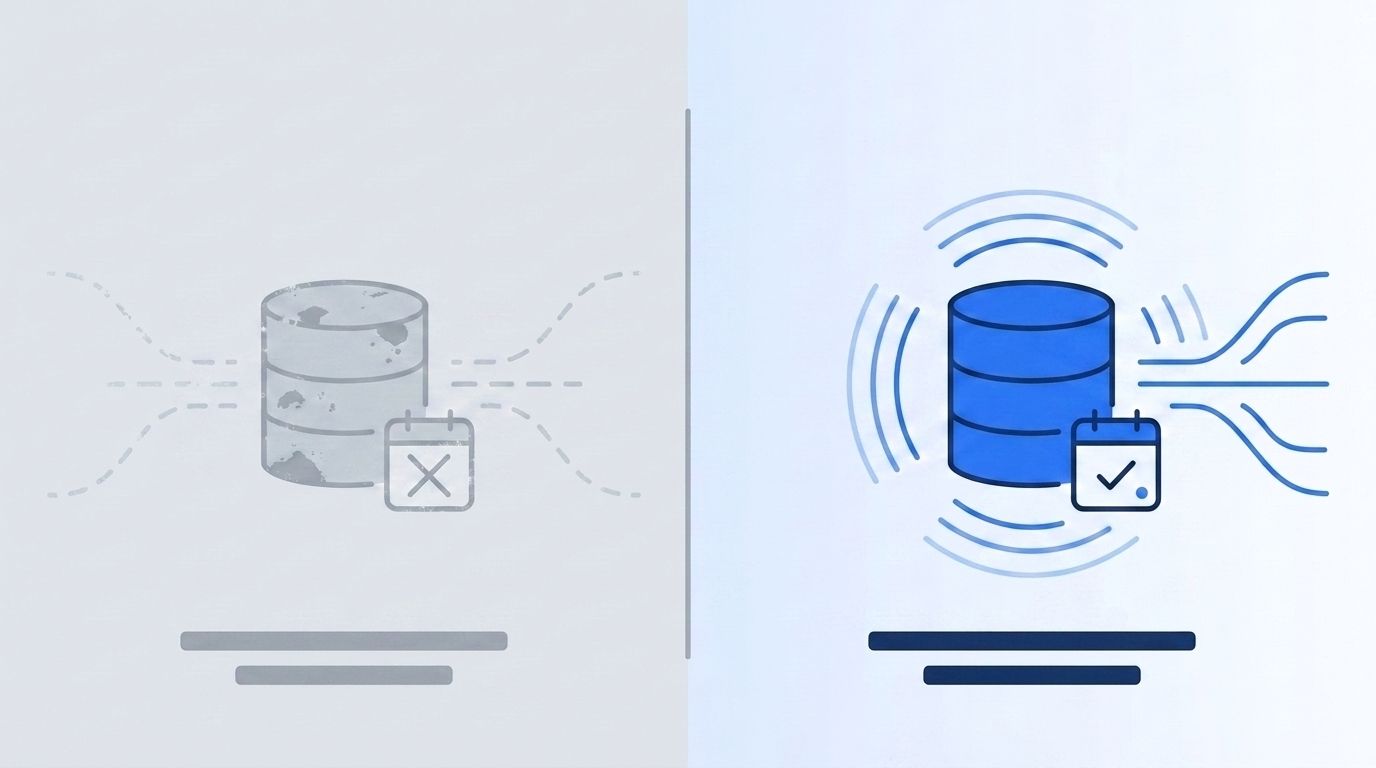
Data accuracy deserves extra scrutiny for any vendor touching people or company records. As of 2026, Dun & Bradstreet's B2B Marketing Data Report estimates that 20-30% of firmographic data goes stale every year (Dun & Bradstreet, B2B Marketing Data Report, retrieved 2026-08-18), which means a vendor's static database snapshot degrades before your contract even renews. If you're scoring a company-data provider, test whether its Company Profile endpoint or ICP Company Search returns headcount and industry data pulled live, not from a quarterly refresh.
How Do You Weight and Score Each Scorecard Criterion?
You weight each criterion by how much it actually blocks a deal or breaks in production, not by gut feel. Assign every criterion a percentage weight that sums to 100%, then score each vendor 1-5 per criterion and multiply by the weight to get a comparable total.
Isn't it tempting to just weight everything equally and call it done? Resist that. In 2026, G2's Buyer Behavior Report found that IT security review is the single biggest source of delay between vendor selection and signed contract, blocking 39% of deals, ahead of budget approval at 32% and implementation planning at 25% (G2, 2026 Buyer Behavior Report, retrieved 2026-08-18). If security and compliance sit at the bottom of your weighted list, you're optimizing for the wrong bottleneck.
Citation capsule: IT security review blocks more B2B software deals than any other single factor — 39% of purchases stall there, ahead of budget approval and implementation planning combined in some cycles. A vendor scorecard that weights security and compliance as an afterthought is scoring against the wrong finish line.
A reasonable starting weight split for most GTM tools: data accuracy 25%, integration depth 20%, security & compliance 20%, pricing transparency 15%, support & SLA 10%, roadmap fit 10%. Adjust up for security if you sell into regulated industries, and adjust up for data accuracy if the tool touches your ICP or outbound targeting directly.
Step-by-Step: How Do You Build and Score a GTM Vendor Scorecard?
What's the one step teams skip that quietly breaks the whole exercise? The pilot. Skipping it is why so many scorecards look rigorous on paper but still greenlight the wrong vendor. You build a working scorecard in six steps, moving from criteria definition through weighting, shortlisting, piloting, scoring, and documentation, and here's the sequence that holds up once real vendors and real data enter the picture.
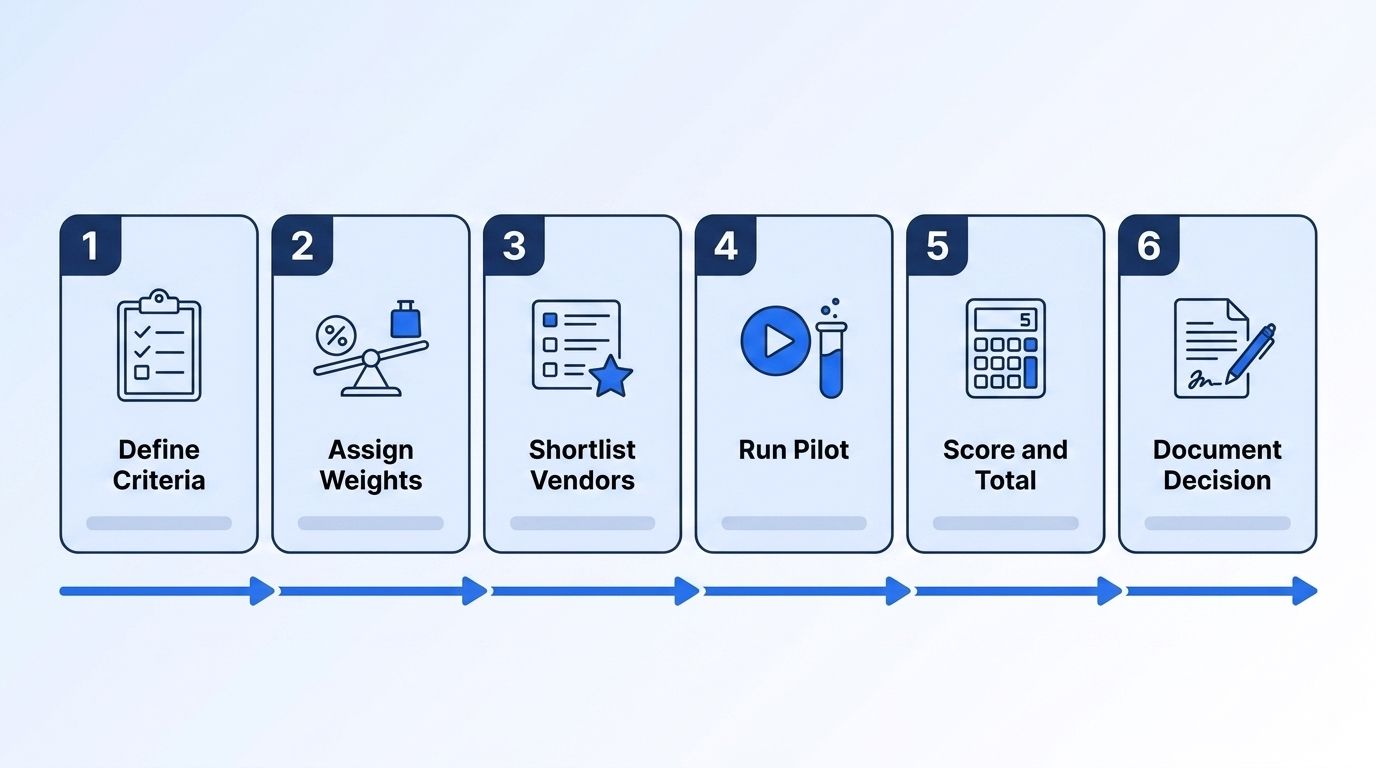
- Define your criteria list. Start from the six categories above and cut or add based on what's actually broken your last three tool purchases.
- Assign weights that sum to 100%. Base weights on what blocks deals and breaks in production, not on which stakeholder is loudest in the room.
- Shortlist 3-4 vendors. More than four candidates slows the process without meaningfully improving the decision.
- Run a real pilot, not a demo. Test each vendor against your actual data — a demo shows you the vendor's best-case sample, not your account list.
- Score every vendor 1-5 per criterion, then multiply by weight. A vendor scoring a 5 on a 10%-weighted criterion still loses to a vendor scoring a 3 on a 25%-weighted one.
- Document the decision and the runner-up. When the tool underperforms in six months, you'll want to know exactly why it won and what came in second.
Watching teams pilot a data or enrichment vendor is a pattern worth naming: they run the trial against a curated "best 50 contacts" list instead of a random pull from their actual account list. The vendor looks great on the curated set and disappoints once it hits real, messy data. Pull your pilot sample at random, or the scorecard scores the vendor's marketing, not the product.
For integration depth specifically, test whether the vendor's API supports the delivery pattern your team actually needs — a webhook for real-time updates scores differently than a nightly export file, even if both technically "integrate." And check the pricing model directly against usage: a credit-based balance you can monitor in real time scores higher on transparency than a seat contract with usage caps buried in the fine print.
What Mistakes Sink Most Vendor Scorecards?
Why do so many scorecards get built and then never actually used? Most vendor scorecards fail for the same handful of reasons, and nearly all of them happen before the scoring even starts, not during it. The scorecard itself is rarely the problem — how it gets applied is. Watch for these four failure patterns, since each one quietly undoes the weighting work from the previous section.
- Skipping the pilot and scoring off the sales deck. A scorecard filled in from a vendor's own claims isn't an evaluation — it's a transcription exercise.
- Treating the scorecard as a one-time gate. GTM tool needs shift as fast as the market does. In 2025, 6sense found the average B2B buying cycle compressed to 10.1 months, down from 11.3 months in 2024 (6sense, B2B Buyer Experience Report, 2025, retrieved 2026-08-18) — a stack you scored a year ago was scored against a slower market.
- Letting one loud stakeholder override the weighted total. The whole point of weighting is to make tradeoffs explicit; overriding it defeats the exercise.
- Never revisiting existing vendors, only new ones. In 2026, G2 found that 84% of B2B buyers consolidated at least 3 best-of-breed tools into fewer platforms in the past year, and 50% consolidated at least 5 (G2, 2026 Buyer Behavior Report, retrieved 2026-08-18). If your scorecard only runs for new purchases, you'll miss the consolidation opportunities sitting in your existing stack.
Citation capsule: More than four out of five B2B buyers consolidated at least three point solutions into fewer platforms in the past year, and half consolidated five or more. A vendor scorecard applied only to new purchases misses most of that opportunity — the biggest savings usually sit in the stack you already own.
Compare how a live, pay-as-you-go data API scores against a static seat-based database on the same criteria — see how Datamagnet stacks up against ZoomInfo's seat contracts or against Apollo's static database model as a worked example of scoring pricing transparency and data freshness side by side.
How Often Should You Re-Score Your GTM Vendors?
How do you know when a vendor's score has gone stale? Re-score your GTM vendors at least once a year, and sooner for any tool touching data accuracy or pricing. B2B buying cycles have already compressed to 10.1 months on average (6sense, B2B Buyer Experience Report, 2025, retrieved 2026-08-18), which means the market you scored a vendor against a year ago has likely already shifted underneath the contract.
Set a recurring calendar reminder tied to contract renewal dates, not a vague "sometime next quarter" intention — vague reviews don't happen. Bring the same weighted criteria back, re-run a small pilot against current data, and compare the new score to the original. A vendor that scored a 4.2 at signing but now scores a 3.1 on data accuracy is worth a renegotiation conversation before the auto-renewal clause kicks in.
Before scaling any vendor evaluation into a formal RFP process, review how each finalist handles security and data practices — that's the criterion most likely to stall the deal later, so front-loading it saves the most time. See Datamagnet's own pricing model and score it against your current data vendor this week.
Frequently Asked Questions
Quick, sourced answers to the questions GTM and RevOps teams ask most before building a vendor scorecard, covering how many criteria to use, how to weight them, and how often to re-score, pulling directly from the SaaS spend, deal-delay, and buying-cycle data cited throughout this guide.
What is a GTM vendor scorecard?
A GTM vendor scorecard is a weighted rubric for comparing sales, marketing, and data tools against consistent criteria — typically data accuracy, integration depth, security, pricing, support, and roadmap fit. It replaces the sales-deck-driven buying pattern behind the average company's 152 to 660 SaaS applications (Zylo, 2025 SaaS Management Index, retrieved 2026-08-18).
How many criteria should a vendor scorecard include?
Most working scorecards use 5-8 weighted criteria — enough to cover data accuracy, integration, security, pricing, support, and roadmap fit without becoming unwieldy. Security and compliance deserve real weight: IT security review blocks 39% of B2B software deals, more than any other factor (G2, 2026 Buyer Behavior Report, retrieved 2026-08-18).
How do you weight scorecard criteria?
Assign each criterion a percentage weight that sums to 100%, based on what actually blocks deals or breaks in production. G2's 2026 research found 84% of buyers consolidated at least 3 tools last year, so weight consolidation-friendly traits like clean APIs and usage-based pricing higher than nice-to-have features.
How often should you update a vendor scorecard?
Re-score at least annually, and sooner for data-dependent tools. B2B buying cycles compressed to 10.1 months in 2025, down from 11.3 months in 2024 (6sense, B2B Buyer Experience Report, 2025, retrieved 2026-08-18), so a scorecard run once at signing is already outdated by the next renewal.
Can a scorecard replace a proof-of-concept trial?
No. A scorecard structures the comparison, but the scores need to come from real data, not vendor claims. Firmographic data alone goes stale at roughly 20-30% a year (Dun & Bradstreet, B2B Marketing Data Report, retrieved 2026-08-18), so a pilot against your actual account list is the only way to score data accuracy honestly.
Sources
- Zylo, 2025 SaaS Management Index, retrieved 2026-08-18, https://zylo.com/news/2025-saas-management-index
- Salesforce, State of Sales (citing Gartner sales survey), retrieved 2026-08-18, https://www.salesforce.com/sales/state-of-sales/sales-statistics/
- G2, 2026 Buyer Behavior Report, retrieved 2026-08-18, https://sell.g2.com/2026-buyer-behavior-report
- 6sense, B2B Buyer Experience Report, 2025, retrieved 2026-08-18, https://6sense.com/science-of-b2b/buyer-experience-report-2025/
- Dun & Bradstreet, B2B Marketing Data Report (cited via Airscale), retrieved 2026-08-18, https://airscale.io/blog/b2b-contact-data-decays-faster-than-you-think-here-is-the-evidence
- Datamagnet, Company Profile endpoint, retrieved 2026-08-18, https://docs.datamagnet.co/api-reference/endpoints/company
- Datamagnet, ICP Company Search, retrieved 2026-08-18, https://docs.datamagnet.co/api-reference/endpoints/icp-company-search
- Datamagnet, Webhooks, retrieved 2026-08-18, https://docs.datamagnet.co/api-reference/webhooks
- Datamagnet, Credit Balance endpoint, retrieved 2026-08-18, https://docs.datamagnet.co/api-reference/endpoints/credits
