
Disclosure: This article is published by Datamagnet. Vendor claims are self-reported unless otherwise noted. Third-party statistics were retrieved 2026-08-08.
Static Intent Scores vs. Signal-Based Selling: Why Point-in-Time Data Falls Short
By the time a static intent score updates, the buyer it flagged may have already picked a vendor. In 2025, 6sense found that 94% of B2B buying groups had ranked a preferred vendor before ever talking to a seller, and bought from that early favorite 77% of the time (6sense, 2025 B2B Buyer Experience Report, retrieved 2026-08-08). This piece compares two ways of reading buyer intent — periodic, aggregated scores and real-time, event-level signals — and shows where each one actually earns its keep.
TL;DR
- Signal-based selling wins on speed: qualification odds fall 21-fold once follow-up stretches from 5 minutes to 30 minutes (InsideSales.com, Lead Response Management Study, retrieved 2026-08-08).
- Static intent scores still work for account prioritization — deciding who to target — just not for timing when to reach out.
- 94% of buying groups pick a favorite vendor before contacting sales (6sense, 2025), so a weekly or monthly score refresh usually arrives after the decision is already made.
- Choose static scores for coarse account-list building. Choose signal-based selling — job changes, funding rounds, engagement events — for anything time-sensitive.
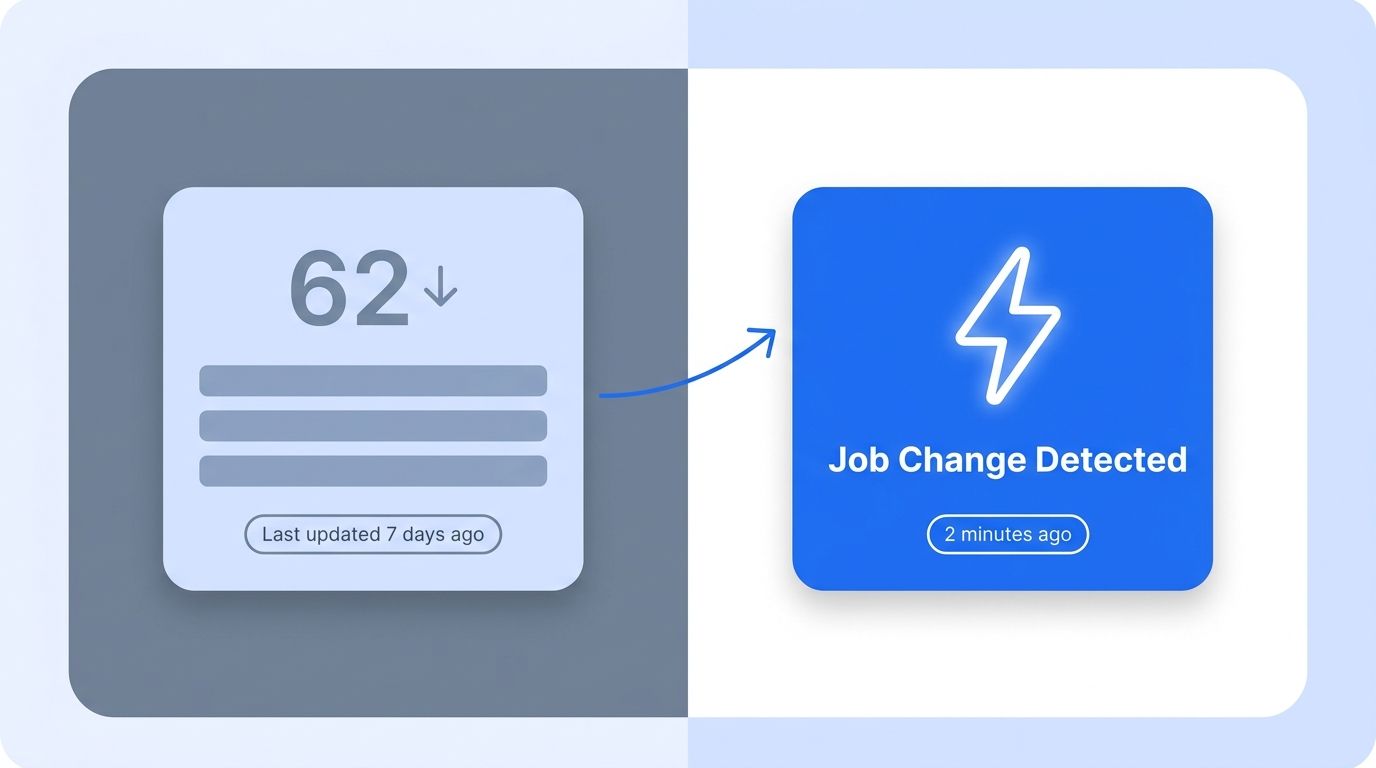
Static Intent Scores vs. Signal-Based Selling at a Glance
Static intent scores rank accounts on a fixed refresh cycle. Signal-based selling triggers outreach the moment a specific, named event happens. Here's how the two stack up on the dimensions that matter to a GTM team.
| Category | Static Intent Scores | Signal-Based Selling |
|---|---|---|
| Best For | Coarse account prioritization across a large TAM | Timing outreach to a specific trigger event |
| Data Freshness | Refreshed weekly or monthly, per co-op cadence | Delivered in near real time via webhook or API pull |
| Signal Type | Aggregated topic/content consumption across a network | Named events: job change, funding round, hiring surge, LinkedIn engagement |
| Sales Rep Trust | Median signal precision of 0.51 in one 2025 benchmark (The Starr Conspiracy, retrieved 2026-08-08) | Higher perceived relevance — the trigger is a specific, explainable event |
| Response Window | Score can be stale by the time a rep sees it | Actionable within minutes of the event firing |
| Delivery Method | Dashboard, CSV export, or CRM field sync | Webhook, API call, or Slack/CRM push |
| Provider Examples | Bombora, G2 intent, Demandbase, Intentsify | Job-change/funding/engagement signal APIs like Datamagnet's Signal API |
| Setup Effort | Low — buy a subscription, get a score field | Moderate — needs a webhook receiver or API integration |
| Our Verdict | Good for building the target list | Better for deciding when to act on it |
Which One Reacts Faster to a Buying Window?
Signal-based selling wins on speed, and the gap isn't small. First published in 2007 and still the industry-standard reference, an MIT-designed analysis of more than 100,000 sales call attempts found that lead qualification odds drop 21-fold once follow-up time stretches from 5 minutes to 30 minutes, and drop more than 10-fold on contact success within the first hour alone (InsideSales.com, Lead Response Management Study, retrieved 2026-08-08).
That decay curve is exactly what a static intent score can't outrun. A monthly-refreshed score tells you an account was "surging" on relevant topics sometime in the last 30 days — not that a buyer is on your site right now. Signal-based selling flips that: a job-change alert, a funding announcement, or a LinkedIn engagement webhook fires the moment the event happens, so a rep can respond inside the window where response speed still moves the needle.
In 2025, Chili Piper measured this gap directly across roughly 4 million demo-request submissions. Forms where the prospect booked a meeting instantly converted at 66.7%, compared to 30% for a standard "submit and wait for a rep" flow (Chili Piper, 2025 Benchmark Report on Demo Form Conversion Rates, retrieved 2026-08-08). Static scores don't create that instant-response moment. They can't — the data behind them is already a week or more old by design.
Verdict: Signal-based selling wins decisively on speed. Static scores can tell you who is worth watching; they can't tell you when to move.
Which Score Do Sales Reps Actually Trust?
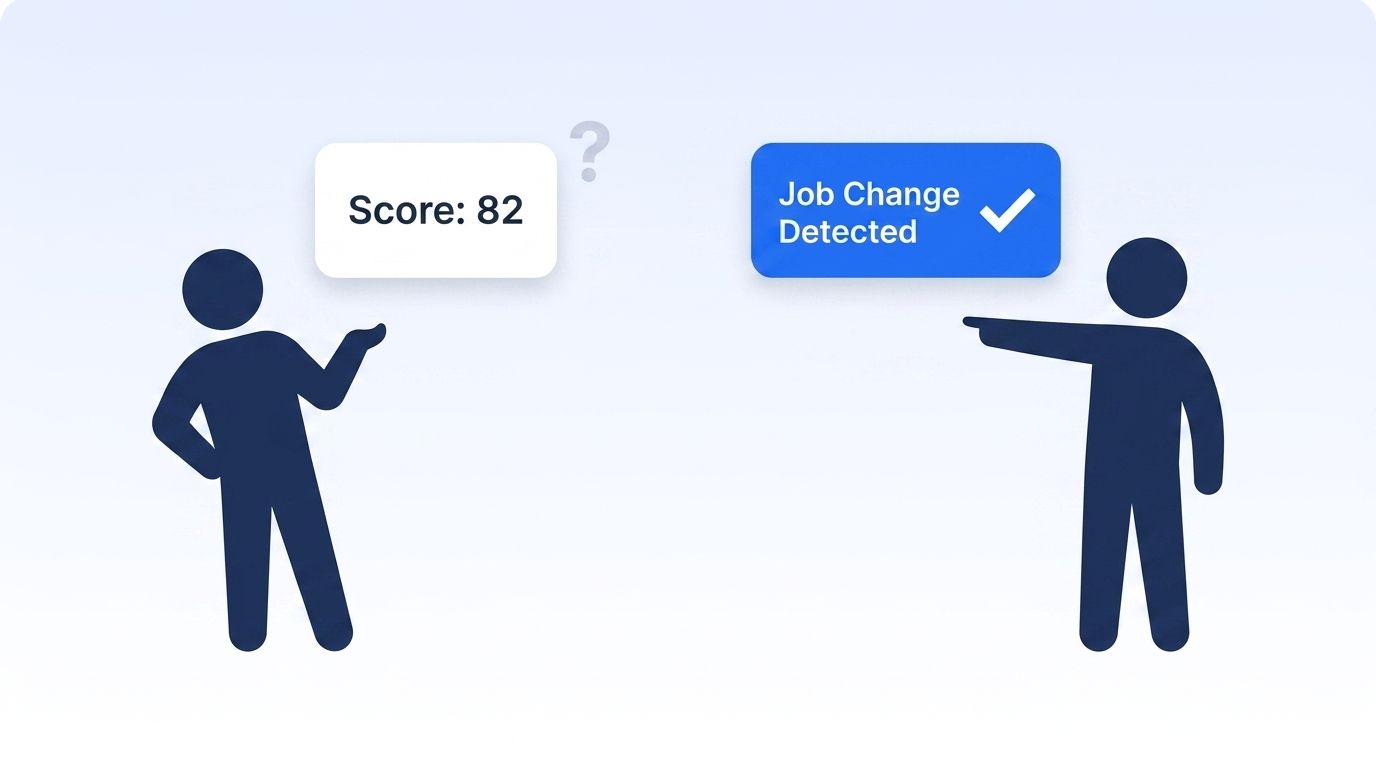
Reps trust a specific, named event more than an abstract number, and the data on static scores explains why. A 2025 benchmark of B2B intent programs found a median signal precision of just 0.51 — meaning fewer than 70% of accounts flagged "high intent" showed any corroborating activity in the CRM within 30 days, even for mature programs scoring 0.63 (The Starr Conspiracy, B2B Intent Data Benchmarks 2025, retrieved 2026-08-08). A coin flip beats that on some deployments.
That doesn't mean intent scoring is worthless — Forrester named 6sense, Bombora, Demandbase, and Intentsify as Leaders in its Q1 2025 evaluation of 15 providers across 21 criteria (Forrester, The Forrester Wave: Intent Data Providers For B2B, Q1 2025, retrieved 2026-08-08), so the top-tier platforms are doing real, defensible work. But "Leader" status describes the aggregation methodology, not whether an individual account flag is fresh enough to act on the day a rep sees it.
When Datamagnet customers switch from a monthly co-op score refresh to webhook-triggered job-change and engagement alerts, the first thing they notice usually isn't more leads — it's fewer stale ones. A rep who calls a prospect two weeks after a "surge" score fired burns credibility fast; a rep who mentions a LinkedIn post from that same morning doesn't.
Verdict: Signal-based events win on rep trust. A named, dated trigger is easier to defend on a call than an unexplained numeric score.
Which One Matches How B2B Buyers Actually Research?
Buyers have mostly finished shopping before a static score would even flag them. 6sense's 2025 survey of more than 4,000 B2B buyers found the split between self-directed research and seller engagement shifted from 70/30 in 2024 to 60/40 in 2025, while average buying cycles compressed from roughly 11 months to 10 (6sense, 2025 B2B Buyer Experience Report, retrieved 2026-08-08). Buyers are doing more of the work themselves, faster — and a scoring cadence built around weekly or monthly snapshots can't keep pace with a cycle that keeps shrinking.
Gartner's research backs this up from a different angle. In a survey fielded in late 2024, 61% of B2B buyers said they'd prefer a rep-free buying experience entirely (Gartner, Gartner Sales Survey Finds 61% of B2B Buyers Prefer a Rep-Free Buying Experience, retrieved 2026-08-08), and a follow-up survey a year later put that figure at 67% (Gartner, Gartner Sales Survey Finds 67% of B2B Buyers Prefer a Rep-Free Experience, retrieved 2026-08-08). Isn't that the opposite of what signal-based selling needs — buyers who don't want to talk to a rep at all?
Not quite. A more recent 2026 Gartner survey found 69% of buyers still turn to a sales rep to validate AI-generated insights before they commit (Gartner, Gartner Survey Finds 69% of B2B Buyers Turn to Sales Reps to Validate AI-Generated Insights, retrieved 2026-08-08). Buyers don't want unsolicited cold outreach; they want a rep who shows up at the exact moment a real decision point opens. That's a signal, not a score.
Verdict: Signal-based selling matches the modern buying motion. A stale score can't catch a buyer who's already 60% of the way through a self-directed, shrinking research cycle.
Which One Drives More Pipeline When Reps Actually Act On It?
Job-change signals — one specific category of signal-based selling — beat cold outbound by a wide margin when sales teams act on them promptly. Champify's 2025 analysis of 230,000 tracked former champions and 7,000 resulting opportunities found job-change signals converted at 12% activity-to-opportunity, versus under 2% for cold outbound, with 39% win rates against a sub-19% SaaS baseline (Champify, The Impact of Tracking Job Changes, retrieved 2026-08-08). That single vendor's book of business generated $256 million in pipeline and $101 million in influenced revenue in 2024.
The reason this gap is so wide isn't just relevance — it's that a job change is a rare, high-trust reason to reach out that doesn't feel like a pitch. A static score never gives a rep that kind of specific, defensible opening line; it just says "this account is warm," without saying why.
The catch is that even the best signal is worthless if nobody responds to it in time. RevenueHero tested live demo-request submissions across 1,000 B2B SaaS companies and found 63.5% never responded at all, with an average response time of 1 day, 5 hours, and 17 minutes among the companies that did reply — only about 17% responded within 2 minutes (RevenueHero, We Tested Lead Response Times of 1000 B2B Sales Teams, retrieved 2026-08-08). Signal-based selling only outperforms static scoring if the team receiving the signal actually acts on it fast — otherwise it decays into the same stale-lead problem it was supposed to fix.
Verdict: Signal-based selling wins on conversion, but only with fast follow-up. The signal is necessary; speed of response is what actually cashes it in.
Which One Fits a Modern, API-First GTM Stack?
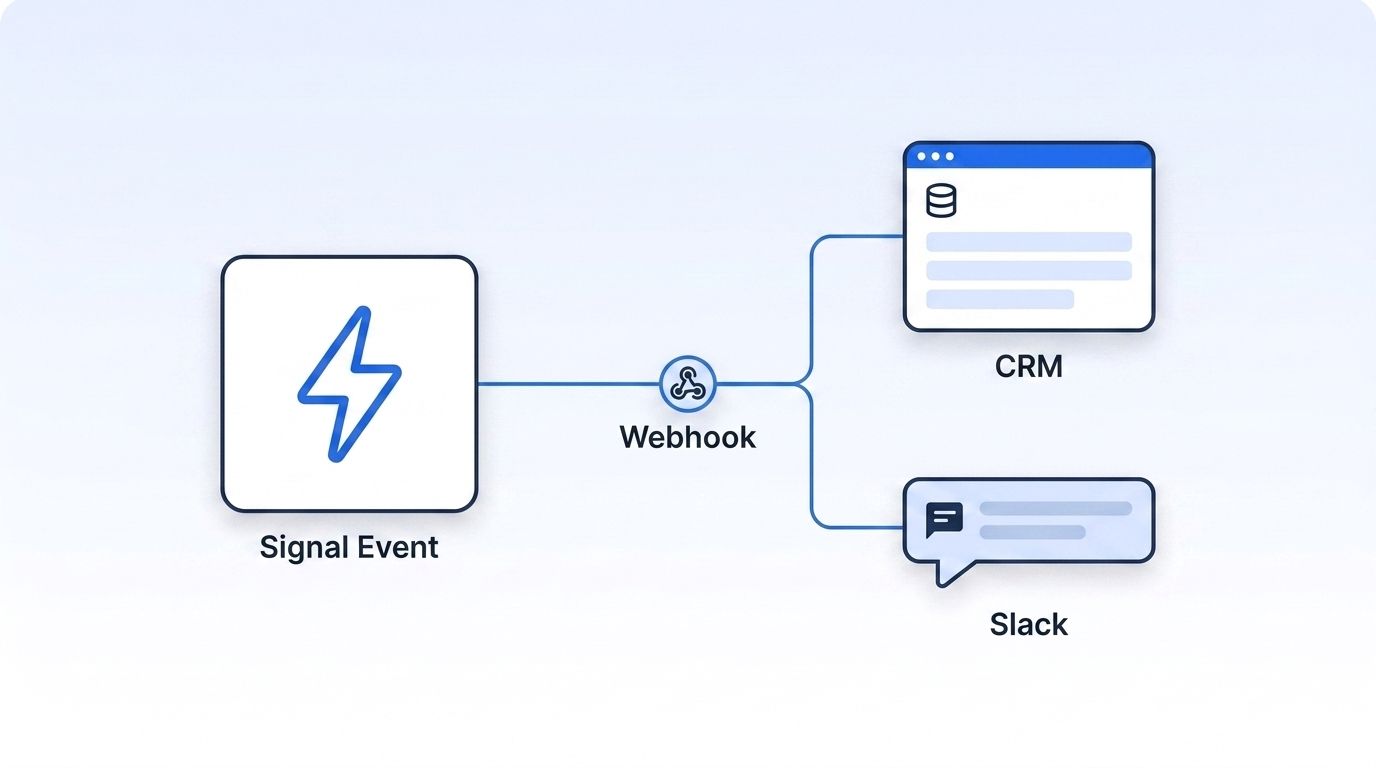
Static intent scores mostly arrive as a dashboard field or a CSV export on a fixed schedule — fine for a quarterly account-planning exercise, awkward for anything that needs to trigger a workflow the moment it happens. Signal-based selling is built the other way: an event fires, a webhook delivers it to your system, and a sequence, Slack alert, or CRM task kicks off automatically without a human checking a dashboard first.
That's the architecture behind Datamagnet's Signal API, which tracks named trigger events — job changes, funding rounds, company engagement, and person engagement on LinkedIn — and pushes them out as they happen rather than bundling them into a weekly score refresh. GTM engineers can wire it directly into a webhook receiver instead of exporting a CSV and re-uploading it every Monday.
Teams already running a champion-tracking motion, similar to the pattern in Datamagnet's Champion Tracker cookbook, see this play out concretely: a job-change event triggers outreach to the new company within the same day it happens, not whenever the next intent-score batch lands.
Verdict: Signal-based selling fits event-driven GTM stacks better. If your team already runs on webhooks and workflow automation, a periodic score is the odd piece out.
Who Should Choose What
Enterprise ABM teams building a large target account list: Keep a static intent platform for coarse account prioritization across a big TAM, but layer signal-based triggers on top to decide when to actually reach out to those accounts.
SDR/BDR teams graded on speed to lead: Go signal-based selling first. Qualification odds fall too fast in the first 30 minutes (InsideSales.com, retrieved 2026-08-08) for a weekly score to matter much.
RevOps and GTM engineers building the stack from scratch: Build around a webhook-driven signal layer, and treat any static score as a coarse, low-priority list rather than a routing input. For a broader look at picking a job-change or engagement API, see 7 Best Real-Time Intent Signal APIs for Job Changes.
Budget-constrained teams comparing a full intent platform against a single signal type: A focused API — job changes alone, for example — usually beats a broad, static co-op subscription on cost per usable trigger. If you're currently on a database-style vendor, Datamagnet vs. ZoomInfo covers the real-time vs. static trade-off in more depth.
If neither fits — you need both broad account discovery and real-time timing — most mature GTM teams end up running a static platform for list-building and a signal API for the actual trigger, rather than picking one exclusively.
Frequently Asked Questions
Is static intent data useless?
No. Static intent scores are still useful for building a broad target account list from a large TAM, and Forrester rates several providers as category Leaders on that job (Forrester, Q1 2025, retrieved 2026-08-08). The problem is using a weekly or monthly score to time outreach, where a real-time signal fits better.
Can you combine static intent scores with signal-based selling?
Yes, and most mature GTM teams do exactly that. A static score narrows a large market down to a manageable target list, while a signal-based layer — job changes, funding rounds, engagement events — decides which accounts on that list to contact today and why.
How fast do signal-based sales teams actually respond?
Not fast enough, on average. RevenueHero found the average response time across 1,000 B2B SaaS companies was over a day, and 63.5% of companies never responded to a live demo request at all (RevenueHero, 2024, retrieved 2026-08-08). Having a real-time signal only helps if the receiving team is set up to act on it in minutes, not days.
What counts as a "signal" in signal-based selling?
A signal is a specific, named, dated event tied to a person or company — a job change, a funding round, a hiring surge, a LinkedIn post or comment, or a technographic change. That's different from an intent score, which aggregates anonymous content-consumption activity across a network into a single number without naming the underlying event.
Is signal-based selling worth it for smaller sales teams?
Often more so than for large enterprises. A small team can't compete on outreach volume, but Champify's 2025 analysis found job-change signals converting at 12% activity-to-opportunity versus under 2% for cold outbound (Champify, 2025, retrieved 2026-08-08) — a lean team acting fast on a small number of high-quality signals can outperform a much larger team working a stale list.
The Verdict
| Category | Winner |
|---|---|
| Speed to a buying window | Signal-Based Selling |
| Sales rep trust | Signal-Based Selling |
| Matching modern buyer research patterns | Signal-Based Selling |
| Pipeline conversion (with fast follow-up) | Signal-Based Selling |
| Fit with API-first GTM stacks | Signal-Based Selling |
| Broad account prioritization at scale | Static Intent Scores |
| Overall | Signal-Based Selling — for timing outreach. Keep static scores for coarse account lists. |
Static intent scores aren't going away, and they still do a reasonable job of narrowing a large TAM into a workable list. But the moment your team needs to know when to reach out — not just who — a periodic score refresh is fighting a buying cycle that's already shrunk to about 10 months and mostly happens without you watching (6sense, 2025, retrieved 2026-08-08). Pair a broad list with real-time, named-event signals, and let the signal — not the score — decide when a rep picks up the phone.
Ready to move from a weekly score refresh to real-time triggers? See who's hiring, funding, and engaging right now with Datamagnet's Signal API.
Sources
- InsideSales.com, Lead Response Management Study, retrieved 2026-08-08, https://www.leadresponsemanagement.org/lrm_study/
- Chili Piper, 2025 Benchmark Report on Demo Form Conversion Rates, retrieved 2026-08-08, https://www.chilipiper.com/post/form-conversion-rate-benchmark-report
- RevenueHero, We Tested Lead Response Times of 1000 B2B Sales Teams, retrieved 2026-08-08, https://www.revenuehero.io/blog/b2b-lead-response-times
- 6sense, 2025 B2B Buyer Experience Report, retrieved 2026-08-08, https://6sense.com/newsroom/the-timeline-for-influencing-b2b-buyers-is-shrinking-insights-from-6senses-2025-buyer-experience-report/
- Forrester, The Forrester Wave: Intent Data Providers For B2B, Q1 2025, retrieved 2026-08-08, https://www.forrester.com/report/the-forrester-wave-tm-intent-data-providers-for-b2b-q1-2025/RES182002
- Gartner, Gartner Sales Survey Finds 61% of B2B Buyers Prefer a Rep-Free Buying Experience, retrieved 2026-08-08, https://www.gartner.com/en/newsroom/press-releases/2025-06-25-gartner-sales-survey-finds-61-percent-of-b2b-buyers-prefer-a-rep-free-buying-experience
- Gartner, Gartner Sales Survey Finds 67% of B2B Buyers Prefer a Rep-Free Experience, retrieved 2026-08-08, https://www.gartner.com/en/newsroom/press-releases/2026-03-09-gartner-sales-survey-finds-67-percent-of-b2b-buyers-prefer-a-rep-free-experience
- Gartner, Gartner Survey Finds 69% of B2B Buyers Turn to Sales Reps to Validate AI-Generated Insights, retrieved 2026-08-08, https://www.gartner.com/en/newsroom/press-releases/2026-05-20-gartner-survey-finds-sixty-nine-percent-of-b-two-b-buyers-turn-to-sales-reps-to-validate-ai-generated-insights
- Champify, The Impact of Tracking Job Changes, retrieved 2026-08-08, https://www.champify.io/resources/the-impact-of-tracking-job-changes-value-report
- The Starr Conspiracy, B2B Intent Data Benchmarks 2025, retrieved 2026-08-08, https://www.thestarrconspiracy.com/insights/benchmarks/b2b-intent-data-benchmarks-2025
- Datamagnet, Signal API, retrieved 2026-08-08, https://www.datamagnet.co/signal-api/
- Datamagnet, Webhooks, retrieved 2026-08-08, https://docs.datamagnet.co/api-reference/webhooks
