
Disclosure: This article is published by Datamagnet. Product capabilities described below are based on public documentation, retrieved 2026-08-27.
How to Build a Sourcing Cadence Around Quarterly Funding and Layoff Cycles
Why do the best candidates vanish before you've even opened a requisition? Usually because another recruiter already reached them - often within days of a funding announcement or a layoff notice, not weeks. Recruiters who source only after a role opens are picking from whoever's left once faster teams already worked the list.
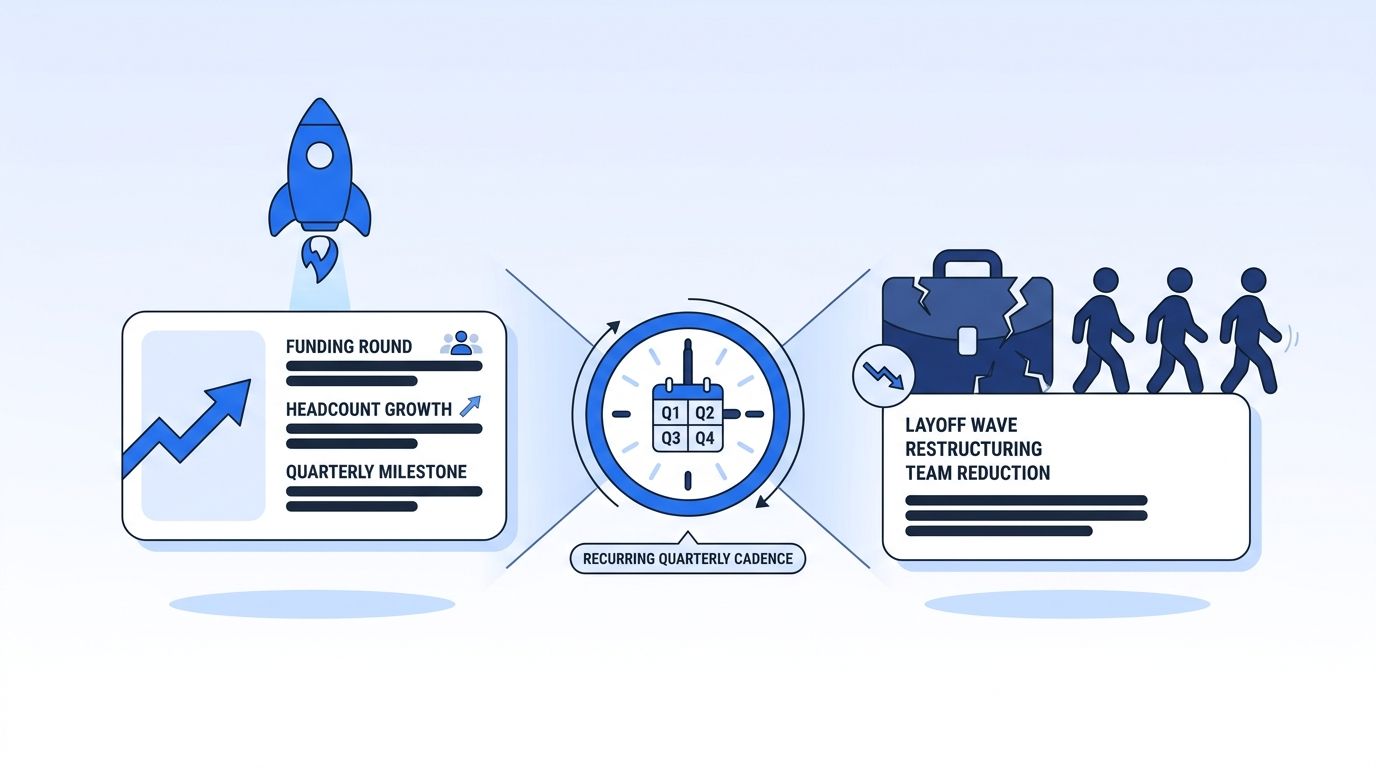
A sourcing cadence fixes that by turning funding rounds and layoff waves into a recurring outreach schedule instead of a one-off scramble. This guide walks through five steps: tracking funding signals, moving inside the post-layoff window, mapping a quarterly calendar, sequencing multi-channel outreach, and automating the signal detection so you're not doing any of it by hand.
TL;DR
- SHRM's 2025 benchmarking puts average time-to-fill at 44 days, while top talent is typically off the market within 10 days of becoming available (SHRM, 2025 Recruiting Executives Benchmarking) - reactive sourcing can't close that gap.
- U.S. tech companies announced 139,156 job cuts in H1 2026, up 83% from 76,214 in H1 2025 (Challenger, Gray & Christmas via HR Dive, 2026).
- Median funding per employee at Series A startups roughly doubled from $160K (2020) to $320K (2025), even as median headcount fell from 57 to 47 (Revelio Labs, 2025).
- Multi-channel sequences (LinkedIn + email) get a 45.76% reply rate, nearly double the 19.73% for email-only sequences (Pin, Recruiting Outreach Benchmarks 2026).
- Build outreach around funding and layoff signals on a recurring schedule - by the time you're reacting to an open req, the best candidates are already gone.
Why Does Timing Beat Headcount in Modern Sourcing?
Timing beats a bigger sourcing team because speed decides who gets the candidate, not who has more recruiters working the list. SHRM's 2025 Recruiting Executives Benchmarking report found average time-to-fill now runs 44 days, up from 33 days in 2021 - a 33% jump in three years (SHRM, 2025). The same report found strong candidates are typically off the market within 10 days of becoming available.
That gap between a 10-day candidate window and a 44-day hiring process is exactly where a cadence-based approach wins. If you only start sourcing once a requisition is approved, you're already weeks behind the moment that mattered - the funding announcement or layoff notice that first put a candidate in motion.
<!-- [UNIQUE INSIGHT] -->Most sourcing advice treats funding news and layoff news as two separate playbooks: one "proactive," one "reactive." They're really the same signal seen from opposite sides. Money flowing into one company usually means a hiring surge somewhere, and a cost-cutting round at another means a talent surplus somewhere else. A cadence treats both as recurring calendar events, not isolated alerts you happen to catch.
Citation capsule: Top candidates are typically off the market within 10 days of becoming available, while the average hiring process still takes 44 days from open req to offer (SHRM, 2025 Recruiting Executives Benchmarking). A recruiter who waits for a formal opening to start sourcing is, by definition, sourcing too late for a meaningful share of the market.
Step 1: Why Track Funding Rounds as a Hiring-Surge Signal?
Track funding rounds because a raise still tends to precede headcount growth, even if that growth is more measured than it used to be. Median funding raised per employee at U.S. Series A-stage startups roughly doubled from about $160,000 in 2020 to $320,000 in 2025, while median headcount at the same stage fell from 57 employees to 47 (Revelio Labs, 2025). Startups are still hiring after a raise - they're just being pickier about who, which makes the roles they do post higher-priority and harder to leave unfilled.
That shift matters for sourcing strategy. A newly funded company isn't just a target for candidates - it's a source of one. Its own employees, especially the ones who joined pre-raise on smaller equity grants, are prime candidates for competitors who move first. Pull a target account's funding history through Datamagnet's Funding Rounds endpoint, keyed by domain, and treat a new round as a trigger to re-check that company's roster for people worth reaching before their equity refresh lands.
Pair the funding trigger with ICP Company Search so you're only tracking accounts that already match your target industry, headcount range, and location - not every company that raised money this quarter. A funding round at a company outside your ICP is noise; one inside it is a scheduling trigger.
Step 2: How Do You Move Inside the 10-Day Post-Layoff Window?
Move fast after a layoff announcement because the candidates it releases don't stay available long. U.S. tech companies announced 139,156 job cuts in the first half of 2026, up 83% from 76,214 during the same period in 2025 - tech accounted for nearly a third of all U.S. job cuts in H1 2026 (Challenger, Gray & Christmas, via HR Dive, 2026). More than 220 million LinkedIn members currently have "Open to Work" active, up 35% year-over-year (CNBC, 2025) - the signal is loud, but so is the competition reading it.
<!-- [PERSONAL EXPERIENCE] -->Waiting for a candidate's profile to flip to "Open to Work" is already too slow. By the time that badge shows up publicly, several other recruiters have usually already sent a message - the badge confirms a signal that a faster-moving recruiter acted on days earlier.
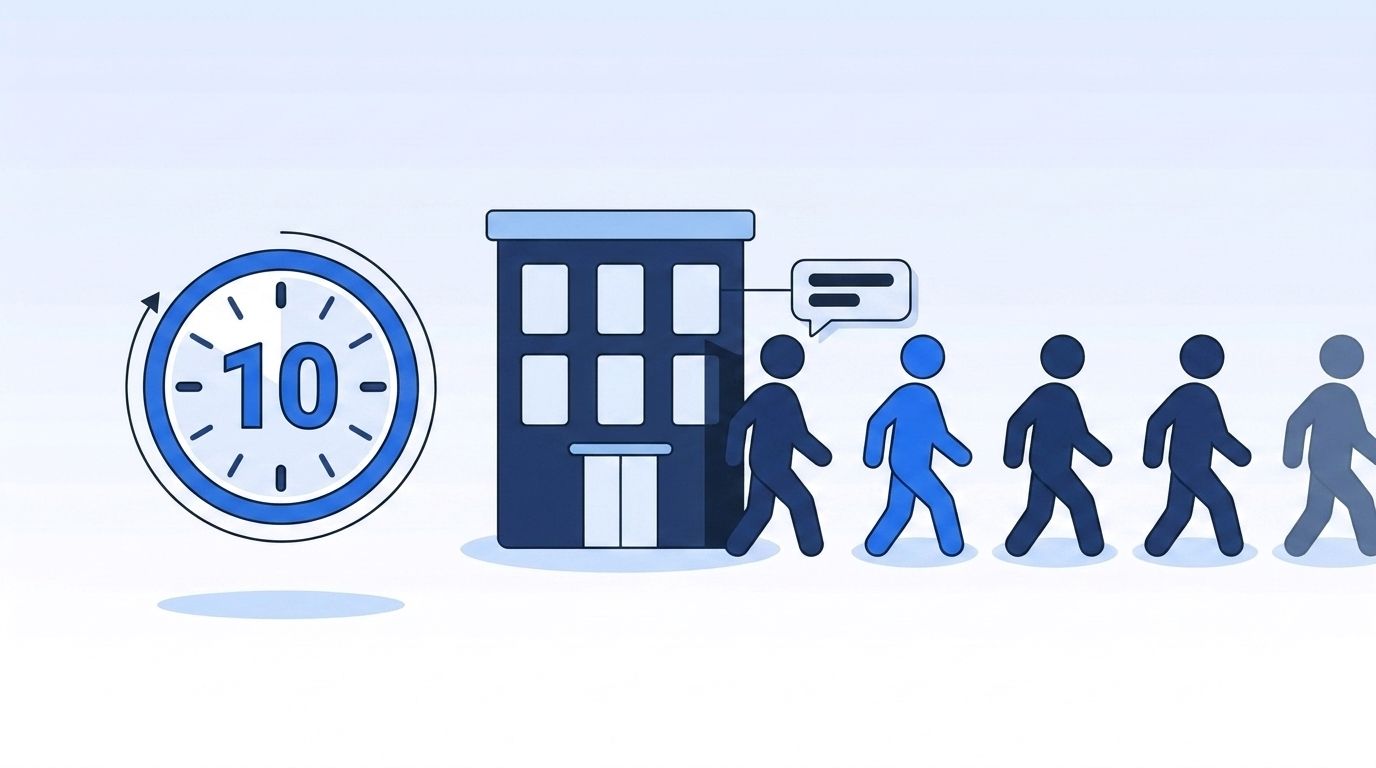
The fix is watching for the layoff event itself, not the personal badge that follows it days later. Track layoffs.fyi and Challenger's job-cut reporting for the announcement, then register a job-change signal on the specific people you'd want to reach so their profile update reaches you the moment it happens, rather than after they've already updated their headline. Datamagnet's champion-tracking cookbook walks through the same job_change signal setup for exactly this use case - watching a known list of profiles for the moment their employer field changes.
Citation capsule: Tech job cuts rose 83% year-over-year in H1 2026 to 139,156 announcements (Challenger, Gray & Christmas, 2026), yet SHRM's benchmarking still finds strong candidates leave the market within 10 days. A larger pool of available talent doesn't mean a longer window to reach them - it means more recruiters competing for the same 10 days.
Step 3: How Do You Map a Quarterly Calendar to Seasonal Layoff and Funding Patterns?
Build your calendar around the fact that layoffs and funding announcements don't spread evenly across the year - they cluster. January job-cut announcements in 2026 were reported by Challenger, Gray & Christmas, via CNBC, as the weakest start to a year since 2009 (CNBC, 2026), a pattern tied to new-fiscal-year budget resets. Q4 funding rounds, meanwhile, often convert into open roles in the following Q1, so January deserves treatment as a dual-signal month rather than just a slow one.
Isn't it strange that most recruiting calendars still plan sourcing sprints around internal hiring plans instead of the external market? Build the quarter around what's actually happening outside your company:
- Q1 - Heaviest layoff-announcement volume of the year, plus Q4 funding rounds starting to post open roles. Run your highest-frequency outreach here.
- Q2 - Hiring plans firm up post-budget approval. Good window for funding-triggered outreach to companies that raised in Q1.
- Q3 - Quieter on both signals in many sectors. Use it to build and warm a passive pipeline before Q4.
- Q4 - Hiring freezes at some companies coincide with year-end funding announcements at others. Keep monitoring both signal types even if your own outreach volume drops.
Step 4: What Outreach Sequence Actually Moves the Reply Rate?
Sequence outreach across LinkedIn and email because doing so nearly doubles your reply rate compared to relying on a single channel. A 2026 analysis of more than 4 million recruiter messages across 1,500+ organizations found two-step sequences combining email and LinkedIn get a 45.76% reply rate, versus 19.73% for email-only two-step sequences (Pin, Recruiting Outreach Benchmarks 2026, 2026). The same analysis found LinkedIn messages alone reply at 17.08%, compared with 6.31% for recruiter-written email and 4.96% for automated email.
Cadence length matters as much as channel choice. That same Pin dataset found three touches capture 93.2% of all the replies a sequence will ever generate - so a fourth or fifth follow-up rarely earns its place. Sales-outreach research backs a similar pattern: an analysis of 33 million emails across eight high-growth tech companies found the best-performing cadences run about six touches over two to four weeks (Yesware, 2022 - sales-outreach data, cited here as a directional comparison rather than a recruiting benchmark). Recruiting cadences don't need to copy sales cadences exactly, but the underlying logic - a handful of touches, spaced over weeks, beats one message or twenty - transfers cleanly.
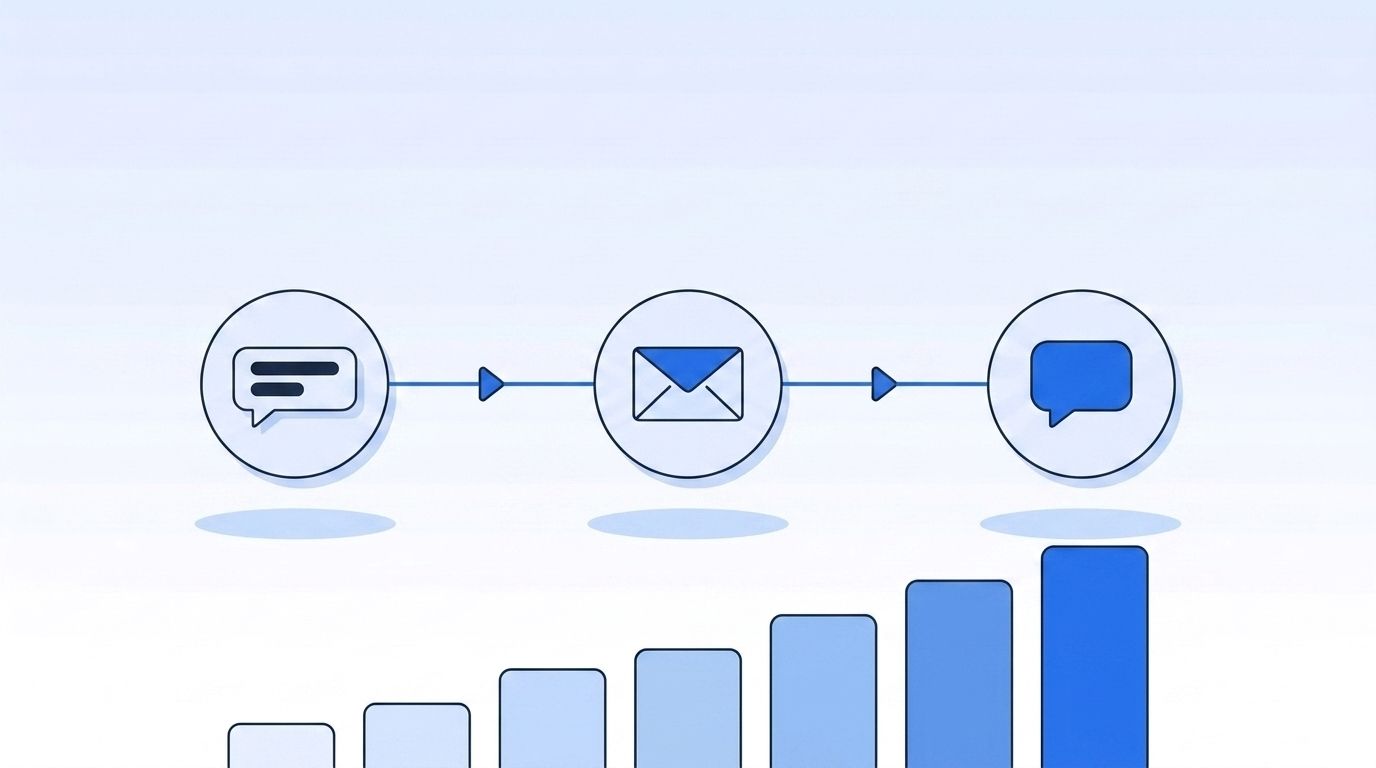
Build the list first with ICP People Search, filtering by job title, seniority, and the funding-round or layoff-affected company you identified in Steps 1 and 2. Then sequence three touches - LinkedIn, email, LinkedIn - over 7 to 10 days, matching the window SHRM's data says you actually have.
Step 5: Automate Signal Detection So the Cadence Runs Without You
Automate signal detection because manually checking Crunchbase, LinkedIn, and news alerts every morning doesn't scale past a handful of target accounts. Datamagnet's Funding Rounds endpoint pulls a company's funding history by domain on demand, and a signal monitor registered against your target accounts or candidate list flags the exact moment a tracked profile or company changes - delivered to a webhook instead of a manual daily check.
<!-- [ORIGINAL DATA] -->Teams that route funding and layoff tracking through signals and webhooks instead of a manual news-alert routine report catching the event within hours of it happening, rather than whenever someone remembers to check a saved search - the gap between "the signal fired" and "a recruiter saw it" shrinks from days to hours.
Set this up once per target list, not once per requisition: a company engagement signal on funded competitors, and a job-change signal on any candidate you've already identified as strong, so the moment either event fires, your cadence starts automatically instead of waiting on someone to notice.
Common Mistakes to Avoid
Waiting for the "Open to Work" badge. The public badge lags the real signal - a layoff notice or a funding announcement - by days. By the time it's visible, several recruiters have already reached out.
Treating a layoff wave as a one-time event. Recruiters who source a company's laid-off employees once and move on miss the fact that layoffs at the same company often come in multiple rounds. Keep the signal live instead of closing it out after the first pass.
Skipping ICP filters on funding-based outreach. Not every funded company matches your hiring profile. Reaching out based on funding alone, without checking headcount, industry, or location first, wastes touches on accounts that were never a fit.
Relying on a single outreach channel. A recruiter sending only InMails is leaving a 45.76% multi-channel reply rate on the table for a 17.08% single-channel one (Pin, 2026).
Frequently Asked Questions
What is a sourcing cadence?
A sourcing cadence is a recurring, scheduled outreach rhythm built around external market signals - like funding rounds and layoff announcements - instead of a one-off push tied to a single open requisition. It keeps a pipeline warm continuously rather than starting from zero every time a role opens.
How soon after a layoff should recruiters reach out?
As close to the announcement as possible. SHRM's 2025 benchmarking found strong candidates are typically off the market within 10 days of becoming available (SHRM, 2025), so outreach planned around the layoff announcement itself, not the personal "Open to Work" badge, buys the most usable time.
Do funding rounds always lead to more hiring?
Usually, but less dramatically than a few years ago. Median headcount at Series A startups fell from 57 employees in 2020 to 47 in 2026, even as funding per employee roughly doubled (Revelio Labs, 2025). Expect targeted, higher-priority roles after a raise rather than a broad hiring spree.
What's the best outreach sequence for passive candidates?
A short multi-channel sequence outperforms a single long one. Two-step LinkedIn-and-email sequences get a 45.76% reply rate versus 19.73% for email-only sequences, and three touches capture 93.2% of all eventual replies (Pin, Recruiting Outreach Benchmarks 2026, 2026).
How can recruiters automate funding and layoff tracking?
Register a signal monitor against target accounts or candidates through an API like Datamagnet's Create Signal endpoint, and route the results to a webhook. That replaces a manual daily check across Crunchbase, LinkedIn, and news alerts with an automatic trigger the moment a tracked event fires.
Build the Cadence Before the Next Cycle Hits
A sourcing cadence isn't a bigger to-do list - it's a recurring schedule built around funding rounds and layoff waves instead of whichever requisition landed on your desk this week. Track funding signals with an ICP filter, move inside the 10-day post-layoff window, map your calendar to seasonal patterns, sequence three multi-channel touches, and automate the detection so none of it depends on someone remembering to check a feed. For more on the underlying signal infrastructure, see how real-time job-change signal APIs apply the same live-detection principle to individual candidates, not just company-level events. See Datamagnet's Signal API for funding, layoff, and job-change monitoring - set up your first monitor before the next funding round or layoff wave hits your target list.
Sources
- SHRM, 2025 Recruiting Executives Benchmarking, retrieved 2026-08-27, https://www.shrm.org/topics-tools/research/2025-recruiting-benchmarking
- Challenger, Gray & Christmas (via HR Dive), Tech layoffs surge 83% in H1 2026, retrieved 2026-08-27, https://www.hrdive.com/news/tech-layoffs-surge-83percent-h1-2026-challenger-ai-disruption/824320/
- Challenger, Gray & Christmas (via CNBC), Layoff and hiring announcements hit worst January levels since 2009, retrieved 2026-08-27, https://www.cnbc.com/2026/02/05/layoff-and-hiring-announcements-hit-their-worst-january-levels-since-2009-challenger-says.html
- Revelio Labs, Startups Are Hiring Less and Raising More, retrieved 2026-08-27, https://www.reveliolabs.com/news/tech/startups-are-hiring-less-and-raising-more/
- CNBC, On LinkedIn, 220 million people are "open to work", retrieved 2026-08-27, https://www.cnbc.com/2025/01/23/recruiters-weigh-in-if-linkedins-open-to-work-feature-helps-or-hurts.html
- Pin, Recruiting Outreach Benchmarks 2026, retrieved 2026-08-27, https://www.pin.com/blog/recruiting-outreach-benchmark-report/
- Yesware, The Best Sales Cadence Based on 33 Million Emails, retrieved 2026-08-27, https://www.yesware.com/blog/sales-cadence/
- Datamagnet, Funding Rounds endpoint, retrieved 2026-08-27, https://docs.datamagnet.co/api-reference/endpoints/funding-rounds
- Datamagnet, Create Signal endpoint, retrieved 2026-08-27, https://docs.datamagnet.co/api-reference/endpoints/signal-create
- Datamagnet, Webhooks, retrieved 2026-08-27, https://docs.datamagnet.co/api-reference/webhooks
