
Disclosure: This article is published by Datamagnet. Vendor claims are self-reported unless otherwise noted.
Signal-Based Account Scoring: A 6-Step RevOps Framework (2026)
In 2025, buyers first contacted sales at 61% of their journey, down from 69% a year earlier, according to the 6sense 2025 B2B Buyer Experience Report. By the time your rep hears about an account, most of the decision is already made. Static fit scores can't see that. Signal-based account scoring can.
This guide shows you how to build one: pick signals, weight them, add decay, set thresholds, and route hot accounts to the right rep. If you've ever watched a "90-point" lead go cold while a quiet account bought from a competitor, you'll see why it matters.
Key Takeaways
- Buyers reach sales at 61% of their journey, so scoring must read behavior before the first call (6sense, 2025).
- Score = fit × weighted, decaying signals. Fit gates the account; signals set the timing.
- Start with 5-8 signals, set decay by signal type, and back-test against closed-won deals.
What Is Signal-Based Account Scoring?
Signal-based account scoring ranks target accounts by what they're doing now, not only by who they are. Buying groups average 10+ people, and 95% of purchases come from the shortlist buyers build on Day One (6sense, 2025 B2B Buyer Experience Report, Nov 2025). Scoring tells you which accounts are forming that shortlist.
A traditional score has two parts. Fit asks whether the company matches your ICP: industry, headcount, tech stack. Engagement usually counts email opens and form fills, which are your own channels. A signal-based model adds a third layer: external, timestamped events like job changes, funding, hiring spikes, and LinkedIn engagement.
Why does that matter? Because fit tells you who could buy. Signals tell you who might buy this quarter. A perfect-fit account with no recent activity is a nurture target. A decent-fit account with three fresh signals deserves a call today.
According to the 6sense 2025 B2B Buyer Experience Report, buyers who contact their preferred vendor first choose that vendor 80% of the time. That's why scoring should flag accounts early enough for your team to be the first call, not the fourth.
Most scoring write-ups treat fit and signals as one blended number. Keep them separate. Fit is a gate, signals are a timer. When you blend them, a huge-fit account with stale signals outranks a smaller account that's actively evaluating, and your reps learn to distrust the list.
What Do You Need Before You Start?
Before you build anything, line up three inputs: a written ICP, 12+ months of closed-won and closed-lost history, and a way to capture signals automatically. Forrester reports over 85% of companies using intent data see business benefits, but the top challenge is identifying the right decision-makers (Forrester, Intent Data Expectations Vs. Reality, Oct 2023).
Here's the checklist:
- A written ICP. Industry, headcount range, region, and technologies. Pull the target list with ICP Company Search if you don't have one.
- Closed-won and closed-lost data. You'll need it to back-test weights in Step 5.
- A signal source. Something that watches accounts continuously, not a quarterly export.
- A system of record. HubSpot, Salesforce, or a warehouse where scores can live.
- Time: about two weeks for a first version. Difficulty: intermediate.
live LinkedIn enrichment for your CRM
Notice the missing item: a data scientist. You can start with a spreadsheet-grade model and rules. Machine learning can come later, once you have enough closed deals to train on.
Step 1: Which Signals Actually Predict Buying?
By the end of this step, you'll have a shortlist of 5-8 signals, each tied to a specific buying reason. Fewer signals mean fewer arguments about weights, and you can always add more later. In our experience, teams that start with a short list ship a working model weeks sooner than teams that try to track everything.
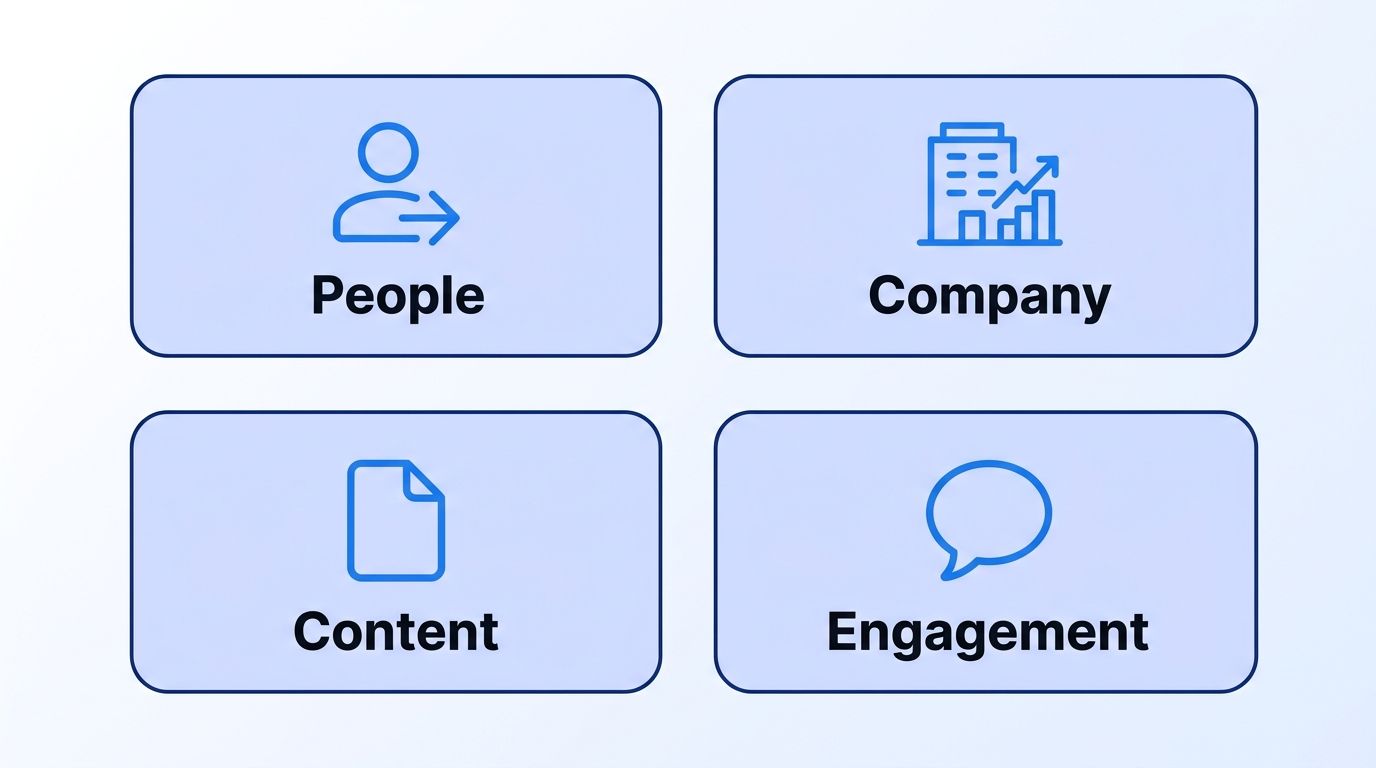
Group candidates into four families:
- People signals. A champion changes jobs, or a new executive joins in your buyer function. Champion moves are strong: UserGems reports deals involving a former champion who changed jobs are 114% more likely to close, though that's vendor data without a stated control group (UserGems, How Much Are Previous Champions Worth, updated Apr 2026).
- Company signals. Funding rounds, headcount growth, hiring for relevant roles. The Funding Rounds endpoint returns round type, amount, and date by domain.
- Content signals. Executives posting about the problem you solve.
- Engagement signals. People at the account liking, commenting on, or sharing posts about your category or your competitors.
Datamagnet's Signal API covers job changes, new posts, and keyword, industry, company, and person engagement. You create monitors with the Create Signal endpoint and get events pushed to you.
Verification: For each signal on your shortlist, write one sentence: "When we see X, it means Y, so the rep should do Z." If you can't, cut it.
Step 2: How Do You Weight Each Signal?
By the end of this step, every signal has a point value reflecting how close to a purchase it sits. Weight by proximity to a decision, not by how easy a signal is to collect. A champion changing jobs says far more about timing than a single like on a post, even if likes are easier to count.
Start with a simple 1-10 scale. Here's an illustrative starting model. These numbers are assumptions to calibrate in Step 5, not benchmarks:
| Signal | Starting weight | Why |
|---|---|---|
| Champion joins a new target account | 10 | Existing trust, known budget authority |
| Exec in buyer function hired | 8 | New leaders often reset tooling |
| Funding round announced | 6 | Budget unlocked, intent unconfirmed |
| Hiring for a role your product supports | 5 | Pain is visible |
| Engages with competitor content | 5 | Active category research |
| Engages with category keyword posts | 3 | Early curiosity |
| Executive posts about your problem | 3 | Interest, not yet a project |
Add a multiplier for repeats and breadth. One person liking one post is noise. Three people from the same account engaging in a week is a pattern. A simple rule: the second distinct person from an account adds 50% of the signal's weight, the third and beyond add 25%.
Count distinct people, not events. Because 6sense finds buying groups of 10+ members, an account where several roles engage is more meaningful than one person who likes everything. This one rule filters out most of the fan-account noise.
capture competitor-content engagers automatically
Verification: Rank 10 accounts you know well by gut feel. Then rank them by the model. If the top three disagree wildly, adjust weights before moving on.
Step 3: How Does Time Decay Keep Scores Fresh?
By the end of this step, each signal loses value as it ages, so last month's funding news doesn't outrank this morning's champion move. Without decay, scores only climb, and every account eventually looks "hot." A half-life gives each signal type its own fade rate, which keeps the ranked list honest without manual resets.
Use a half-life: the number of days after which a signal is worth half its original points. Formula:
current_points = base_weight × 0.5 ^ (days_since_signal / half_life_days)
Choose half-lives by how long the underlying intent lasts:
- Engagement and content signals: 7-14 days. Attention is short.
- Hiring signals: 30 days. Job posts stay open for weeks.
- Funding and executive hires: 60-90 days. Budget planning takes a quarter.
- Champion job change: 45-60 days. The new-role window is real but finite.
These half-lives are my starting assumptions, not published benchmarks. I couldn't find a verified public source for signal half-lives, so treat them as hypotheses and test them in Step 5.
Why bother? Decay is the biggest difference between a signal model and a points-for-activity lead score. It also keeps your list fresh without anyone manually resetting scores.
Verification: Take one signal from 30 days ago and compute its value. It should be well below its original weight. If it isn't, check your half-life units.
Step 4: How Do You Combine Fit and Signals Into One Score?
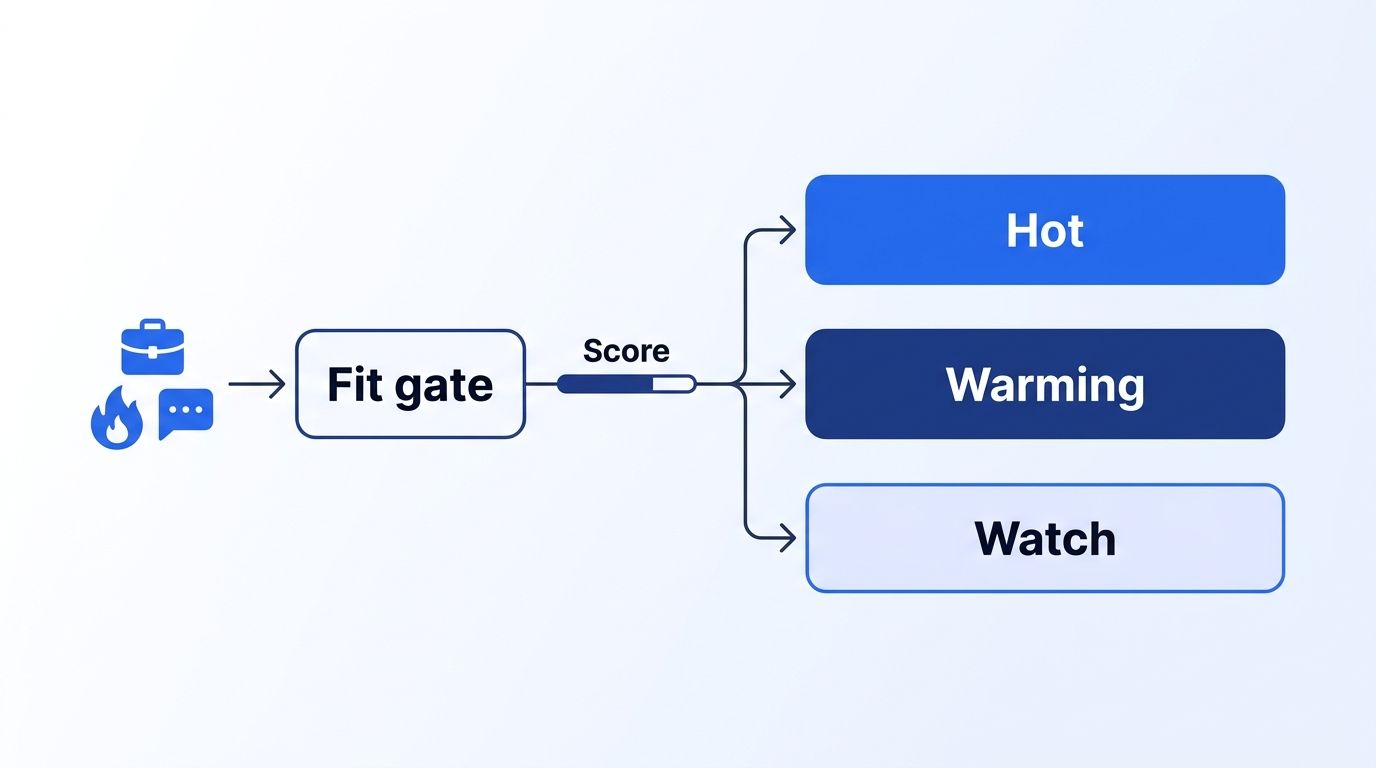
By the end of this step, you'll have a single number per account, plus a tier label your reps can act on. Use fit as a gate and signals as the ranker. Multiplying the two keeps poor-fit accounts near zero while letting fresh, high-weight signals push good-fit accounts to the top of the list.
Score fit from 0 to 1 using your ICP: for example, 1.0 for a full match, 0.6 for a partial match, 0 for a disqualifier. Then:
account_score = fit_score × sum(decayed signal points)
A zero-fit account stays at zero no matter how many signals it fires. That's deliberate. A student club posting about your category shouldn't reach your reps.
Then map scores to tiers:
- Tier 1 (hot): Score above your top-decile cutoff. Rep action within one business day.
- Tier 2 (warming): Middle band. Automated sequence or marketing touch.
- Tier 3 (watch): Everything else. Keep monitoring; no outreach.
Datamagnet's engagement signals also score each engager against your ICP, using a 1-3 scale on matched leads, which gives you a ready-made input for the fit side at the person level.
Competitor Hijack signals with ICP scoring
Verification: No account should sit in Tier 1 for more than a few weeks without a rep touching it. If many do, your threshold is too loose.
Step 5: How Do You Back-Test and Calibrate the Model?
Back-test by scoring last year's accounts as of the date each opportunity was created, then checking whether won deals scored higher than lost ones. This is the step most teams skip, and it's where a guess becomes a model. Self-reported data supports the stakes: 6sense finds the Day One shortlist produces 95% of purchases, so the signals before shortlisting are what you need to explain (6sense, 2025).
Here's a workable process:
- Export closed-won and closed-lost opportunities from the last 12-18 months.
- For each, reconstruct which signals existed in the 90 days before opportunity creation.
- Score each account using your weights and decay as of that date.
- Compare the average score and the share above your Tier 1 cutoff for won versus lost.
- Adjust one variable at a time and re-run.
Be honest about limits. Historical signal data is hard to rebuild, so start by logging signals going forward and calibrating after one or two quarters. If your closed-won sample is under about 50 deals, treat results as directional.
Look at which signals appear in lost deals too. A signal common to both won and lost deals has no predictive value, whatever its intuitive appeal. Cut it or drop its weight.
Verification: Tier 1 accounts should convert to opportunity at a visibly higher rate than Tier 3. If they don't, the model isn't ready to route leads.
Step 6: How Do You Route Hot Accounts and Close the Loop?
By the end of this step, a signal crossing your threshold creates a task, an alert, or a sequence enrollment with no manual list pulling. Speed matters because buyers are moving earlier and picking a shortlist before you call. Routing is where the score finally turns into pipeline, so wire it up before you polish the weights.
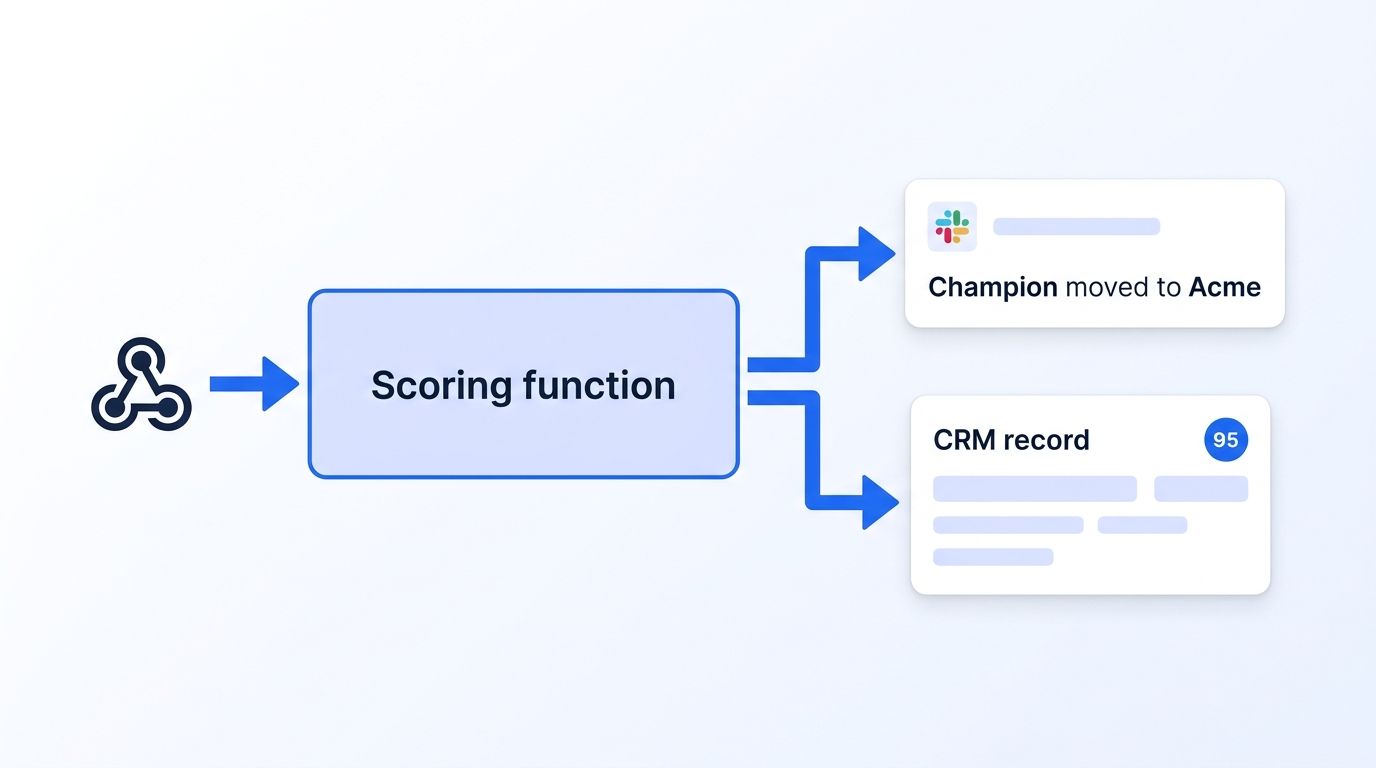
Wire it up in three parts:
- Capture. Signal monitors send events to a webhook. See the Webhooks docs for payload format, retries, and signature verification.
- Score. A small function (or your CRM workflow) updates the account's score on every event and recomputes decay nightly.
- Route. Tier 1 creates a task for the account owner in Slack or your CRM with the reason: "Former champion Sam now VP Ops at Acme, joined 4 days ago." Reps act faster on a reason than on a number.
If you use n8n or Clay, n8n and Clay both work as the glue layer. Our account research infrastructure guide covers the enrichment side.
Finally, close the loop. Log whether each alert led to a meeting, and review weights quarterly. Scoring decays too, so a model you never revisit will drift.
What Mistakes Should You Avoid?
The most common failure is a score nobody trusts. Forrester's finding that identifying the right decision-makers is the top intent-data challenge hints at why: signals without people attached don't tell reps who to call (Forrester, 2023).
1. Blending fit and signals into one weighted sum. It hides timing. Gate with fit, rank with signals.
2. Skipping decay. Scores only go up, every account turns "hot," and reps stop looking.
3. Too many signals on day one. Twenty signals means twenty weights nobody can defend. Start with five to eight.
4. Scoring accounts but not people. An account-level alert that doesn't name who to contact leaves reps guessing. Pair every alert with a contact; the ICP People Search endpoint can find the decision-makers.
5. Never recalibrating. Markets shift. Review weights every quarter.
Frequently Asked Questions
What is signal-based account scoring?
It's a method that ranks target accounts by fit plus recent, time-decayed buying signals like job changes, funding, and engagement. In the 6sense 2025 B2B Buyer Experience Report, buyers first contacted sales at 61% of their journey, so scoring behavior early helps teams reach accounts before shortlists are set.
How is it different from lead scoring?
Lead scoring rates individual contacts, mostly on your own channels such as email opens and form fills. Account scoring rolls up multiple people and adds external signals. Because buying groups average 10+ people (6sense, 2025), scoring the account captures activity a single-lead score misses.
How many signals should I start with?
Start with five to eight. That's enough to cover people, company, and engagement activity without creating weights nobody can defend. Add signals only after your back-test shows they separate won deals from lost ones.
Do I need machine learning?
No. A rules-based model with weights and decay is a solid first version and is easy to explain to reps. Move to ML only once you have enough closed deals, often several hundred, to train and validate against.
Where do the signals come from?
Public sources such as LinkedIn activity, funding databases, and your own product and web data. Datamagnet's Signal API delivers job-change, new-post, and engagement signals by email or signed webhook, and you can try it with free starter credits via the Quickstart.
Conclusion
You now have a six-step framework: choose signals, weight them, add decay, combine with fit, back-test, and route. Keep fit as the gate and signals as the timer, and revisit weights quarterly. Start small with five to eight signals, log every alert's outcome, and let your own closed-won data decide what stays.
Ready to feed the model with live data? See who's engaging in your market with the Signal API, or read about tracking champions across job changes as your first high-weight signal.
Sources
- 6sense, 2025 B2B Buyer Experience Report, retrieved 2026-10-24, https://6sense.com/report/buyer-experience/
- Forrester, Intent Data Expectations Vs. Reality, retrieved 2026-10-24, http://www.forrester.com/blogs/intent-data-expectations-vs-reality-whats-working-and-where-are-the-gaps/
- UserGems, How Much Are Previous Champions Worth, retrieved 2026-10-24, https://www.usergems.com/blog/how-much-are-previous-champions-worth
