
Disclosure: Datamagnet publishes this article. Product capabilities described below are based on public documentation, retrieved 2026-09-16.
RevOps vs. GTM Engineering: Where the Roles Actually Split
In 2025, GTM Engineer job postings grew 205% year-over-year — one of the fastest-growing titles in B2B tech (Bloomberry, "I analyzed 1,000 GTM Engineering jobs", 2025). That growth is colliding with an already-established RevOps function, and a lot of org charts now have both titles doing work that sounds nearly identical on paper.
Are these two different jobs, or is "GTM Engineer" just RevOps with a rebrand? This comparison walks through what each role actually owns, who they report to, what they get paid, and how to decide which one your team needs first — using job-posting data, salary benchmarks, and reporting-structure research rather than title-based guesswork.
TL;DR
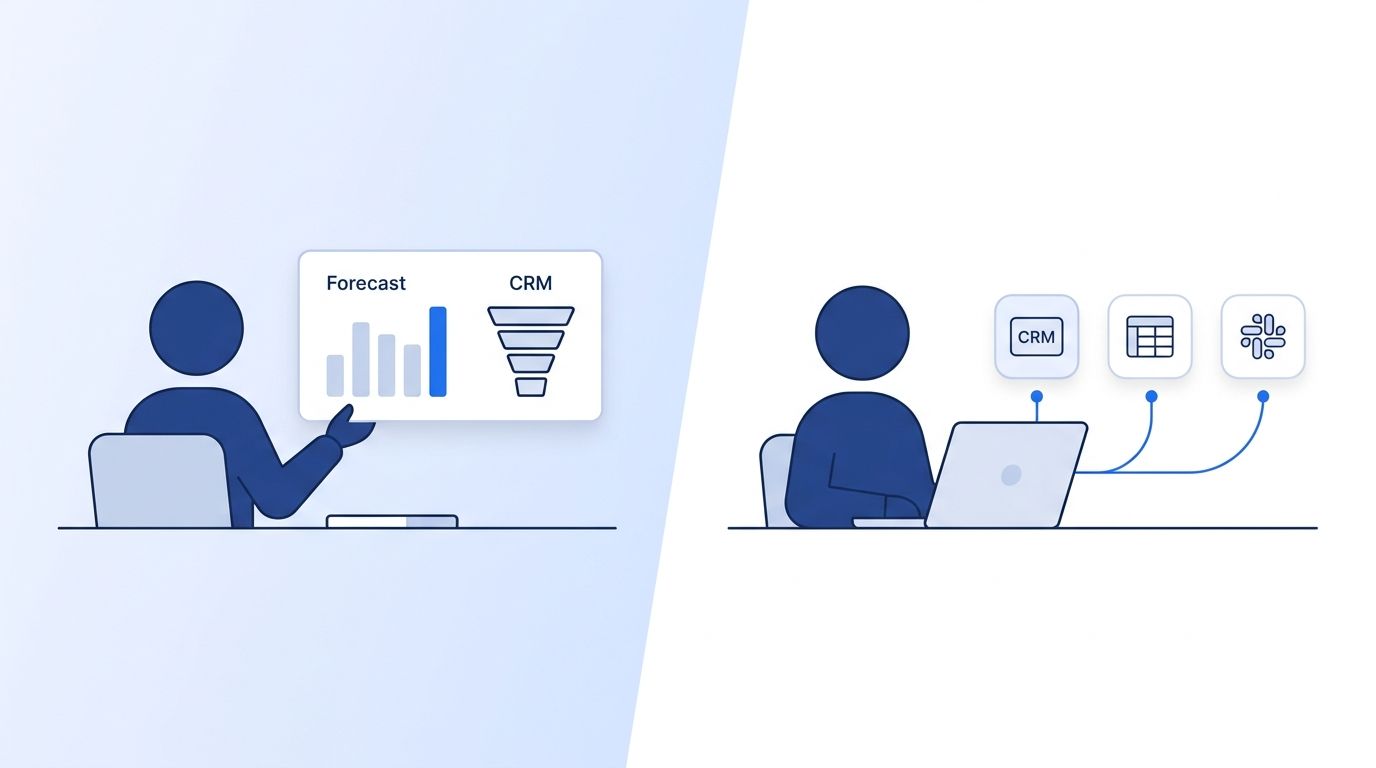
- RevOps runs and governs existing revenue processes — forecasting, CRM data quality, comp attainment. GTM Engineering builds new automated systems — enrichment pipelines, signal-based routing, custom internal tools.
- GTM Engineer postings grew 205% year-over-year in 2025, with a median advertised salary of $127,500 (Bloomberry, 2025).
- 73% of companies surveyed now have a dedicated C-suite RevOps role, but 98% say the function's scope expanded in the past year (Salesloft/Wakefield Research, "The Rise of RevOps", 2025).
- The two roles overlap heavily — one analysis found 9 of 10 listed responsibilities appear in postings for both titles — so the real split is reporting line and skill set, not job description.
- Hire RevOps first to fix process and governance gaps. Hire a GTM Engineer when the bottleneck is manual, repetitive, tool-connecting work no headcount increase will solve.

RevOps vs. GTM Engineering: Quick Comparison
RevOps and GTM Engineering solve different problems even when their day-to-day tasks overlap: RevOps optimizes what already exists, while GTM Engineering builds what doesn't exist yet. The table below breaks down the practical differences a hiring manager actually needs.
| Category | RevOps | GTM Engineering |
|---|---|---|
| Core question | Is our revenue process working as designed? | Can we automate or connect this ourselves? |
| Primary skill | Process design, forecasting, cross-functional alignment | Scripting, APIs, workflow automation, data pipelines |
| Typical background | Sales/marketing ops, finance, analytics | Growth engineering, data engineering, technical sales ops |
| Median advertised salary | Not consistently benchmarked (est. low six figures to $200K+ at VP) | $127,500 (Bloomberry, 2025) |
| Most common reporting line | Operations, then Sales/CRO at scale (Pave, 2026) | No settled reporting line — often "a team of one" spanning sales, RevOps, and engineering |
| Team maturity | Established function; 73% of surveyed companies have a C-suite RevOps role | Emergent title; formalized industry-wide starting around 2024 |
| Output | Playbooks, forecasts, comp plans, dashboards | Internal tools, enrichment pipelines, custom integrations |
| Best hired when | Process is undefined or forecasting is unreliable | Manual, repetitive tool-connecting work is the bottleneck |
Where Did the "GTM Engineer" Title Come From?
The GTM Engineer title emerged as companies realized their RevOps and sales ops teams needed engineering skills that generalist ops hires didn't have. Clay, the workflow-automation platform, popularized the term starting in 2023 as its own customers — technical operators building enrichment and outreach workflows — needed a name for what they did (Clay, "The Complete Guide to GTM Engineering", 2026).
That naming stuck fast. As of September 2026, Clay itself had raised a $115 million Series D at a $7.1 billion valuation — more than double its valuation just 13 months earlier — and serves over 17,000 customers including Anthropic, OpenAI, and Stripe (Yahoo Finance, September 9, 2026). <!-- [ORIGINAL DATA] --> That funding trajectory is a better signal of category growth than any market-size report currently in circulation, since most "RevOps software market" estimates for 2026 vary by billions of dollars depending on the analyst firm and don't disclose comparable methodology.
The role's spread outpaced any single vendor, though. A 228-respondent practitioner survey spanning 32 countries found GTM Engineering has become a distinct enough discipline that it now has its own conferences, communities, and hiring benchmarks — even though the survey's authors are upfront that their sample isn't statistically representative of the whole labor market (OneGTM, "The 2026 State of GTM Engineering", March 2026). If you're building the automation layer that connects your CRM, enrichment, and outreach tools, the Datamagnet API documentation covers the endpoints most GTM engineering builds start from.
What Does RevOps Actually Own Day to Day?
RevOps owns the health of the revenue engine that already exists: forecasting accuracy, CRM data governance, comp plan design, and the handoffs between marketing, sales, and customer success. In 2025, 73% of surveyed companies reported having a dedicated C-suite RevOps role, up from a support function a few years earlier (Salesloft/Wakefield Research, "The Rise of RevOps", 2025).
That same 400-respondent study found 98% of RevOps leaders say their function's scope expanded over the past year, but 89% still say RevOps lacks clearly defined strategic goals. RevOps has grown into a C-suite-adjacent function faster than most companies have built the governance structure to support it — which is exactly the gap that pushes some of that expanded scope onto a separate technical hire instead of piling it onto the existing RevOps team.
Where does RevOps report? Among 746 companies with a dedicated RevOps function, Operations is the single most common reporting line, with the Sales/CRO line becoming dominant (33%) once a company passes roughly 3,000 employees; Finance reporting plateaus around 9% once a company grows past 200 employees (Pave, "Where Should RevOps Report?", 2026). That's a mature, benchmarked reporting structure — the kind GTM Engineering doesn't have yet.
What Does a GTM Engineer Actually Build?
A GTM Engineer builds the automated systems that connect a company's tools and data — enrichment pipelines, lead routing logic, signal-based alerts, and custom internal apps that no off-the-shelf tool covers. That building work matters because B2B contact data decays at roughly 2.1% a month, compounding to about 22.5% annually, so pipelines that keep records fresh in real time do work a quarterly cleanup project can't (HubSpot, "Database Decay Simulation", 2026).
<!-- [PERSONAL EXPERIENCE] --> Teams we've worked with rarely start GTM Engineering as a dedicated hire — it usually starts as a RevOps or sales ops person who taught themselves enough scripting to stop copy-pasting between tools, then formalized the role once the automation work outgrew a side project. That path shows up in the job-posting data too: GTM Engineer listings average about 4.1 years of required experience, closer to a mid-level ops hire than a senior engineering role ([Bloomberry](https://bloomberry.com/blog/i-analyzed-1000-gtm-engineering-jobs-here-is-what-i-learned/), 2025).Tool sprawl is a big part of why this building work exists at all. As of 2025, the average B2B go-to-market team relies on tools from 23 separate vendors, and 95% of GTM leaders say poor data quality has hurt their results (ZoomInfo, "Go-to-Market Intelligence Report 2025", 2025). A GTM Engineer's job is largely making those 23 vendors talk to each other reliably — pulling structured company and people data via API, wiring it into signal-based alerts for job changes or intent, and routing it into whatever system the sales team actually lives in. Our own breakdown of programmatic CRM enrichment benefits covers why this kind of pipeline work pays off faster than a one-time data cleanup. If you're evaluating whether to build that layer yourself, the Datamagnet ICP People Search endpoint is a common starting point for a first automated prospecting workflow, and the n8n integration is a common no-code-to-code bridge for teams still ramping up their scripting skills.

Who Reports to Whom — and Why GTM Engineering Still Doesn't Have an Answer?
RevOps has a benchmarked reporting hierarchy; GTM Engineering doesn't, and that gap is itself the clearest evidence the two roles aren't the same job. RevOps reporting lines are well-documented — mostly Operations, with Sales/CRO taking over at scale, as shown in the Pave data above. GTM Engineering has no equivalent benchmark yet.
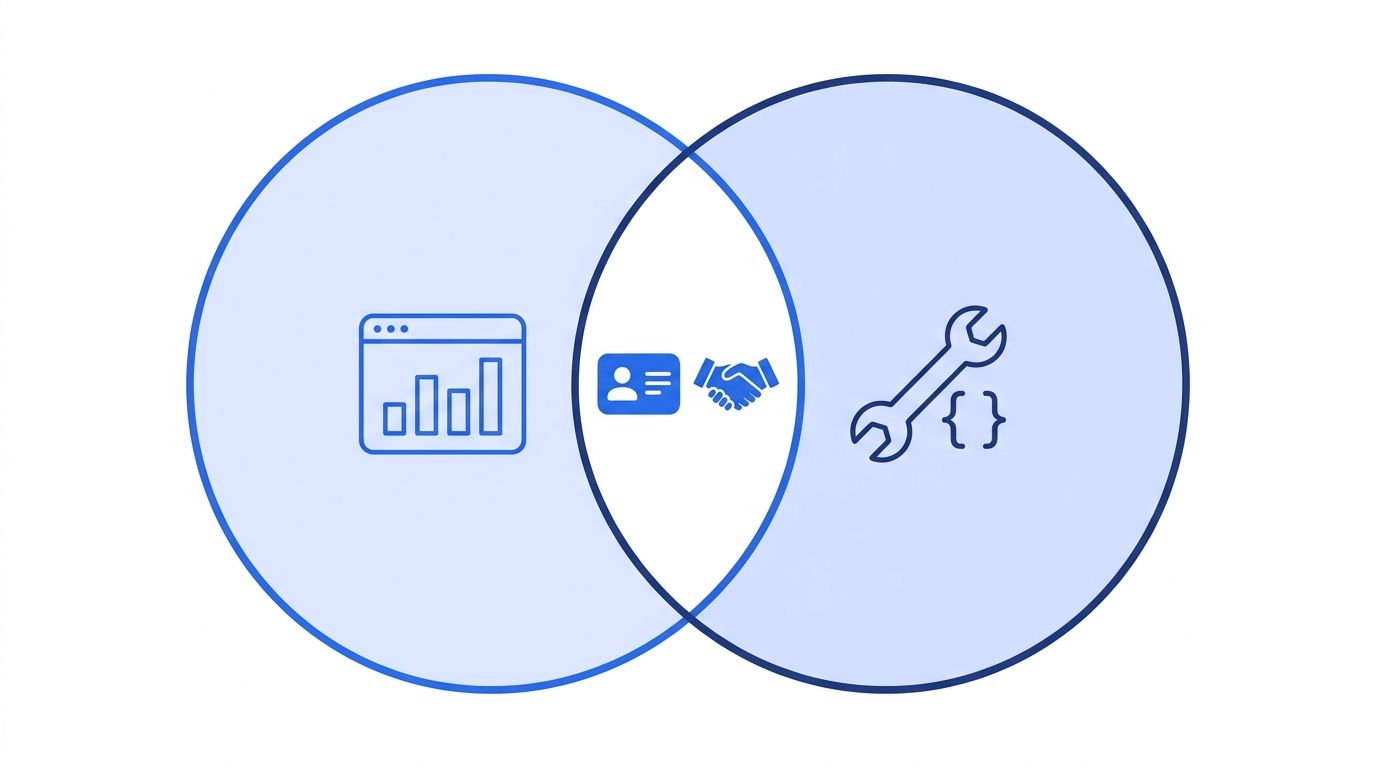
Instead, the practitioner research describes GTM Engineers as functioning like "a team of one" sitting at the intersection of sales, RevOps, and engineering rather than reporting cleanly into any single department (OneGTM, "The 2026 State of GTM Engineering", March 2026). That's a structural difference worth planning around: a RevOps hire slots into an existing chain of command, while a GTM Engineering hire usually needs someone to define reporting lines for the first time.
How Do RevOps and GTM Engineering Salaries Compare?
GTM Engineers command a median advertised salary of $127,500, with top-paying companies like Vercel and OpenAI advertising roles above $250,000 for senior positions (Bloomberry, 2025). RevOps pay lacks an equally rigorous public benchmark, but Glassdoor's aggregated salary data shows GTM Engineer total compensation trending closer to $190,000 when senior and AI-company roles are included — a wider range than the job-posting median alone suggests.
That salary spread tracks the skill gap between the two roles. RevOps hiring tends to favor cross-functional experience and process fluency, which is harder to price into a single number across industries. GTM Engineering hiring skews toward demonstrable technical output — scripts written, pipelines shipped, integrations maintained — which recruiters and job boards can benchmark more precisely because it maps to concrete deliverables rather than soft-skill judgment calls.
Where the Two Roles Overlap — and Where They Genuinely Don't
The overlap between RevOps and GTM Engineering is bigger than most job descriptions admit. One analysis of GTM Engineering postings found that 9 out of 10 listed responsibilities also appear in RevOps postings — things like CRM administration, reporting, and cross-team coordination show up in both (Bloomberry, 2025). If you're hiring off the job description alone, you won't find much of a split.
The real distinction, according to practitioner commentary from RevOps and GTM consultancies, is a "run vs. build" line: RevOps governs and optimizes revenue processes that already exist at scale, while GTM Engineering builds net-new automated systems those processes don't have yet (RevPartners, "GTM Engineering vs. RevOps," 2026; Factors.ai, "GTM Engineering vs. RevOps," 2026). A RevOps leader asks whether the forecast is accurate. A GTM Engineer asks whether the forecast could pull its numbers automatically instead of a rep updating a spreadsheet by hand.
That distinction matters more as AI tooling enters both roles. As of early 2026, 71% of RevOps leaders rate their own AI knowledge 7 or higher out of 10, yet fewer than 10% report measurable pipeline ROI from it, and only 25% say they're integrating AI across every GTM function (Default, "The State of AI in Revenue Operations", 2026). That confidence-to-results gap is a strong argument for why companies increasingly hire a GTM Engineer to build the automation rather than expecting a generalist RevOps hire to close it solo. <!-- [UNIQUE INSIGHT] --> The gap isn't a knowledge problem — it's a building-capacity problem, and building capacity is precisely what the GTM Engineering title was created to supply.
Who Should You Hire First — RevOps, a GTM Engineer, or Both?
Hire RevOps first if your revenue process itself is undefined — forecasting is unreliable, comp plans are inconsistent, or marketing and sales don't agree on what a qualified lead looks like. That's a process and governance problem, and RevOps is built to own it end to end.
Hire a GTM Engineer first if the process is defined but the execution is manual and repetitive — someone is hand-copying enriched contact data between tools, manually tagging leads from a spreadsheet, or building the same report from scratch every week. That's a building problem, not a governance problem, and no amount of process documentation fixes it.
Early-stage startups (under 50 employees): Choose RevOps first, even part-time or fractional. You need someone owning the process before you need someone automating it.
Scaling companies (50-500 employees) with tool sprawl: Hire a GTM Engineer alongside RevOps. This is exactly the stage where the average 23-vendor tool stack starts producing more manual work than it saves.
Enterprise GTM orgs (500+ employees): You likely need both, reporting through separate lines — RevOps into Sales/CRO per the Pave benchmark above, and GTM Engineering embedded closer to whichever function owns the most automation-heavy workflows.
If neither hire fits your budget yet, most of what a first GTM Engineering hire builds — enrichment, ICP-based targeting, and job-change signal monitoring — can run on API-first data infrastructure before you commit to a full-time technical hire. Our account research infrastructure guide for AEs shows what that looks like in practice.
Frequently Asked Questions
Is GTM Engineering just a rebrand of RevOps?
Not exactly. Job-posting analysis found 9 of 10 listed responsibilities overlap between the two titles, but RevOps governs existing revenue processes while GTM Engineering builds new automated systems (Bloomberry, 2025). The overlap is real; the intent behind each hire is different.
Can one person do both RevOps and GTM Engineering?
At small companies, yes — many GTM Engineers started as RevOps or sales ops hires who taught themselves scripting to automate their own workload. Once tool sprawl and automation demands grow past what one person can maintain, most teams split the roles rather than continuing to combine them.
Who should a GTM Engineer report to?
There's no settled answer yet. Unlike RevOps, which most often reports into Operations or Sales/CRO at scale (Pave, 2026), GTM Engineers frequently function as a "team of one" spanning sales, RevOps, and engineering without a single clean reporting line (OneGTM, 2026).
Is RevOps still relevant if a company hires a GTM Engineer?
Yes. RevOps ownership of forecasting, comp design, and cross-functional process didn't shrink as GTM Engineering emerged — 98% of RevOps leaders report their scope actually expanded in the past year (Salesloft/Wakefield Research, 2025). GTM Engineering adds building capacity RevOps didn't have, rather than replacing it.
How much does a GTM Engineer cost compared to a RevOps hire?
GTM Engineer postings carry a median advertised salary of $127,500, with senior roles at AI-native companies posting above $250,000 (Bloomberry, 2025). RevOps compensation isn't benchmarked as rigorously in public data, but generally spans a comparable range depending on seniority and reporting level.
Getting the Split Right Starts With Better Data
RevOps and GTM Engineering will keep overlapping on paper — that's the nature of two young functions solving related problems from different angles. What separates them in practice is whether the work is governing a process (RevOps) or building the pipeline that runs it (GTM Engineering). Get that distinction right, and the hiring decision gets a lot easier.
Whichever role you hire next, both need clean, real-time data to do their job well. See how Datamagnet's real-time people and company API feeds the enrichment and signal workflows a GTM Engineer builds and the reporting RevOps depends on.
Sources
- Bloomberry, I analyzed 1,000 GTM Engineering jobs here is what I learned, retrieved 2026-09-16, https://bloomberry.com/blog/i-analyzed-1000-gtm-engineering-jobs-here-is-what-i-learned/
- Clay, The Complete Guide to GTM Engineering, retrieved 2026-09-16, https://www.clay.com/guides/gtm-engineering
- OneGTM, The 2026 State of GTM Engineering, retrieved 2026-09-16, https://stateofgtme.com/
- Salesloft/Wakefield Research, The Rise of RevOps, retrieved 2026-09-16, https://www.prnewswire.com/news-releases/revenue-operations-makes-the-leap-from-support-role-to-the-c-suite-according-to-salesloft-study-302510064.html
- Pave, Where Should RevOps Report? Choosing the Best Reporting Structure, retrieved 2026-09-16, https://www.pave.com/blog-posts/revops-team-structure
- ZoomInfo, Go-to-Market Intelligence Report 2025, retrieved 2026-09-16, https://www.zoominfo.com/offers/gtm-intelligence-report-2025
- HubSpot, Database Decay Simulation, retrieved 2026-09-16, https://www.hubspot.com/database-decay
- Default, The State of AI in Revenue Operations, retrieved 2026-09-16, https://www.default.com/reports/ai-2025
- RevPartners, GTM Engineering vs. RevOps: Key Differences, Roles & When to Hire Each, retrieved 2026-09-16, https://blog.revpartners.io/en/revops-articles/gtm-engineering-vs-revops
- Factors.ai, GTM Engineering vs. RevOps: Why They're Not the Same Job, retrieved 2026-09-16, https://www.factors.ai/blog/gtm-engineering-vs-revops
- Yahoo Finance, Clay hits $7.1B valuation, retrieved 2026-09-16, https://finance.yahoo.com/technology/ai/articles/clay-hits-7-1b-valuation-091113699.html
- Datamagnet, API Documentation, retrieved 2026-09-16, https://docs.datamagnet.co/api-reference/introduction
