
Disclosure: This article is published by Datamagnet. Vendor claims are self-reported unless otherwise noted.
Recruiting CRM vs. ATS: Where Should Signal Data Actually Live?
Signal data — job changes, LinkedIn engagement, alumni moves — belongs in your recruiting CRM, not your ATS. In 2026, 46% of sourced hires came from candidates recruiters had already talked to before, up from 26% in 2021 (Gem, 2026 Recruiting Benchmarks Report). Your ATS wasn't built to catch that.
TL;DR
- In 2026, 46% of sourced hires came from rediscovered candidates, nearly double the 26% share from 2021 (Gem, 2026 Recruiting Benchmarks Report).
- Sourced candidates are 8x more likely to get hired than inbound applicants, but ATS platforms rank candidates by application date, not relationship signal.
- Median time-to-fill sits around 45 days in 2025, and only 7% of nonexecutive roles get filled internally (SHRM, State of Recruiting 2025).
- The fix isn't replacing your ATS. It's routing live signal data — job changes, engagement, re-engagement triggers — into a CRM layer built to act on it, then pushing candidates into the ATS only once a requisition opens.
What's the Actual Difference Between an ATS and a Recruiting CRM?
An ATS manages requisitions and compliance for candidates who've already applied, while a recruiting CRM manages relationships with people who haven't applied yet. That distinction sounds small, but it decides which system should own signal data — and most teams get it backward.
Applicant tracking systems like Greenhouse, Lever, Workday, and iCIMS were designed around a specific workflow: post a job, collect applications, move candidates through interview stages, generate compliance records. That's requisition-centric software. A candidate without an open req to attach to is, structurally, dead weight in an ATS.
A recruiting CRM — think Beamery, Gem, Eightfold, or Ashby's sourcing layer — is built around the person, not the req. It tracks a candidate across years, multiple roles, and every touchpoint, whether or not a job is currently open. That's exactly the shape signal data needs.
The confusion isn't that teams don't know the difference on paper. It's that most TA stacks were built ATS-first and had a CRM bolted on later, so signal data defaults to wherever the integration happened to land — usually the ATS, because that's the system of record everyone already trusts.
Where Does Signal Data Actually Fit in Each System?
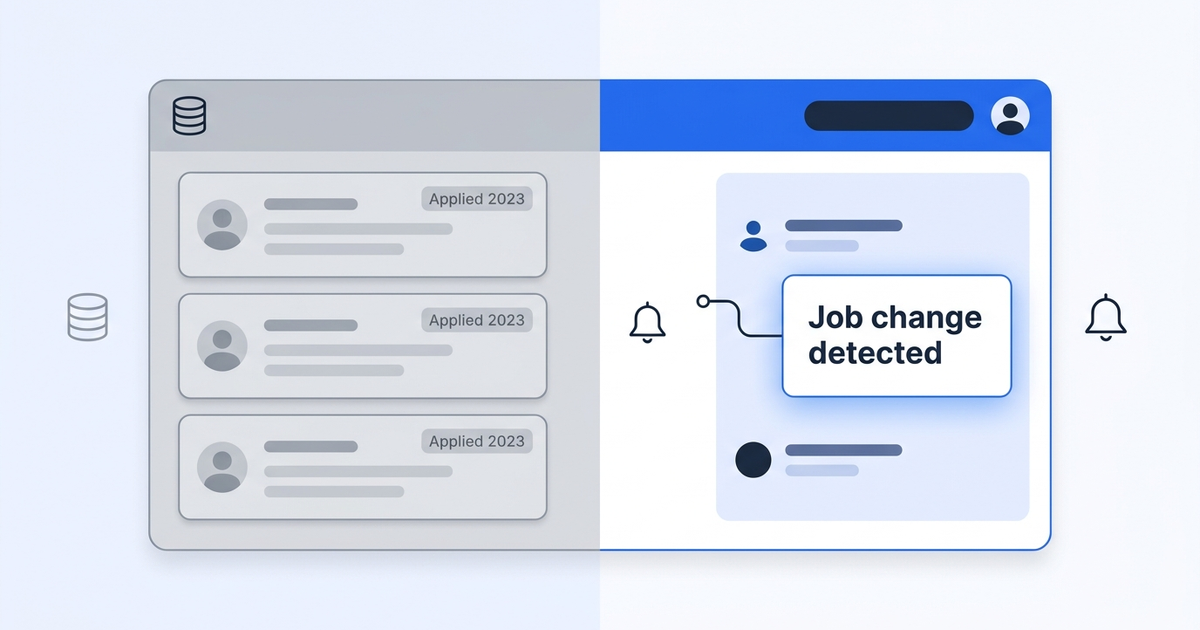
Signal data — a job change, a LinkedIn post, a promotion, a company layoff — needs a home that can act on it the moment it fires, and an ATS isn't built for moment-to-moment action. It's built for stage-gated workflows tied to a requisition, which means anything without a req attached tends to get filed and forgotten.
A recruiting CRM is built to hold a candidate in a nurture state indefinitely, watching for the trigger that makes them a fit. That's the entire point of signal-based sourcing: you're not searching a database on demand, you're getting notified the moment a passive candidate's situation changes.
This is the layer where Datamagnet's signal monitors sit. You can create a signal that tracks job changes, new posts, or engagement events on a LinkedIn profile, then deliver the result straight into your CRM through a webhook instead of waiting for a recruiter to re-search a name.
Nearly doubling that share in five years is a workflow shift, not a sourcing-volume shift. Teams got better at holding onto candidates and reacting to signals instead of running the same searches from scratch every time a req opened.
Why Do ATS Databases Turn Into Dead Archives?
An ATS database goes stale because nothing in its design rewards keeping records fresh once a candidate's application closes out. The system's job is done the moment a candidate is hired, rejected, or withdraws — there's no built-in reason to keep watching that person afterward.
Compliance requirements make this worse, not better. ATS platforms are optimized to retain immutable, auditable records of what happened during a specific hiring process, which is exactly the opposite of a system designed to track what's changing about a person right now.
That's why "search your ATS for qualified candidates" so often turns up names attached to job titles, employers, and skills that are years out of date. The record froze the day the req closed. Nobody updates a rejected candidate's profile after the fact, so any signal-based sourcing built on top of raw ATS search is working from a snapshot, not a live feed.
Sourced candidates are 8x more likely to be hired than candidates who apply inbound, and direct sourcing drove 11% of hires from just 2.6% of total applications in 2026 (Gem, 2026 Recruiting Benchmarks Report). That gap only widens if the sourcing pool it's drawing from is current, which is why teams are increasingly turning to real-time intent signal APIs instead of periodic ATS re-searches.
How Much Value Are You Leaving on the Table by Not Reactivating Past Candidates?
You're leaving real pipeline on the table, because the fastest hires often aren't new sourcing at all — they're people already in your system who just needed the right trigger to come back into the funnel. That 46% rediscovered-hire share means almost half of all sourced placements in 2026 came from a database your team already had.
Median time-to-fill sat around 45 days in 2025, and only 7% of nonexecutive roles were filled internally (SHRM, State of Recruiting 2025). Every day spent re-sourcing a candidate your team has already vetted is a day added to that 45-day clock.
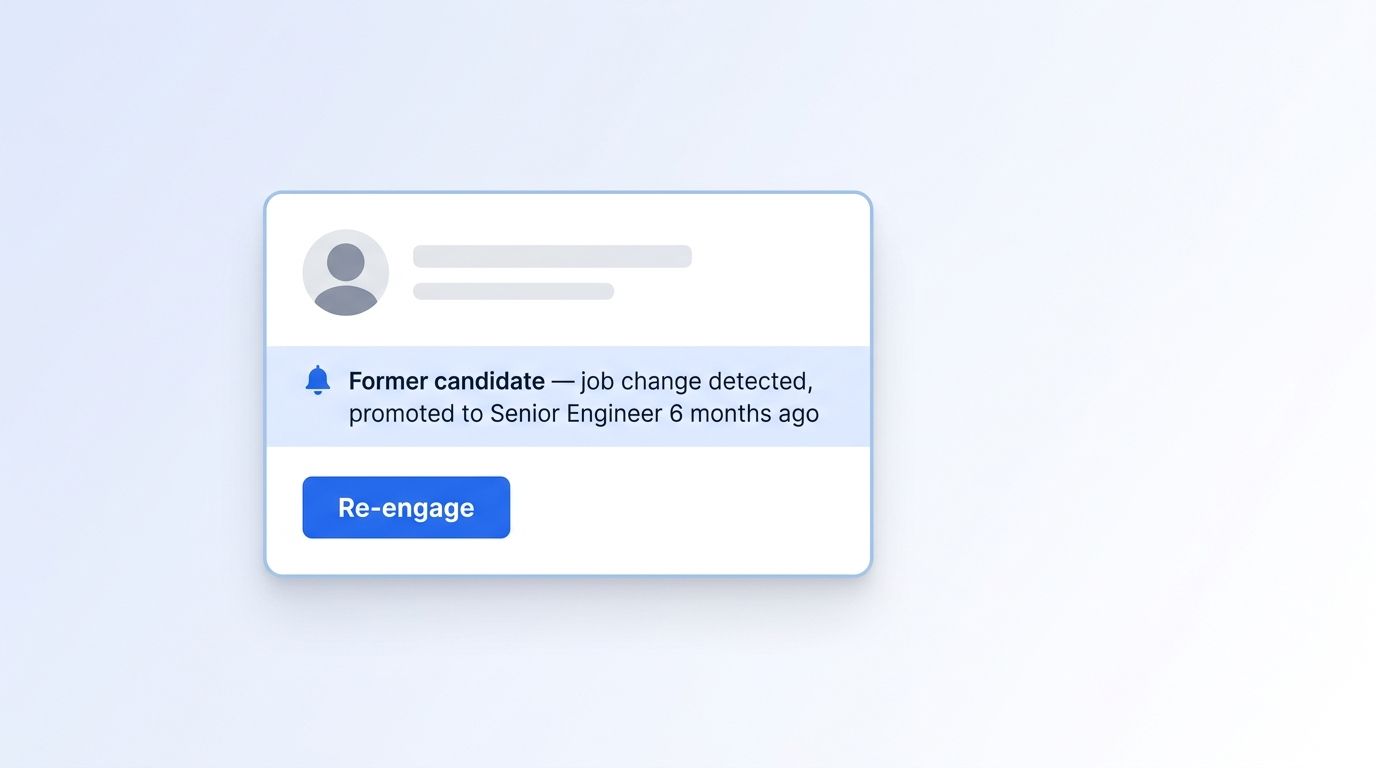
This is where recruiting CRMs earn their keep over a bare ATS search bar. A CRM that's watching for job-change signals on your past finalists, silver medalists, and boomerang alumni turns "we should reach back out to that candidate from last year" into an automatic alert instead of a recruiter's memory.
Teams we've worked with on signal integrations describe the same pattern: the candidates worth re-engaging fastest are the ones a recruiter already screened once, not brand-new sourcing leads — the vetting work is already done, so the only missing piece is timing.
Recruiting CRM vs. ATS: A Feature-by-Feature Comparison
The clearest way to see where signal data belongs is to line the two systems up side by side, because their design priorities point in opposite directions. One optimizes for compliance and workflow stages; the other optimizes for relationships and timing.
| Capability | ATS | Recruiting CRM |
|---|---|---|
| Core unit of record | Requisition + application | Person, independent of any open req |
| Best at | Interview stages, offer letters, compliance/EEOC records | Long-term nurture, passive candidate tracking |
| Handles job-change/engagement signals | Poorly — no built-in trigger layer | Natively — built to watch and react |
| Data freshness | Frozen at application close | Updated continuously via signals/enrichment |
| Typical platforms | Greenhouse, Lever, Workday, iCIMS | Beamery, Gem, Eightfold, Ashby |
| Where it fails | Passive/rediscovered candidates go cold | No system of record for compliance-grade hiring data |
Neither system replaces the other, and trying to force one to do both jobs is usually where the friction starts. An ATS without a CRM layer in front of it loses passive candidates. A CRM without an ATS behind it has no compliant record of the actual hiring decision.
How Should Signal-Based Triggers Route Between Your CRM and ATS?
Signal-based triggers should land in the CRM first and only cross into the ATS once a candidate is being actively considered for a specific open requisition. Routing it the other way — dumping every signal straight into the ATS — is how recruiters end up burying real triggers inside thousands of stale application records.
A workable architecture looks like this: a signal monitor watches a list of past candidates, alumni, or champions for job changes and engagement events. When a signal fires, it's delivered via webhook into the CRM, which enriches the record using people search against your own database of previously touched profiles. The recruiter reviews the trigger in the CRM. Only when that candidate is slotted against an actual req does the record get pushed into the ATS for compliance tracking.
In our own signal-delivery architecture, we treat the CRM as the "decision layer" and the ATS as the "record layer" — signals never write directly into ATS fields, because that's exactly how stale, duplicate candidate records pile up.
This also solves the sync-friction problem TA ops teams run into constantly: duplicate candidate records, conflicting statuses, and two systems that disagree about who a person is. Keeping signal ingestion in one place — the CRM — means the ATS only ever receives a clean, decision-ready record.
For teams tracking specific people over time rather than open-ended signal types, the Champion Tracker cookbook and the Executive Intelligence / VIP Engagement Radar pattern both apply the same routing logic recruiting teams need for alumni and boomerang candidates.
So Which System Should Own Signal Data — CRM or ATS?
The recruiting CRM should own signal data, full stop — the ATS should only receive a candidate record once that signal has already been qualified against an open requisition. This isn't a close call: ATS platforms have no native concept of "watch this person over time," and retrofitting one to do that job usually means fighting the platform's own compliance-first design.
That doesn't mean your ATS is obsolete. It's still the right system for what it does best — auditable, requisition-tied hiring records that survive an audit. The mistake is expecting it to also be your sourcing brain.
Rhetorical check: if your ATS could tell you the moment a rejected candidate from 18 months ago got promoted at their new company, would you even need this article? For most teams, the honest answer is no — and that gap is exactly what a signal-fed CRM closes.
Datamagnet's recruiting intelligence tools are built for that gap specifically: live job-change and engagement signals that feed your CRM in real time, so rediscovered candidates stop depending on a recruiter remembering a name.
Frequently Asked Questions
Should job-change signal data go into my ATS or my CRM?
It should go into your recruiting CRM. Job-change signals need a system built to watch a person indefinitely and act the moment their situation changes, not a requisition-tied system that treats candidates as closed records once an application ends. Route the CRM's qualified output into the ATS only once a req is attached.
What counts as "signal data" in recruiting?
Signal data covers job changes, promotions, new LinkedIn posts, and engagement events (likes, comments, shares) tied to a specific person or company. In 2026, teams increasingly use these signals to time outreach instead of relying on periodic manual searches (Gem, 2026 Recruiting Benchmarks Report).
Can I sync signal data automatically between my CRM and ATS?
Yes — most modern setups use webhooks to push qualified signals from a monitoring layer into the CRM, then a one-way sync into the ATS once a candidate is attached to an open requisition. Datamagnet delivers signals via webhook so this handoff doesn't require manual re-entry.
Do I need to replace my ATS to use signal-based recruiting?
No. Signal-based recruiting sits on top of your existing ATS as a CRM or sourcing layer — it doesn't require ripping out compliance-grade hiring records your ATS already handles well. The 46% rediscovered-hire share in 2026 came from teams adding signal capability, not switching platforms (Gem, 2026 Recruiting Benchmarks Report).
Why do rediscovered candidates convert better than new sourcing?
Rediscovered candidates have already been screened once, so the vetting work is done and only timing is missing. Sourced candidates overall are 8x more likely to be hired than inbound applicants (Gem, 2026 Recruiting Benchmarks Report), and that gap is highest among candidates a recruiter has met before.
