
Disclosure: This article is published by Datamagnet. Vendor claims are self-reported unless otherwise noted.
Proxycurl Alternatives in 2026: What Changed With EnrichLayer and Where to Go Next
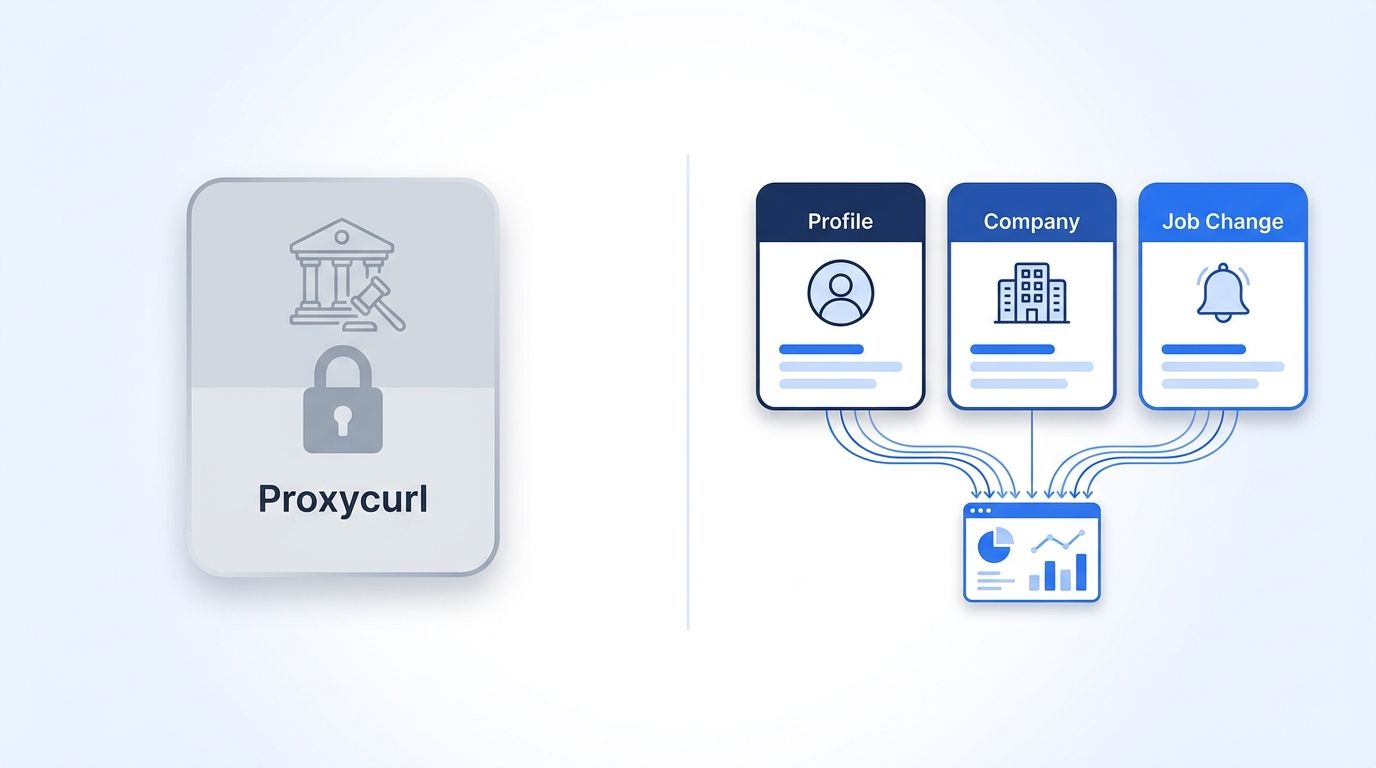
Proxycurl shut down on July 4, 2025, nine months after LinkedIn sued its parent company, Nubela, over how it collected profile data. If you had a Proxycurl API key in production, you've likely already migrated somewhere — the question now is whether you migrated to the right place, and whether "EnrichLayer" is really what everyone online says it is.
TL;DR
- Proxycurl shut down July 4, 2025 after LinkedIn sued Nubela in January 2025, alleging fake-account scraping. Nubela settled and deleted its LinkedIn-sourced data (Nubela, "Proxycurl Shuts Down. Thank you.", July 2025).
- Nubela's own site never mentions EnrichLayer — it points instead to NinjaPear, a product built to "never touch a professional social network." Whether EnrichLayer shares Proxycurl's team is unconfirmed.
- EnrichLayer's pay-as-you-go pricing runs from $0.10 per credit down to $0.0216 per credit at the $1,000 tier, with no published free tier (EnrichLayer Pricing).
- For profile, company, and job-change lookups specifically, Coresignal, Bright Data, and Datamagnet each cover different gaps EnrichLayer's compatibility layer doesn't close.
What Actually Happened to Proxycurl?
In January 2025, LinkedIn (owned by Microsoft) filed a federal lawsuit against Proxycurl's parent company, Nubela, in the U.S. District Court for the Northern District of California. The complaint alleged Nubela created "hundreds of thousands" of fake LinkedIn accounts to scrape millions of member profiles, including data sitting behind LinkedIn's login wall (AdNews, 2025).
Nubela didn't fight it. In a founder-authored post titled "Proxycurl Shuts Down. Thank you.," the company explained its reasoning in plain terms: "there is no winning in fighting this," citing two problems it couldn't get around. First, the American legal system's fee-shifting rules mean you can't recover your legal costs even if you eventually win. Second, and more bluntly: "LinkedIn, owned by Microsoft, has more or less an unlimited war chest" (Nubela, July 4, 2025).
Proxycurl was doing roughly $10 million in annual recurring revenue when it shut down. The settlement reportedly required a permanent injunction — Nubela agreed to stop accessing LinkedIn entirely and delete all the LinkedIn-sourced data it had already collected (StartupHub.ai, 2025). That's not a rebrand story. It's a company forced to walk away from its entire product line under legal pressure, which matters for anyone deciding how much to trust whatever comes next in this space.
If you're weighing what to replace Proxycurl with, our proxycurl alternative comparison maps the specific endpoints most teams relied on.
Is EnrichLayer Really Proxycurl Under a New Name?
<!-- [UNIQUE INSIGHT] -->Here's what nearly every "Proxycurl alternative" post gets wrong: they state as fact that EnrichLayer is Proxycurl's rebrand, and none of them link to a primary source that actually proves it. We checked directly, and the two companies' own sites contradict each other.
EnrichLayer does publish a genuine transition path. Its docs include a "Transition Guide" with a URL-conversion tool, plus a Python package (enrichlayer-api) with a compatibility layer that maps the old ProxycurlException class to a new EnrichLayerException, so legacy Proxycurl code can run against the new backend with minimal changes (EnrichLayer Transition Guide; GitHub, retrieved 2026-09-05). That part is real and verifiable — we opened the repo and the docs page ourselves.
What isn't verifiable: common ownership. Nubela's own homepage — the actual company that built and shut down Proxycurl — never mentions EnrichLayer. Instead, it describes its post-shutdown project as NinjaPear, and says plainly: "We built Proxycurl, so we learned this the expensive way... NinjaPear was built from scratch to never touch a professional social network" (Nubela, retrieved 2026-09-05). That's the opposite of EnrichLayer's entire product line, which is LinkedIn person, company, and job data.
EnrichLayer and Proxycurl also show up as two separate organizations in Crunchbase's database, which would be unusual for a straightforward internal rename. Treat any "same team as Proxycurl" claim you read elsewhere as unconfirmed marketing until someone publishes an actual founder statement saying so.
Compare the two side by side in our EnrichLayer alternative breakdown, which covers what EnrichLayer's model still doesn't do that live request-time APIs handle differently.
What Does the EnrichLayer Transition Mean for Pricing and Endpoints?
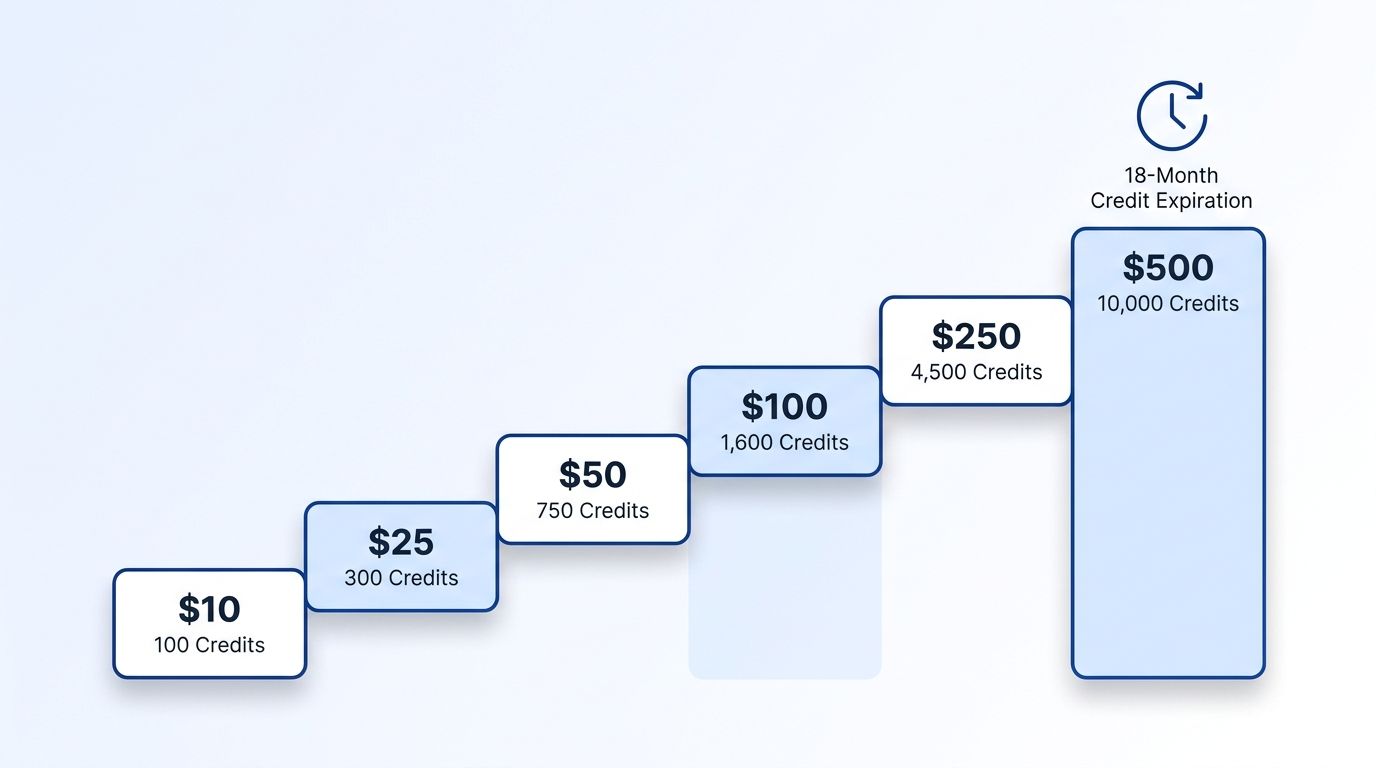
EnrichLayer's current pricing has no free tier, and it charges more per credit at low volume than most teams expect from a "successor" product. Pay-as-you-go starts at $10 for 100 credits ($0.10/credit) and improves to $0.0216/credit at the $1,000 tier; annual plans drop the effective rate further but require upfront commitment (EnrichLayer Pricing, retrieved 2026-09-05).
<!-- [ORIGINAL DATA] -->We pulled the raw numbers off EnrichLayer's pricing page and calculated the effective per-credit rate ourselves, since the page doesn't show it directly:
| Plan | Annual cost | Credits included | Effective $/credit |
|---|---|---|---|
| PAYG (entry) | $10 | 100 | $0.1000 |
| PAYG (top tier) | $1,000 | 46,297 | $0.0216 |
| Starter (annual) | $588 | 35,000 | $0.0168 |
| Growth (annual) | $3,588 | 350,000 | $0.0103 |
| Pro (annual) | $10,788 | 1,258,600 | $0.0086 |
| Ultra (annual) | $22,788 | 2,954,000 | $0.0077 |
Source: EnrichLayer Pricing, retrieved 2026-09-05.
Per-endpoint costs vary too: a Person Profile lookup runs 1 credit base, with a "cached if recent" option adding 1 credit and a forced live re-fetch adding 9 credits on top. Company lookups run 1-10 credits, Job endpoints 2 credits, and Search 3 credits per call. Credits expire after 18 months of account inactivity, which is worth noting if you're building a low-volume side project rather than a production pipeline.
On endpoint compatibility: EnrichLayer's transition guide and URL-conversion tool are real, but we couldn't retrieve a detailed field-by-field breaking-change list from the public docs — the OpenAPI spec isn't fully exposed to automated review. Budget time to manually test each endpoint your integration touches rather than assuming a 1:1 response-schema match.
One more gap worth flagging plainly: as of this writing, there's no independent public track record — no Reddit threads, G2 reviews, or Hacker News discussion — covering EnrichLayer's uptime, support responsiveness, or data freshness post-launch. That's not a red flag by itself, but it does mean you're an early adopter of an unproven track record, not a battle-tested one.
You Used Proxycurl for Profile Lookup - What Replaces It?
Proxycurl's Person Profile endpoint was the most-used part of the API for most teams — pulling job history, education, skills, and current role from a LinkedIn URL. If that's what you built on, the replacement decision comes down to whether you need cached data or live-fetched data, and how much a stale profile costs you.
EnrichLayer keeps this endpoint but layers cost onto freshness: the base 1-credit call can return cached data, and getting a guaranteed live fetch costs 9 credits more. Coresignal takes a different approach entirely, offering a database of 907 million-plus employee records built since 2016 rather than fetching at request time (Coresignal, retrieved 2026-09-05) — good for bulk historical analysis, less useful if you need this week's job title.
Datamagnet's People API fetches a LinkedIn URL live at request time rather than serving from a stored snapshot, which matters most for outbound sales and recruiting workflows where a title that's six months stale can misroute an entire sequence. See the People Profile endpoint reference for the exact fields returned.
You Used Proxycurl for Company Lookup - What Replaces It?
Company profile lookups — headcount, industry, specialties, funding history — are the second-most common Proxycurl use case, usually feeding account scoring or territory mapping. The core question when picking a replacement is whether headcount and funding data update often enough to catch a company mid-growth-spurt, not just at initial enrichment.
Coresignal reports 70 million-plus company records across 500-plus fields (Coresignal, retrieved 2026-09-05), which gives broad coverage but on the same request-or-database tradeoff as its person data. Bright Data positions itself as the enterprise-scale, compliance-focused option for teams that need volume and a documented legal posture more than real-time freshness (Bright Data, retrieved 2026-09-05).
Datamagnet's Company API pulls headcount, industry, specialties, and recent funding rounds live from a LinkedIn company URL. If your old Proxycurl calls fed a scoring model, re-check the field names — even API providers with a stated "compatibility layer" don't guarantee identical response shapes.
You Used Proxycurl for Job-Change Detection - What Replaces It?
Job-change detection is where speed actually shows up in your pipeline numbers, not just in your data warehouse. A widely cited MIT and InsideSales.com study of over 100,000 call attempts found leads contacted within 5 minutes are 21 times more likely to become qualified than those contacted after 30 minutes, with contact odds dropping roughly 100x over that same window (MIT/InsideSales.com Lead Response Management study). The same logic applies to a champion switching jobs — the alert that reaches your rep an hour later is worth a lot less than the one that reaches them in minutes.
Proxycurl never had a dedicated push-based signal product; most teams polled its Person Profile endpoint on a schedule and diffed the results themselves, which is slow and easy to under-sample. That gap is still open in most alternatives — EnrichLayer's transition guide focuses on profile and company endpoints, not webhook-based change monitoring.
Datamagnet's Signal API runs job-change detection as a monitored signal rather than a polling job: you create a monitor once, and get a webhook when someone on your tracked list changes roles. The Create Signal endpoint and the champion-tracking cookbook walk through wiring that into a re-engagement workflow rather than a nightly diff script. Separately, Foundry's benchmarking data found 71% of B2B organizations already collect buyer signals, but more than half never operationalize what they collect (Foundry, "Top 30 Stats on ABM and Intent Data", retrieved 2026-09-05) — a migration is a natural point to fix that, not just swap the vendor name.

Proxycurl Alternatives Compared at a Glance
No single alternative replaces every Proxycurl use case equally well, so match the tool to the job instead of picking one "winner." Here's how the main options split by what they're actually built for:
| If you need... | Consider | Model |
|---|---|---|
| Drop-in endpoint compatibility | EnrichLayer | Same-shaped API, unconfirmed team lineage, no free tier |
| Large historical people/company database | Coresignal | Stored records, 4.5B+ data points, updated on a schedule |
| Enterprise-scale compliant collection | Bright Data | Volume-focused, documented legal posture |
| Sales-motion-native enrichment + CRM | Apollo.io | Free tier (900 credits/yr), seat-based paid plans |
| Live request-time profile, company, and job-change signals in one API | Datamagnet | Fetched at request time, webhook-based signals, pay-as-you-go credits |
We looked for independent third-party reviews or press coverage of every vendor listed here, including Datamagnet. We found reasonably solid public data on Coresignal and Apollo's pricing, but no independent, methodology-disclosed reviews of Datamagnet outside its own site — so treat every vendor's self-reported claims, ours included, as a starting point for your own trial, not a final verdict.
Your Proxycurl-to-EnrichLayer Migration Checklist
Whether you land on EnrichLayer or somewhere else, the migration work looks the same. Work through this before you flip production traffic over:
- Audit your current Proxycurl call volume by endpoint. Pull the last 90 days of logs and split calls into person profile, company profile, and search, so you're not paying for capacity you don't use.
- Confirm the new vendor's response schema field-by-field. Don't trust a "compatibility layer" claim without testing it — run your existing parsing code against a handful of real responses first.
- Recalculate cost per 1,000 records at your actual volume, not the vendor's headline rate. Credit costs shift heavily by tier, and by whether you need cached or forced-live data.
- Check for a job-change or webhook-based signal option, not just a static lookup — if you were polling Proxycurl on a cron job, this is the moment to switch to push-based alerts instead.
- Verify data retention and deletion terms, especially if you're subject to GDPR or CCPA — Proxycurl's own shutdown happened partly because of how it collected data, so ask any new vendor directly about sourcing method.
- Run a parallel test for 1-2 weeks before fully cutting over, comparing field completeness and freshness against your old Proxycurl output on a sample of known accounts.
- Update rate-limit and retry logic — new vendors rarely share Proxycurl's exact throttling behavior, and a naive retry loop can burn through a credit budget fast.
If you want a head start on step 2, see how Datamagnet's People API fields map to what you were pulling from Proxycurl.
Ready to test a live alternative instead of guessing from documentation? See who's job-hopping on your target account list with a free-credit trial before you commit to an annual plan.
Frequently Asked Questions
Did Proxycurl get acquired, or did it just shut down?
It shut down. Proxycurl's parent company, Nubela, settled a LinkedIn lawsuit filed in January 2025 and ceased operations on July 4, 2025, agreeing to delete its LinkedIn-sourced data (Nubela, 2025). No acquisition was announced by Nubela itself.
Is EnrichLayer run by the same team as Proxycurl?
It's unconfirmed. EnrichLayer offers a genuine technical migration path from Proxycurl, but Nubela's own site never mentions EnrichLayer and instead describes a different post-shutdown project, NinjaPear, built to avoid LinkedIn scraping entirely. Treat "same team" claims as unverified until a primary source confirms it.
Does EnrichLayer have a free tier like Proxycurl did?
No published free tier appears on EnrichLayer's current pricing page. Pay-as-you-go starts at $10 for 100 credits ($0.10/credit), with per-credit cost dropping to $0.0077 only at the highest annual tier ($22,788/year) (EnrichLayer Pricing, retrieved 2026-09-05).
What's the fastest way to replace Proxycurl's job-change detection?
Move from polling a profile endpoint on a schedule to a webhook-based signal that fires when a tracked profile's role changes. Response speed matters here — leads or champions contacted within 5 minutes convert at up to 21 times the rate of those contacted after 30 minutes (MIT/InsideSales.com).
Should I pick one Proxycurl alternative or split across vendors?
Many teams split: a bulk historical database like Coresignal for account scoring, plus a live request-time API for job-change alerts and outbound sequencing where freshness matters more than volume. Pick based on the endpoint you relied on most, not a single "best overall" label.
Where This Leaves You
Proxycurl's shutdown wasn't a rebrand story, even though most of the search results calling EnrichLayer its successor treat it like one. The legal facts are clear — a lawsuit, a settlement, a shutdown. The corporate lineage of what replaced it isn't, and that's worth knowing before you build a year of infrastructure on an assumption nobody's actually confirmed.
Whichever direction you go, run the migration checklist above before you cut over production traffic, and don't skip the parallel-test step just because a vendor's docs promise compatibility. For a side-by-side on request-time data, webhook signals, and pricing, our Proxycurl alternative comparison has the endpoint-level detail this post didn't have room for.
