
Disclosure: This article is published by Datamagnet. Vendor claims are self-reported unless otherwise noted.
How to Build a Lead Routing Engine That Doesn't Break When Reps Change Territories
Your routing engine doesn't fail on day one. It fails eight weeks later, the first time someone reshuffles territories and three accounts quietly stop getting leads. LeanData's 2026 routing analysis found that roughly 1 in 4 leads gets sent to the wrong owner, and 73% of MQLs never get contacted by any rep at all (LeanData, 2026).
This tutorial walks through building a lead routing engine with a territory layer that's decoupled from your assignment logic. Change a reassignment, and it updates one rules table instead of every hardcoded list your routing depends on. By the end, you'll have a working resolver service, a transition queue for leads caught mid-change, and a nightly audit that catches orphaned accounts early.
TL;DR
- In 2011, HBR found companies that responded to a lead within an hour were roughly 7x more likely to qualify it than slower responders (Harvard Business Review, 2011) — every minute a lead sits unowned during a territory change costs real conversion odds.
- As of 2026, LeanData estimates 1 in 4 leads is routed to the wrong rep, and 73% of MQLs never get a human follow-up at all (LeanData, 2026).
- In 2025, Validity found 76% of teams say less than half their CRM data is accurate, and 37% report losing revenue directly because of it (Validity, State of CRM Data Management, 2025).
- Separate territory rules from assignment logic: store ownership as time-stamped data, resolve it at request time, and never hardcode a rep-to-account list your routing engine has to remember to update.
- As of 2026, 35% of field sales teams still plan territory changes on spreadsheets (SPOTIO, 2026 State of Field Sales, 2026) — a routing engine that reads live firmographic data instead of that spreadsheet survives the next reorg automatically.
Why Do Lead Routing Engines Break When Reps Change Territories?
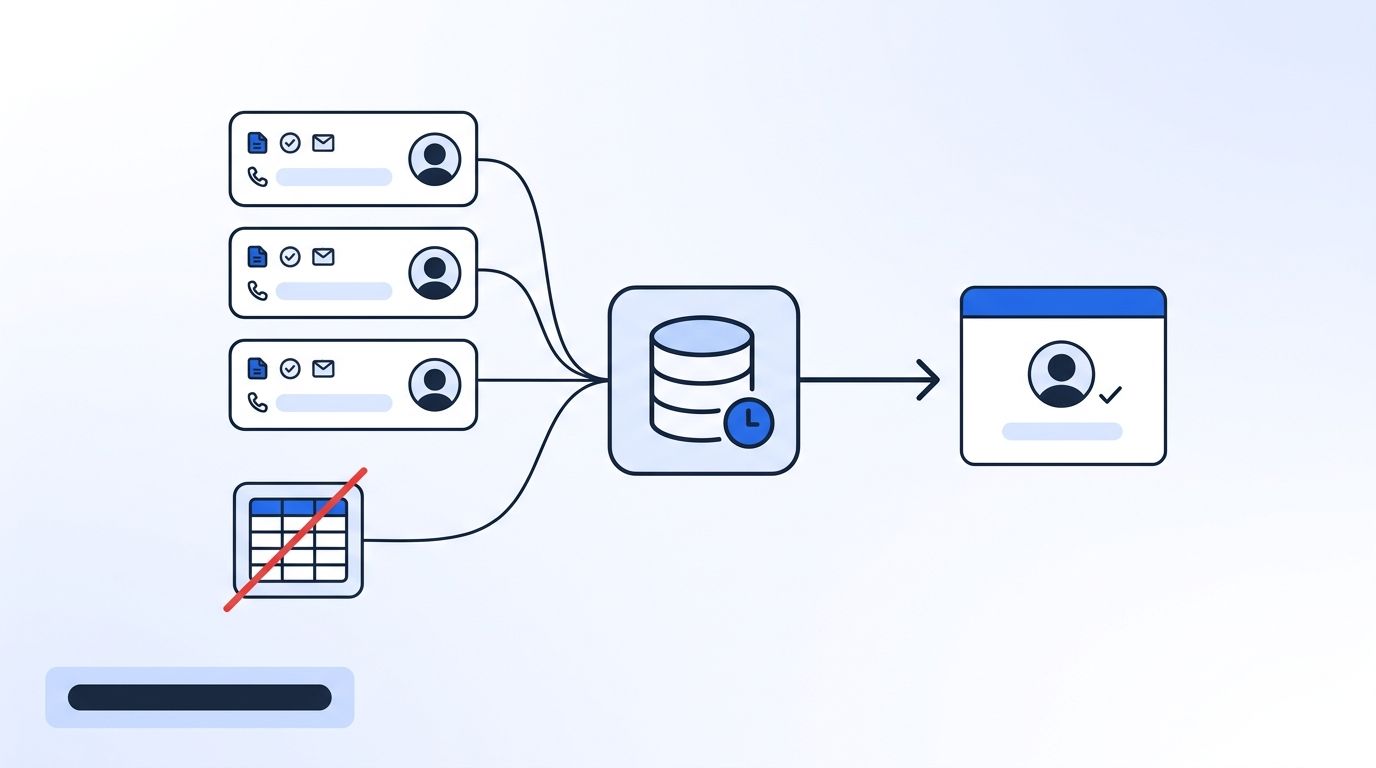
Routing engines break because most of them store ownership as a fixed attribute on the account record instead of a rule that changes over time. When a rep leaves, a territory splits, or headcount grows past a threshold, that stale owner_id field doesn't update itself — and nothing tells you it's wrong until a lead sits untouched.
LeanData's routing analysis puts a number on the damage: roughly 1 in 4 leads gets routed to the wrong owner, and 73% of MQLs never get contacted by a rep at all (LeanData, 2026). Most of that isn't a broken rule on day one. It's a rule that was correct when it was written and never got revisited when the org chart moved underneath it.
Manual territory planning makes this worse. As of 2026, 35% of field sales teams still manage territory and route planning on spreadsheets or paper maps (SPOTIO, 2026 State of Field Sales, 2026). Underperforming teams are roughly twice as likely as top performers to still rely on that approach — 34% versus 17%. A spreadsheet doesn't push updates to your routing engine. Someone has to remember to open it, change a cell, and then go update every downstream system that reads from it.
Teams usually diagnose this as a "data quality" problem and go fix the CRM record. That's treating the symptom. The actual defect is architectural: ownership is stored as a snapshot on the lead or account row instead of a rule with a start and end date. A snapshot can only be right or wrong. A time-stamped rule can be correct as of any given moment, which is what a routing engine actually needs.
For related reading on why stale CRM fields cause downstream errors like this, see how programmatic CRM enrichment keeps account records current instead of letting them drift.
What Does a Territory-Resilient Routing Architecture Look Like?
A territory-resilient architecture separates three things that most routing setups collapse into one. Those are the territory rules (who owns what, and since when), the resolver that matches a lead to a rule, and the assignment action that writes the result to your CRM. Change the rules, and the resolver picks up the new owner automatically — no code deploy, no manual re-sync.
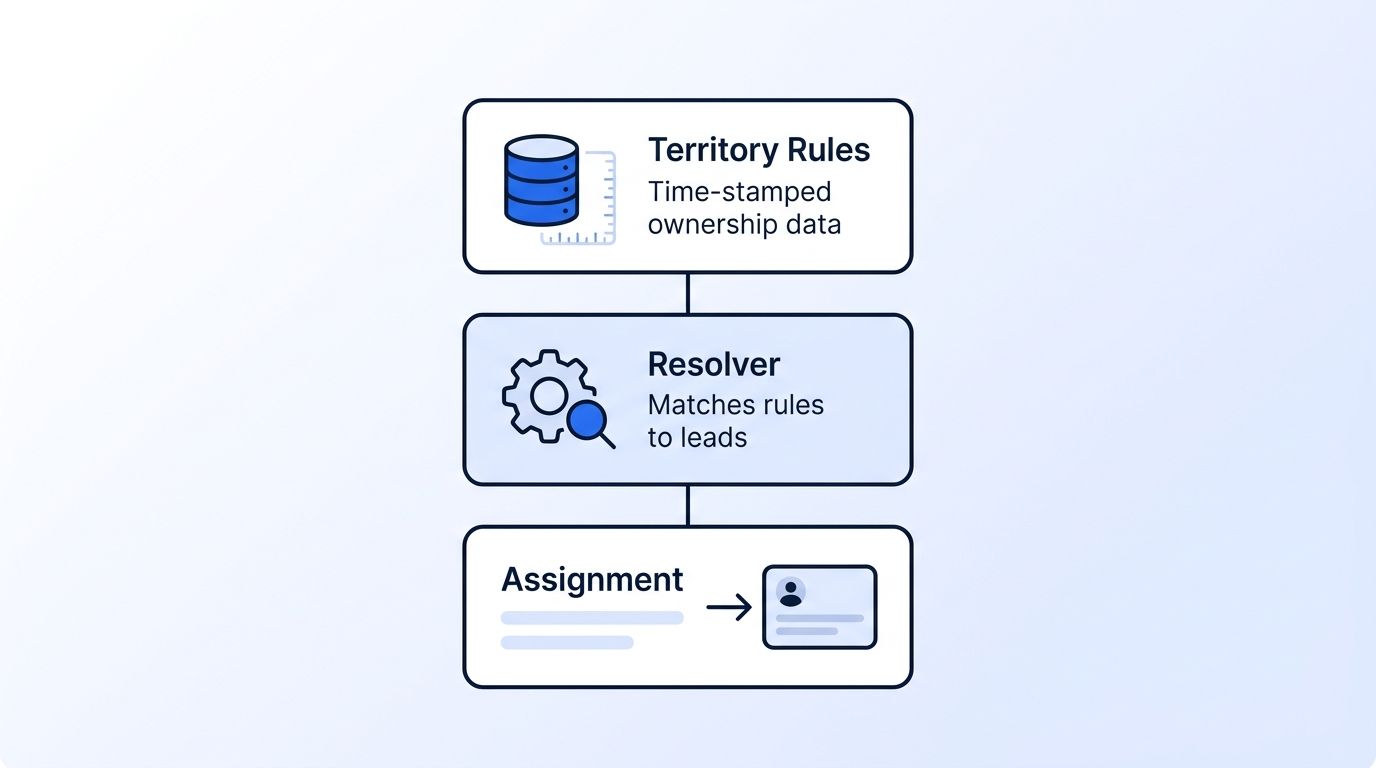
What you'll build: a routing resolver service that takes an incoming lead, enriches it with live firmographic data, resolves the current territory owner from a time-stamped rules table, and falls back to a queue instead of dropping the lead when no rule matches yet.
You'll need:
- Python 3.11+ and a Postgres (or SQLite for local testing) database
- A Datamagnet API key for live company enrichment
- A CRM webhook or REST endpoint you can post assignments to
- ~60 minutes to complete
Citation capsule: Roughly 1 in 4 B2B leads gets routed to the wrong owner, and 73% of MQLs never get a human follow-up at all, according to LeanData's 2026 routing analysis. A routing engine that resolves ownership from a live, time-stamped rules table instead of a hardcoded list is the direct fix for both numbers.
Step 1: How Do You Model Territories as Data Instead of a Hardcoded Rep List?
Territory data belongs in its own table with a start and end date, not as a single owner_id column you overwrite every time someone gets reassigned. Overwriting a value destroys history — you can't tell your resolver "who owned this account last Tuesday," which matters when you're debugging a misrouted lead.
-- territory_rules: time-stamped ownership, never overwritten in place
CREATE TABLE territory_rules (
  id SERIAL PRIMARY KEY,
  owner_id TEXT NOT NULL,        -- CRM user ID of the rep
  region TEXT,                   -- e.g. 'US-West', 'EMEA'
  industry TEXT,                 -- matches Datamagnet's `industry` field
  headcount_min INT,
  headcount_max INT,
  effective_from DATE NOT NULL,
  effective_to DATE              -- NULL = currently active
);
When a territory changes, insert a new row and set effective_to on the old one in the same transaction. Never UPDATE an existing rule's owner_id directly — that's the exact overwrite pattern that erases the history you need for debugging later.
Watch out: if
effective_todoesn't get set on the outgoing rule, you'll end up with two active rules matching the same account, and your resolver has no way to know which one is correct.
Step 2: Feed the Resolver With Live Firmographic Data, Not a Static List
Static account lists rot the moment a company grows past a headcount threshold or opens a new office. Instead of maintaining a manually updated list of which accounts belong to which territory, resolve territory membership dynamically from live company data every time a lead comes in.
import httpx

DATAMAGNET_BASE = "https://api.datamagnet.co/v1"

async def enrich_lead_company(domain: str) -> dict:
    async with httpx.AsyncClient(timeout=8.0) as client:
        resp = await client.get(
            f"{DATAMAGNET_BASE}/company",
            params={"domain": domain},
            headers={"Authorization": f"Bearer {API_KEY}"},
        )
        resp.raise_for_status()
        data = resp.json()
    return {
        "region": data.get("headquarters_region"),
        "industry": data.get("industry"),
        "headcount": data.get("employee_count"),
    }
This calls Datamagnet's Company Profile endpoint to pull current headcount, industry, and headquarters location straight from the company's live LinkedIn page. Pair it with ICP Company Search if you need to re-check an entire account list against updated territory boundaries in one pass, using plain-language filters instead of internal IDs.
Isn't it strange that most routing engines trust a two-year-old "500-person company" tag more than a live data source? Firmographic drift is exactly the kind of thing a hardcoded list can't catch, because nobody's job is to notice it happened.
Step 3: Resolve Ownership at Request Time, Not at Import Time
The resolver has to run its match at the moment a lead arrives, not once when the lead was first imported into your CRM. A query run at request time always reflects the current territory table. A value cached on the lead record reflects whatever was true whenever someone last touched it.
SELECT owner_id
FROM territory_rules
WHERE region = :region
  AND industry = :industry
  AND :headcount BETWEEN headcount_min AND headcount_max
  AND effective_from <= CURRENT_DATE
  AND (effective_to IS NULL OR effective_to > CURRENT_DATE)
ORDER BY effective_from DESC
LIMIT 1;
What just happened: the query filters for a rule that's active as of today and matches the lead's region, industry, and headcount band, then takes the most recently created match if more than one somehow qualifies. Run this at assignment time, and a territory change that happened five minutes ago is already reflected in the next lead's routing.
Teams that cache the resolved owner on the lead record almost always regret it the first time a territory shifts mid-quarter. The cached value looks correct in the CRM right up until someone checks whether it's actually still true — and by then, three more leads have already routed to a rep who no longer owns that account.
Step 4: Add a Transition Queue for Leads Caught Mid-Change
A lead that arrives during a territory transition shouldn't get dropped just because no rule matches yet. Hold it in a queue instead, so it's still visible and still gets assigned once the new rule lands or a fallback kicks in.
async def route_lead(lead: dict) -> str | None:
    firmographics = await enrich_lead_company(lead["domain"])
    owner_id = resolve_owner(firmographics)
    if owner_id is None:
        # No active rule matched — hold instead of dropping the lead
        await transition_queue.push(lead, reason="no_active_territory_match")
        return None
    return owner_id
Speed matters here more than most teams assume. HBR's classic study found companies that responded to a lead within an hour were roughly 7x more likely to qualify it than those that waited (Harvard Business Review, 2011). A 2025 field test found 63.5% of B2B companies never responded to an inbound demo request at all, with an average response time of over a day among those that did (RevenueHero, 2025). Every minute a lead sits in the transition queue is a minute closer to that drop-off.
Turnover is why territories keep moving in the first place. SDR and BDR turnover runs roughly 45% a year, with Account Executive turnover around 30% (Optifai, Sales Team Turnover Rate by Role, 2025-2026). A routing engine built for a static org chart is out of date within months, not years.
Step 5: Add a Fallback and Round-Robin Safety Net
Even a well-maintained rules table has gaps — a new region nobody's added coverage for yet, or an industry tag that doesn't match any existing rule. A fallback pool keeps those leads moving instead of stacking up in the transition queue indefinitely.
FALLBACK_POOL = ["rep_104", "rep_118", "rep_122"]  # rotating safety net
_rr_index = 0

def fallback_assign() -> str:
    global _rr_index
    owner = FALLBACK_POOL[_rr_index % len(FALLBACK_POOL)]
    _rr_index += 1
    return owner
Set a threshold — five minutes, fifteen, whatever your speed-to-lead target allows. Once a lead exceeds it in the transition queue, assign it via the fallback pool and flag it for manual review. A 2025 benchmark found top-decile B2B teams convert 78% of qualified inbound leads to booked meetings, against a 62% median and 53% among the bottom quartile (RevenueHero, 2025 Inbound Conversion Benchmark, 2025). That gap tracks closely with how fast and how reliably a lead actually reaches a rep.
Step 6: How Do You Monitor and Alert When Leads Fall Through the Cracks?
The most dangerous failure mode isn't a routing error — it's a routing error nobody notices. An account with no active territory rule doesn't throw an exception. It just sits there, silently unowned, until a rep or a customer eventually asks why nobody's reached out.
#orphan_audit.py — run nightly
async def find_orphaned_accounts():
    orphans = await db.fetch("""
        SELECT domain FROM accounts a
        WHERE NOT EXISTS (
          SELECT 1 FROM territory_rules t
          WHERE t.region = a.region AND t.industry = a.industry
            AND a.headcount BETWEEN t.headcount_min AND t.headcount_max
            AND t.effective_from <= CURRENT_DATE
            AND (t.effective_to IS NULL OR t.effective_to > CURRENT_DATE)
        )
    """)
    if orphans:
        await post_to_slack_webhook(orphans)

Route this nightly audit through a webhook to your team's Slack channel instead of a dashboard someone has to remember to check. The same signal-and-webhook pattern Datamagnet's Create Signal endpoint uses for job-change alerts works here — the Champion Tracker cookbook covers the closely related problem of catching a contact's status change automatically instead of waiting for someone to notice.
<!-- [ORIGINAL DATA] -->Validity's 2025 survey of 602 CRM administrators found 76% say less than half their CRM data is accurate or complete, and teams lose an average of 16 sales deals a quarter to data problems (Validity, State of CRM Data Management, 2025). An orphan audit is a cheap, direct countermeasure against the exact failure mode driving that number.
How Do You Test a Territory-Resilient Routing Engine?
Run these checks against a staging territory table before you trust the resolver with live leads.
Quick Smoke Test
curl -X POST http://localhost:8000/route \
  -H "Content-Type: application/json" \
  -d '{"domain": "acme.com"}'
Expected result:
{"domain": "acme.com", "owner_id": "rep_104", "resolved_via": "active_rule"}
Manual Verification Checklist
- Insert a new
territory_rulesrow and set the old one'seffective_to— confirm the next lead for that account routes to the new owner immediately - Submit a lead for a region/industry combination with no matching rule — confirm it lands in the transition queue instead of erroring
- Let a queued lead exceed your fallback threshold — confirm it gets assigned via the round-robin pool and flagged for review
- Run
orphan_audit.pyagainst a table with a known coverage gap — confirm the Slack alert fires
Troubleshooting
Here are the issues teams hit most often once this pattern moves past a proof of concept.
| Problem | Symptom | Solution |
|---|---|---|
| Every lead lands in the transition queue | Queue depth grows steadily, few leads resolve | Territory rules have coverage gaps — run the orphan audit against real account data to find them |
| Leads keep routing to a rep who left | Reassigned account still shows the old owner | The outgoing rule's effective_to wasn't set in the same transaction as the new rule's insert |
| Firmographic lookup times out and blocks routing | Routing latency spikes, leads queue unnecessarily | Add a client timeout and fall back to the last cached firmographic snapshot rather than blocking |
| Fallback pool absorbs too many leads | Round-robin assignment volume climbs | Usually means real rule coverage gaps, not fallback misuse — check the orphan audit report first |
| Two reps both get notified for one lead | Duplicate assignment on the same account | Race condition on write — add a unique constraint or row lock at the assignment step |
Still stuck? Review Datamagnet's security and data practices before connecting this resolver to a production CRM webhook, since compliance requirements vary by how leads flow into your stack.
Should You Build This or Buy a Routing Platform?
Build it yourself when your territory logic depends on firmographic data your CRM's native rules can't evaluate — headcount bands, live industry classification, or company data that changes faster than a quarterly re-sync. The resolver pattern above is genuinely a day or two of focused work.
Buy a dedicated routing platform once you're managing dozens of overlapping rule sets across multiple product lines, or when your RevOps team is small enough that maintaining a custom service outweighs its benefit. As of 2025, 48% of B2B companies already have a dedicated RevOps function, and 73% have a C-suite role for it (Salesloft/Wakefield Research, The Rise of RevOps, 2025). That's usually the team that owns this build-or-buy call.
Route Leads on Current Data, Not Last Quarter's Org Chart
A lead routing engine breaks when ownership lives as a fixed value instead of a time-stamped rule, and territory changes happen constantly — turnover alone reassigns close to a third of AE-owned accounts most years. Model territories as data, and resolve ownership at request time against live firmographic inputs. Hold unmatched leads in a transition queue instead of dropping them, and run a nightly orphan audit so a coverage gap surfaces before a rep does. See how live company data keeps routing rules accurate — test it against one territory this week before rolling it out further.
For the account-side version of this same problem, see how account research infrastructure for AEs applies the same live-data principle to research, not just routing.
Frequently Asked Questions
What causes lead routing to break when a sales rep changes territories?
Routing breaks when ownership is stored as a fixed field on the account or lead record instead of a time-stamped rule. The old value doesn't update itself when a territory changes, so leads keep routing to a rep who no longer owns the account until someone notices and manually fixes it.
How do I handle leads that arrive during a territory transition?
Hold them in a transition queue instead of dropping or misrouting them. Once a matching territory rule exists, or a fallback threshold is reached, assign the lead automatically and flag it for a quick manual review rather than letting it sit unowned.
Should routing rules live in the CRM or a separate service?
Either works if the rules are time-stamped and queried at request time. A separate resolver service is easier to test and version, while native CRM rules avoid an extra system — the deciding factor is usually whether your logic needs firmographic inputs the CRM can't natively evaluate.
How fast do I need to route a lead after it's captured?
As fast as your speed-to-lead target allows. HBR found companies responding within an hour were roughly 7x more likely to qualify a lead than slower responders (Harvard Business Review, 2011). A 2025 test found 63.5% of B2B companies never responded to an inbound demo request at all (RevenueHero, 2025).
What's the difference between round-robin and rules-based routing?
Round-robin assigns leads in rotation regardless of fit, while rules-based routing matches leads to the rep who actually owns that territory or segment. Use rules-based routing as the primary path and round-robin only as a fallback safety net for leads no rule currently covers.
Sources
- Harvard Business Review, The Short Life of Online Sales Leads, retrieved 2026-09-02, https://hbr.org/2011/03/the-short-life-of-online-sales-leads
- RevenueHero, We Tested Lead Response Times of 1,000 B2B Sales Teams, retrieved 2026-09-02, https://www.revenuehero.io/blog/b2b-lead-response-times
- RevenueHero, 2025 Inbound Conversion Benchmark, retrieved 2026-09-02, https://www.revenuehero.io/2025-inbound-benchmark
- LeanData, Lead Response Time: Why Slow Follow-Up Is Usually a Routing Problem, Not a Rep Problem, retrieved 2026-09-02, https://www.leandata.com/blog/lead-response-time/
- Validity, State of CRM Data Management in 2025, retrieved 2026-09-02, https://www.prnewswire.com/news-releases/validity-releases-state-of-crm-data-management-in-2025-report-revealing-disconnect-between-data-quality-and-ai-implementation-302499899.html
- SPOTIO, Sales Territory Alignment (2026 State of Field Sales), retrieved 2026-09-02, https://spotio.com/blog/sales-territory-alignment/
- Optifai, Sales Team Turnover Rate by Role, retrieved 2026-09-02, https://optif.ai/learn/questions/sales-team-turnover-rate/
- Salesloft/Wakefield Research, The Rise of RevOps: 2025 Wakefield Research Report, retrieved 2026-09-02, https://www.salesloft.com/resources/guides/wakefield-revops-study-2025
- Datamagnet, Company Profile endpoint, retrieved 2026-09-02, https://docs.datamagnet.co/api-reference/endpoints/company
- Datamagnet, ICP Company Search endpoint, retrieved 2026-09-02, https://docs.datamagnet.co/api-reference/endpoints/icp-company-search
- Datamagnet, Webhooks, retrieved 2026-09-02, https://docs.datamagnet.co/api-reference/webhooks
