
Disclosure: This article is published by Datamagnet. Product capabilities described below are based on public documentation, retrieved August 8, 2026.
GTM Engineer Job Description Template: Skills, Tools, and KPIs
You need to hire a GTM engineer, but the job title barely existed two years ago and there's no standard template to copy. That's not you being behind - GTM engineering job postings grew 205% year over year between the Jan-Sep 2024 and Jan-Sep 2025 windows (Bloomberry, October 2025), so most hiring managers are writing this description for the first time.
This guide gives you a ready-to-use job description template, the specific skills and tools that show up most often in real postings, and the KPIs that actually tell you whether the hire is working.
TL;DR
- GTM engineering job postings grew 205% year over year through September 2025, with a median salary of $127,500 (Bloomberry, 2025).
- SQL and Python each appear in 38% of postings; HubSpot (52%), Outreach (49%), and Salesforce (45%) are the most-required tools (Bloomberry, 2025).
- Clay, n8n, and Zapier consistently show up as the orchestration layer GTM engineers build on top of the CRM, not as optional add-ons.
- Only 23% of RevOps professionals can actually prioritize GTM strategy alignment day-to-day, even though 48% rank it as the top driver of revenue success (RevOps Co-op & BoostUp.ai, 2024).
- Measure the role with pipeline sourced through automation, workflow launch time, and enrichment coverage - not just "tickets closed."
What Is a GTM Engineer?
A GTM engineer is a hybrid RevOps and technical builder who automates the systems behind pipeline generation instead of doing hands-on selling. Postings for the role average 4.11 years of prior experience (Bloomberry, 2025), so in 2026 most companies are hiring someone who's already worked in RevOps, sales engineering, or a technical GTM role - not an entry-level generalist.
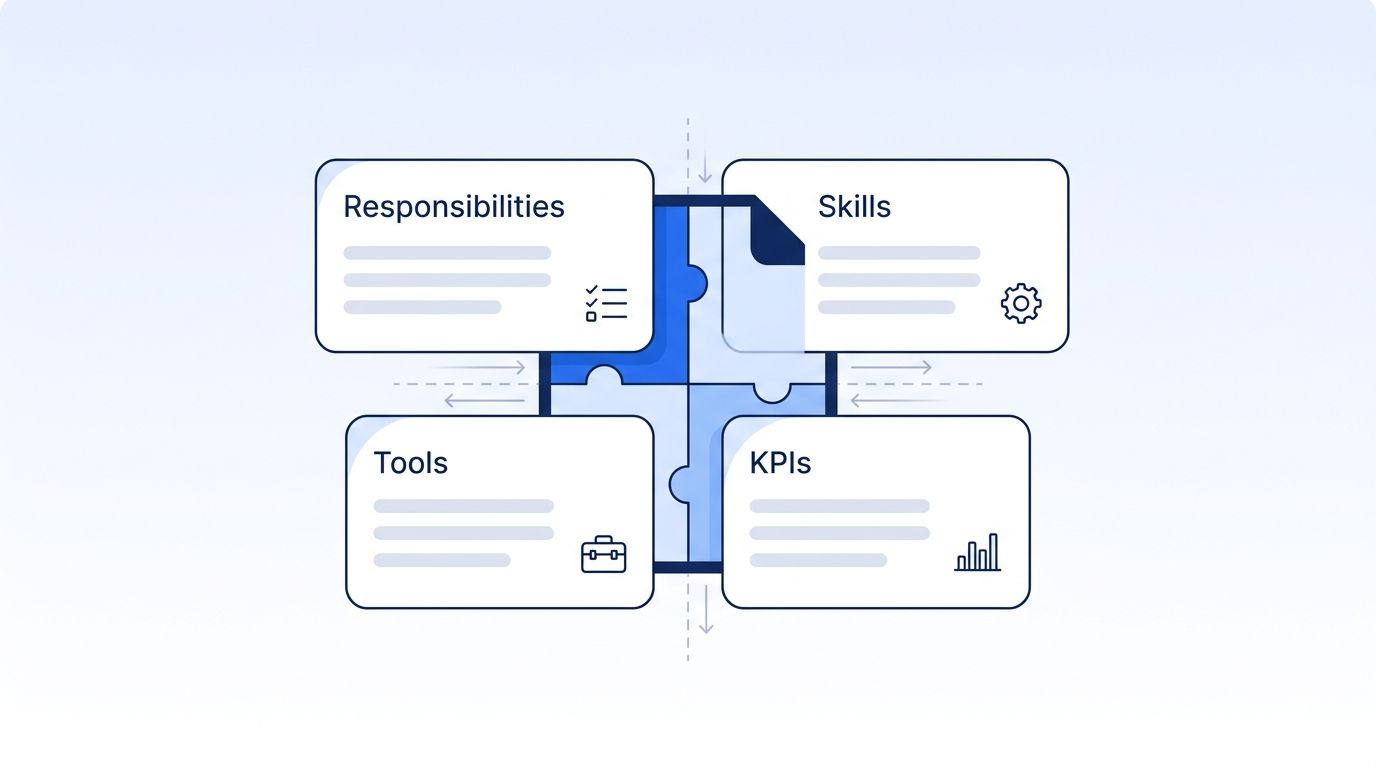
Job postings and practitioner write-ups converge on five recurring responsibility clusters: pipeline automation and data enrichment, CRM architecture and data integrity, outbound infrastructure, GTM analytics and attribution, and increasingly, AI-native workflows like auto-updating CRM fields from call transcripts or job-change alerts.
Citation capsule: A GTM engineer builds and maintains the automated systems - enrichment waterfalls, CRM workflows, outbound sequencing - that power revenue operations, rather than carrying a sales quota. The role sits between RevOps and software engineering, and job postings for it grew 205% year over year through 2025 (Bloomberry, 2025).
Isn't it strange that a role this specific still doesn't have a standard job description? That's exactly why a reusable template is worth having, instead of rewriting the posting from scratch every time a seat opens. For a deeper look at what these engineers automate first, see programmatic CRM enrichment.
What Should a GTM Engineer Job Description Include?
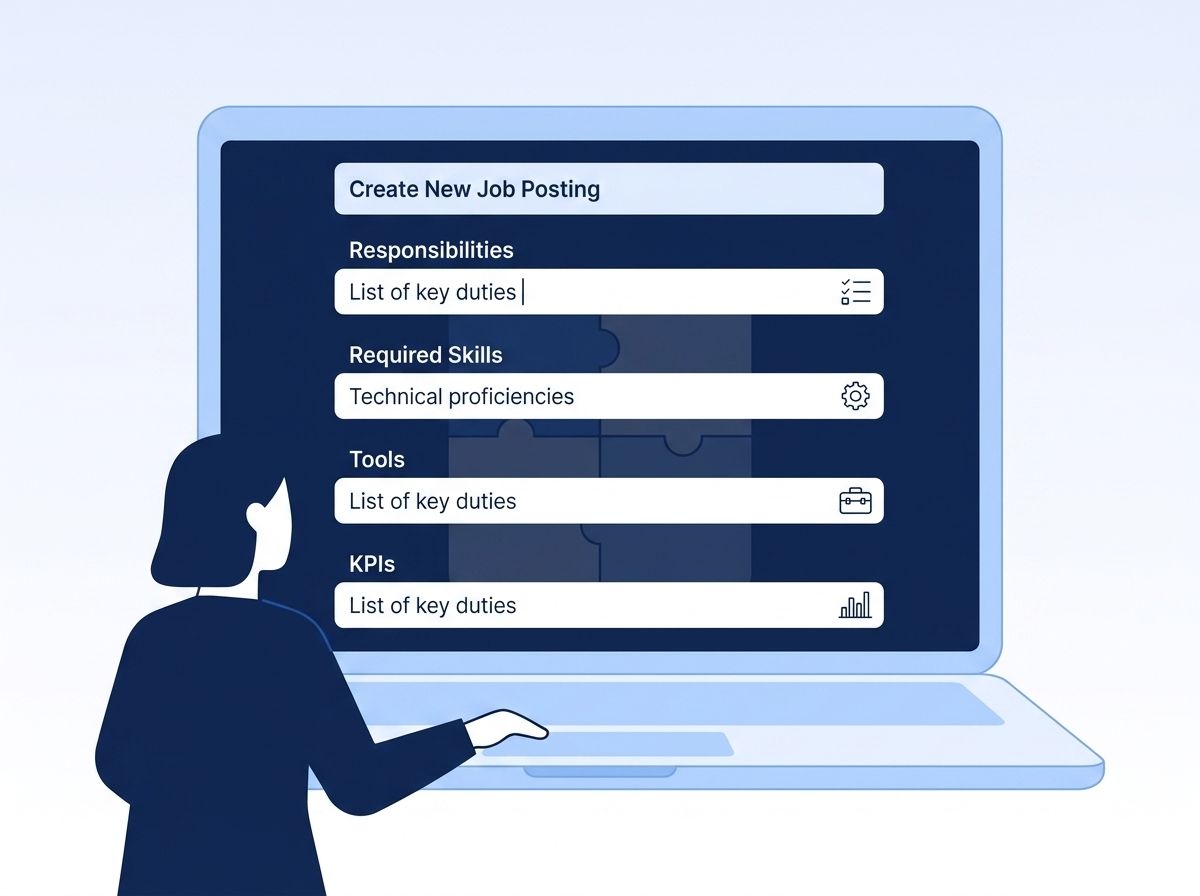
A GTM engineer job description should include five sections: a role summary, a responsibilities list, required and preferred skills, the expected tool stack, and the KPIs the role will be measured against. Skipping the KPI section is the most common mistake - candidates can't tell what success looks like without it.
Copy and adapt this template:
Job Title: GTM Engineer

Role Summary:
Build and maintain the automated systems that power our pipeline -
enrichment workflows, CRM data integrity, and outbound infrastructure.
You are a technical builder embedded in revenue operations, not a
quota-carrying seller.

Responsibilities:
- Design and maintain multi-source enrichment "waterfalls" for inbound
  and outbound lead lists
- Build and monitor CRM workflows (lead routing, deduplication,
  lifecycle stage automation)
- Own outbound infrastructure: list sourcing, verification, and
  trigger-based sequencing
- Set up job-change, intent, and engagement signal monitoring for
  target accounts
- Report on pipeline sourced, data coverage, and workflow reliability

Required Skills:
- SQL and one scripting language (commonly Python)
- Hands-on experience with a CRM (HubSpot or Salesforce)
- Experience with a sales engagement platform (e.g., Outreach, Salesloft)
- Comfort working directly with REST APIs and webhooks

Preferred Tools:
- Clay, n8n or Zapier for workflow orchestration
- A real-time enrichment or signal API
- Segment, Census, or Hightouch for data movement

KPIs:
- Pipeline sourced through automated workflows
- Time-to-launch for a new enrichment or routing workflow
- Data enrichment / match-rate coverage
- CRM data decay rate, monitored monthly

Compensation Band: [insert your band - see salary section below]
What Skills Should You Require in a GTM Engineer Job Description?
Require SQL and one scripting language first - they're the two most consistently listed technical skills. Both SQL and Python appear in 38% of GTM engineering job postings analyzed by Bloomberry (Bloomberry, 2025), and postings average 4.11 years of prior experience.
<!-- [UNIQUE INSIGHT] -->Most job descriptions for this role over-index on tool names and under-specify the underlying skill. Listing "Clay experience required" filters out a strong candidate who's never touched Clay specifically but has built the exact same waterfall logic in a different platform. Requiring the underlying skill - API integration, data transformation, workflow logic - and treating specific tools as "nice to have" gets you a wider, stronger pool.
Beyond SQL and Python, the skills that separate a strong GTM engineer from a generalist RevOps hire are:
- API and webhook literacy - reading documentation, authenticating requests, and handling rate limits without engineering support
- Data modeling for CRMs - understanding lifecycle stages, deduplication logic, and how a bad merge cascades into reporting
- Workflow debugging - tracing why an automated sequence silently stopped enriching records, not just building it once
- Basic statistics for reporting - explaining match rates and pipeline attribution to a VP without an analyst translating
For a plain-English reference on how enrichment coverage is calculated, see Datamagnet's People Profile endpoint documentation, which returns match confidence alongside every enriched field.
What Tools Belong in a GTM Engineer's Tech Stack?
The GTM engineer's stack centers on a CRM, a sales engagement platform, and an orchestration layer that connects them. HubSpot shows up in 52% of postings, Outreach in 49%, and Salesforce in 45% (Bloomberry, 2025) - meaning most companies expect the hire to already know at least one CRM and one engagement platform on day one.
| Layer | Common tools | Required in job postings |
|---|---|---|
| CRM | HubSpot, Salesforce | HubSpot 52%, Salesforce 45% |
| Sales engagement | Outreach, Salesloft | Outreach 49% |
| Workflow orchestration | Clay, n8n, Zapier, Make | Named consistently, not tracked as a single % |
| Enrichment / signals | Real-time people & company APIs | Growing category, tied to AI-native workflows |
Clay is described almost universally in practitioner write-ups as the default orchestration layer for enrichment logic, and n8n and Zapier appear repeatedly as the glue between the CRM and everything else (Clay blog, "GTM Engineering: What It Is and How to Hire in 2026", April 2026; Norwest Venture Partners, "What Is a GTM Engineer?", June 2026). Datamagnet plugs into that same layer directly - see the Clay integration, n8n integration, and HubSpot integration for how a real-time enrichment source drops into an existing workflow.
<!-- [PERSONAL EXPERIENCE] -->Watching companies build their first GTM engineering stack is a common pattern: they buy the CRM and the sales engagement tool first, then realize six months in that nothing actually talks to anything else. The orchestration layer - Clay, n8n, or a similar tool - isn't a "nice to have" bolt-on. It's the piece that turns four disconnected point solutions into one system.
What KPIs Should You Use to Measure a GTM Engineer?
Measure a GTM engineer on pipeline sourced through their automated workflows, not on tasks completed. Teams that prioritize GTM strategy alignment see 2x higher revenue attainment, yet only 23% of RevOps professionals can actually make it a daily priority because of workload constraints (RevOps Co-op & BoostUp.ai, 2025 RevOps Compensation & Impact Report, November 2024). Clear KPIs are how you protect that priority instead of losing it to firefighting.
Citation capsule: GTM strategy alignment is the single factor most RevOps leaders point to when explaining revenue success, and teams that actually execute on it see double the revenue attainment of teams that don't. Only a minority of RevOps professionals report having enough bandwidth to prioritize it consistently, which is exactly the gap a dedicated GTM engineer is hired to close.
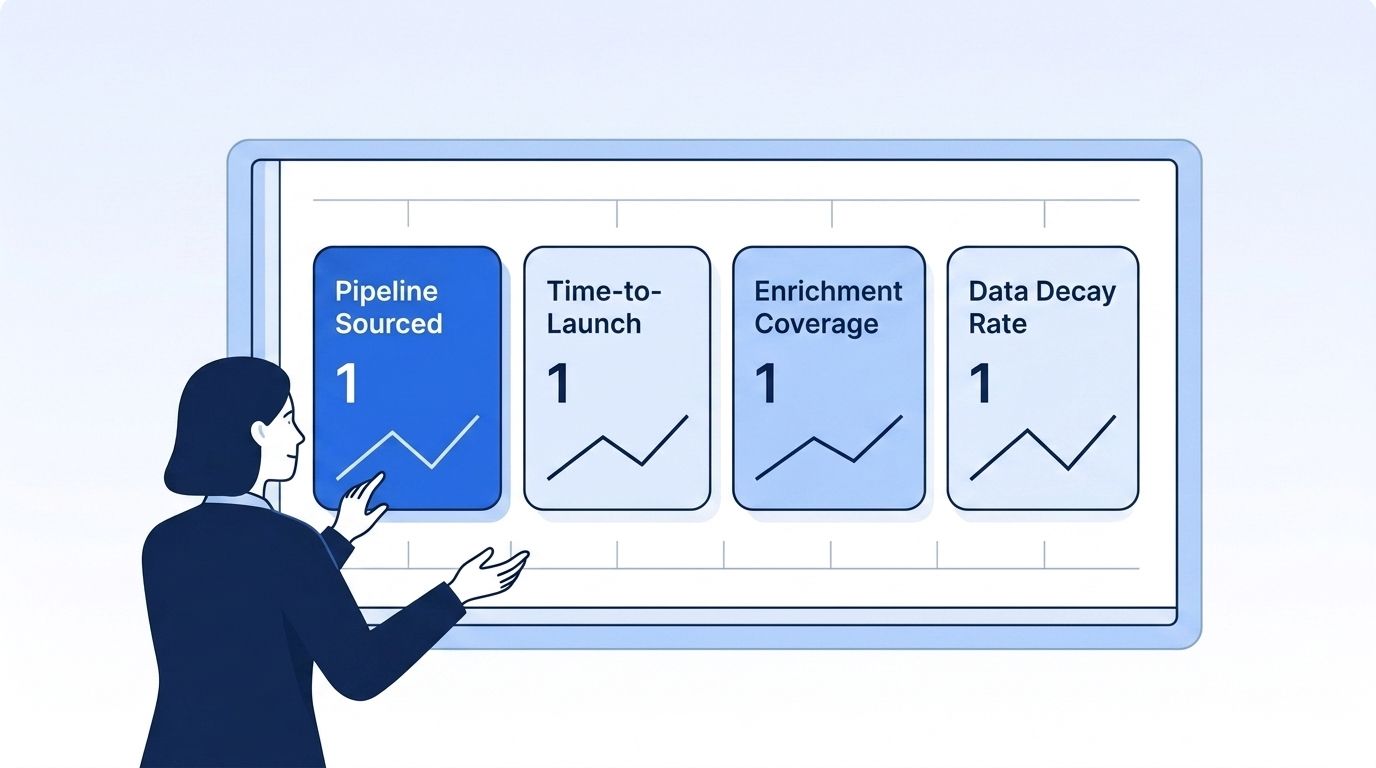
Four KPIs cover most of what matters:
- Pipeline sourced through automated workflows - dollar or opportunity count directly attributable to a workflow the GTM engineer built, tracked separately from manually-run campaigns
- Time-to-launch for a new workflow - how long it takes to go from "we need this enrichment/routing logic" to a live, monitored workflow
- Data enrichment coverage / match rate - the percentage of target records successfully enriched, not just attempted
- CRM data decay rate - B2B contact data decays at roughly 2.1% per month as people change roles (HubSpot, Database Decay, retrieved August 2026), so a GTM engineer's monitoring should track how much of that decay gets caught automatically versus discovered by a rep mid-outreach
In 2026, a growing number of these KPIs are shifting toward AI-assisted workflows. Gartner found AI tools save sellers an average of 4.8 hours per week, but 72% of sales organizations fail to reinvest that saved time into higher-value work (Gartner, "AI Saves Sellers Nearly 5 Hours Per Week", May 2026). A GTM engineer's KPIs should account for that reinvestment gap directly, not just the time saved.
For teams tracking job-change and engagement events as part of pipeline KPIs, Datamagnet's Signal API and webhook delivery turn "did we catch this account event" into a measurable, automated number instead of a manual spot-check.
How Much Does a GTM Engineer Cost to Hire?
Budget a median base salary of roughly $127,500 for a GTM engineer in 2026, with senior hires trending well above $200,000 total compensation. Bloomberry's analysis of 1,000 postings put the median at $127,500, with top-paying companies like Vercel and OpenAI listing roles above $250,000 (Bloomberry, 2025).
| Level | Approximate total comp | Notes |
|---|---|---|
| Junior | $110,000 - $140,000 | Often a RevOps generalist moving into automation-heavy work |
| Mid | $160,000 - $200,000 | Owns a full enrichment/routing stack independently |
| Senior | $210,000 - $280,000+ | Sets GTM engineering strategy, may manage a small team |
These bands come from Apollo.io's 2026 GTM engineer compensation guide, which reports a total comp range of $132,000-$241,000 - use it as a directional benchmark, not a precise market rate for your region or stage. For comparison, a generalist Revenue Operations role averages $108,344 on Glassdoor's crowdsourced pay data, which is roughly $19,000 below the GTM engineer median - a useful anchor if you're deciding whether to hire a generalist or a specialist.
Turn Your Job Description Into a Working GTM Stack
A job description only gets you the hire - the enrichment and signal infrastructure they'll actually build on is a separate decision. See how Datamagnet's real-time People and Company APIs plug into a GTM engineer's stack and give them a live data source instead of a stale database from day one.
Frequently Asked Questions
What is a GTM engineer job description template?
A GTM engineer job description template is a reusable posting structure covering five sections: role summary, responsibilities, required skills, tool stack, and KPIs. It standardizes what's still a new and inconsistently-defined role, so candidates and hiring managers agree on scope before the interview process starts.
Is a GTM engineer the same as a RevOps engineer?
They overlap heavily but aren't identical. A RevOps engineer typically owns broader systems strategy across sales, marketing, and CS, while a GTM engineer focuses more narrowly on building automated pipeline and enrichment workflows - often using tools like Clay, n8n, or a CRM's native automation layer.
What skills should a GTM engineer job posting require?
Require SQL and one scripting language (commonly Python), since both appear in 38% of postings (Bloomberry, 2025). Add hands-on CRM experience, API/webhook literacy, and workflow debugging skills rather than requiring specific tool names alone.
How much should you pay a GTM engineer?
Budget a median of about $127,500, with senior hires reaching $210,000-$280,000+ in total compensation (Bloomberry, 2025). Adjust for your region, stage, and whether the role also carries management responsibility.
What KPIs prove a GTM engineer is working?
Track pipeline sourced through their automated workflows, time-to-launch for new workflows, data enrichment coverage, and CRM data decay rate. Task-completion metrics like "tickets closed" don't capture whether the automation is actually generating or protecting pipeline.
Sources
- Bloomberry, I analyzed 1,000 GTM Engineering jobs - here is what I learned, retrieved 2026-08-08, https://bloomberry.com/blog/i-analyzed-1000-gtm-engineering-jobs-here-is-what-i-learned/
- Apollo.io, What Do GTM Engineer Jobs Pay in 2026?, retrieved 2026-08-08, https://www.apollo.io/insights/gtm-engineer-jobs
- Gartner, Gartner Survey Finds AI Saves Sellers Nearly 5 Hours Per Week, Yet 72% of Sales Organizations Fail to Reinvest Time in High-Value Activities, retrieved 2026-08-08, https://www.gartner.com/en/newsroom/press-releases/2026-05-19-gartner-survey-finds-ai-saves-sellers-nearly-five-hours-per-week-yet-seventy-two-percent-of-sales-organizations-fail-to-reinvest-time-in-high-value-activities
- RevOps Co-op & BoostUp.ai, 2025 RevOps Compensation & Impact Report, retrieved 2026-08-08, https://www.prnewswire.com/news-releases/boostupai-and-revops-co-op-release-first-ever-revops-compensation--impact-survey-report-302306156.html
- HubSpot, Database Decay, retrieved 2026-08-08, https://www.hubspot.com/database-decay
- Glassdoor, Revenue Operations Salaries, retrieved 2026-08-08, https://www.glassdoor.com/Salaries/revenue-operations-salary-SRCH_KO0,18.htm
- Clay, GTM Engineering: What It Is and How to Hire in 2026, retrieved 2026-08-08, https://www.clay.com/blog/gtm-engineering
- Norwest Venture Partners, What Is a GTM Engineer? And Why Should You Hire One?, retrieved 2026-08-08, https://www.norwest.com/blog/what-is-a-gtm-engineer/
- Datamagnet, People Profile endpoint, retrieved 2026-08-08, https://docs.datamagnet.co/api-reference/endpoints/people
- Datamagnet, Webhooks, retrieved 2026-08-08, https://docs.datamagnet.co/api-reference/webhooks
