
Disclosure: This article is published by Datamagnet. Vendor claims are self-reported unless otherwise noted.
How Fast Are Top Recruiting Teams Following Up? 2026 Benchmarks
Ask ten recruiters how fast they follow up with candidates, and you'll get ten different answers - most of them optimistic. In 2026, the average US employer takes 63 to 68 days to fill an open role, while the fastest teams close the same roles in under a month (The Resource Company, 2026). That gap isn't luck. It's a follow-up speed problem, and it's quietly costing slower teams their best candidates.
This roundup pulls from named third-party recruiting and staffing benchmark reports to show how fast top teams actually move in 2026, where the industry average lags behind, and what closes the gap.
Key Takeaways
- In 2026, US average time-to-fill reached 63-68 days, up from 36-44 days in 2023 - nearly double in three years (The Resource Company, 2026).
- Top-performing teams fill individual-contributor roles in 18-30 days - roughly a third of the national average - though senior and executive roles run 50-100% longer even at fast teams (Ashby, 2026 Talent Trends Report, 2026).
- Candidates wait a median of 6 days for an interview invite after applying, then nearly double that - 11 days - between the interview and the next update (Pin, Sourcing Metrics and Benchmarks 2026, 2026).
- 61% of candidates say they've been ghosted by an employer after an interview, up 9 percentage points since early 2024 (The Interview Guys, 2025 Ghosting Index, 2025).
- Automated interview scheduling runs 26% faster than manual coordination - one of the clearest levers separating fast teams from slow ones (Ashby, 2026 Talent Trends Report, 2026).
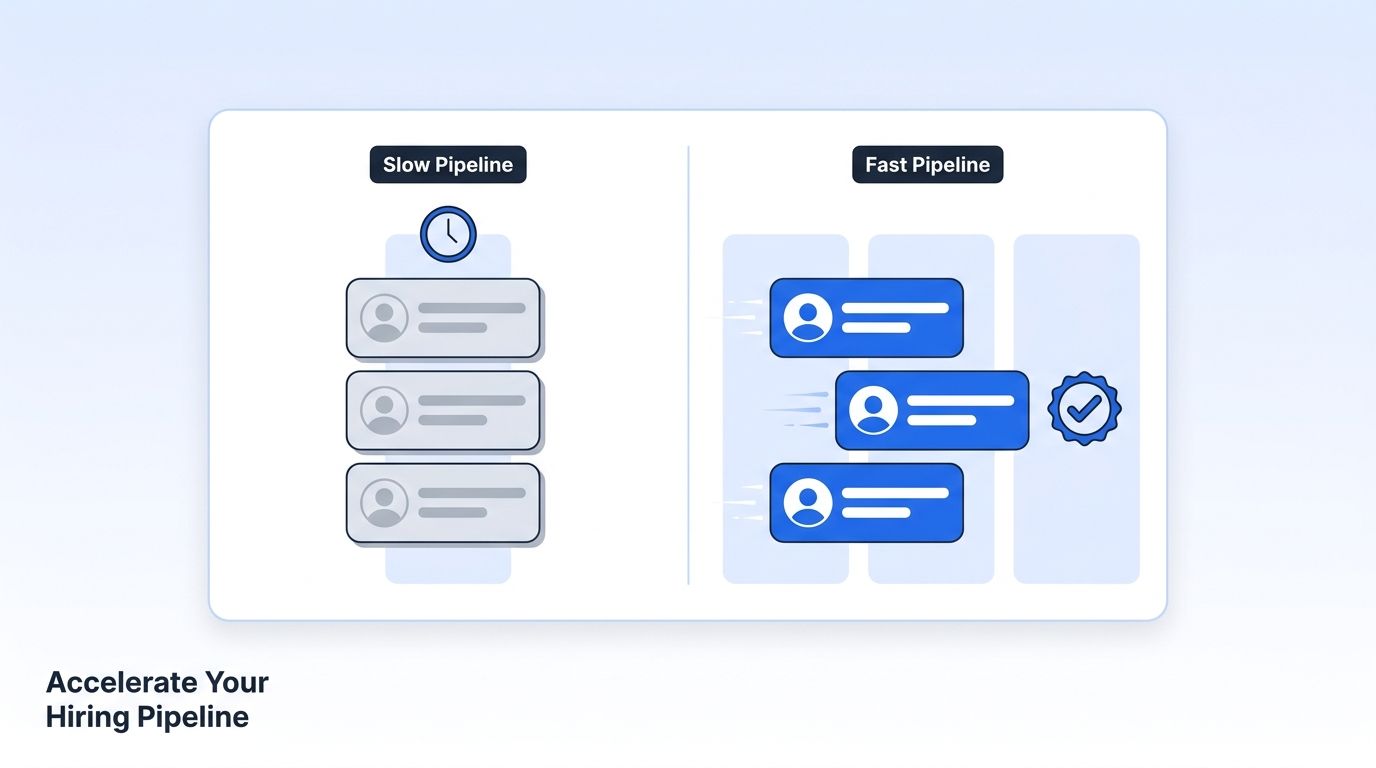
Key Findings: How Recruiting Speed Breaks Down in 2026
Five benchmarks define the gap between fast and slow recruiting teams in 2026, and every one of them ties back to follow-up speed. Together they show a widening split: top teams are getting faster and more automated, while the national average keeps slipping.
- National time-to-fill hit 63-68 days in 2026 - nearly double the 36-44 day range recorded in 2023 (The Resource Company, 2026).
- Top-quartile teams fill individual-contributor roles in 18-30 days - a fraction of the national average, though senior roles still stretch 50-100% longer (Ashby, 2026 Talent Trends Report, 2026).
- Candidates wait a median of 6 days for a first interview invite, then 11 more days for the next real update (Pin, Sourcing Metrics and Benchmarks 2026, 2026).
- Text outreach gets an 8x higher response rate than email among candidates being sourced (Pin, Sourcing Metrics and Benchmarks 2026, 2026).
- 61% of candidates report being ghosted after an interview, up 9 percentage points since early 2024 (The Interview Guys, 2025 Ghosting Index, 2025).
Line up findings 1 and 2 and a pattern emerges that neither report states on its own: the national average now takes roughly two to three times longer than the top-quartile benchmark to fill the same class of role. That's not a small efficiency gap - it's the difference between a candidate accepting your offer and a candidate accepting someone else's while your team is still "getting back to them."
How Long Does It Actually Take to Fill a Role in 2026?
In 2026, the average US employer needs 63 to 68 days to fill an open role, according to a staffing-industry benchmark update - up sharply from the 36-44 day range reported in 2023 (The Resource Company, UPDATE: Average Time to Hire, 2026 Report, 2026). That's not a minor drift. It's a near-doubling of the hiring cycle in three years, driven by longer approval chains, more interview rounds, and slower internal follow-up between each stage.
Citation capsule: US employers now average 63-68 days to fill a role in 2026, up from 36-44 days in 2023, according to The Resource Company's annual time-to-hire benchmark update. The lengthening cycle reflects more interview rounds and slower internal handoffs, not a shortage of qualified candidates.
Top-performing teams don't play by that timeline. Ashby's 2026 Talent Trends Report puts "healthy" time-to-fill for individual-contributor roles at 18-30 days, with senior and executive searches running 50-100% longer even among fast teams (Ashby, 2026 Talent Trends Report, 2026). Why does the gap matter so much? Because every extra week a role sits open is another week for a strong candidate to accept a competing offer.
Sourcing candidates who already match your criteria helps close that gap before the clock even starts. ICP People Search lets a team filter by job title, seniority, company, and location up front, instead of screening a broad, unfiltered pipeline down to the handful of candidates worth pursuing.
How Fast Do Candidates Expect a Response After They Apply?
Candidates wait a median of 6 days for a first interview invite after applying, and then wait almost twice as long - 11 days - for the next real update once that interview happens (Pin, Sourcing Metrics and Benchmarks 2026, 2026). The second wait is the more dangerous one: a candidate who made it through a first interview is already invested, and silence at that stage reads as disinterest rather than process.
Channel matters as much as speed. Text outreach gets an 8x higher response rate than email when sourcing candidates (Pin, Sourcing Metrics and Benchmarks 2026, 2026), which suggests part of the "slow follow-up" problem isn't recruiters being unresponsive - it's messages landing in a channel candidates barely check. Isn't it worth testing a faster channel before assuming your team needs to work more hours?
Recruiters can shorten the second wait by watching for activity signals instead of waiting for a scheduled check-in. Person Activity surfaces a candidate's recent LinkedIn posts and engagement, giving a natural, timely reason to re-engage instead of sending a generic "just checking in" message eleven days later.
What Happens When Recruiting Teams Let Candidates Wait?
61% of job seekers say they've been ghosted by an employer after an interview in 2025, up 9 percentage points from early 2024 (The Interview Guys, The 2025 Ghosting Index, 2025). A separate survey puts the share of candidates ghosted by a potential employer at any point in their search at 53% (iHire, 53% of Job Seekers Have Been Ghosted by a Potential Employer, 2025). Ghosting isn't candidates being dramatic - it's what "no update for 11 days" looks like from the other side of the process.
Citation capsule: Six in ten candidates report being ghosted by an employer after an interview in 2025, a figure that climbed 9 percentage points in a single year. Employers rarely intend to ghost anyone - the gap between "we're still deciding" and "we forgot to follow up" is invisible to the candidate, who only sees silence.
<!-- [UNIQUE INSIGHT] -->Set the ghosting trend next to the time-to-fill trend and the connection is hard to miss: as national time-to-fill nearly doubled between 2023 and 2026, employer-side ghosting complaints climbed too. Neither report frames it this way, but the two data sets are describing the same underlying failure - longer pipelines create more silent gaps, and every silent gap reads to a candidate as being ghosted, whether or not that was the intent.
Slow follow-up doesn't just cost goodwill. It costs the candidate. Once a strong applicant assumes they've been ghosted, they stop waiting and start interviewing elsewhere - which is exactly the outcome a 63-68 day pipeline makes more likely, not less.
How Are Top Teams Closing the Speed Gap?
Top recruiting teams close the speed gap by automating the parts of follow-up that don't need a human decision. Automated interview scheduling runs 26% faster than manual back-and-forth coordination (Ashby, 2026 Talent Trends Report, 2026), which sounds small until you multiply it across every candidate in an active pipeline.
The bigger shift is moving from scheduled check-ins to event-driven follow-up. Instead of a recruiter remembering to message a candidate every few days, a signal monitor can watch a candidate's LinkedIn profile for a new post, a job-title change, or other tracked activity, and push an alert the moment something worth acting on happens. Paired with webhook delivery, that alert lands directly in a Slack channel or ATS instead of sitting in a dashboard nobody checks.
For sourcing at the top of the funnel, the same real-time principle applies: querying live LinkedIn data through the LinkedIn Signal API or People Search DB means a recruiter is working from a candidate's current role and activity, not a database snapshot that's already a few weeks stale by the time the internal approval chain catches up.
What Can Recruiting Borrow From B2B Sales Speed-to-Lead Playbooks?
A quick note on scope: this section describes a B2B sales benchmark, not a recruiting-specific one - it's included as an analogy, not as recruiting data.
In a landmark 2011 study still cited across B2B sales teams today, Harvard Business Review found that contacting a sales lead within 5 minutes made a rep dramatically more likely to reach that lead than waiting even 30 minutes, with contact rates falling off sharply after the first few minutes (Harvard Business Review, "The Short Life of Online Sales Leads," James B. Oldroyd, 2011). Sales teams built entire tooling categories - real-time lead alerts, instant routing - around that one finding.
Recruiting hasn't had its own "5-minute rule" moment yet, but the underlying logic transfers directly: interest decays the moment it's expressed, whether that's a form fill or a job application. A candidate who applies and hears nothing for six days is experiencing the recruiting version of the same decay curve that costs sales teams a lead.
For a closer look at how real-time signal monitoring applies the same logic to spotting buying and hiring intent as it happens, see how job-change signal APIs turn a delayed manual check into an instant alert.
Recommendations: How to Close Your Own Follow-Up Gap
Based on these benchmarks, recruiting teams sitting at or above the 63-68 day national average should start with the two levers that show the clearest speed payoff: automated scheduling and event-driven re-engagement.
- Automate interview scheduling first. It's the single largest documented speed gain (26%) and requires no new sourcing process to implement (Ashby, 2026 Talent Trends Report, 2026).
- Replace the 11-day silent gap with a scheduled minimum-touch cadence, even if the update is just "still reviewing, next update by Friday." A committed date beats silence every time.
- Test text over email for time-sensitive outreach. An 8x response-rate difference is too large to leave untested in your own pipeline (Pin, Sourcing Metrics and Benchmarks 2026, 2026).
- Route candidate activity signals to the recruiter, not the other way around. A signal monitor with webhook delivery flags when a candidate updates their profile or posts about a job search, so outreach happens on the candidate's timeline instead of the recruiter's calendar reminder.
Explore the Recruiting Intelligence product page to see how real-time candidate signals fit into an existing sourcing workflow.
Frequently Asked Questions
What counts as a "fast" time-to-fill in 2026?
Ashby's 2026 Talent Trends Report puts 18-30 days as a healthy benchmark for individual-contributor roles, with senior and executive searches running 50-100% longer even at top-performing teams. Anything close to the 63-68 day national average signals room to cut follow-up delays, not just sourcing volume.
Why are candidates reporting more ghosting from employers?
61% of candidates said they were ghosted after an interview in 2025, up 9 percentage points from early 2024 (The Interview Guys, 2025 Ghosting Index, 2025). The rise tracks closely with longer time-to-fill cycles - more pipeline stages create more silent gaps, and candidates read every silent gap as a ghost.
Where do these benchmark numbers come from?
This roundup synthesizes named, publicly available 2025-2026 reports from staffing and recruiting-operations research firms - The Resource Company, Ashby, Pin, iHire, and The Interview Guys - rather than a single proprietary survey. Each figure is attributed to its original report in the Sources section below.
Does the sales "5-minute rule" actually apply to recruiting?
Not literally - it's a sales benchmark, not a recruiting one. But the underlying decay curve is the same: interest fades the moment it's expressed. A candidate who hears nothing for six days after applying is experiencing the recruiting equivalent of a cold sales lead.
How can a small recruiting team speed up follow-up without adding headcount?
Automate the parts of follow-up that don't need judgment - scheduling, status nudges, and activity monitoring - and reserve recruiter time for the parts that do. Automated scheduling alone runs 26% faster than manual coordination (Ashby, 2026 Talent Trends Report, 2026), which frees up hours without adding a single seat.
Sources
- The Resource Company, UPDATE: Average Time to Hire, 2026 Report, retrieved 2026-07-21, https://www.theresource.com/2025/10/13/average-time-to-hire/
- Ashby, 2026 Talent Trends Report: Recruiting Operations Benchmarks, retrieved 2026-07-21, https://www.ashbyhq.com/talent-trends-report/reports/recruiting-operations-benchmarks-talent-trends
- Pin, Sourcing Metrics and Benchmarks 2026, retrieved 2026-07-21, https://www.pin.com/blog/sourcing-benchmarks-report/
- iHire, 53% of Job Seekers Have Been Ghosted by a Potential Employer, retrieved 2026-07-21, https://www.ihire.com/resourcecenter/employer/pages/53-percent-of-job-seekers-have-been-ghosted-by-a-potential-employer
- The Interview Guys, The 2025 Ghosting Index: How Employers and Candidates Are Disappearing From Each Other, retrieved 2026-07-21, https://blog.theinterviewguys.com/the-2025-ghosting-index/
- Harvard Business Review, The Short Life of Online Sales Leads (James B. Oldroyd), retrieved 2026-07-21, https://hbr.org/2011/03/the-short-life-of-online-sales-leads
- Datamagnet, Create Signal endpoint, retrieved 2026-07-21, https://docs.datamagnet.co/api-reference/endpoints/signal-create
- Datamagnet, Webhooks, retrieved 2026-07-21, https://docs.datamagnet.co/api-reference/webhooks
