
Disclosure: This article is published by Datamagnet. Vendor claims are self-reported unless otherwise noted.
How to Design a Fallback Strategy When Your Enrichment Vendor Fails
In 2025, average API uptime fell from 99.66% to 99.46% year over year — roughly nine extra hours of downtime annually (Uptrends, State of API Reliability 2025). If your CRM enrichment pipeline calls a single vendor, that's nine hours a year your lead scoring, routing, and outreach quietly break. This guide walks you through designing a fallback strategy so one vendor's bad day doesn't become yours.
Key Takeaways
- API uptime dropped from 99.66% to 99.46% between Q1 2024 and Q1 2025, a ~60% increase in downtime (Uptrends, 2025).
- 76% of CRM users say less than half their CRM data is accurate or complete, and 37% report direct revenue loss from bad data (Validity, 2025).
- Third-party involvement in data breaches doubled from 15% to 30% year over year (Verizon, 2025 DBIR).
- Proxycurl, a $10M-ARR LinkedIn enrichment vendor, shut down permanently in July 2025 — a reminder that "reliable" and "permanent" aren't the same thing.
- A working fallback strategy needs four parts: an abstraction layer, a secondary vendor, automated failover logic, and a reconciliation rule for when the two disagree.
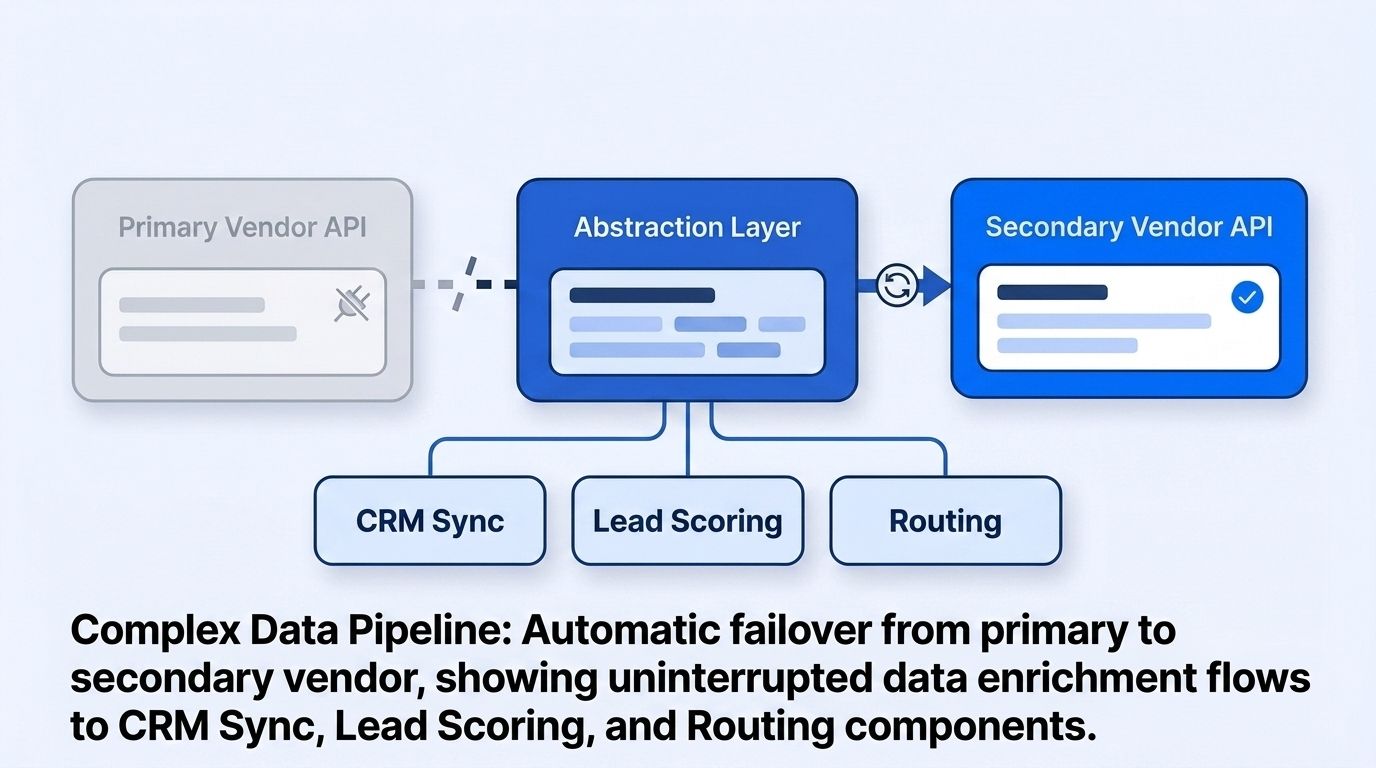
Why Do Enrichment Vendors Fail More Often Than You Think?
Enrichment vendors fail for reasons that have nothing to do with your integration: outages, ToS disputes, acquisitions, and quiet shutdowns. In 2025, third-party involvement in confirmed data breaches doubled from 15% to 30% year over year, based on an analysis of more than 12,000 confirmed incidents (Verizon, 2025 Data Breach Investigations Report, 2025). Your enrichment vendor is a third party too.
It's not just breaches. In 2025, Proxycurl — a LinkedIn data enrichment API doing roughly $10M in annual recurring revenue — shut down permanently on July 4, after LinkedIn and Microsoft filed suit alleging it used hundreds of thousands of fake accounts to scrape profile data (Nubela, founder announcement, July 2025). Customers who built their pipeline around a single vendor lost that data source overnight, with no warning window to migrate.
Vendor failure also shows up as consolidation, not collapse. HubSpot acquired Clearbit for $140.4 million in late 2023 and shut down its legacy free tools — Platform, Connect, the TAM Calculator, the Slack integration — on April 30, 2024, cutting off customers who weren't on HubSpot (TechCrunch; SEC 8-K filing, Nov 2023). Clearbit didn't go down. It just stopped being available to anyone outside HubSpot's ecosystem.
Most vendor-risk conversations focus on uptime SLAs, but the Clearbit and Proxycurl cases show the bigger threat is business-model risk: acquisition, litigation, and platform policy shifts that kill a vendor relationship without a single dropped API call. A fallback strategy built only to catch 500 errors misses both.
Datamagnet's own API status and error reference documents the failure modes your fallback logic needs to detect — rate limits, authentication failures, and malformed responses — which is the same taxonomy you should build for any vendor you depend on.
how programmatic CRM enrichment works
What Does a Vendor Risk Assessment Actually Cover?
A vendor risk assessment answers one question: what breaks in your pipeline if this vendor disappears tomorrow, and how much would that cost you? In 2024, more than 90% of mid-size and large enterprises said one hour of downtime costs over $300,000, and 41% put the hourly cost between $1 million and $5 million or more (ITIC, 2024 Hourly Cost of Downtime Report, 2024).
Score every enrichment vendor you depend on against four dimensions:
- Data coverage overlap. Does a candidate secondary vendor cover the same fields (title, seniority, company size, funding) your workflows actually consume, or just the ones that are easy to sell?
- Historical reliability. Pull uptime history where the vendor publishes it, and separately track your own error rates over the last 90 days.
- Business continuity signals. Funding stage, acquisition rumors, ToS enforcement patterns (like LinkedIn's March 2025 delisting of Apollo.io and Seamless.ai company pages over scraping violations — MarTech, May 2025) all matter more than a marketing page's uptime badge.
- Switching cost. How much custom mapping, retries, or field translation would a full migration require if this vendor vanished with no notice?
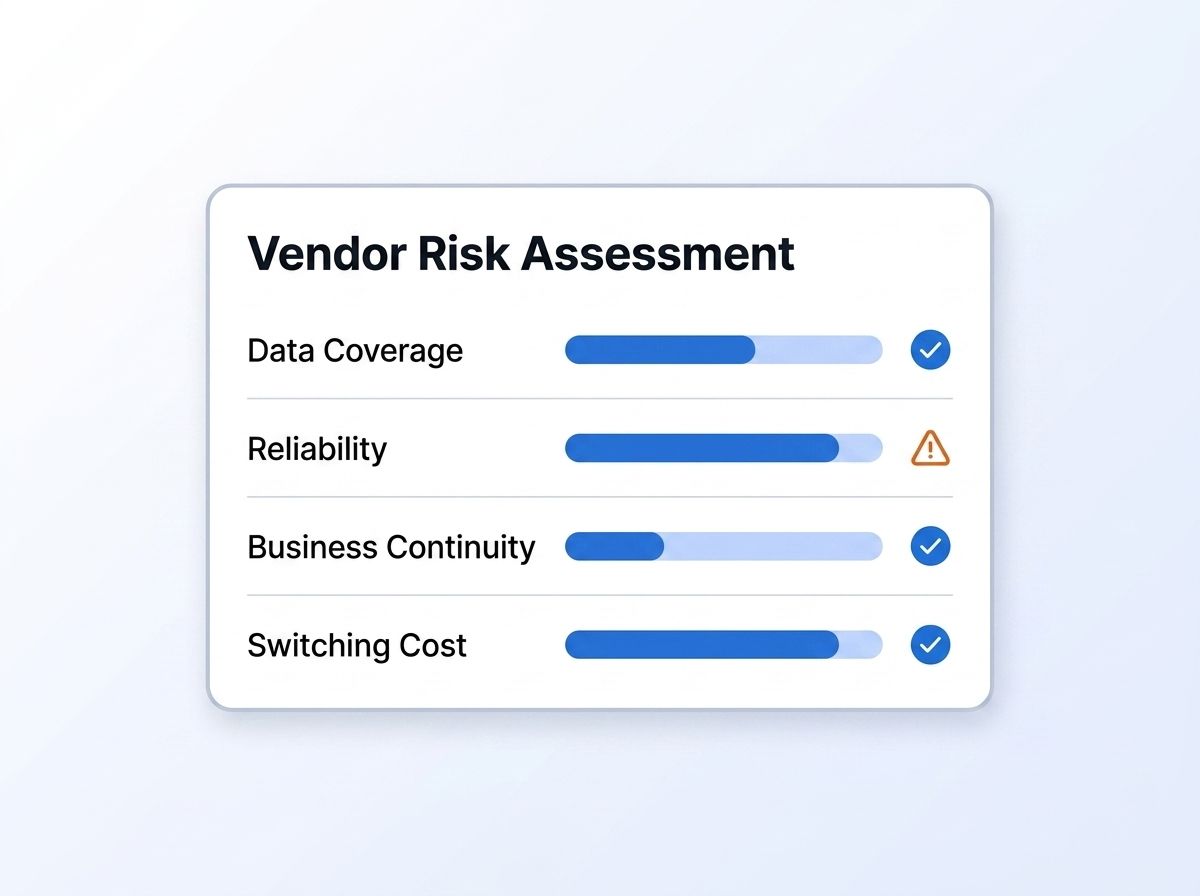
Rank your vendors by combined risk score, and treat anything in the top quartile as a candidate for an active fallback — not a "we'll deal with it later" line item.
How Do You Build an Abstraction Layer Between Your Pipeline and Any Vendor?
An abstraction layer is the piece of code that separates "get company data" from "call Datamagnet's /company endpoint." Without it, every downstream script, CRM workflow, and enrichment job is hardcoded to one vendor's response shape — and swapping vendors means rewriting all of them at once, under pressure, during an outage.
Micro-outcome: by the end of this step, your enrichment calls go through one internal interface, not directly to any single vendor's SDK.
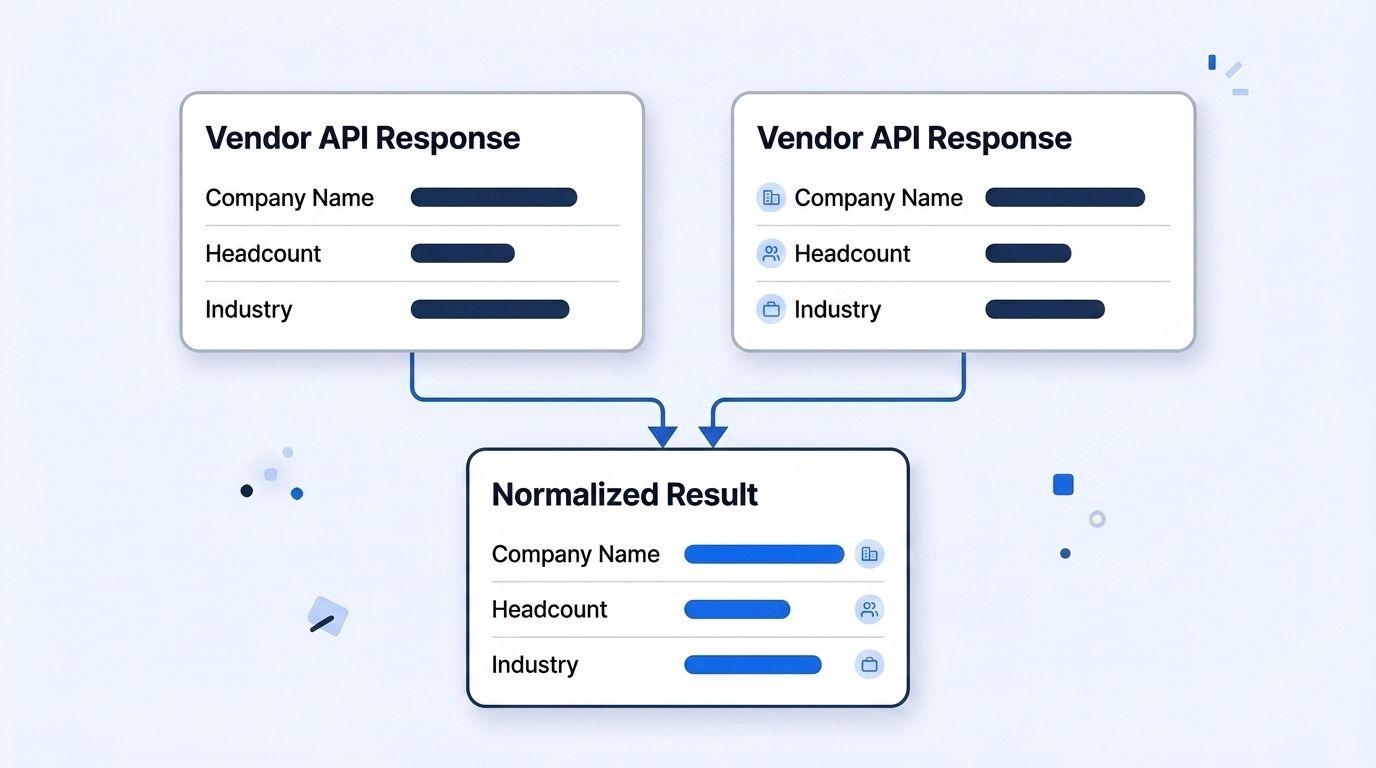
Build the layer around a normalized schema, not a vendor's schema:
class EnrichmentResult:
    company_name: str
    domain: str
    headcount: int | None
    industry: str | None
    source_vendor: str
    confidence: float
Every vendor adapter — Datamagnet, a secondary vendor, even a cached-data fallback — maps its raw response into this shape. Your CRM sync, lead scoring model, and routing logic only ever read from EnrichmentResult. This is the single change that makes every other step in this guide possible.
Verify this step worked by swapping which vendor populates a test record and confirming nothing downstream needs to change. If a script breaks because it expected a vendor-specific field name, the abstraction isn't finished yet.
how to authenticate and structure API requests
How Do You Choose a Secondary Enrichment Vendor?
Your secondary vendor doesn't need to match your primary feature-for-feature — it needs to cover the specific fields your critical workflows can't run without. Trying to find a full-parity backup for every field is how fallback projects stall for months and never ship.
Micro-outcome: by the end of this step, you have one secondary vendor under contract (or on a usable free tier) mapped into your abstraction layer.
- List the 5-10 fields your lead scoring, routing, and CRM sync actually depend on — not every field the primary vendor returns.
- Test 2-3 candidate vendors against a shared sample list of 200-500 accounts, and compare fill rate and freshness on those specific fields.
- Confirm the candidate has a startable relationship — a usable free tier or low-commitment plan — since you want this vendor active in production, not sitting in a contract drawer.
- Write the adapter that maps the secondary vendor's response into your
EnrichmentResultschema from Step 2.
Teams that treat their secondary vendor as a documentation exercise — an approved name in a spreadsheet with no live integration — consistently discover during an actual outage that the "backup" was never wired in. A fallback vendor that isn't called in staging monthly isn't a fallback. It's a hope.
The average company now runs 275 SaaS applications in production, up 2.2% year over year (Zylo, 2025 SaaS Management Index, 2025) — one more enrichment vendor in that stack is a small addition if it's wired in correctly, and a wasted line item if it isn't.
How Do You Automate Failover Between Vendors?
Automated failover means your pipeline detects a vendor failure and routes to the secondary vendor without a human deciding to flip a switch. Manual failover sounds fine until you remember that outages happen at 2 a.m., over a holiday weekend, or while the one engineer who knows the vendor config is out sick.
Micro-outcome: by the end of this step, a failed primary-vendor call triggers an automatic, logged retry against your secondary vendor.
Implement a circuit breaker pattern in your abstraction layer:
def enrich_company(domain: str) -> EnrichmentResult:
    if circuit_breaker.is_open("primary"):
        return secondary_adapter.enrich(domain)
    try:
        result = primary_adapter.enrich(domain)
        circuit_breaker.record_success("primary")
        return result
    except (RateLimitError, ServerError, TimeoutError) as e:
        circuit_breaker.record_failure("primary")
        log.warning(f"Primary vendor failed: {e}. Falling back.")
        return secondary_adapter.enrich(domain)
Set the circuit breaker to open after a defined failure threshold (for example, 5 failures in 60 seconds) and half-open after a cooldown period to test recovery automatically. Route on error type, not just error presence — a 429 rate limit and a 500 server error call for different retry timing, and treating them identically wastes your quota on the vendor that's actually still working.
Confirm this step worked by forcing a primary-vendor timeout in a staging environment and watching the log for an automatic fallback call within your defined threshold window.
how signal webhooks handle retries and delivery
How Do You Reconcile Conflicting Data Between Vendors?
Two vendors will disagree about the same company more often than you'd like — different last-crawl dates, different headcount buckets, different industry taxonomies. Reconciliation is the rule set that decides which answer wins when your primary and secondary vendor both return a value for the same field.
Micro-outcome: by the end of this step, every field in your EnrichmentResult has a documented tie-breaking rule, not an implicit "whichever vendor responded first."
In 2025, 76% of CRM users reported that less than half their CRM data was accurate or complete, and 37% said inaccurate data had directly cost them revenue (Validity, State of CRM Data Management in 2025, July 2025). Silent field conflicts between vendors are one of the quiet contributors to that number — nobody notices until a rep works a lead with the wrong headcount bracket.
Simple, workable rules beat clever ones:
- Recency wins for time-sensitive fields like headcount and job title.
- Primary vendor wins ties when confidence scores are equal, to keep behavior predictable.
- Flag, don't silently overwrite, when two vendors disagree by more than a defined threshold (for example, headcount buckets two tiers apart) — route those records to a review queue instead of picking one automatically.
What Should You Monitor Once Fallback Is Live?
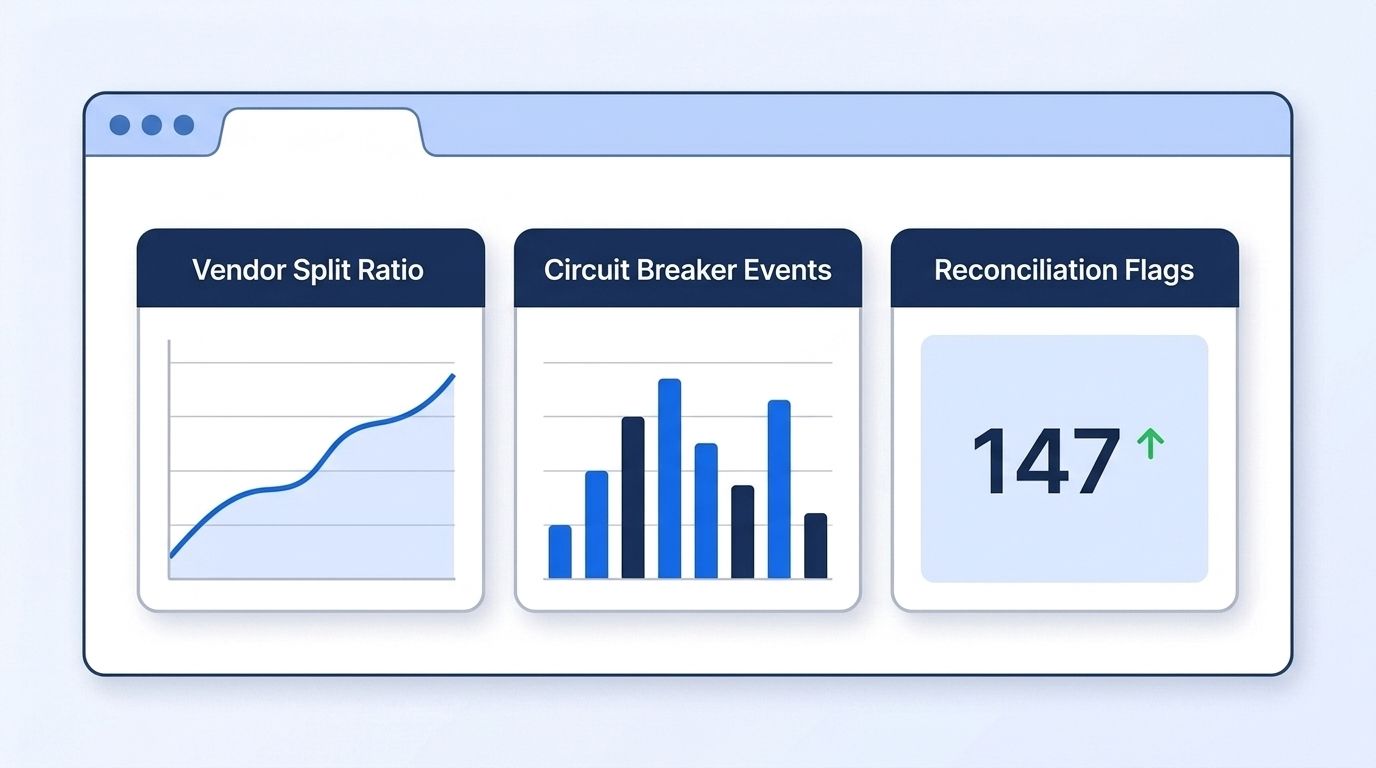
Fallback logic you can't observe is fallback logic you can't trust. Instrument three things: which vendor served each request, how often the circuit breaker opens, and how often reconciliation flags a conflict for review.
Micro-outcome: by the end of this step, you have a dashboard that answers "is my fallback system actually working" without checking logs by hand.
High-impact outages carry a median cost of $2 million per hour among organizations without full observability coverage — a figure that drops meaningfully for teams with better monitoring in place, based on a survey of 1,700 IT and engineering leaders across 23 countries (New Relic, 2025 Observability Forecast, September 2025). The gap between those two numbers is your monitoring investment paying for itself.
Track, at minimum:
- Vendor split ratio — the percentage of requests served by primary vs. secondary, trended weekly. A rising secondary share you didn't expect is an early warning your primary vendor is degrading.
- Circuit breaker open events — count and duration, alerted in real time, not surfaced only in a weekly report.
- Reconciliation flag rate — how often vendors disagree enough to require review, trended over time to catch a vendor's data quality drifting before it becomes a bigger problem.
Common Mistakes to Avoid
1. Treating the secondary vendor as a paper backup. Teams pick a fallback vendor, sign a contract, and never call it until the day they need it — at which point the integration doesn't work, the field mapping is stale, or the account has been suspended for inactivity. Run a scheduled monthly test call against your secondary vendor in staging so it's proven working, not just approved.
2. Failing over on every error type identically. A 429 rate limit means slow down, not switch vendors. Routing every error class to the secondary vendor burns through its quota during what might be a 30-second primary-vendor blip, and can trigger its own rate limit right when you need it most.
3. Skipping the abstraction layer to "move faster." It's tempting to hardcode a quick fallback call directly where the primary vendor call lives. In our experience, teams that do this end up with vendor-specific logic scattered across a dozen files — and when they finally need to add a third vendor, they're rewriting all of them instead of adding one adapter.
4. No reconciliation rule, so conflicts get silently overwritten. Without a documented tie-breaking rule, whichever vendor's response lands last in the code path wins by accident. That's how a correct headcount from your primary vendor gets overwritten by a stale one from the fallback.
how real-time people data reduces stale-record risk
What Does Success Look Like?
If you've followed all six steps, a primary vendor outage should now be invisible to your sales team — enrichment keeps flowing through your secondary vendor, reconciliation flags anything that needs a human look, and your monitoring dashboard shows exactly which vendor served each record.
You should be able to answer, without checking logs manually: what percentage of last week's enrichment calls went to your secondary vendor, how many times the circuit breaker opened, and how many records are currently sitting in a reconciliation review queue. If you can't answer those three questions in under a minute, your monitoring step (Step 5) isn't finished yet.
As a stretch goal, extend the same abstraction layer to a third vendor for your highest-risk data fields — the ones tied to revenue-impacting decisions like lead routing or account scoring — so you're never more than one failover away from a working pipeline.
exploring a live LinkedIn data API as a fallback source
Ready to add a real-time secondary source to your enrichment stack? Get 10 free credits and wire Datamagnet into your abstraction layer as a live fallback vendor today.
Frequently Asked Questions
How many enrichment vendors should a fallback strategy include?
Two is enough for most teams — one primary and one active secondary, both wired into your abstraction layer and tested monthly. Adding a third only makes sense for your highest-risk fields, since each additional vendor adds contract overhead and reconciliation complexity without a proportional reliability gain.
What's the difference between a fallback strategy and just having an SLA with your vendor?
An SLA is a contractual promise about uptime; a fallback strategy is the engineering that keeps your pipeline running when that promise is broken anyway. Third-party involvement in data breaches doubled from 15% to 30% in a single year (Verizon, 2025 DBIR), and no SLA prevents the outage — it only defines the refund.
Can I use a cached data snapshot instead of a second live vendor?
A cache works as a last-resort fallback for read-heavy use cases like historical reporting, but it degrades quickly for anything time-sensitive — job changes, funding events, or headcount shifts won't appear until your next full refresh. Use a cache as a third layer behind a live secondary vendor, not as your only fallback.
What should I do if my secondary vendor also fails?
This is why the reconciliation and monitoring steps matter — if both vendors fail simultaneously, your dashboard should flag a spike in circuit-breaker-open events immediately, and the pipeline should degrade to queuing records for delayed enrichment rather than silently dropping them. Simultaneous multi-vendor failure is rare, but it's the scenario that separates a real fallback design from a checkbox one.
Is building this fallback layer worth it for a small team?
If your enrichment pipeline feeds revenue-critical workflows like lead scoring or account routing, yes — 90%+ of mid-size and large enterprises report an hour of downtime costs over $300,000 (ITIC, 2024 Hourly Cost of Downtime Report), and a small team feels that cost proportionally harder than a large one. Start with just the abstraction layer and one secondary vendor — the other steps can follow incrementally.
