
Disclosure: This article is published by Datamagnet. Vendor claims are self-reported unless otherwise noted.
Executive Search vs. In-House Sourcing: When Signal Data Changes the Math
Retained executive search firms typically charge 25-35% of a hire's first-year compensation (Coverdill, The Oxford Handbook of Job Loss and Job Search Practices, via Wikipedia, cited 2026). On a $400,000 VP package, that's a $120,000 invoice before the person has done a single day of work. So when does it actually make sense to write that check instead of running the search yourself?
TL;DR
- Retained search fees run 25-35% of first-year total comp — roughly $75K-$180K on a $250K-$600K package (Coverdill via Wikipedia, 2026).
- SHRM's 2025 benchmarking put average cost-per-hire at $35,879 for executive roles built in-house, versus $5,475 for nonexecutive roles (SHRM, 2025).
- In-house median time-to-fill for executive roles sat at 45 days in SHRM's 2025 and 2026 benchmarking, while retained search timelines commonly run 60-120+ days.
- Candidates flagged with a "between roles" activity signal replied to outreach 74% more often across a 940,000-candidate sample (Pin, Recruiting Outreach Benchmarks 2026, July 2026).
- The honest answer is usually hybrid: signal data narrows the gap, but it doesn't erase every reason to hire a search firm.

What Does Executive Search Actually Cost?
In 2026, retained search remains priced as a percentage of the placed candidate's pay, not as a flat project fee. Firms commonly charge 25-35% of first-year total cash compensation, with 30-33.3% being the most cited convention, billed across an engagement retainer, a shortlist milestone, and a placement fee (Coverdill via Wikipedia, cited 2026).
That percentage scales with the offer, which creates an odd incentive: the more the candidate earns, the more the firm bills, regardless of how hard the search actually was. A VP of Sales at $250,000 total comp generates roughly $75,000 in fees at the 30% mark. A CFO at $600,000 generates $180,000 for what might be a comparably difficult search.
If you're weighing whether a percentage-of-comp fee makes sense for your next VP or director-level search, it helps to first know what your own team could realistically source using ICP People Search filters for job title, seniority, and company before you sign a retainer.
How Long Does Each Approach Actually Take to Fill a Role?
As of 2025, SHRM's benchmarking data put median in-house time-to-fill at 45 days for executive roles and 44 days for nonexecutive roles (SHRM, 2025 Benchmarking Reports, October 2025). Retained search, by contrast, commonly runs 60-120 days for senior roles, and C-suite mandates routinely stretch past 120 days.
That gap is bigger than it first looks. SHRM's "executive" bucket includes director and VP-level roles, not just C-suite, which is part of why the in-house number lands so much lower than the retained-search range. Retained search firms are typically deployed for the hardest 10-20% of searches — confidential CEO transitions, board-sensitive hires, or roles with a thin, guarded candidate pool.
<!-- [UNIQUE INSIGHT] -->That framing matters for how you read this comparison: the two numbers aren't measuring identical work. In-house teams are winning the volume game on a broader definition of "executive," while search firms are absorbing the narrow, high-stakes tail where confidentiality and reach genuinely justify a specialist.
What's the True Cost-Per-Hire Difference?
In 2025, SHRM measured average cost-per-hire at $35,879 for executive roles built in-house, compared with $5,475 for nonexecutive roles — nearly a 7x gap (SHRM, 2025 Benchmarking Reports, October 2025). SHRM's 2026 update confirmed executive cost-per-hire rose again while nonexecutive costs held roughly flat.
Even at $35,879, in-house executive hiring still lands well under a retained search fee once total comp crosses roughly $120,000 (where a 30% fee equals that same $35,879 figure). Above that comp level, the percentage-based fee structure starts working against the buyer, not for them.
Here's the part that doesn't show up in either number: SHRM's $35,879 figure already assumes a team that can run a competent executive search process — sourcing, screening, and closing — without outside help. Teams without that muscle built in tend to quietly pay a shadow cost in slipped timelines and settled-for hires, which is exactly the gap that better sourcing data is built to close.
If your team wants to see what candidate identification and outreach look like without a search-firm markup, how the Datamagnet Signal API surfaces job-change and engagement alerts is a reasonable place to start comparing tooling costs against a 25-35% fee.
Why Do Placements Still Fail — Regardless of Who Sourced Them?
As of 2026, Korn Ferry's standing onboarding benchmark holds that 40% of executives hired externally or promoted internally fail within their first 18 months (Korn Ferry, Best Practice Series: Executive Onboarding, updated January 2026). That figure isn't split by sourcing channel — it applies whether a search firm or an in-house team made the placement.
Search firms typically hedge this risk with a replacement guarantee, usually spanning 6-12 months, with a 12-month window considered the gold standard on senior mandates. If the hire doesn't work out inside that window, the firm re-runs the search at no additional fee. In-house teams carry that same 40% failure risk with no contractual backstop.
That guarantee is real value, and it's worth pricing honestly against the fee rather than treating the retainer as pure overhead. Where signal data helps isn't in preventing onboarding failure — it's in giving in-house teams a faster, cheaper way to re-open a search if a hire doesn't stick, without eating another six-figure invoice.
How Does Signal Data Change What In-House Teams Can Actually Do?
In 2026, candidates flagged with a "currently between roles" activity signal replied to recruiter outreach 74% more often than candidates with no signal, across a sample of more than 940,000 contacted candidates (Pin, Recruiting Outreach Benchmarks 2026, July 2026). The same dataset found multi-channel sequences — email plus LinkedIn — drove a 45.76% reply rate, versus 19.73% for email-only outreach.
<!-- [ORIGINAL DATA] -->That reply-rate gap is the mechanism behind the whole comparison. Search firms have historically justified their fee partly on network access and partly on knowing who's quietly open to a move. Real-time signals — a job change, a flurry of LinkedIn activity, engagement with a competitor's post — replicate a slice of that "who's actually available" intelligence without a retainer attached.
This also matters because most of the candidates you actually want aren't looking. LinkedIn's talent research puts roughly 70% of the global workforce in the passive category — employed, not job-hunting, but open to the right approach (LinkedIn Talent Solutions, How to Recruit Passive Candidates, cited 2026). LinkedIn also reports 83% of recruiting professionals expect engaging passive candidates to be the most important recruiting skill over the next five years.
A signal doesn't make a passive candidate active. It just tells you when their attention window is briefly wider than usual — right after a job change, a promotion announcement, or a burst of public engagement. how job-change signals fire in real time is the mechanical version of what a search-firm researcher used to track by hand in a spreadsheet.
Can Your In-House Team Actually Handle the Load?
As of 2026, in-house recruiters commonly manage 13-14 concurrent open requisitions, with some high-volume teams running 15-20 at once; SHRM's 2026 benchmarking recorded a 67% jump in median reqs-per-recruiter at extra-large organizations. Solo executive search consultants, by contrast, typically carry only 4-6 active searches at a time and close roughly 8-12 mandates a year.
That's not a knock on in-house recruiters — it's a structural difference in how the work is scoped. A search consultant treats each mandate as a dedicated, weeks-long project with deep candidate mapping. An in-house recruiter is usually splitting attention across a full req load, which is exactly where signal-based prioritization earns its keep: it tells a stretched recruiter which of their 14 open roles has a live, reachable candidate right now instead of forcing them to cold-map each one manually.
If capacity is the real constraint rather than search skill, it's worth checking ICP Company and People Search filter reference before assuming the answer is another req on a recruiter's plate or another retainer on the finance team's desk.
When Does It Still Make Sense to Use a Search Firm?
Retained search still earns its fee in a specific set of situations: confidential CEO or C-suite transitions where the current incumbent can't know a search is underway, board-level hires that need an outside-neutral process, and roles with a genuinely thin, guarded candidate pool that requires deep personal networks to reach.
In those cases, the 25-35% fee is buying discretion, network depth, and a contractual replacement guarantee — none of which signal data replaces on its own. Signal data is strongest at the volume end of the spectrum: director and VP-level roles, functional leadership hires, and any search where "who's quietly available right now" is more valuable than "who does the search firm already know."
<!-- [PERSONAL EXPERIENCE] -->Teams that get this wrong tend to make one of two mistakes: paying full retained-search fees for a VP of Marketing role that a well-equipped in-house recruiter could fill in six weeks, or trying to run a confidential CEO succession entirely in-house without the network reach it actually requires.
Building a Hybrid Model That Uses Both
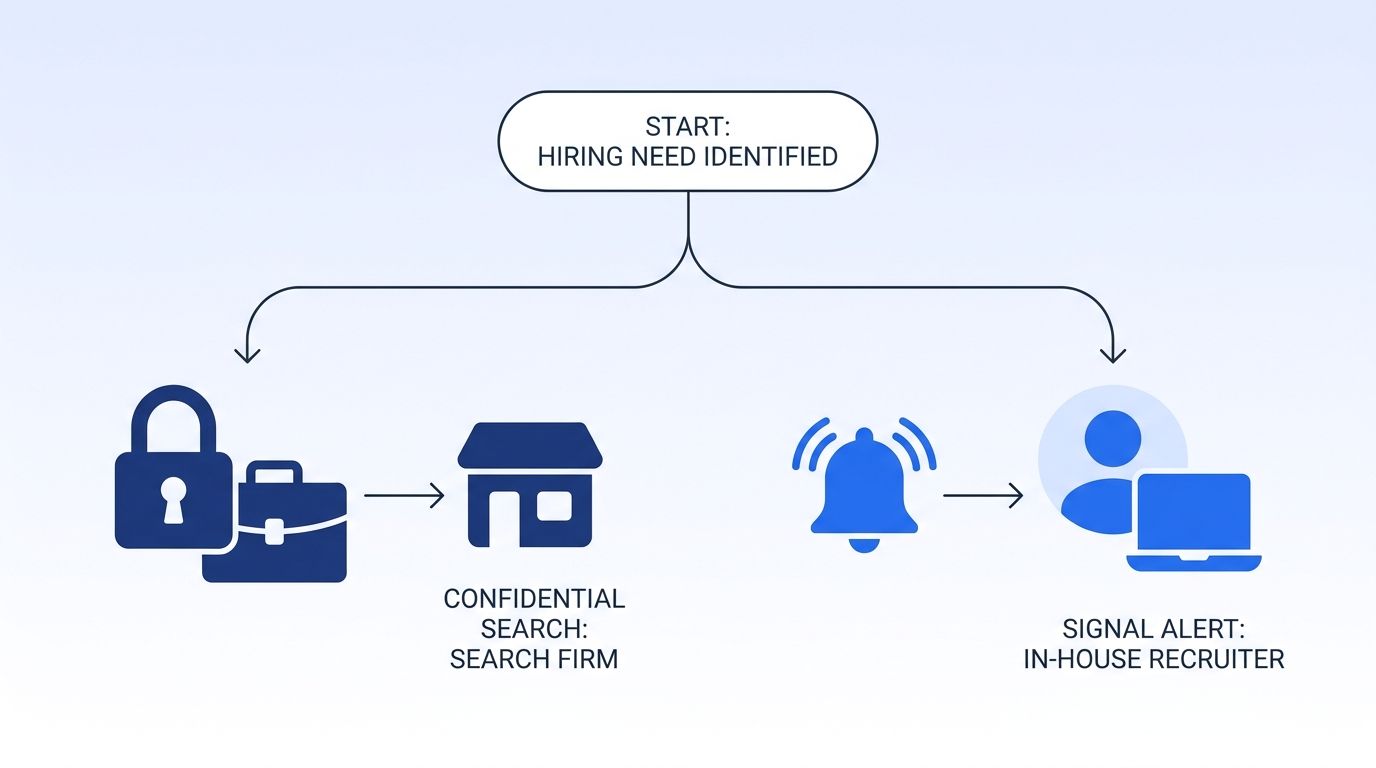
The strongest setups don't pick a side — they route the search by risk and confidentiality, not by seniority alone. A confidential CEO succession goes to a retained firm. A VP of Sales or Director of Engineering role, where speed and cost matter more than discretion, stays in-house and gets backed by real-time signal alerts on job changes, engagement activity, and ICP-matched profiles.
That routing decision alone can shift a meaningful share of your annual search volume off the 25-35% fee structure and onto a cost-per-hire that tracks closer to SHRM's $35,879 executive benchmark — or lower, once signal-driven prioritization cuts down wasted outreach. monitoring executive engagement in real time shows one way TA teams are building that muscle without adding headcount.
Frequently Asked Questions
Is executive search worth the 25-35% fee?
It's worth it for confidential C-suite transitions, board-sensitive hires, and roles with a thin, hard-to-reach candidate pool. For director or VP-level roles where speed and cost matter more than discretion, SHRM's $35,879 average in-house executive cost-per-hire (SHRM, 2025) usually beats a percentage-of-comp fee.
How much faster is in-house sourcing with signal data?
SHRM's benchmarking put in-house time-to-fill at 45 days for executive roles in 2025 and 2026, versus 60-120+ days commonly reported for retained search. Signal data doesn't shrink the calendar directly, but the 74% reply-rate lift on signaled candidates (Pin, 2026) reduces the wasted-outreach time that stretches most in-house timelines.
Do search firms guarantee their placements?
Most retained search firms offer a replacement guarantee, typically spanning 6-12 months, with a 12-month window considered standard for senior roles. If the hire fails inside that window, the firm re-runs the search at no extra fee — a real hedge against Korn Ferry's reported 40% executive failure rate within 18 months.
Can signal data replace a search firm entirely?
Not for every search. Signal data — job-change alerts, engagement monitoring, ICP-matched profiles — is strong at surfacing passive candidates who are quietly reachable, and roughly 70% of the workforce falls into that passive category (LinkedIn Talent Solutions, cited 2026). It doesn't replicate the discretion a confidential CEO search requires.
How many searches can one in-house recruiter realistically run?
In-house recruiters commonly manage 13-14 concurrent requisitions, with high-volume teams running 15-20. Solo executive search consultants typically carry only 4-6 active searches at once, closing 8-12 mandates a year — a structural tradeoff between breadth and depth that signal-based prioritization helps offset for stretched in-house teams.
The Bottom Line
Executive search and in-house sourcing aren't really competing for the same searches — they're built for different risk profiles. Retained search earns its 25-35% fee on confidential, high-stakes mandates. Everything below that tier is where signal data changes the math: faster reply rates, better prioritization across a recruiter's 13-14 open reqs, and a cost-per-hire that stays closer to SHRM's benchmarks than to a percentage of someone's salary.
The teams getting this right aren't eliminating search firms. They're shrinking the share of searches that need one, and giving their in-house recruiters the same "who's quietly available right now" intelligence that used to be a search firm's private edge. real-time job change signal APIs for recruiting teams is a good next read if you're building that capability in-house.
Sources
- SHRM, "SHRM Releases 2025 Benchmarking Reports," retrieved 2026-09-11, https://www.shrm.org/about/press-room/shrm-releases-2025-benchmarking-reports--how-does-your-organizat
- SHRM, "2026 Recruiting Executives Benchmarking: Attracting Critical Talent," retrieved 2026-09-11, https://www.shrm.org/topics-tools/research/recruiting-benchmarking
- Coverdill, J., cited in "Executive search," Wikipedia, retrieved 2026-09-11, https://en.wikipedia.org/wiki/Executive_search
- Pin, "Recruiting Outreach Benchmarks 2026," published July 8, 2026, retrieved 2026-09-11, https://www.pin.com/blog/recruiting-outreach-benchmark-report/
- Korn Ferry, "Best Practice Series: Executive Onboarding," updated January 30, 2026, retrieved 2026-09-11, https://www.kornferry.com/insights/this-week-in-leadership/best-practice-series-executive-onboarding
- LinkedIn Talent Solutions, "How to Recruit Passive Candidates," retrieved 2026-09-11, https://www.linkedin.com/business/talent/blog/talent-acquisition/how-to-recruit-passive-candidates
- Bullhorn, "2026 GRID Recruitment Industry Trends Report," retrieved 2026-09-11, https://www.bullhorn.com/grid/2026-industry-trends/report/
