
Disclosure: Datamagnet publishes this article. Product capabilities described below are based on public documentation, retrieved September 21, 2026.
How Data Enrichment Improves Lead Qualification: Fields, Scoring Rules, and a Worked Example
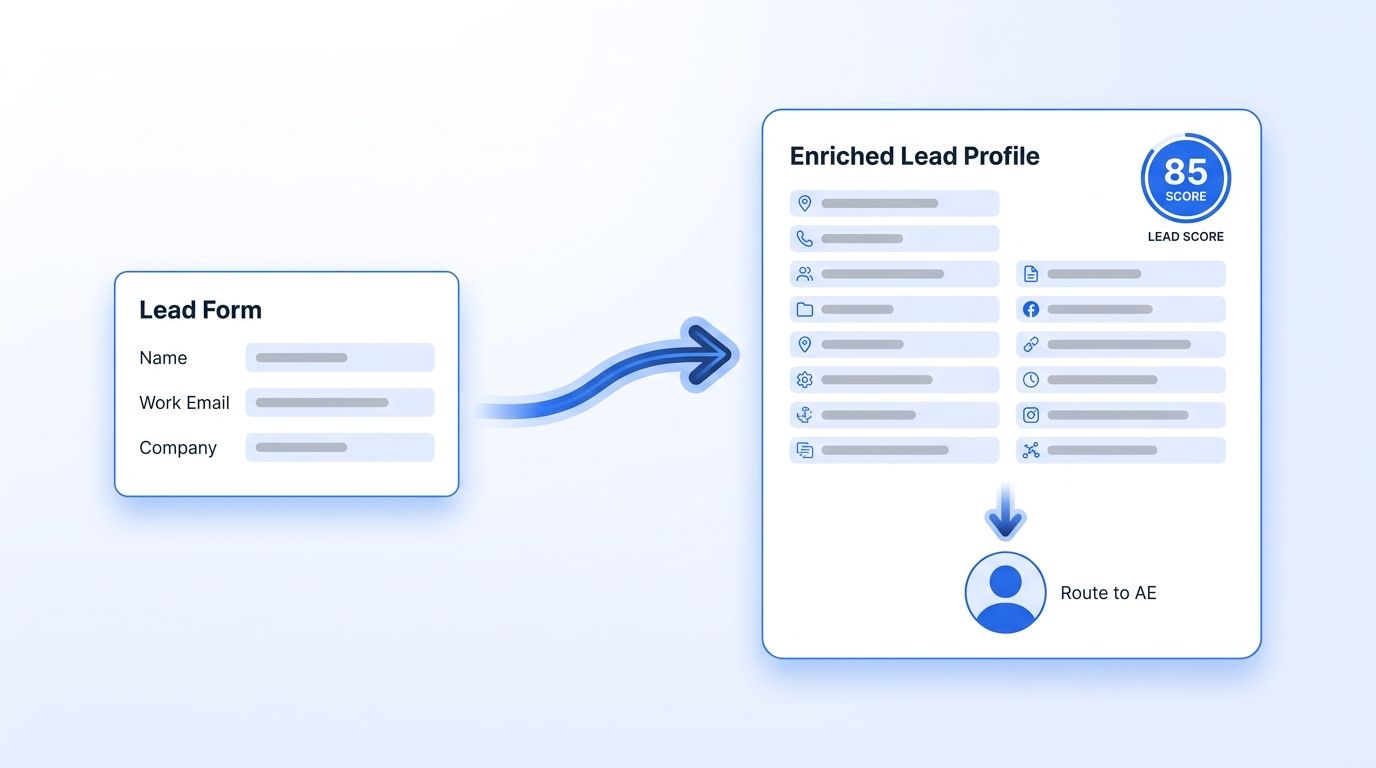
A lead form with three fields tells you almost nothing about whether that person can buy. Data enrichment fixes that gap by matching a name, email, or domain against live company and person data, then feeding the result into a scoring model that decides who gets a call today and who gets a nurture email. This guide walks through which fields matter, how to build the scoring rules, and what enrichment still can't tell you.
TL;DR
- B2B contact data decays at roughly 2.1% a month — 22.5% a year — so a lead scored against stale enrichment data starts wrong (HubSpot, Database Decay Simulation, 2026).
- A 3-field form (name, email, company) can enrich to roughly 25 fields across person, company, and signal data — enough to score and route without asking a prospect a single extra question.
- Contacting a lead within 5 minutes instead of 30 minutes raises contact odds 100x and qualification odds 21x, according to the foundational MIT/InsideSales.com study (Lead Response Management Study, 2007, still the industry benchmark).
- Enrichment tells you who a lead is and what their company looks like. It does not tell you intent, budget authority, or timing — those need a separate signal layer or a human conversation.
- 76% of organizations say less than half of their CRM data is accurate and complete (Validity, State of CRM Data Management, 2025), which is exactly the data most scoring models are quietly built on top of.
What Does Data Enrichment Actually Add to Lead Qualification?
Data enrichment adds the fields a form never captures — job title, seniority, headcount, industry, and recent company activity — by matching a name, email, or domain against a live data source. Without it, qualification depends on self-reported form data that's often incomplete, outdated, or simply skipped by the person filling it out.
The problem compounds over time. B2B contact and firmographic data decays at roughly 2.1% a month, or about 22.5% a year, according to research HubSpot cites from MarketingSherpa (HubSpot, Database Decay Simulation, 2026). A title that was accurate when a lead first filled out a form can be wrong within months — enrichment run once at form-fill and never refreshed just locks in that decay.
Citation capsule: Data enrichment turns a bare form submission into a workable profile by appending job title, company size, and industry the moment a lead comes in — but because B2B data decays roughly 2.1% a month, enrichment run once and never refreshed just freezes that decay in place instead of preventing it.
For a fuller breakdown of the four-step enrichment pipeline and the five data types behind it, review what B2B data enrichment actually involves before building a scoring model on top of it.
Which Enriched Fields Actually Move a Lead Score?
The fields that move a lead score fall into three groups: person data (who they are), company data (what their employer looks like), and signal data (what just changed). Most scoring models lean hardest on person and company fields because they're the most stable and the easiest to verify against a live source.
| Category | What it answers | Example fields | How it's typically sourced |
|---|---|---|---|
| Person | Can this individual buy or influence the purchase? | Job title, seniority, department, LinkedIn URL, tenure in role | Matched via email or name against a live LinkedIn profile |
| Company | Does this account fit your ideal customer profile? | Headcount, industry, HQ location, funding stage, tech stack | Matched via email domain against a live company page |
| Signal | Did something just change that makes this the right moment? | Job change, new hire, recent post, funding announcement | Real-time monitoring, delivered via job-change and engagement signals |
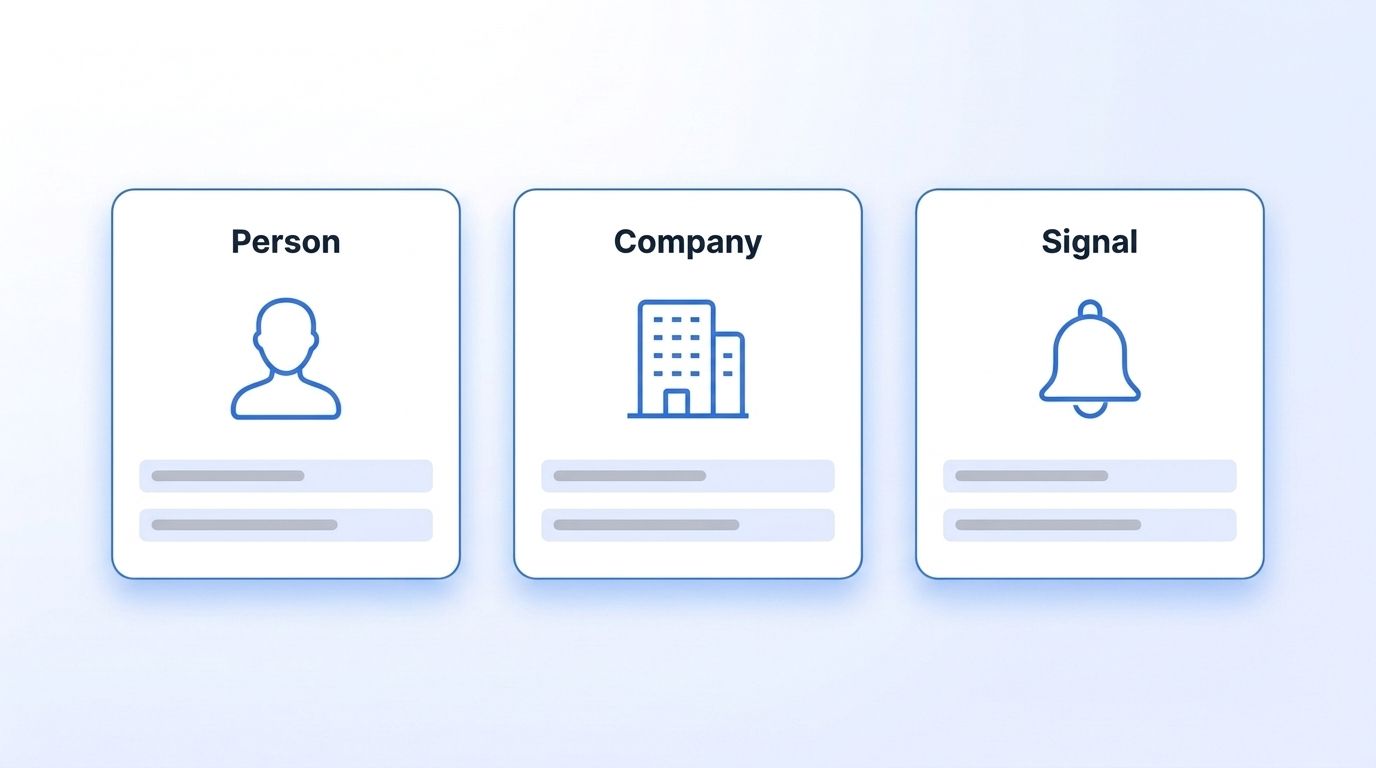
Person and company fields are the foundation almost every scoring model starts with, since they're stable enough to trust for weeks at a time. Signal fields are different — they're time-sensitive by design, which is why they get weighted for recency rather than presence alone. A "VP of Marketing" field is worth the same whether it was appended yesterday or three months ago; a "changed jobs" signal loses most of its value after the first couple of weeks.
Citation capsule: A lead score built only on person and company fields answers "does this account fit," while signal fields answer "is now the right moment" — and treating both categories the same way in a scoring formula is one of the more common mistakes teams make when they first move from form-only qualification to enrichment-based scoring.
How Do You Turn Enriched Fields Into a Scoring Model?
You turn enriched fields into a scoring model by assigning point ranges to each field based on how strongly it predicts a closed deal, then setting score thresholds that map to routing tiers. The model only works if it's built on fields that are actually current — a scoring rule applied to inaccurate data just produces a confident, wrong number.
That risk is real: 76% of organizations report that less than half of their CRM data is accurate and complete, and 37% say they've lost revenue directly because of data quality issues (Validity, State of CRM Data Management, 2025, survey of 602 CRM users). A scoring model is only as trustworthy as the fields feeding it.
A simple point-based model, scored out of 100, looks like this:
| Signal | Field(s) used | Point range | Why it matters |
|---|---|---|---|
| Seniority | Job title, seniority level | 0–20 | A VP can approve budget; an individual contributor usually can't |
| Department fit | Function/department | 0–15 | Confirms the lead sits in a role your product actually serves |
| Company size fit | Headcount | 0–15 | Most products have a sweet-spot account size that converts best |
| Industry fit | Industry | 0–10 | Vertical match correlates with faster, better-fit deals |
| Growth signal | Headcount growth, funding stage | 0–15 | Growing or recently funded companies have budget to spend |
| Tech stack fit | Tech stack | 0–10 | A compatible stack means faster onboarding and less friction |
| Recency signal | Job-change flag, recent activity | 0–15 | A fresh signal is a real reason to reach out now, not in a month |
Set thresholds once the point ranges are in place: 70 or above routes straight to an account executive, 40–69 goes into an SDR sequence, and anything under 40 stays in marketing nurture. The exact cutoffs should move with your own close-rate data, not stay fixed at whatever a template suggests.
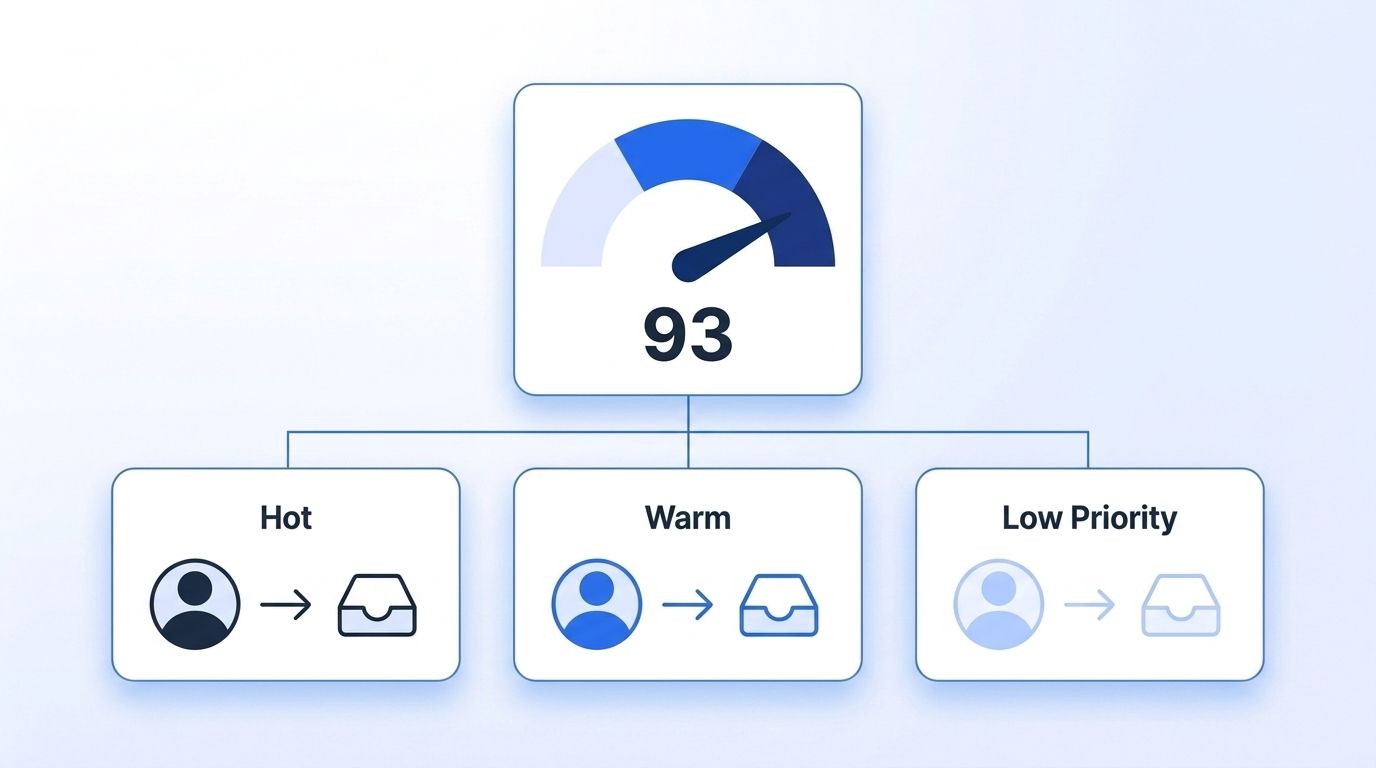
Most teams copy a generic scoring template and never revisit the point values. That's backwards — the point ranges should come from looking at which enriched fields actually appeared on your last 50 closed-won deals, not from a framework someone else published. A field that predicts nothing in your pipeline shouldn't carry the same weight it does in someone else's.
Worked Example: From a 3-Field Form to a 25-Field Scored, Routed Lead
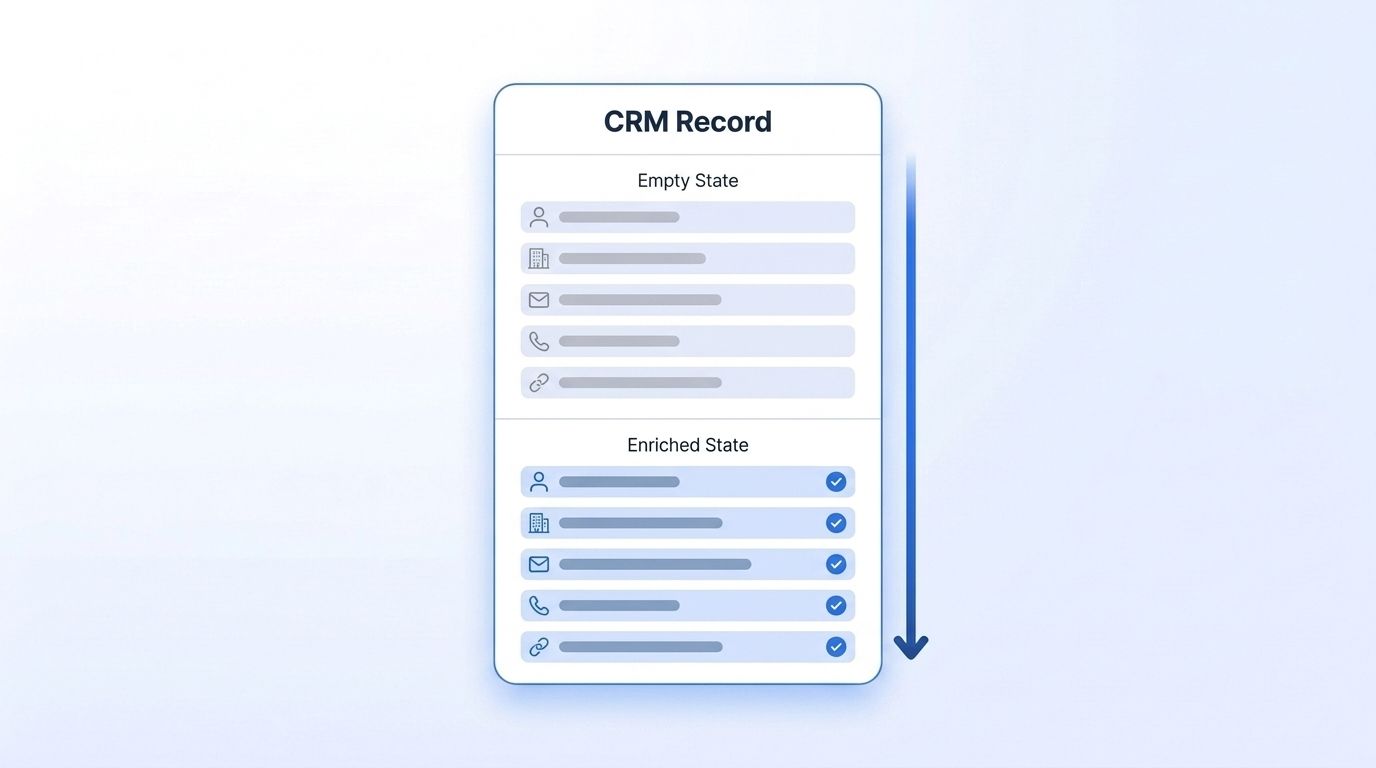
A form that only collects name, email, and company can still produce a fully scored, routed lead — the extra 22 fields come from enrichment, not from asking the prospect more questions. Here's what that looks like end to end, using a single example lead.
Priya Shah fills out a demo request form with three fields: her name, her work email ([email protected]), and her company name. That's all the form asks for. Everything below the line gets appended automatically once the email domain and name are matched against live person and company data.
| # | Field | Category | Source |
|---|---|---|---|
| 1 | Full name | Form input | Self-reported |
| 2 | Work email | Form input | Self-reported |
| 3 | Company name | Form input | Self-reported |
| 4 | Verified job title | Person | LinkedIn profile match |
| 5 | Seniority level | Person | Derived from title |
| 6 | Department/function | Person | Derived from title |
| 7 | LinkedIn profile URL | Person | Matched profile |
| 8 | Time in current role | Person | Matched profile |
| 9 | Time at current company | Person | Matched profile |
| 10 | Location (city, region) | Person | Matched profile |
| 11 | Education (school, degree) | Person | Matched profile |
| 12 | Top skills/expertise tags | Person | Matched profile |
| 13 | Previous employer | Person | Matched profile work history |
| 14 | Verified company legal name | Company | Company page match |
| 15 | LinkedIn company URL | Company | Matched company page |
| 16 | Industry | Company | Matched company page |
| 17 | Current headcount | Company | Matched company page |
| 18 | Headcount growth rate | Company | Matched company page |
| 19 | HQ location | Company | Matched company page |
| 20 | Founded year | Company | Matched company page |
| 21 | Funding stage | Company | Matched company page |
| 22 | Total funding raised | Company | Matched company page |
| 23 | Primary tech stack signal | Company | Matched company page |
| 24 | Job-change flag (last 90 days) | Signal | Real-time signal |
| 25 | Recent company post/news mention | Signal | Real-time monitoring |
Applying the scoring rubric from the previous section: Priya's title (VP Marketing) scores 20/20 for seniority, her department (Marketing) scores 15/15 for department fit, her company's 180-person headcount lands in the sweet-spot band for 15/15, her industry (B2B SaaS) matches the target vertical for 10/10, a Series B raise eight months ago scores 15/15 for growth signal, an existing HubSpot integration scores 10/10 for tech stack fit, and a job change flagged two months ago scores 8/15 for recency, since it's fresh but not brand-new. Total: 93 out of 100 — comfortably in the "route to an AE" tier.
<!-- [ORIGINAL DATA] -->Run this same math on a lead where every field matches except the job-change flag, and the score drops to roughly 85 — still Hot. Swap the headcount to 12,000 employees instead of 180, outside most mid-market sweet spots, and the same lead can fall to the Warm tier even with an identical title and industry. Small field changes move leads across routing tiers more often than teams expect until they've watched it happen.
Citation capsule: A 3-field form and a 25-field enriched profile can describe the exact same person — the difference is entirely in what enrichment appends after submission, not in what the prospect had to type, which is why shorter forms and enrichment increasingly replace long qualification forms rather than supplementing them.
What Doesn't Data Enrichment Tell You?
Data enrichment tells you who a lead is and what their company looks like. It does not tell you whether they're actively evaluating a purchase right now, who else is involved in the buying decision, or what budget they actually control beyond what their title implies.
This is the honest limit worth stating plainly: enrichment describes a static or near-static state — title, headcount, funding — while buying intent is a behavior that changes week to week. A VP of Marketing with a perfect firmographic fit might not be shopping for anything; a mid-level manager at the same company might be the one actually running the vendor evaluation. Enriched fields can't distinguish between the two on their own.
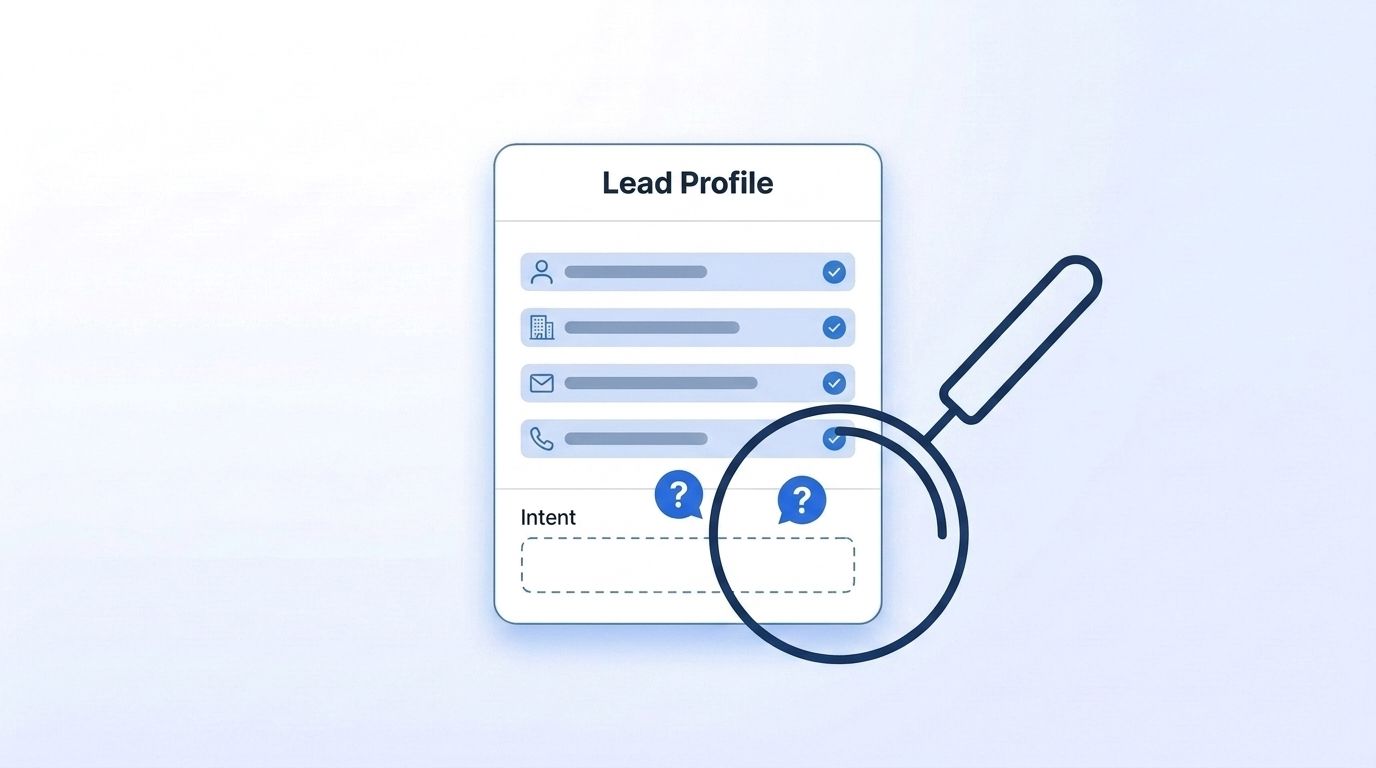
Intent data — tracking what a company is actively researching, like content consumption or review-site visits — is a separate data category built specifically to fill this gap, and analyst firms track it as its own market; Forrester's Q1 2025 Wave for intent data providers names several dedicated vendors in that category alone (Forrester Wave: Intent Data Providers for B2B, Q1 2025, via Intentsify, 2025). Job-change and engagement signals get closer to timing than static firmographic fields do, since a new role or a competitor engagement is at least an event, not just a description — but even a signal tells you something changed, not that the person is ready to buy.
<!-- [PERSONAL EXPERIENCE] -->Teams that treat a high enrichment-based score as proof of intent tend to over-prioritize accounts that look perfect on paper and go quiet the moment a rep reaches out. A score built on firmographic and person fields answers "is this worth a call" — it doesn't answer "will they pick up."
Citation capsule: Data enrichment answers who a lead is and what their company looks like, but it can't tell you whether they're actively shopping, who controls the budget, or when they'll be ready to talk — those questions need intent data, signal monitoring, or a conversation, not another appended field.
Why Does Lead Response Speed Matter as Much as the Score?
Lead response speed matters because a high score delivered late converts worse than a lower score acted on immediately. Calling a lead within 5 minutes instead of 30 minutes raises contact odds 100x and qualification odds 21x, per the field's most-cited benchmark (Lead Response Management Study, MIT/InsideSales.com, 2007).
That study is nearly two decades old — no comparably rigorous modern replication exists — but the underlying mechanism hasn't changed: a fast, mediocre response still beats a perfect one that arrives late.
This is the practical case for real-time enrichment over batch: if scoring and routing depend on an overnight enrichment job, the highest-scoring lead of the day might not get a routed alert until hours after it stops mattering. Feeding the scoring model from a live API at the moment of form submission, then pushing the routing decision out through a webhook the instant the score crosses a threshold, keeps the score and the response inside the same narrow window that the research says actually matters.
Citation capsule: A perfectly scored lead that sits in a queue until the next enrichment batch runs loses most of its value before a rep ever sees it — the response-time research is decades old, but the mechanism it describes (fast contact beats perfect contact) hasn't changed just because the enrichment got more sophisticated.
How Do You Choose an Enrichment Provider for Lead Qualification?
Choosing a provider for lead qualification comes down to matching delivery speed and data types to how your routing actually works, not picking whoever claims the biggest database. A provider built for bulk list licensing solves a different problem than one built for scoring a lead the moment it hits your CRM.
| Provider | Data for qualification | Delivery model | Pricing model | Where it wins |
|---|---|---|---|---|
| ZoomInfo | Firmographic, contact, technographic, bundled intent | Positions itself as continuously updated "live data" vs. point-in-time snapshots (ZoomInfo, 2026) | Seat-based licenses plus credit consumption | Broadest all-in-one platform — data, dialer, and workflow tools bundled together |
| Clearbit (now HubSpot Breeze Intelligence) | Firmographic, technographic, contact-level attributes | Enrichment on a commercial dataset with periodic re-enrichment, native to HubSpot | Credit-based, bundled into a HubSpot subscription | Fastest deployment for teams already standardized on HubSpot forms and workflows |
| Apollo | Contact and company database, email/phone verification | Database plus waterfall-style enrichment via API | Seat-based plans plus per-record credits (Apollo API pricing, 2026) | Lowest cost per seat for SMB/mid-market teams that also want built-in sequencing |
| Clay | Orchestration across 150+ third-party providers | Waterfall — queries multiple sources per row, not a single proprietary dataset | Data credits plus platform "actions," tiered plans (Clay pricing, 2026) | Highest achievable match rate by combining several providers automatically |
| People Data Labs | Person and company data for bulk modeling | Developer-facing API and bulk dataset access | Pay-per-match credits | Best fit for data science teams building or training their own scoring models offline |
| Coresignal | Company, workforce, and job-posting data | Offers both a real-time database API and separate bulk datasets (Coresignal pricing, 2026) | Credit-based, tiered from $49 to enterprise plans | Most flexibility for teams that need both a live lookup and periodic historical exports |
| Datamagnet | Real-time LinkedIn person, company, post, and signal data | Live, request-time API — queries the current state of a profile or company page at form-fill | Pay-as-you-go credits, no seat contract | Freshest point-in-time data for scoring at the exact moment a lead is created, plus job-change signals for re-scoring later |
Datamagnet isn't the strongest choice if you need a massive static database for offline model training — People Data Labs covers that better with bulk licensing built for exactly that use case. It also doesn't bundle a dialer, sequencer, or intent co-op the way ZoomInfo does as a full platform. Where it fits is narrower and more specific: scoring a lead against a live profile the moment it's created, then catching the job change six months later that makes it worth a second look — without an annual seat contract attached to either step.
Citation capsule: No enrichment provider wins on every axis relevant to lead qualification — bundled platforms like ZoomInfo and Apollo trade specialization for workflow breadth, bulk-dataset vendors like People Data Labs and Coresignal trade freshness for volume, and a live-API specialist trades platform breadth for point-in-time accuracy at the exact moment a lead needs scoring.
Start With the Fields Your Scoring Model Actually Needs
Data enrichment turns a bare 3-field form into a scoreable, routable lead by appending person, company, and signal data most forms never ask for — but the model only holds up if the underlying fields stay current and the score triggers a fast response. Build the scoring rubric from your own closed-won data, route on thresholds rather than gut feel, and remember that a perfect score still can't tell you intent or timing on its own. See live LinkedIn people and company data in action — run a lookup against a real lead this week and see what a 3-field form actually enriches to.
Frequently Asked Questions
What is data enrichment in lead qualification?
Data enrichment in lead qualification is the process of appending job title, company size, industry, and other fields a form didn't collect, so a scoring model has enough information to judge fit. It replaces guesswork with verified fields matched against a live person or company data source.
How many fields do you actually need to score a lead well?
There's no fixed number, but a working scoring model typically needs 15-25 fields across person, company, and signal categories — enough to cover seniority, department, company size, industry, and one or two recency signals. More fields help less once you're past covering those core categories.
Can data enrichment tell you if a lead has buying intent?
No. Enrichment describes who a lead is and what their company looks like, but intent — whether they're actively evaluating a purchase — is a separate, behavior-based data category. Forrester tracks dedicated intent data vendors as their own market segment (Forrester Wave: Intent Data Providers, Q1 2025, 2025), distinct from firmographic or people enrichment.
What score should trigger routing to an account executive?
That threshold should come from your own closed-won data, not a generic template, but a common starting split is 70+ points routes to an AE, 40-69 goes into an SDR sequence, and under 40 stays in marketing nurture. Recalculate the cutoffs once you have a few months of actual conversion data to check against.
How fast should enrichment and routing happen after a form fill?
As close to real time as your stack allows. Contacting a lead within 5 minutes instead of 30 minutes raises contact odds 100x and qualification odds 21x (Lead Response Management Study, 2007), so enrichment that runs in an overnight batch undercuts even a perfectly built scoring model.
Sources
- HubSpot, Database Decay Simulation, retrieved 2026-09-21, https://www.hubspot.com/database-decay
- Validity, The State of CRM Data Management in 2025, retrieved 2026-09-21, https://www.validity.com/resource-center/the-state-of-crm-data-management-in-2025/
- MIT / InsideSales.com, Lead Response Management Study, retrieved 2026-09-21, https://www.leadresponsemanagement.org/lrm_study/
- Forrester (via Intentsify), The Forrester Wave: Intent Data Providers For B2B, Q1 2025, retrieved 2026-09-21, https://intentsify.io/resources/forrester-wave-report-2025/
- ZoomInfo, Point-In-Time Data Versus Live Data, retrieved 2026-09-21, https://pipeline.zoominfo.com/marketing/point-in-time-data-live-data
- Apollo, API Pricing Documentation, retrieved 2026-09-21, https://docs.apollo.io/docs/api-pricing
- Clay, Pricing, retrieved 2026-09-21, https://www.clay.com/pricing
- Coresignal, Pricing, retrieved 2026-09-21, https://coresignal.com/pricing/
- Datamagnet, API Documentation, retrieved 2026-09-21, https://docs.datamagnet.co/api-reference/introduction
