
Disclosure: This article is published by Datamagnet. Product capabilities described below are based on public documentation, retrieved 2026-08-22.
Dark Funnel Signals: What They Are and Why They're Hard to Track
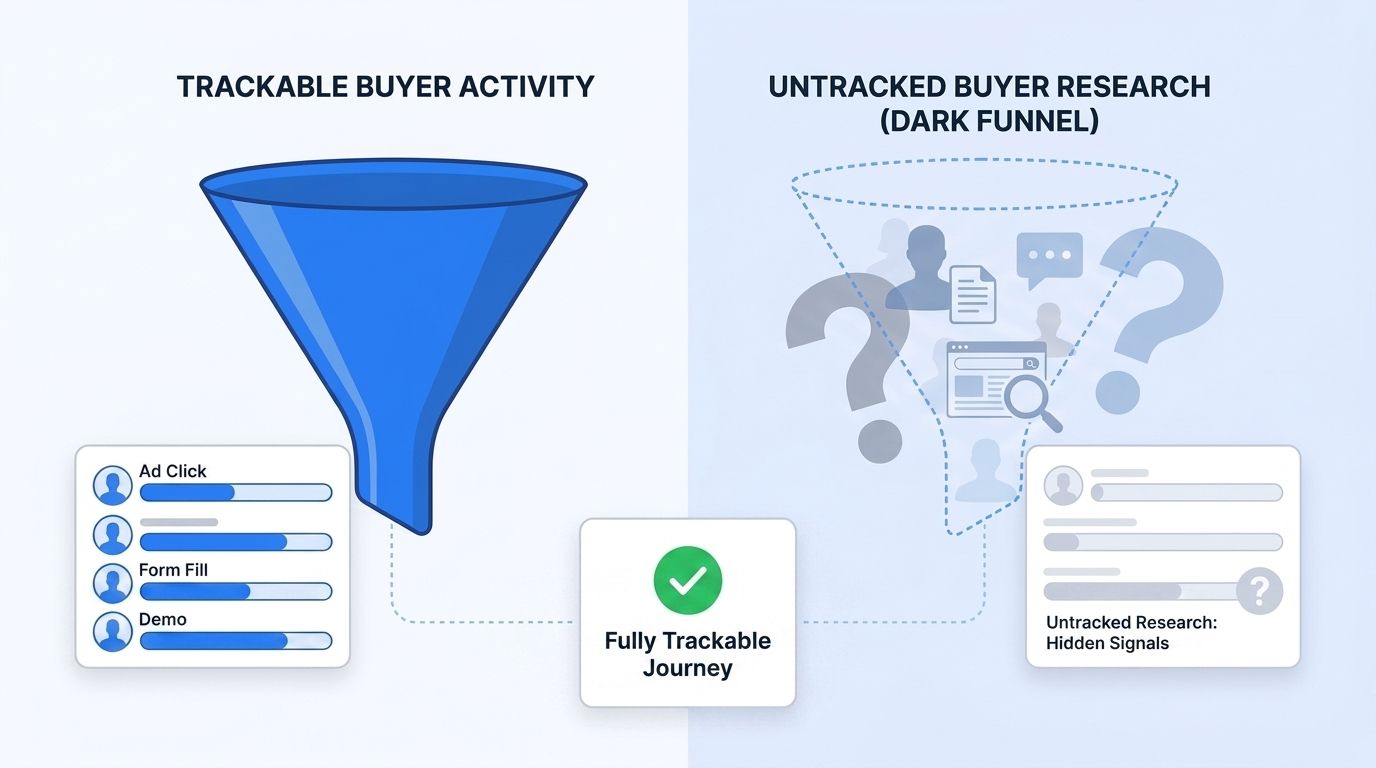
Most of your pipeline forms before your CRM ever notices. In 2025, B2B buyers completed 60% of their purchase journey before they contacted a vendor at all (6sense, B2B Buyer Experience Report 2025, Nov 2025). That research, that peer comparison, that shortlist conversation in a private Slack channel — none of it leaves a trail in your marketing analytics. That's the dark funnel, and it's where most B2B deals are actually decided.
You can't A/B test what you can't see, and you can't coach a rep on a conversation that happened somewhere else entirely. This piece breaks down what dark funnel signals are, why standard attribution tools are structurally blind to them, and what it actually takes to catch a piece of that activity before a deal shows up fully formed in your pipeline.
TL;DR
- In 2025, B2B buyers finished 60% of their purchase journey before first vendor contact, down from 69% the year before, while the average buying committee grew past 10 people (6sense, 2025).
- Direct, unattributed traffic makes up 64-72% of visits to major B2B SaaS platforms like Gong, HubSpot, and Salesforce — the largest single "channel" in most funnels is the one labeled "unknown" (Similarweb, 2026).
- LinkedIn engagement grew 14% year-over-year even as visible actions like likes and comments fell, because the growth is almost entirely silent: clicks, video views, and carousel swipes (Metricool, 2026 LinkedIn Study, Apr 2026).
- Attribution software can't fix this — it can only see channels with a referrer. Closing the gap takes engagement and job-change signals layered on top of your existing analytics, not a better dashboard.
What Are Dark Funnel Signals?
Dark funnel signals are the traces of buyer research and engagement that happen outside any channel your analytics can attribute to a source. Think peer Slack communities, private DMs, review sites, incognito browsing, and conversations that never touch a trackable link. In 2026, Gartner found that 67% of B2B buyers now prefer a rep-free purchasing experience, and 45% used AI tools during a recent purchase (Gartner, sales survey press release, Mar 2026) — both of which push even more research into channels that never generate a lead form.
The name borrows from "dark social," the older marketing term for content shares that happen through copy-paste links in email or messaging apps instead of trackable share buttons. Dark funnel is the B2B sales version of the same blind spot, applied to the entire buying journey instead of just social sharing. It's not a new behavior — buyers have always talked to peers before talking to vendors. What's changed is how much of the journey now happens before a rep ever gets a signal that a deal is in motion.
<!-- [UNIQUE INSIGHT] -->Here's the part most attribution conversations skip: dark funnel isn't a tracking failure you can patch. It's a structural gap. A UTM parameter can tell you someone clicked an ad. No tag exists for "a VP mentioned your product in a private Slack channel and three colleagues nodded along." The channels themselves aren't built to be measured, so no amount of tooling investment closes that gap on its own.
Why Is So Much of the Buying Journey Invisible Now?
The buying journey is more invisible than ever because more people are involved in it, and each one runs their own research in parallel. The average B2B purchase now involves 13 internal stakeholders and 9 external participants — 22 total influencers — and 94% of buyers in groups of six or more say the group process produced a clearly better outcome (Forrester, State of Business Buying 2026, Jan 2026). Older Gartner benchmarks put the median SaaS buying committee for deals over $100K ACV at 11 people, up from just 7 in 2017 (Gartner, compiled by The Starr Conspiracy).
Every one of those people researches independently before the group ever gets on a call together. In 2026, Dreamdata's benchmark data put the average B2B path-to-purchase at 272 days and 88 touchpoints across four channels, with the first ad impression landing a full 320 days before the deal closes (Dreamdata, "Dark Funnel", Mar 2026). Dreamdata frames this with what it calls the "95:5 rule" — at any given moment, 95% of your total addressable market is out-of-market and not actively buying, which means most of the research you'd want to see is happening for people who aren't even on your radar yet.
Citation capsule: A B2B deal now involves as many as 22 influencers, per Forrester's 2026 buying study, up sharply from the 5-7 person committees common a decade ago. Every additional stakeholder runs their own independent research before the group ever compares notes, which multiplies the amount of buying activity that happens outside any channel your team can directly observe.
Where Does Dark Funnel Activity Actually Happen?
Dark funnel activity concentrates in three places: private sharing, passive social consumption, and peer review sites. On the sharing side, the classic benchmark — still the most-cited number in the industry even though the underlying study dates back to 2016 — found that 84% of content sharing happens through "dark social" channels like copy-pasted links in email or DMs, rather than trackable share buttons (RadiumOne, Dark Social Data Report, 2016). Nobody has run a cleaner large-scale replication since, but the behavior it describes — sharing a link in a private channel instead of clicking a public share icon — hasn't gotten any easier to track in the years since.
On LinkedIn specifically, most of what buyers do is invisible by design. In 2026, a study of over 673,000 LinkedIn posts found overall engagement grew 14% year-over-year, driven almost entirely by "invisible interactions" — clicks, carousel swipes, and video views — even as visible actions declined: likes down 13%, comments down 17%, shares down 10% (Metricool, 2026 LinkedIn Study, Apr 2026). Isn't that the opposite of what most social strategies assume? Teams chase comments and shares as their engagement metric, while the actual growth is happening in the interactions nobody's dashboard shows them.
The pattern isn't new — Jakob Nielsen's 90-9-1 rule described it back in 2006: roughly 90% of people in any online community read and observe without ever posting or reacting, 9% contribute occasionally, and 1% account for most visible activity (Nielsen Norman Group, "Participation Inequality", Oct 2006). What's changed since 2006 isn't the ratio — it's the stakes. That silent 90% now includes the buying committee member who's going to sign off on your deal.
Peer review sites are the third leg. In 2025, TrustRadius found 77% of B2B buyers consulted user or peer reviews during a software purchase, ranking close behind product demos (53%) and the vendor's own website (52%) — while only 14% consulted analyst reports, a 60% drop since 2022 (TrustRadius, "Bridging the Trust Gap", Apr 2025). A prospect reading twenty reviews of your product on a third-party site generates exactly zero events in your analytics.
Why Can't Standard Attribution Tools See Any of This?
Standard attribution tools can't see dark funnel activity because they're built to track referrers, and dark funnel activity has none. When someone clicks a copy-pasted link, opens a bookmarked tab, or types your URL from memory after hearing about you in a peer conversation, your analytics tool logs it as "direct traffic" — a catch-all bucket that tells you nothing about where the visit actually came from.
That bucket is bigger than most teams realize. In 2026, Similarweb's traffic analysis found direct, unattributed visits made up 72.1% of traffic to Gong, 71.6% to HubSpot, 71.1% to Outreach, and 64.5% to Salesforce (Similarweb, "B2B Dark Funnel", 2026, citing Q4 2025 data). Those are some of the most sophisticated marketing orgs in B2B software, and for two-thirds to three-quarters of their own traffic, "direct" is the most specific label their own analytics can offer.
Citation capsule: Direct traffic accounts for 64-72% of visits to major B2B SaaS websites, according to Similarweb's 2026 traffic analysis. That's not a measurement gap you close with a better attribution model — it's the label analytics tools apply by default whenever a visit arrives without a trackable referrer, which is exactly what dark funnel research produces.
What Happens When You Ignore Dark Funnel Signals?
Ignoring dark funnel signals means your team gets surprised by deals that were actually decided weeks earlier. 6sense's 2025 research found that 95% of the time, the vendor that ultimately wins was already on the buyer's shortlist on day one of a formal evaluation, and 80% of deals go to that pre-contact favorite (6sense, B2B Buyer Experience Report 2025, Nov 2025). If your first real signal is a demo request, you're not opening the deal — you're finding out how it's already going to end.
That's the real cost. Sales teams that only react to trackable, form-filled activity are optimizing for the 40% of the journey they can see, while 60% of the decision has already happened somewhere they weren't watching. A rep who gets a warm inbound lead has usually just been told, late, that the deal reached its conclusion earlier than expected — not that a new opportunity is opening up.
How Do You Actually Track Dark Funnel Signals?
You track dark funnel signals by watching engagement and account activity instead of waiting for a form fill, since engagement data captures behavior that attribution tools structurally can't. Intent-prioritized accounts convert at 21.3% versus 8.4% for non-prioritized accounts, and the sales cycle for intent-flagged accounts compresses by 28 days on average (Forrester's 2024 B2B Buying Study, compiled by The Starr Conspiracy). The lift comes from watching for activity, not from tracking a channel that was never going to show up in a UTM report.
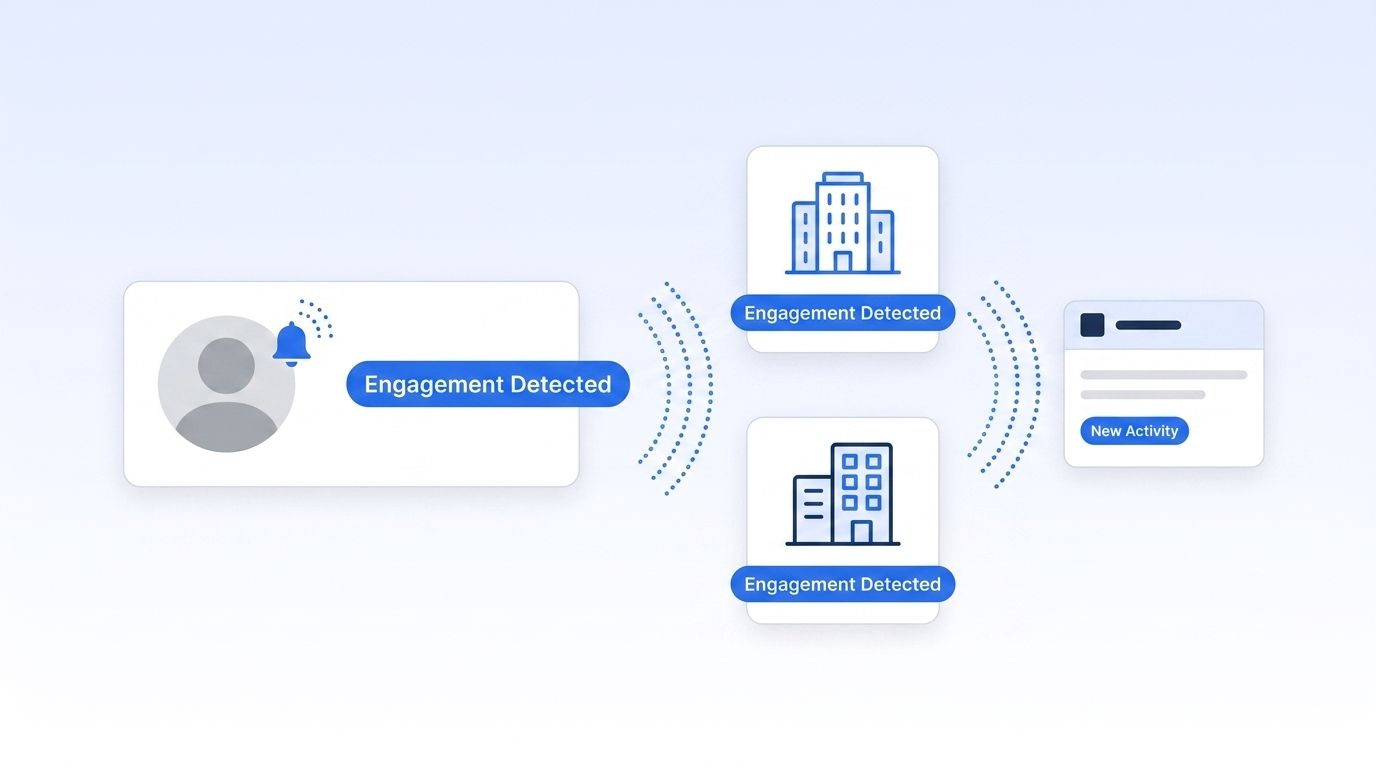
This is where signal-based selling closes part of the gap dark social sharing opens. Datamagnet's Person Engagement Signal and Company Engagement Signal endpoints monitor LinkedIn posts from tracked people or target accounts and surface the people who like, comment on, or share them — capturing exactly the passive, silent-majority behavior the Nielsen Norman Group's research describes, instead of waiting for it to become a form fill. A Keyword Engagement Signal extends the same idea to topic-level monitoring, flagging anyone engaging with content about a pain point your product solves, even when they've never visited your site.
<!-- [UNIQUE INSIGHT] -->None of this fully solves dark funnel — no vendor honestly claims that. What signal-based monitoring does is convert one specific slice of dark funnel behavior (public-but-passive LinkedIn engagement) from completely invisible to partially visible. It doesn't recover the private Slack conversation or the incognito review-site visit. It recovers the layer sitting just above those — the layer most teams currently treat as equally invisible, when it doesn't have to be.
Building a Signal Stack That Catches What Attribution Can't
Start with the accounts and people you already care about, not a blanket net over the entire internet. Register a signal monitor against your target account list and named champions first — that's a smaller, higher-signal dataset than trying to catch dark funnel activity across your entire addressable market on day one.
- Layer engagement signals on top of your CRM, not instead of it. Engagement and job-change signals tell you who's active; your CRM still tells you deal stage and owner. Route new activity through a webhook so it lands as a task, not a report someone has to remember to check.
- Watch buying-committee members individually, not just the primary contact. With 22 potential influencers per deal, tracking only your one named champion means missing the other 21 people whose engagement never reaches your inbox. Datamagnet's executive intelligence cookbook walks through alerting your team the moment a target executive posts, so outreach can follow within minutes instead of after the fact.
- Track champions across job changes, not just within one company. A champion who goes quiet didn't necessarily lose interest — they may have moved. Datamagnet's champion-tracking cookbook shows how to keep watching a person's signals after they change roles, so a warm relationship doesn't just evaporate into the dark funnel at the exact moment it changed companies.
- Score, don't just collect. A raw feed of "someone liked a post" isn't actionable at scale. Weight signals by role, account fit, and recency before they hit a rep's queue, the same way you'd already filter and prioritize inbound form fills.
For a broader look at how job-change and engagement signals combine into a single monitoring layer, see Datamagnet's guide to real-time intent signal APIs. And if your team is still building the account-research groundwork these signals plug into, the account research infrastructure guide for AEs covers the layer that sits underneath signal monitoring.
Frequently Asked Questions
What's the difference between dark funnel and dark social?
Dark social specifically refers to content shares that happen through untrackable channels like email or DMs instead of public share buttons — a term coined around 2016 research finding 84% of sharing happened this way (RadiumOne, 2016). Dark funnel is the broader term, covering the entire buyer journey that happens outside attributable channels, including but not limited to sharing.
Can you ever fully attribute dark funnel activity?
No, and treating full attribution as the goal sets teams up to fail. Dark funnel activity happens in genuinely private channels — Slack DMs, incognito browsing, in-person conversations — that no tracking technology can observe by design. The realistic goal is recovering the visible edges of it, like public LinkedIn engagement, not eliminating the invisible core.
Is a lot of dark funnel activity a sign my marketing isn't working?
Not necessarily. High dark funnel volume often means buyers are actively researching your brand through channels you don't control, like peer reviews and community discussions. In 2025, 77% of B2B buyers consulted peer reviews during a purchase (TrustRadius, Apr 2025) — a channel you can influence but never fully instrument.
How is dark funnel different from intent data?
Intent data typically refers to third-party signals showing a company is researching a topic, often aggregated from content-consumption networks. Dark funnel is the broader phenomenon those signals only partially expose. Engagement signals, like tracking who interacts with specific LinkedIn posts, are one way to convert a slice of dark funnel behavior into first-party intent data you can act on directly.
The Dark Funnel Isn't Going Away
Buyers now finish 60% of their purchase before contacting a vendor, spread across a buying committee that can top 20 people, most of whose research never touches a trackable channel. Attribution software won't fix this — it can only report on channels with a referrer, and dark funnel activity was never going to have one. The practical move is layering engagement and job-change signals over your existing analytics so you catch the visible edges of that activity, instead of waiting for a form fill to tell you a deal already happened. See how real-time signal monitoring surfaces dark funnel activity — check it against your current target account list this week.
Sources
- 6sense, B2B Buyer Experience Report 2025, retrieved 2026-08-22, https://6sense.com/science-of-b2b/buyer-experience-report-2025/
- Gartner, "Gartner Sales Survey Finds 67% of B2B Buyers Prefer a Rep-Free Experience," retrieved 2026-08-22, https://www.gartner.com/en/newsroom/press-releases/2026-03-09-gartner-sales-survey-finds-67-percent-of-b2b-buyers-prefer-a-rep-free-experience
- Forrester, "2026: The State of Business Buying," retrieved 2026-08-22, https://www.forrester.com/press-newsroom/forrester-2026-the-state-of-business-buying/
- The Starr Conspiracy, "B2B Buying Committee Benchmarks 2025," retrieved 2026-08-22, https://www.thestarrconspiracy.com/insights/benchmarks/b2b-buying-committee-benchmarks-2025
- The Starr Conspiracy, "B2B Intent Data Benchmarks 2025," retrieved 2026-08-22, https://www.thestarrconspiracy.com/insights/benchmarks/b2b-intent-data-benchmarks-2025
- RadiumOne, "Dark Social Data Report," retrieved 2026-08-22, https://radiumone.com/darksocial/
- Similarweb, "B2B Dark Funnel: Surface Invisible Buyers In 2026," retrieved 2026-08-22, https://www.similarweb.com/blog/marketing/marketing-strategy/dark-funnel-b2b/
- Dreamdata, "Dark Funnel," retrieved 2026-08-22, https://dreamdata.io/library/dark-funnel
- TrustRadius, "Bridging the Trust Gap: B2B Tech Buying in the Age of AI," retrieved 2026-08-22, https://solutions.trustradius.com/vendor-blog/bridging-the-trust-gap-b2b-tech-buying-in-the-age-of-ai/
- Metricool, "2026 LinkedIn Study," retrieved 2026-08-22, https://metricool.com/press-release-linkedin-study-2026/
- Nielsen Norman Group, "The 90-9-1 Rule for Participation Inequality," retrieved 2026-08-22, https://www.nngroup.com/articles/participation-inequality/
