
Disclosure: This article is published by Datamagnet, a Crustdata alternative. Vendor claims are self-reported unless otherwise noted. This is a desk review of Crustdata's public pricing page and docs, not a hands-on test, and prices were read on 2026-11-13.
Crustdata API Pricing 2026: Credits and Live Data Costs
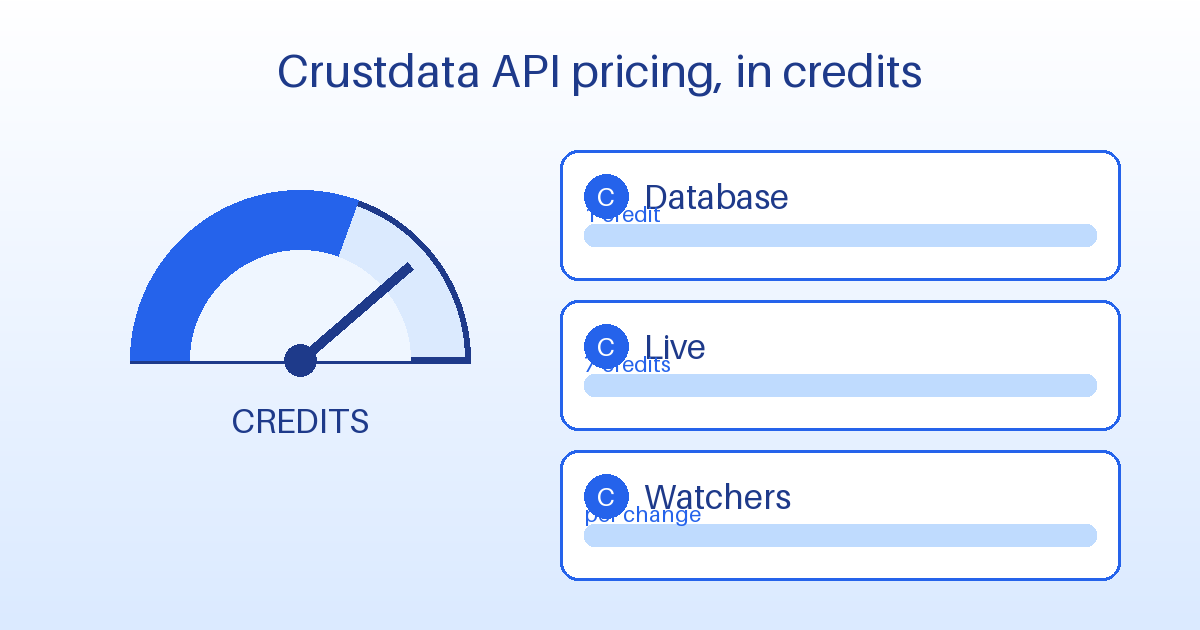
Crustdata sells people and company data through an API that runs on credits. A basic person lookup costs 1 credit, a live one costs 7, and Crustdata doesn't publish what a credit is worth in dollars. So you can compare endpoints, but you can't price a project without talking to sales.
TL;DR
- Crustdata gives new accounts $20 in free credits, then bills by credit (Crustdata pricing, 2026).
- Database lookups are cheap. Live person enrichment is 7 credits per profile.
- The dollar value per credit and the real-time plan price aren't public.
- Verdict: strong coverage, but you'll budget in credits, not dollars.
Is the Crustdata API Worth It? A Quick Verdict
Crustdata scores about 7 out of 10 in this review. In 2026, it offers a self-serve In-DB API covering 1B+ people and 60M+ companies, plus a sales-led Real-time API and an Enterprise tier (Crustdata pricing, 2026). It's broad. It's also hard to budget.
| Pros | Cons |
|---|---|
| $20 in free credits to test | No dollar price per credit is published |
| Empty searches and no-match contact lookups cost nothing | Real-time and watcher features sit behind sales |
| Watchers bill only for new or changed records | Credit costs vary by account and endpoint version |
| Free company identify endpoint | Enterprise "starts at four figures per month" |
| Job search and web search endpoints included | Public review base is thin |
Best for: teams that want database-style coverage with optional live lookups, and have a budget conversation in them. Not ideal for: developers who need a price per call before writing any code.
How Did We Review It?
I read Crustdata's pricing page, its pricing docs, and its blog on 2026-11-13. I didn't run production calls, so I can't tell you latency or match rates. Treat every number below as a list price from Crustdata's own docs, which say prices "can change by plan, entitlement, and endpoint version" (Crustdata docs, 2026).
That caveat matters. Crustdata's account endpoints call shows the rates your account actually pays. Run it before you trust any table, including mine.
What Does the Crustdata API Cost per Endpoint?
Most self-serve lookups run 1 to 4 credits, while live endpoints cost more. According to the Crustdata pricing docs (2026), base person enrichment is 1 credit, company enrichment is 2 to 4, and live person enrichment is 7 per profile. Here's the full picture.
| Endpoint | Credits | Access |
|---|---|---|
| Company search | 0.03 per result (premium groups add 0.1-1) | Self-serve |
| Company enrich | 2-4 per record | Self-serve |
| Company identify | Free | Self-serve |
| People search | 0.03 per result (premium fields add 0.1-2.5) | Self-serve |
| People enrich | 1-4 per person | Self-serve |
| Job search | 0.03 per result | Self-serve |
| Web search / web enrich (live) | 1 per query / page | Self-serve |
| Live person search | 2 per profile | Plan-gated |
| Live person enrich | 7 per profile | Plan-gated |
| Live company search | 2 per company | Plan-gated |
| Contact enrich | 1-5.5 per match | Enterprise |
Source: Crustdata docs, retrieved 2026-11-13, list prices.
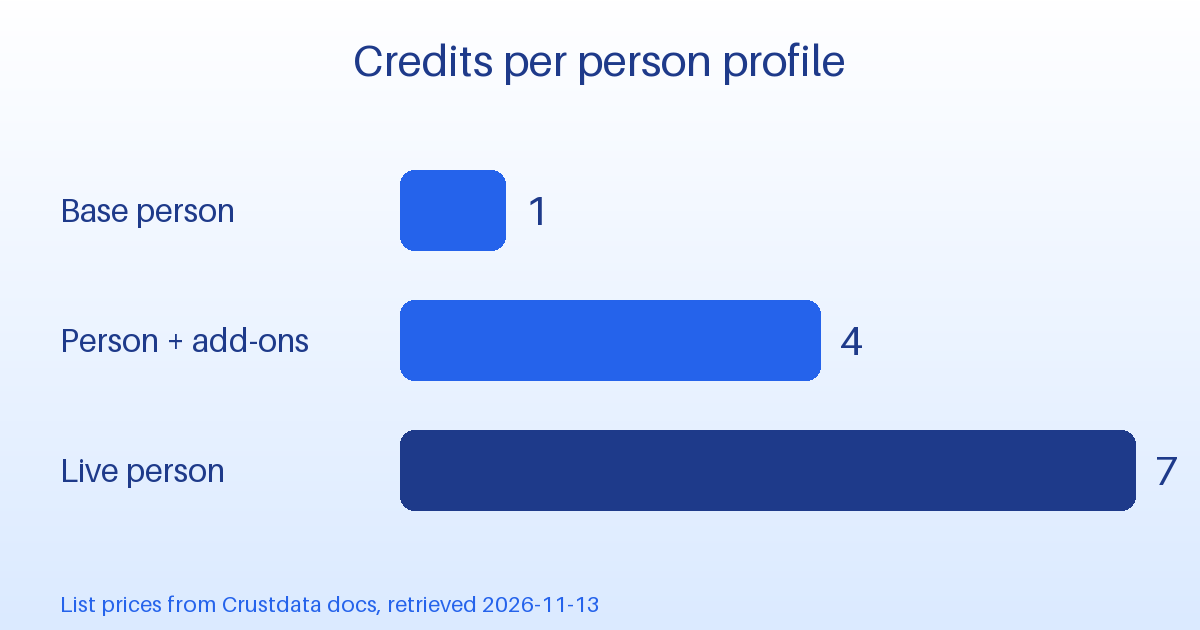
Add-ons stack up fast. A person record starts at 1 credit, then work email adds 1, personal email 2, phone 2, developer profile 1, and research profile 2. Crustdata's bundles per person run 2 for sales outreach, 4 for full outbound, 5 for recruiting and 9 for everything (Crustdata pricing, 2026).
How Does Live Data Pricing Compare to Database Pricing?
Live data costs far more per record than database data. In 2026, Crustdata lists live person enrichment at 7 credits against 1 credit for a base database profile, a 7x gap (Crustdata docs, 2026). You're paying for a fetch at request time instead of a lookup in an index.
Is the 7x worth it? It depends on how fast your records go stale. Vendors commonly cite 20 to 30 percent annual decay for B2B contact data, though that figure repeats across vendor blogs without a clear primary study. Even at the low end, a database refreshed monthly can miss a job change for weeks. If you're routing leads or sending outreach, a stale title can cost you more than 6 extra credits.
Here's a practical split. Use database endpoints for broad list building, where 0.03 credits per search result keeps costs tiny. Use live endpoints only on the shortlist you're about to contact. That keeps the 7-credit calls to a few hundred records, not tens of thousands.
Crustdata also says its company enrichment "returns records fresh at query time" and offers a monthly flat-file snapshot (Crustdata blog, 2026). Those are vendor claims. I couldn't verify freshness independently.
What Do Crustdata Watchers Cost?
Watchers charge only when something new shows up, which makes spend easier to predict. Per the Crustdata docs (2026), discovery watchers give a free first run of up to 5 matches, then bill new records only, and runs with no changes cost nothing.
- Company discovery: 2 credits per new company on a 30-day SLA, 150 on a 1-day SLA.
- Job discovery: 0.5 credits per new job (30-day), 150 (1-day).
- Company entity watcher: 5 credits per changed company, 30-day only.
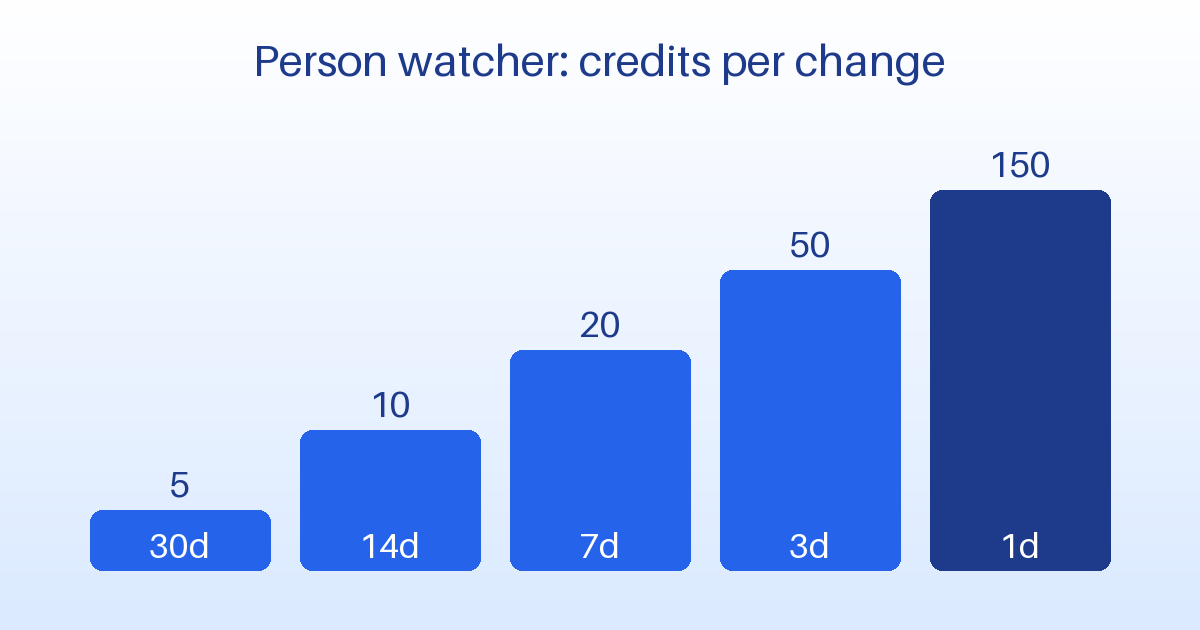
- Person entity watcher: 5 credits at 30 days, 10 at 14, 20 at 7, 50 at 3 and 150 at 1 day.
The pattern is clear. Faster refresh gets expensive quickly: a one-day person watcher costs 30x a monthly one per change. Crustdata's blog also describes hourly monitoring at 5 credits per notification, but that conflicts with the docs' tiered structure, so go with the docs.
What Does Crustdata Not Tell You Up Front?
The biggest gap is the dollar value of a credit. Crustdata's pricing page publishes no credit pack prices and no minimum spend for self-serve, and says Enterprise "starts at four figures per month" (Crustdata pricing, 2026). The Real-time API is sales-led.
Credit expiry is also muddy. The docs say purchased credits last 12 months. A Crustdata blog post says 6 months (Crustdata blog, 2026). Get the real term in writing before you buy a big pack.
Some third-party sites quote dollar tiers for Crustdata. I couldn't tie any of them to a Crustdata page, so I won't repeat them as fact. Competitor-run reviews also describe opaque pricing and demo-gated watchers. Those are opinions from vendors with something to sell, as are ours.
What Does Datamagnet Charge for Comparable Work?
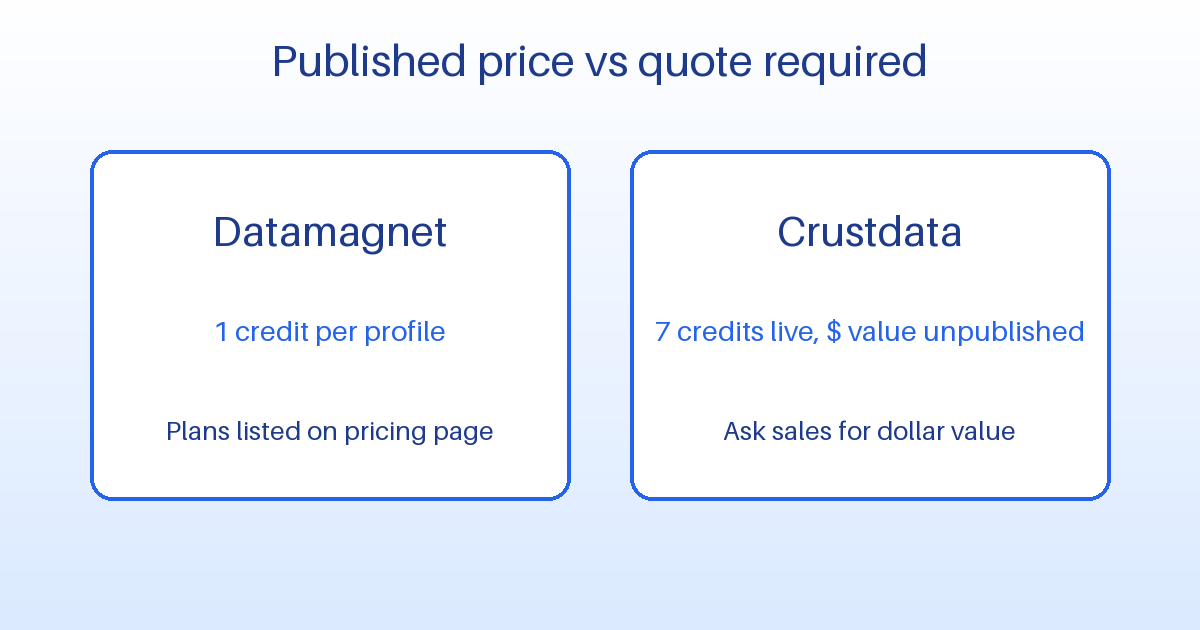
Datamagnet publishes its prices. A profile costs 1 credit, a search or engagement page costs 10 credits, and new accounts get 10 free credits. Plans run $39 (Starter), $99 (Pro) and $199 (Scale), which works out to $0.039, $0.0099 and $0.0080 per credit. Pay-as-you-go starts at $10 (Datamagnet pricing, 2026). So a live profile costs 1 credit, or about $0.04 on Starter and under a cent on Pro or Scale.
Compare that with Crustdata's 7 credits for a live profile. I can't turn those 7 credits into dollars, because Crustdata doesn't say what they're worth. That's the point of this section: with one vendor you can do the math today, and with the other you'll need a quote.
What Datamagnet does and doesn't cover:
- Live profiles and companies: the People API and Company API fetch LinkedIn data at request time. See the People profile docs for fields.
- Search: the ICP Search API returns decision-makers by title, seniority and industry.
- Signals: the Signal API monitors job changes and engagement. See the Create Signal docs.
- Gaps: Datamagnet isn't a contact-finding tool. The People API lists "email & phone where publicly available", but the People profile docs show email returned only when publicly visible and the phone field always null. There's also no job-listings endpoint. Crustdata offers dedicated contact add-ons and job search. If you need those, that's a real reason to pick Crustdata.
A note on sourcing. Datamagnet collects public profile data only. LinkedIn's User Agreement prohibits using bots or other unauthorized automated methods to access its services, and says LinkedIn may restrict, suspend or terminate accounts that breach it, so don't build pipelines around personal logins. That's a factual risk, not legal advice.
Who Should Pick Crustdata, and Who Shouldn't?
Pick Crustdata if you need contact add-ons, job search, watchers and a large indexed database from a single vendor, and you're fine negotiating. Look elsewhere if you need a fixed price per call on day one. Crustdata's free $20 is a sensible way to test match quality before any conversation.
If you're comparing a wider field, our pages on People Data Labs and ZoomInfo alternatives cover how database and seat-based pricing differ from pay-per-call.
Our bias is obvious, so here's the honest test: ask both vendors for a cost on 10,000 enriched profiles. If one answers with a number and the other with a meeting, that tells you how the next year of invoices will feel.
Final verdict: 7 out of 10. Broad endpoints and fair empty-result rules, held back by unpublished credit values and plan-gated real-time features.
Frequently Asked Questions
How much does the Crustdata API cost?
Crustdata doesn't publish a dollar price per credit. New accounts get $20 in free credits, and Enterprise starts at four figures per month (Crustdata pricing, 2026). Endpoint costs are public in credits, such as 1 credit for a base person profile and 7 for a live one. Ask for a quote to convert credits to dollars.
Does Crustdata offer a free trial?
Yes. Crustdata gives new accounts $20 in free credits, which you can spend on self-serve endpoints. That's enough to test match rates on a sample list. One third-party review claims a permanent free tier, but Crustdata's own page describes trial credits, so rely on that wording and confirm at signup.
What is the difference between Crustdata's database and real-time APIs?
Database endpoints query Crustdata's indexed data and cost less, such as 1 credit for a base person profile. Real-time endpoints fetch data live from the web and cost more, such as 7 credits for a live person profile (Crustdata docs, 2026). Several real-time endpoints are plan-gated or enterprise-only.
Can you get a flat dollar price for live LinkedIn data elsewhere?
Yes. Datamagnet charges 1 credit per profile. Pay-as-you-go starts at $10, and plans at $39, $99 and $199 work out to $0.039, $0.0099 and $0.0080 per credit (Datamagnet pricing, 2026). Email appears only where publicly visible and phone isn't returned. If you need profiles, companies, search and signals, you can price a project upfront.
