
Disclosure: Datamagnet publishes this article. Coresignal and Crustdata are third-party vendors; pricing and product claims below are self-reported by each company based on public documentation, retrieved September 23, 2026.
Coresignal vs Crustdata: Datasets or Real-Time Data?
Coresignal and Crustdata solve the same problem - getting company and people data out of LinkedIn and onto your team's desk - in almost opposite ways. Coresignal built its business on bulk datasets and a database API you query against a stored snapshot. Crustdata built its business on live, request-time lookups and a credits-only pricing model with no public dollar figures.
Which one is right for you depends on whether you need millions of records at once or a handful of accurate profiles the moment you ask for them. This comparison walks through coverage, freshness, API design, and pricing for both, using only figures each vendor publishes on its own site.
Key Takeaways
- Coresignal claims 70M+ companies, 907M+ employees, and 482M+ job postings across its datasets (Coresignal, retrieved 2026-09-23); Crustdata claims 1B+ people profiles, with company counts ranging 60M-200M+ across its own pages.
- Coresignal publishes clear dollar pricing from $49/month to $5,000/month; Crustdata publishes credit costs per endpoint but no public dollar amounts.
- B2B contact data decays roughly 2.1% a month - about 22.5% a year (HubSpot, Database Decay Simulation, retrieved 2026-09-23), which is the core argument for real-time lookups over static snapshots.
- Choose Coresignal if you need a large bulk dataset to load into a warehouse. Choose Crustdata if you need live, on-demand API lookups. Choose Datamagnet if you want live LinkedIn profile data at a fixed, transparent 1 credit per request.
What's the Core Difference Between Coresignal and Crustdata?
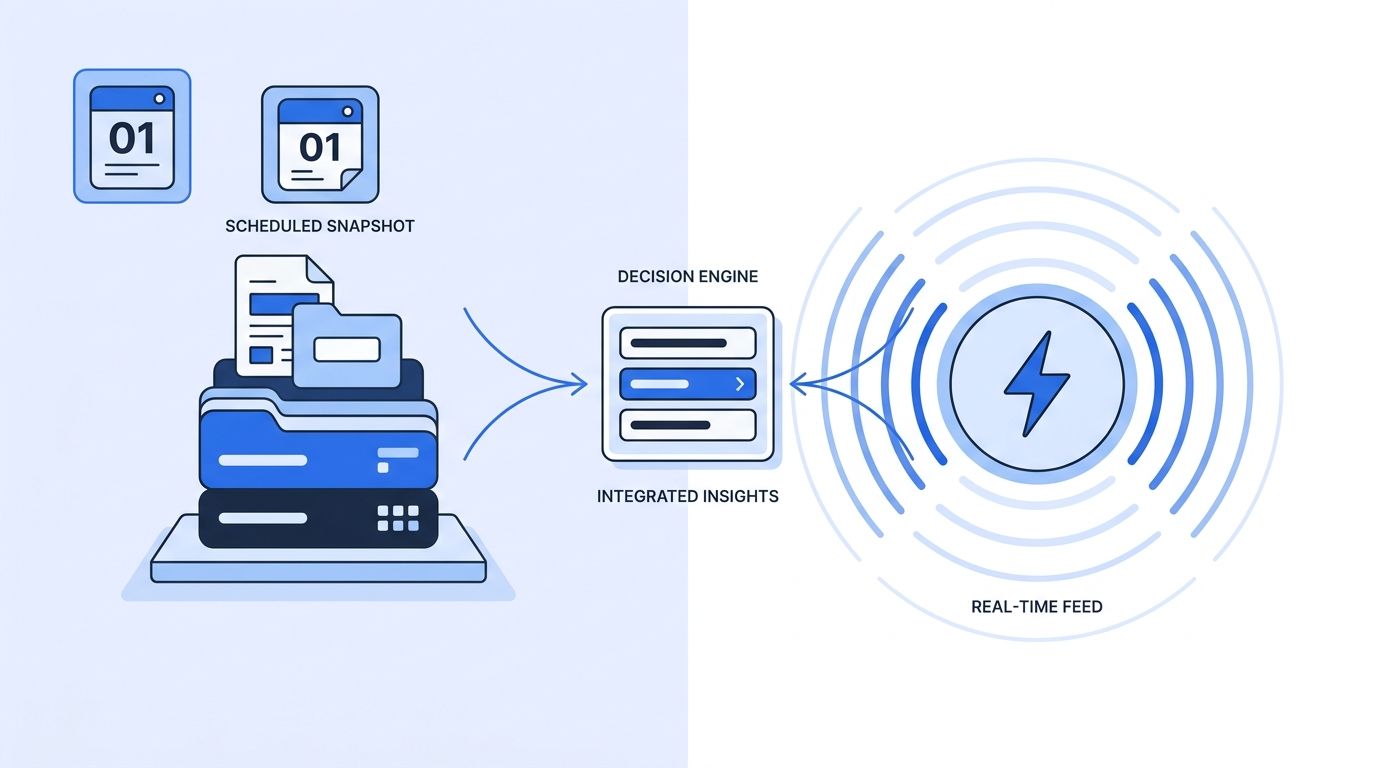
Coresignal is a dataset-and-database-API company; Crustdata is a real-time-API-first company, and that single distinction explains most of the differences in how you'd actually use each one. Coresignal's homepage now uses "real-time" language too, but its core product remains bulk exports (CSV, JSONL, Parquet) refreshed on a schedule, plus a database API that queries a stored copy of that data.
Crustdata flips the model. Its People Search and enrichment endpoints can query a continuously-refreshed database or pull directly from the live web at request time, and it ships a Watcher API that pushes alerts the moment a tracked record changes - a job change, a funding round, a hiring surge. Neither approach is wrong. They're built for different jobs: Coresignal for bulk analysis and warehouse loading, Crustdata for live enrichment inside a workflow.
Isn't the real question which one matches how your team actually uses the data - in batch, or one lookup at a time? That's the lens for every section below.
Which Has More Data Coverage?
Coresignal claims broader company and job coverage; Crustdata claims broader people coverage - and the two vendors don't even agree on their own numbers page to page, so treat every figure here as a vendor claim, not an audited count.
Coresignal's homepage lists 70M+ company records (500+ fields), 907M+ employee records (300+ fields), and 482M+ job postings (85+ fields), for 4.5B+ combined data records across sources (Coresignal, retrieved 2026-09-23). Crustdata's own pages claim 1B+ people profiles, with 550M+ profiles in its core database and 300M+ searchable via 60+ filters in-database versus 20+ filters for live web search (Crustdata, People Search API, retrieved 2026-09-23).
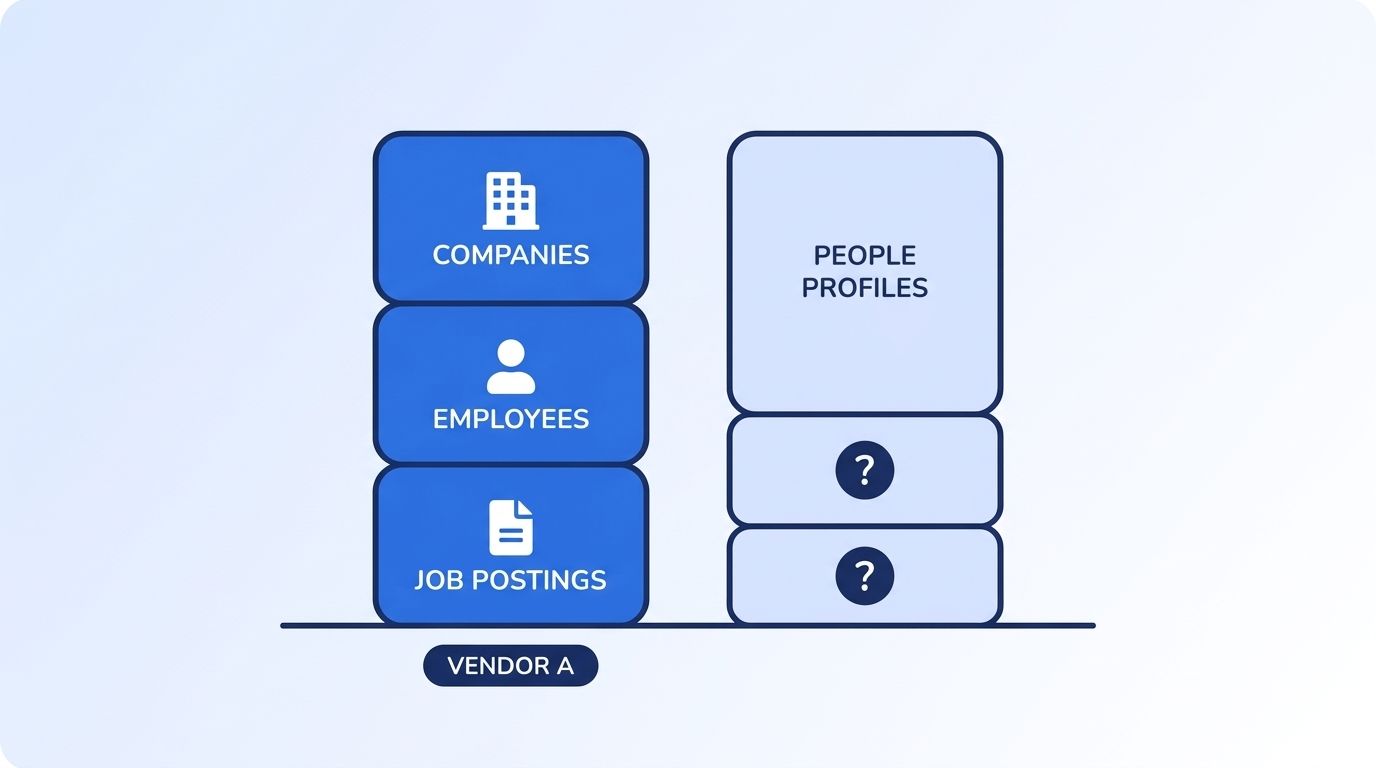
Crustdata's company-count claims are genuinely inconsistent - different pages on crustdata.com cite figures ranging from 60M to 200M+ companies. Coresignal's homepage numbers are internally consistent, but a lower third-party estimate elsewhere puts its employee count closer to 792M rather than 907M+. Neither discrepancy is disqualifying, but it means you should verify coverage for your specific market (industry, region, seniority) with a trial rather than trusting the headline number alone.
Verdict: Coresignal's numbers are more internally consistent; Crustdata claims the larger total pool but with a wider, unresolved range on company counts.
Which Delivers Fresher Data?
Crustdata wins on freshness because its architecture is built around request-time lookups, not a refresh schedule - though Coresignal has closed part of the gap by moving to a daily refresh cadence for company data (Coresignal, retrieved 2026-09-23). The difference shows up the moment a contact changes jobs: a snapshot is only as fresh as its last refresh, while a request-time lookup checks the live record every time you call it.
Coresignal states that multi-source company data is now delivered daily, with roughly 695M+ records refreshed monthly across its broader dataset library (Coresignal, retrieved 2026-09-23). That's meaningfully faster than a traditional quarterly data-broker refresh, but it's still a snapshot - the record you pull was accurate as of the last refresh cycle, not as of the moment you queried it.
Crustdata's People Search API can query the live web directly at request time instead of only a stored database, and its Watcher API pushes real-time alerts when a tracked profile changes (Crustdata, retrieved 2026-09-23). That matters because B2B contact data decays fast: business contact records decay roughly 2.1% a month, compounding to about 22.5% a year (HubSpot, Database Decay Simulation, retrieved 2026-09-23). A dataset refreshed monthly still carries weeks of accumulated decay by the time you act on it; a request-time lookup doesn't.
Citation capsule: B2B contact data goes stale at roughly 2.1% a month - about 22.5% a year - as people change jobs, titles, and companies. A dataset refreshed daily or monthly still carries days to weeks of accumulated decay between refresh cycles, while a request-time API lookup checks the record at the exact moment you use it, closing that gap entirely.
Verdict: Crustdata's request-time model beats any fixed refresh cycle for freshness, though Coresignal's daily company-data cadence is faster than most legacy dataset vendors.
Which Has the Better API?
Coresignal has the more mature, documented API surface; Crustdata's API is narrower but built API-first from day one. Coresignal backs that maturity with five dedicated endpoints and an average query response time of 176 ms (Coresignal, retrieved 2026-09-23), while Crustdata trades breadth for an API built around live lookups and agent integrations from the start.
Coresignal offers a Company API, Employee API, Jobs API, an Agentic Search API, and Elasticsearch DSL querying, with an average query response time of 176 ms (Coresignal, retrieved 2026-09-23). It also ships dedicated "Real-Time Employee API" and "Company Enrichment API" products for on-demand lookups by profile URL, separate from its bulk datasets (Coresignal, Company Enrichment API, retrieved 2026-09-23).
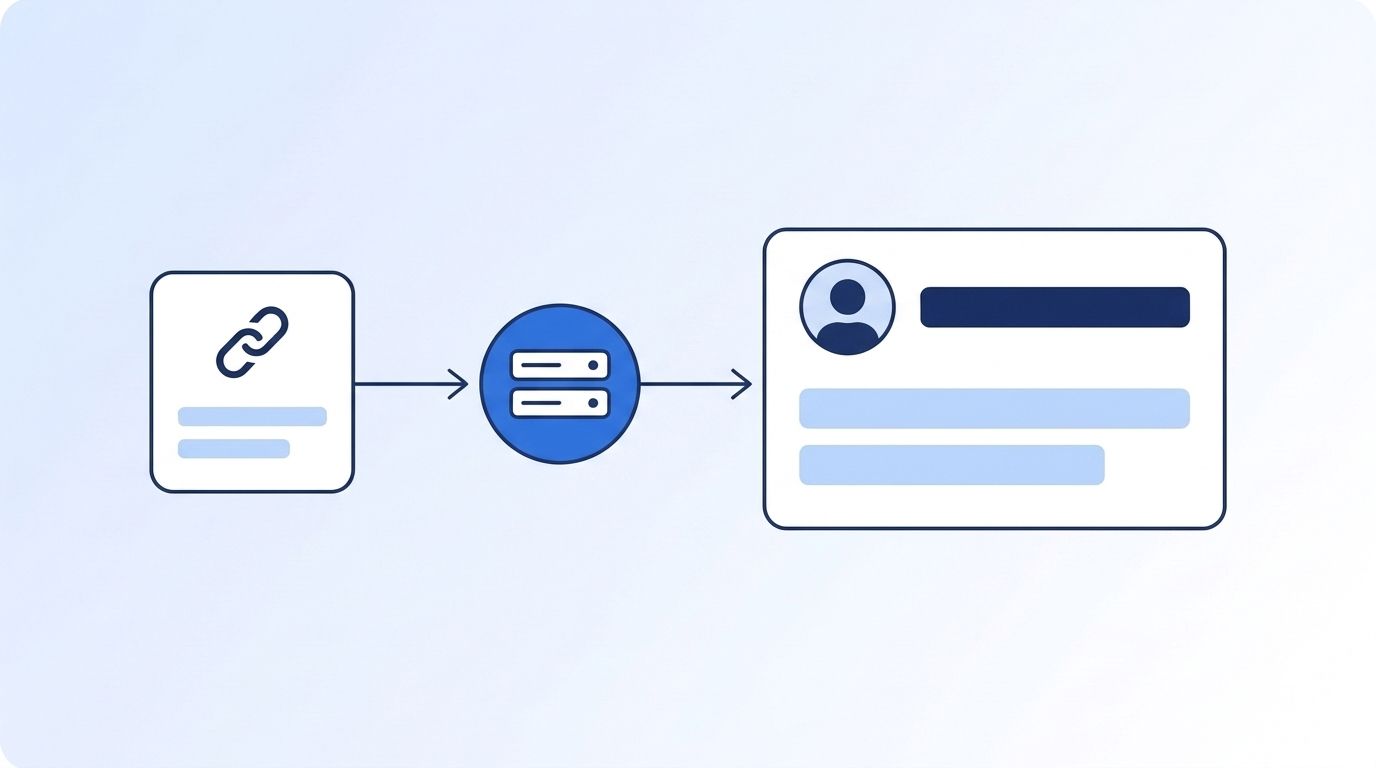
Crustdata's REST API covers Company Search/Discovery, People Search, People Enrichment, Jobs, Posts (LinkedIn post and engagement data), and the Watcher API for change alerts, plus an MCP (Model Context Protocol) integration for plugging the data graph directly into AI agents (Crustdata, retrieved 2026-09-23). That MCP support is a genuine differentiator for teams building agentic workflows rather than traditional dashboards.
If you'd rather skip the dataset-vs-database-API tradeoff entirely, Datamagnet's People Profile endpoint and Company Profile endpoint fetch a LinkedIn profile live at request time for a flat 1 credit, so every response reflects the page as it exists right now, not a cached record from a prior crawl.
Verdict: Coresignal wins on API breadth and documentation depth; Crustdata wins on agent-native integration with MCP support.
Which Has More Transparent Pricing?
Coresignal publishes exact dollar tiers; Crustdata publishes exact credit costs per endpoint but no dollar figures at all - and that difference alone might decide which one fits your procurement process. Coresignal's eight tiers run from $49 to $5,000 a month (Coresignal Pricing, retrieved 2026-09-23), while Crustdata requires a sales call to convert its published credit costs into a dollar budget.
Coresignal's pricing page lists eight tiers, from a free 7-day trial (2,000 credits) up to Elite at $5,000/month (10,000,000 credits), with roughly a 10% discount on annual plans (Coresignal Pricing, retrieved 2026-09-23):
| Plan | Price/mo | Credits | Rate limit |
|---|---|---|---|
| Free trial | $0 (7 days) | 2,000 | 5 req/s |
| Mini | $49 | 2,500 | 5 req/s |
| Starter | $199 | 12,000 | 5 req/s |
| Pro | $499 | 35,000 | 10 req/s |
| Growth | $1,000 | 150,000 | 20 req/s |
| Premium | $1,500 | 1,000,000 | 50 req/s |
| Scale | $3,000 | 4,000,000 | 100 req/s |
| Elite | $5,000 | 10,000,000 | 100+ req/s |
A single employee or company record costs 10 credits (20 for multi-source), a job posting costs 1 credit, and contact enrichment costs 20 credits. Full custom datasets are quote-based, starting around $1,000 for a smaller pull (Coresignal Pricing, retrieved 2026-09-23).
Crustdata's pricing page confirms credit-based usage tiers and an enterprise tier that's "contact our team" - with no dollar amounts published anywhere on the official pricing pages (Crustdata Pricing, retrieved 2026-09-23). Its docs do publish exact per-endpoint credit costs (Crustdata Pricing Docs, retrieved 2026-09-23):
| Endpoint | Credit cost |
|---|---|
| Person search | 0.03 credits/result |
| Person enrich | 1-7 credits/record |
| Person contact enrich | 1-5.5 credits/matched person |
| Company search | 0.03 credits/result |
| Company enrich | 2-4 credits/record |
| Live web search | 1 credit/query |
| Discovery watchers | 0.5-2 credits/new record |
| Entity watchers | 5-150 credits/changed entity |
Purchased Crustdata credits are valid for 12 months. Datamagnet checked Crustdata's pricing page and its pricing docs directly, and neither publishes a dollar figure anywhere - not a starting price, not a range, not an enterprise floor (Crustdata Pricing, retrieved 2026-09-23). If you see a specific dollar amount quoted for Crustdata elsewhere, it's a third-party estimate, not a vendor-confirmed price, and you should confirm the real number on a sales call before budgeting against it.

Verdict: Coresignal wins on pricing transparency for budget planning; Crustdata's per-endpoint credit costs are precise, but you'll need a sales call to convert them to a dollar budget.
Who Should Choose What?
If you need to load millions of records into a warehouse for offline analysis, choose Coresignal. Its dataset exports and documented dollar tiers make budgeting straightforward, and 4.5B+ combined records give you volume for training models or building an internal database.
If you're building an AI agent or a live enrichment workflow and want request-time freshness, choose Crustdata. Its MCP integration and live web search mode are built for exactly that use case, even though you'll need a sales conversation to pin down actual dollar costs.
If you want live LinkedIn profile data without committing to either a bulk dataset or an opaque credit system, choose Datamagnet. For teams evaluating Coresignal alternatives that don't want to manage refresh cycles, or a Crustdata alternative with simpler, flat per-request pricing, Datamagnet fetches a LinkedIn person or company profile live at request time for 1 credit.

Datamagnet also covers ICP and Sales Navigator URL search, LinkedIn post engagement data, and job-change signals delivered via webhook - but it does not return emails or phone numbers, so teams that need contact-level data will still need a separate enrichment source for that piece.
Where Datamagnet Fits Between the Two
Datamagnet sits closer to Crustdata's request-time model than to Coresignal's dataset model, but with a simpler pricing structure: every People Profile or Company Profile lookup costs a flat 1 credit, fetched live, rather than a variable credit range that depends on which fields you request.
<!-- [UNIQUE INSIGHT] -->The dataset-vs-real-time framing usually gets presented as a binary choice, but the honest answer is that most GTM teams need both at different points in the funnel. A dataset is fine for building a target account list once a quarter. The moment a rep is about to send an email, though, that record needs to be checked against the live page - not the January snapshot - because a two-word "current employer" change can sink the whole message.
That's the gap real-time APIs close. Whether you fill it with Crustdata's broader agent-oriented toolkit or Datamagnet's simpler flat-rate profile and company lookups depends on how much of your workflow is already agent-driven versus rep-driven.
Frequently Asked Questions
These are the questions GTM and RevOps teams ask most often when weighing Coresignal's bulk datasets against Crustdata's request-time API. Answers below cite the same vendor pricing pages, coverage figures, and documentation used throughout this comparison, all retrieved September 23, 2026, so you can verify each claim against the vendor's own site before you commit budget.
Is Coresignal better than Crustdata?
Neither is universally better - they're built for different jobs. Coresignal wins for teams that need bulk datasets and documented dollar pricing ($49-$5,000/month across 8 tiers). Crustdata wins for teams that need live, request-time lookups and agent-native MCP support, though its pricing is credits-only with no public dollar figures.
Does Crustdata publish dollar pricing anywhere?
No. As of September 2026, Crustdata's official pricing page and docs publish exact credit costs per endpoint (for example, 0.03 credits per search result, 1-7 credits per person enrichment) but no dollar amounts. Enterprise pricing requires contacting their sales team directly.
How much data coverage do Coresignal and Crustdata each claim?
Coresignal claims 70M+ companies, 907M+ employees, and 482M+ job postings (4.5B+ total records). Crustdata claims 1B+ people profiles, with company counts ranging 60M-200M+ across its own pages - a range you should verify for your specific market before committing.
Can I get real-time LinkedIn profile data without buying a bulk dataset?
Yes. Crustdata's People Search API and Datamagnet's People Profile endpoint both fetch data at request time rather than requiring a bulk dataset purchase. Datamagnet charges a flat 1 credit per profile lookup with no tiered credit-cost variation by field.
Which is better for AI agents, Coresignal or Crustdata?
Crustdata has a specific edge here: its MCP (Model Context Protocol) integration is built for dropping its data graph directly into AI agent workflows. Coresignal offers an Agentic Search API and Elasticsearch DSL querying, which suits agents that need to query a large stored dataset rather than pull live web data.
The Bottom Line
| Category | Winner |
|---|---|
| Data coverage | Coresignal (more consistent figures) |
| Freshness | Crustdata |
| API breadth | Coresignal |
| Agent-native integration | Crustdata |
| Pricing transparency | Coresignal |
| Overall | Depends on workflow: Coresignal for bulk/warehouse use, Crustdata for live/agent use |
Coresignal and Crustdata aren't really competing for the same buyer - one sells you a dataset, the other sells you a live connection. If your team needs millions of records for offline analysis, Coresignal's documented pricing and dataset breadth make budgeting easier. If your workflow depends on catching a job change or a fresh profile the moment it happens, Crustdata's real-time architecture fits better, credits-only pricing and all. See how Datamagnet's live LinkedIn API compares on pricing and coverage - check the current field list against your own use case before you commit to a contract.
Sources
- Coresignal, Homepage, retrieved 2026-09-23, https://coresignal.com/
- Coresignal, Pricing, retrieved 2026-09-23, https://coresignal.com/pricing/
- Coresignal, Company Dataset, retrieved 2026-09-23, https://coresignal.com/company-dataset/
- Coresignal, Company Enrichment API, retrieved 2026-09-23, https://coresignal.com/solutions/company-enrichment-api/
- Crustdata, Homepage, retrieved 2026-09-23, https://crustdata.com/
- Crustdata, People Search API, retrieved 2026-09-23, https://crustdata.com/apis/people-discovery
- Crustdata, Pricing, retrieved 2026-09-23, https://crustdata.com/pricing
- Crustdata, Pricing Docs, retrieved 2026-09-23, https://docs.crustdata.com/general/pricing
- HubSpot, Database Decay Simulation, retrieved 2026-09-23, https://www.hubspot.com/database-decay
- Datamagnet, People Profile endpoint, retrieved 2026-09-23, https://docs.datamagnet.co/api-reference/endpoints/people
- Datamagnet, Company Profile endpoint, retrieved 2026-09-23, https://docs.datamagnet.co/api-reference/endpoints/company
