
Disclosure: This article is published by Datamagnet. Vendor claims are self-reported unless otherwise noted.
9 Best Signal Data Platforms for Job Changes and Funding Events (2026)
A new VP doesn't wait long to touch the tool stack. Average SaaS spend climbs 20% in the six months after a company raises a round, and teams add 2-4 new tools within the first 90 days (Cledara, 2025). If you're not watching for that window, a competitor is.
Signal data platforms exist to catch these two moments — a champion changing jobs, a target account closing a funding round — before your competitors do. Picking the wrong one means stale alerts, missing companies, or a workflow that never actually reaches your CRM. We compared 9 platforms on data freshness, job-change and funding coverage, and how each one gets an alert into your hands.
Key Takeaways
- SaaS spend rises 20% in the 6 months after a funding round, and buying teams add 2-4 new tools in the first 90 days (Cledara, 2025).
- North American startup funding hit $280 billion in 2025, up 46% year-over-year — more accounts triggering funding signals than any year since 2021 (Crunchbase News, 2026).
- Datamagnet, ZoomInfo, Apollo, and 6 other platforms take very different approaches — live API vs. static database vs. bulk dataset — and that choice determines how fast a signal reaches you.
- Response speed compounds the value of any signal: qualification odds drop 21-fold when follow-up stretches from 5 to 30 minutes (Lead Response Management Study, Kellogg School of Management).
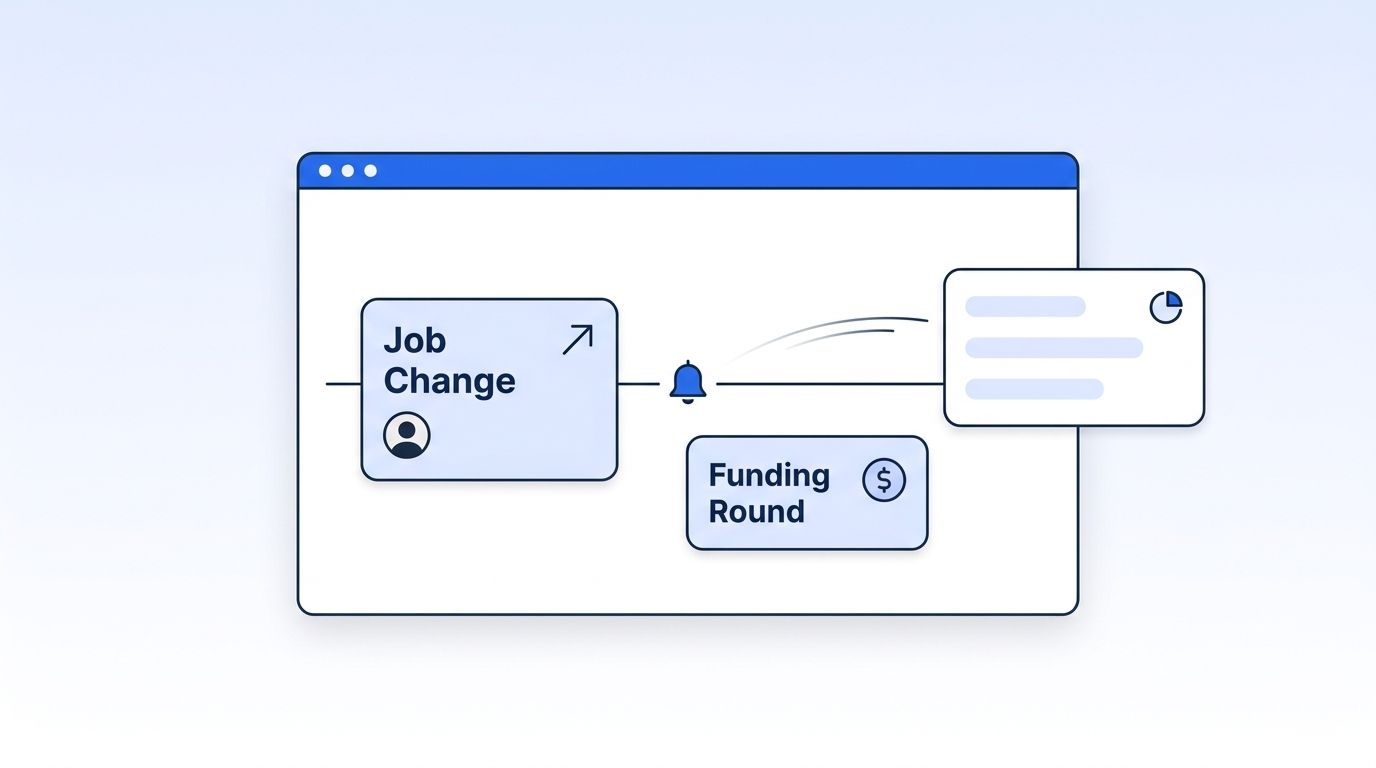
Why Are Job Changes and Funding Events the Sharpest Buying Signals You Have?
A champion who changes jobs doesn't bring your product with them by default. In fact, 91% of past buyers don't repurchase on their own after moving to a new company, even three months into the new role (UserGems, 2023). That's not a reason to ignore job-change signals — it's the reason to automate them, since almost nobody re-engages without a nudge.
Funding events work the opposite way: they don't need a nudge, they need speed. In 2025, North American startups raised $280 billion, a 46% jump over the prior year, with roughly 60% of that flowing into AI-related companies (Crunchbase News, 2026). Every one of those rounds triggers a predictable spending curve in the following months.
<!-- [UNIQUE INSIGHT] -->Most sales teams treat job-change and funding alerts as two separate feeds. Stack them and you get something sharper: a former champion who just moved into a newly-funded company is both a warm re-entry point and a budget event at the same time — a combination almost no outbound list captures on its own.
How Did We Compare These Platforms?
We evaluated 9 platforms that surface job-change or funding-event data, drawing on each vendor's published documentation, pricing pages, and product changelogs rather than marketing copy alone. Four criteria mattered most: data freshness, meaning whether the data is pulled live at request time or served from a periodic snapshot; signal coverage, meaning whether the platform tracks job changes, funding events, or both; delivery mechanism, meaning whether an alert arrives by webhook, API poll, or manual export; and integration depth, meaning how directly an alert reaches a CRM or outbound tool.
- Data freshness — is the data pulled live at request time, or served from a periodic snapshot?
- Signal coverage — does the platform track job changes, funding events, or both?
- Delivery mechanism — webhook, API poll, or manual export?
- Integration depth — how directly does an alert reach a CRM or outbound tool?
Talk to enough revenue teams and a pattern shows up fast: the platforms that fail aren't the ones with bad data, they're the ones with no workflow waiting when the alert fires. A funding signal that sits in an inbox for three days isn't a signal anymore. That's why delivery mechanism carries as much weight below as raw data coverage does.
1. Datamagnet — Why Is It Best for Real-Time Job-Change and Funding Signals via API?
Datamagnet fetches LinkedIn company and people data live at request time instead of serving it from a static, periodically-refreshed database. That distinction matters most for job-change and funding signals, where a stale snapshot means you're alerted to news your competitor already acted on. Its Signal API monitors LinkedIn profiles for job changes alongside company-level engagement, and pairs that with a dedicated funding rounds endpoint that returns a company's Crunchbase funding history — round type, amount, and announcement date — by domain. Alerts deliver through signed webhooks, so a job change or new round can land directly in a CRM workflow without a manual export step.
Best for: Sales, recruiting, and RevOps teams that want job-change and funding signals in the same API instead of stitching together two separate vendors.
Key feature: Six signal types in one account — job change, new post, and four engagement-based signals — so a champion tracker and a funding-event feed run off the same infrastructure.
Pricing: Pay-as-you-go credits with a free tier to start; no annual seat contract required.
2. ZoomInfo — Why Is It Best for Enterprise Teams Already Standardized on a Data Platform?
ZoomInfo runs on a large, seat-licensed contact database rather than a live, request-time API, which makes it a familiar fit for enterprise teams that already budget for an annual data contract. It bundles job-change and funding alerts inside a broader sales intelligence suite that also covers intent data, org charts, and technographics, all accessible from one login, which suits teams that want one vendor covering the whole stack rather than a single-purpose signal tool.
Best for: Large sales orgs that want one vendor covering contact data, intent signals, and job-change alerts under a single enterprise agreement. See our full ZoomInfo comparison for how the data-freshness model differs from a request-time API.
Key feature: Org chart visualization layered on top of job-change alerts, useful for mapping a champion's new reporting line after a move.
Pricing: Custom, seat-based enterprise contracts — pricing isn't published and typically requires a sales call.
3. Apollo.io — Why Is It Best for SMB Sales Teams Wanting Signals and Outbound in One Tool?
Apollo pairs a large static contact database with built-in sequencing, so job-change alerts can trigger an outbound sequence without leaving the platform. Job-change tracking, buying-intent scores, and email/call sequencing all live in one workspace, which keeps smaller sales teams from paying for a separate outbound tool on top of a data vendor, and it fits teams that want signal-triggered outreach without stitching two products together.
Best for: Smaller sales teams that want signal-triggered outbound without stitching together a data API and a separate sequencer. Our Apollo comparison breaks down where a live API adds coverage a static database can miss.
Key feature: Signal-to-sequence automation — a detected job change can auto-enroll a contact into an existing outreach cadence.
Pricing: Public self-serve plans starting free, with paid tiers scaling by seat and credit usage.
4. Clearbit (Now HubSpot Breeze) — Why Is It Best for HubSpot-Native Teams?
Clearbit was acquired by HubSpot and rebranded as part of HubSpot Breeze, so its job-change and firmographic data now lives natively inside the HubSpot ecosystem rather than as a standalone product. For teams already running marketing, sales, and service on HubSpot, Breeze enrichment surfaces job-change and company data directly on contact and company records without a separate integration, which removes a step that a bolt-on data vendor would otherwise add.
Best for: HubSpot-first GTM teams that want enrichment baked into the CRM they already use daily. See our Clearbit alternative breakdown for what a standalone, API-first option adds back.
Key feature: Native HubSpot workflow triggers off enrichment fields, no middleware required.
Pricing: Bundled into HubSpot's paid tiers; no longer sold as a standalone product.
5. Bright Data — Why Is It Best for Custom Scraping Infrastructure at Scale?
Bright Data is built for teams that want to construct their own job-change or funding-event pipeline rather than consume a pre-built signal product. Purpose-built collection endpoints and a broad proxy network give data teams the raw infrastructure to build custom monitors, including for LinkedIn job-change and company data, without maintaining scraping infrastructure in-house, which suits engineering teams more than reps who just want a finished alert.
Best for: Data engineering teams that want to build a proprietary signal pipeline on top of raw collection infrastructure. Our Bright Data comparison covers where a finished, purpose-built API saves that build time.
Key feature: Configurable collection endpoints that can be pointed at a wide range of data sources beyond LinkedIn.
Pricing: Usage-based, pay-as-you-go pricing tied to data volume and endpoint type.
6. Coresignal — Why Is It Best for Bulk Dataset and Data Science Use Cases?
Coresignal serves periodic database snapshots rather than live, request-time lookups, which suits data science teams building models on top of large historical datasets more than reps who need same-day alerts. Bulk access to structured LinkedIn-sourced datasets makes Coresignal a fit for teams training models or running batch analysis rather than triggering real-time outreach, so it trades alert speed for dataset breadth and historical depth.
Best for: Data science and analytics teams doing bulk analysis where a same-day alert matters less than dataset breadth. See our Coresignal comparison for the live-vs-snapshot tradeoff in more detail.
Key feature: Large historical dataset exports designed for offline analysis and model training.
Pricing: Enterprise, volume-based licensing — custom quote required.
7. People Data Labs — Why Is It Best for Large-Scale Enrichment Pipelines?
People Data Labs offers a large static, multi-billion-record database built for enrichment at scale rather than real-time, request-time signal detection. Broad global coverage and a straightforward enrichment API make it a common backend choice for products that need to enrich records in bulk, including job-history fields useful for detecting past changes, which fits an engineering build more than a plug-and-play alert feed.
Best for: Engineering teams building enrichment into their own product rather than buying a finished signal-alerting tool. Our People Data Labs comparison covers what request-time freshness adds for time-sensitive signals.
Key feature: Multi-billion-record global database accessible via a straightforward enrichment API.
Pricing: Usage-based credits, with published starting tiers for lower-volume use.
8. EnrichLayer — Why Is It Best for Teams Migrating Off Proxycurl?
EnrichLayer picked up where Proxycurl left off after that product shut down, offering request-time LinkedIn data for teams that built workflows around the Proxycurl model. For teams with existing Proxycurl integrations, EnrichLayer offers the closest like-for-like migration path with a similar request-time data model, so a switch mostly means repointing existing calls rather than rebuilding an integration from scratch.
Best for: Teams that already built on Proxycurl and need a drop-in replacement rather than a full integration rebuild. Our EnrichLayer migration comparison covers where post-engagement and signal features go beyond what Proxycurl offered.
Key feature: Request-time LinkedIn person and company lookups designed to mirror the Proxycurl endpoint structure.
Pricing: Credit-based, pay-as-you-go pricing similar to the legacy Proxycurl model.
9. ScrapIn — Why Is It Best for Lightweight LinkedIn Data Pulls?
ScrapIn fetches LinkedIn data live, similar to Datamagnet's request-time model, but with a narrower endpoint set focused on core profile and company lookups. A simpler API surface makes ScrapIn a reasonable fit for teams that need straightforward, live LinkedIn lookups without a large feature set to configure, which trades breadth of signal types for a lighter integration.
Best for: Small teams or side projects that need occasional live LinkedIn pulls rather than an always-on signal-monitoring system. See our ScrapIn comparison for where post engagement, ICP search, and funding data extend beyond a basic lookup API.
Key feature: Live data fetching with a smaller, more focused endpoint catalog.
Pricing: Credit-based pricing scaled to request volume.
How Do These Platforms Compare?
| Platform | Best For | Data Model | Job-Change Signals | Funding Signals | Pricing Model |
|---|---|---|---|---|---|
| Datamagnet | Real-time API for both signal types | Live, request-time | Yes (webhook) | Yes (dedicated endpoint) | Pay-as-you-go credits |
| ZoomInfo | Enterprise, all-in-one suite | Seat-licensed database | Yes | Yes | Custom enterprise |
| Apollo.io | SMB signals + outbound | Static database | Yes | Partial | Self-serve seats/credits |
| Clearbit (HubSpot Breeze) | HubSpot-native teams | Static database | Yes | Partial | Bundled in HubSpot |
| Bright Data | Custom pipeline building | Configurable collection | Buildable | Buildable | Usage-based |
| Coresignal | Bulk dataset / data science | Periodic snapshot | Yes (batch) | No | Enterprise license |
| People Data Labs | Enrichment pipelines | Static database | Historical only | No | Usage-based credits |
| EnrichLayer | Proxycurl migration | Live, request-time | Yes | No | Credit-based |
| ScrapIn | Lightweight LinkedIn pulls | Live, request-time | Yes | No | Credit-based |
Frequently Asked Questions
What's the difference between a signal data platform and a static contact database?
A signal platform monitors for changes — a new job, a funding round, a new post — and alerts you when they happen. A static database is a snapshot refreshed periodically. In 2025, that gap matters more: SaaS spend rises 20% within 6 months of a raise, and a stale database won't flag the window while it's open (Cledara, 2025).
Which signal matters more for B2B sales — job changes or funding events?
Neither wins outright; they answer different questions. A job change tells you a relationship moved. A funding event tells you a budget just opened. Since 91% of past champions don't repurchase on their own after a move (UserGems, 2023), job-change signals need an automated nudge more than funding signals do.
How fast do I need to act on a job-change or funding signal?
Fast. Qualification odds fall fourfold between a 5- and 10-minute response gap, and 21-fold by the 30-minute mark (Lead Response Management Study, Kellogg School of Management). A signal platform with webhook delivery closes that gap; one that requires a manual CSV export usually doesn't.
Can I combine job-change and funding signals in one automated workflow?
Yes, if the platform delivers both through the same API or webhook system. Datamagnet's signal creation endpoint lets a team configure a job-change monitor and pull funding data by domain from the same account, instead of reconciling two separate vendor feeds by hand.
Do signal data platforms replace my CRM?
No. A signal platform detects and delivers the event; your CRM still owns the record, the pipeline stage, and the follow-up task. The platforms above differ mainly in how directly they hand that event to your CRM — a live webhook is a more direct handoff than a scheduled export file.
What's the Bottom Line?
Datamagnet wins on breadth for teams that want job-change and funding signals from one live API instead of two vendors. ZoomInfo or Apollo make sense if you already run your whole GTM stack through them. If your team is building a custom data pipeline, Bright Data, Coresignal, or People Data Labs give you the raw infrastructure instead of a finished alert product.
Whichever you pick, the platform matters less than the workflow behind it. A job-change or funding alert that sits unread for three days isn't a signal — it's just old news with better formatting.
Ready to see live job-change and funding signals in your own account? Explore the Datamagnet Signal API and get 10 free credits to test it against your own target list.
Sources
- Cledara, "The effects of funding on software spend," retrieved 2026-07-22, https://www.cledara.com/blog/funding-on-software-spend
- Crunchbase News, "North American Startup Funding Soared 46% In 2025, Driven By AI Boom," retrieved 2026-07-22, https://news.crunchbase.com/venture/north-american-startup-funding-2025-data-ai-us-investment/
- UserGems, "UserGems Sheds Light on Revenue Potential of 'Forgotten Champions' in New Research," retrieved 2026-07-22, https://www.usergems.com/news/usergems-sheds-light-on-revenue-potential-of-forgotten-champions
- Mordor Intelligence, "Sales Intelligence Market Size, Growth, Share & Industry Report," retrieved 2026-07-22, https://www.mordorintelligence.com/industry-reports/sales-intelligence-market
- Lead Response Management Study, Dr. James Oldroyd with InsideSales.com and Kellogg School of Management, Northwestern University, retrieved 2026-07-22, https://www.leadresponsemanagement.org/lrm_study/
