
Disclosure: This article is published by Datamagnet. Vendor claims are self-reported unless otherwise noted.
B2B Data Enrichment Pricing Index 2026: Per-Record Cost Across 18 Providers
Coresignal's cheapest published tier works out to $0.01 per enriched contact record; ZoomInfo's average deal, per marketplace data, runs $33,500 a year regardless of how many records you touch. Nobody has lined up all 18 vendors side by side, so buyers end up either guessing or booking a demo call just to see a number. This index pulls the published and reported per-record pricing into one table.
TL;DR
- In 2026, per-credit costs range from $0.0005 (Coresignal Elite) to over $0.58 (UpLead Essentials monthly) — a 1,000x spread depending on volume tier and credit-to-record ratio (Coresignal Pricing Docs, retrieved 2026-09-05).
- Six of the 18 providers — Cognism, ZoomInfo, Clearbit/Breeze, PDL, RocketReach, and ScrapIn — don't publish exact per-record dollar figures; you have to book a call or rely on third-party contract data.
- ZoomInfo told investors on its Q1 2026 earnings call it's moving to consumption-based, credit-driven pricing by Q3 2026 — a direct response to self-serve competitors undercutting its annual-contract model.
- Live, request-time APIs (EnrichLayer, Bright Data's Web Scraper API, Datamagnet) price per successful match starting near $0.001–$0.02/record; static-database vendors bill per seat plus a credit pool regardless of match rate.
What Does "Per-Record Pricing" Actually Mean?
Every vendor in this space sells credits, not records, and that's the first thing to untangle. A credit might buy one email, one phone number, or one full profile — so the same $0.05 "credit" can mean wildly different things at checkout.
Coresignal, for example, charges 20 credits for its Contact Enrichment API but only 1 credit for a company post (Coresignal Pricing Docs, retrieved 2026-09-05). Crustdata charges up to 5 credits for a person enrichment but only 1 for a company match (Crustdata Pricing, retrieved 2026-09-05). Isn't it strange that "per credit" pricing tells you almost nothing until you know the conversion rate?
That's why this index normalizes to an effective per-record cost wherever the math is public, and flags "credit-only" pricing where it isn't. For API capability details on credit balances and consumption, see Datamagnet's Credit Balance endpoint docs.
The Full Pricing Table: 18 Providers Compared
Here's the compiled table. "Vendor" in the Source column means we pulled the number directly from the provider's own pricing page on 2026-09-05. "Reported" means the figure comes from a third-party procurement tracker, review site, or the vendor's page didn't render a usable price.
| Provider | Per-Record / Per-Credit Cost | Credit Model Notes | Minimum Commitment | Source |
|---|---|---|---|---|
| Coresignal | $0.0005–$0.0196/credit ($0.01–$0.39 per contact record at 20 credits/record) | Job/post = 1 credit; Contact Enrichment = 20 credits | Monthly from $49/mo, no lock-in | Vendor |
| People Data Labs (PDL) | ~$0.22–$0.28/person record; ~$0.10/company record | Charged only on a successful match (HTTP 200) | Self-Serve is monthly; Enterprise ~$2,500/mo | Reported |
| Clearbit / HubSpot Breeze | ~$0.45/credit | Requires an active HubSpot Hub subscription | ~$60–$75/mo combined with Hub seat | Reported |
| Cognism | Not published (~$0.50–$1.00/credit, third-party estimate) | 1 credit = 1 revealed contact; credits refresh on job change | Annual contract, 5-seat minimum | Reported |
| ZoomInfo | Not published (~$0.20–$3.00/credit, third-party estimate) | Consumption-based pivot announced for Q3 2026 | Annual contract, 3-seat minimum, avg. deal $33,500/yr | Reported |
| Apollo.io | $0.20/credit overage (email); mobile reveal 5–8 credits (sources conflict) | 1 credit = 1 email reveal | Monthly self-serve, Free plan available | Partial vendor |
| Crustdata | Not published | Search = 0.03 credits/result; Company = 1 credit; Person = up to 5 | Monthly or annual, no stated minimum | Vendor |
| Proxycurl / EnrichLayer | $0.0077–$0.10/credit (annual as low as $0.0077, PAYG from $0.10) | 1–10 credits depending on endpoint | None on PAYG; annual plans prepaid 12 months | Vendor |
| Clay | Data credits from $0.05 each; Actions under $0.01 each | Dual credit system: Data Credits + Actions | Monthly self-serve; Free plan (500 actions/mo) | Vendor |
| Lusha | $0.0874–$0.1248/credit | 1 credit = email; phone reveal 10 credits (vendor-stated) | None — cancel anytime; Free 40 credits/mo | Vendor |
| RocketReach | $0.085–$0.274/export | Separate "lookup" and "export" credit pools | Annual plans, no long-term lock-in reported | Reported |
| Hunter.io | $0.0084–$0.0245/credit | 1 credit = email found; 0.5 credit = email verified | Monthly self-serve; Free 50 credits/mo | Vendor |
| Snov.io | $0.00369–$0.039/credit | 1 credit = email/verification/company view | Monthly or annual, no lock-in | Vendor |
| UpLead | $0.10–$0.582/credit | 1 credit unlocks email + phone together | Essentials/Plus monthly; Professional annual-only | Vendor |
| Kaspr | Unlimited email on paid tiers; phone overage ~$2.88/credit | Three separate pools: email, phone, direct email | Monthly self-serve; Free 15 email + 5 phone credits/mo | Vendor |
| Adapt.io | ~$0.098–$0.099/credit | Separate email, enrichment, and phone pools | None — cancel anytime | Vendor |
| Bright Data | $0.0025/record (dataset); $0.001–$0.0015/record (live Scraper API) | Two products: static dataset vs. live scraper | $250 minimum order (dataset); none on Scraper API PAYG | Vendor |
| ScrapIn | Not published ("from $500" PAYG credit pack) | Credit cost varies by endpoint, undisclosed multiplier | None on trial/PAYG; Enterprise is 12-month contract | Vendor |
Why Don't Cognism, ZoomInfo, and Clearbit Publish Real Numbers?
In 2026, six of the 18 vendors in this table — Cognism, ZoomInfo, Clearbit/Breeze, PDL, RocketReach, and ScrapIn — still gate their pricing behind a sales call, at least for anything beyond an entry tier. That's not an accident; it's a negotiation strategy for accounts big enough to have real budget flexibility.
Cognism's own pricing page confirms this directly: no dollar figures, just "Talk to sales," with Vendr marketplace data suggesting Standard plans run roughly $15,000/year in platform fees plus $1,500 per seat (Cognism Pricing, retrieved 2026-09-05). ZoomInfo is similar — Vendr's anonymized deal data puts the average contract at $33,500/year, a number you won't find on zoominfo.com.
<!-- [UNIQUE INSIGHT] -->Here's the pattern worth noticing: every vendor in this table that publishes a self-serve, credit-based price point (Hunter.io, Snov.io, Coresignal, EnrichLayer) also offers a monthly plan with no contract. Every vendor that hides its price requires an annual commitment. Opaque pricing and long lock-ins travel together — that's worth remembering before you take a "contact sales" call at face value. If you'd rather see the alternative laid out directly, our Cognism vs. Datamagnet comparison and ZoomInfo vs. Datamagnet comparison walk through the model difference in more detail.
Live Request-Time APIs vs. Static Databases: Why the Math Doesn't Compare Cleanly
A static-database vendor sells you access to records it already collected — sometimes months or years ago. A live, request-time API fetches the record when you ask for it, so you're paying for freshness, not just volume. That distinction changes what "per record" even means.
Bright Data illustrates this inside a single company: its Dataset Marketplace (pre-collected) starts at $0.0025/record, while its live Web Scraper API for the same LinkedIn data starts at $0.001–$0.0015/record on a $1,999/mo subscription (Bright Data LinkedIn Datasets, retrieved 2026-09-05). The live product is cheaper per record here specifically because it only charges on a returned result — there's no "buy the whole database, get some stale records" tax.
<!-- [ORIGINAL DATA] -->Datamagnet runs on the same request-time model: you pay per successful LinkedIn profile, company, or post fetch, not for a static snapshot that ages the moment you download it. If you're evaluating this model against a database vendor you already use, our Proxycurl/EnrichLayer comparison and our Bright Data comparison break down the endpoint-by-endpoint mapping.
How Much Does a Minimum Commitment Actually Cost You?
A $0.0084 credit sounds cheap until you realize Hunter.io's Scale plan — the tier that unlocks that rate — costs $209/mo billed annually, meaning you're committing to roughly $2,508 upfront whether you use all 300,000 credits or not (Hunter.io Pricing, retrieved 2026-09-05).
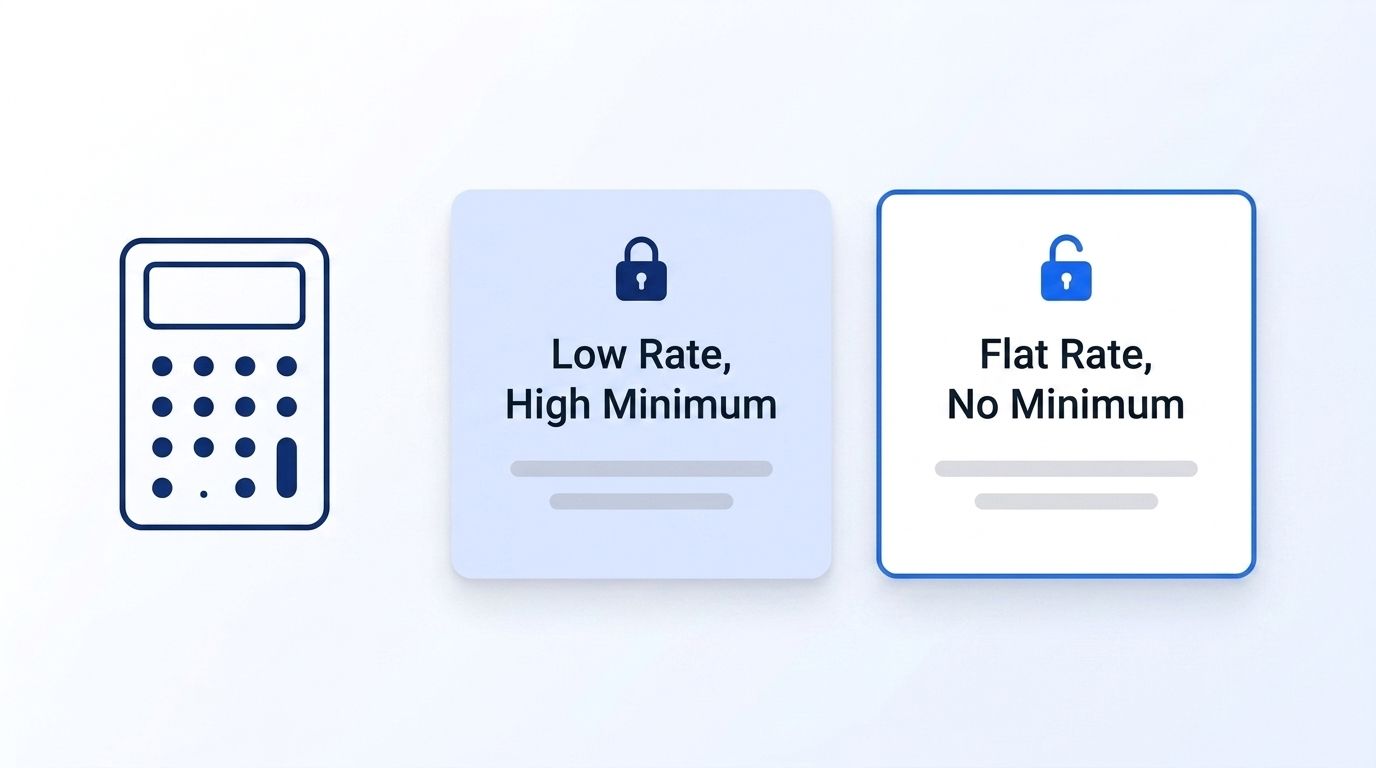
Minimum commitments hide the real cost comparison more than credit-model complexity does. A vendor with a higher listed per-credit rate but a $0 minimum (Adapt.io, Kaspr, Snov.io) can be cheaper in practice for a team enriching under 1,000 records a month than a vendor with a rock-bottom rate that only kicks in at enterprise volume.
<!-- [PERSONAL EXPERIENCE] -->When we compared vendor quotes for teams under 5,000 records/month, the "cheapest per credit" plan was rarely the cheapest total spend — the volume needed to unlock that rate usually exceeded actual usage by 3-5x. Run your own numbers against last month's actual enrichment volume, not the vendor's example use case, before signing anything annual.
What's Changing in Data Enrichment Pricing for 2026?
In 2026, the biggest shift is ZoomInfo's own admission that its model is under pressure. On its Q1 2026 earnings call, the company confirmed it's moving toward "data-led, consumption-based pricing" — a hybrid of a lower platform fee plus pre-purchased data credits — targeted for a Q3 2026 rollout (ZoomInfo Q1 2026 Earnings Call Transcript, retrieved 2026-09-05). The stock dropped roughly 36% after-hours on the guidance cut tied to that transition.
Clay made a similar move earlier in the year, overhauling three self-serve tiers down to two and cutting data marketplace costs by 50-90% while introducing a combined Data Credits/Actions system (Cleanlist — Clay Pricing Changes 2026, retrieved 2026-09-05). The direction across the market is the same: seat-based, annual-contract pricing is losing ground to consumption-based, self-serve credit pricing, because buyers can compare the latter without a sales call.
Isn't that the whole point of a pricing index like this one? The more vendors publish real numbers, the harder it gets for the rest to hide behind "contact sales." For a closer look at how a pay-as-you-go, request-time model handles high-volume enrichment, see Datamagnet's own pricing page and the API quickstart docs.
Frequently Asked Questions
What is the cheapest B2B data enrichment API per record in 2026?
Bright Data's live Web Scraper API and Coresignal's Elite tier both price near $0.001–$0.01 per record, the lowest in this index. But both require high committed volume ($1,999/mo and $5,000/mo respectively) to unlock those rates — at low volume, Adapt.io and Snov.io are typically cheaper in practice.
Do all B2B data providers charge per record?
No. Most charge per credit, and a credit can equal one email, one phone number, or one full profile depending on the vendor. UpLead and Bright Data's Web Scraper API are the closest to true per-record billing; ZoomInfo and Cognism bill per seat with a credit pool layered on top.
Why don't ZoomInfo and Cognism publish their pricing?
Both sell primarily through annual, negotiated contracts rather than self-serve checkout. Marketplace data from Vendr puts the average ZoomInfo contract at $33,500/year, but neither company lists that figure on its own site — pricing is set per account based on seats, data add-ons, and negotiated volume.
What's the difference between a live enrichment API and a static database?
A static database (like a Dataset Marketplace purchase) sells pre-collected records that age from the moment you buy them. A live, request-time API — the model Datamagnet, EnrichLayer, and Bright Data's Scraper API use — fetches the record when you call it, so you pay for a current result instead of a snapshot.
Is Coresignal cheaper than People Data Labs?
At high volume, yes — Coresignal's Elite tier can fall to $0.01 per enriched contact record versus PDL's reported $0.22-$0.28 per person record on its Self-Serve plan. At low volume, the gap narrows since Coresignal's entry Mini tier prices closer to $0.39 per contact record.
Sources & Methodology
Every provider row above was checked directly against that vendor's own pricing page on 2026-09-05 where the page rendered a usable price table; rows marked "Reported" in the table rely on third-party procurement data (Vendr, G2, Cleanlist) because the vendor's own page either doesn't publish dollar figures or returned no extractable pricing content on fetch. Effective per-record figures were calculated by dividing plan price by included credits, then multiplying by the credit cost of the closest "full contact record" endpoint where that conversion is publicly documented.
- Coresignal, Pricing Documentation, retrieved 2026-09-05, https://docs.coresignal.com/pricing
- Crustdata, Pricing, retrieved 2026-09-05, https://crustdata.com/pricing
- EnrichLayer, Pricing, retrieved 2026-09-05, https://enrichlayer.com/pricing
- Clay, Pricing, retrieved 2026-09-05, https://www.clay.com/pricing
- Lusha, Pricing, retrieved 2026-09-05, https://www.lusha.com/pricing/
- Hunter.io, Pricing, retrieved 2026-09-05, https://hunter.io/pricing
- Snov.io, Pricing, retrieved 2026-09-05, https://snov.io/pricing
- UpLead, Pricing, retrieved 2026-09-05, https://www.uplead.com/pricing/
- Kaspr, Pricing, retrieved 2026-09-05, https://www.kaspr.io/pricing
- Adapt.io, Pricing, retrieved 2026-09-05, https://www.adapt.io/pricing
- Bright Data, LinkedIn Datasets, retrieved 2026-09-05, https://brightdata.com/products/datasets/linkedin
- ScrapIn, Pricing, retrieved 2026-09-05, https://scrapin.io/pricing
- Cognism, Pricing, retrieved 2026-09-05, https://www.cognism.com/pricing
- Investing.com, ZoomInfo Q1 2026 Earnings Call Transcript, retrieved 2026-09-05, https://www.investing.com/news/transcripts/earnings-call-transcript-zoominfos-q1-2026-earnings-beat-but-guidance-cut-93CH-4694910
- Cleanlist, Clay Pricing Changes 2026, retrieved 2026-09-05, https://www.cleanlist.ai/blog/2026-03-12-clay-pricing-changes-2026
- Cleanlist, People Data Labs Pricing Guide, retrieved 2026-09-05, https://www.cleanlist.ai/blog/2026-09-01-people-data-labs-pricing-guide
- Vendr, Cognism Marketplace, retrieved 2026-09-05, https://www.vendr.com/marketplace/cognism
